
Specs are compiled from manufacturer listings and verified buyer reviews and can change over time — please confirm the key details on the product page before buying.
A garden hose that just dribbles turns a simple watering chore into a frustrating wait. You stand there, watching a weak stream barely reach the far flower bed, while your sprinkler heads just shudder instead of spinning. A garden hose booster pump adds the missing muscle to your water supply, turning a trickle into a jet that covers your lawn, fills a kiddie pool in minutes, or runs an irrigation system without slowing down.
I’m Rikta — the founder and writer behind Lawn Gear Lab. This guide is built by comparing the manufacturers’ published specifications and the patterns across verified customer reviews, so you get each pick’s real strengths and trade-offs instead of marketing spin.
if you need to push water 160 feet down a hose or just want a decent shower while camping, a garden hose booster pump solves the common problem of insufficient home water pressure with surprising ease.
Our Picks at a Glance

How To Choose The Best Garden Hose Booster Pump
Choosing the right pump means matching flow and pressure to your specific yard or RV needs. A pump that works well for a single sprinkler may struggle with a long hose or multi-head irrigation system.
Flow Rate (GPM) — How Much Water Moves
Gallons per minute (GPM — how many gallons the pump pushes every 60 seconds) tells you the volume. A pump moving 4 GPM fills a bucket faster than one moving 1 GPM, and it can supply multiple sprinklers at once. For a standard garden hose, 4 to 5.5 GPM is a common range that handles most watering tasks without feeling slow.
Pressure (PSI) — How Hard the Water Hits
Pounds per square inch (PSI — the force behind the water) determines whether your stream reaches the far end of the yard or just puddles at your feet. Higher PSI is what makes a misting system produce a fine, dry fog and what lets a sprinkler head pop up and spin properly. Many home water supplies sit around 40–50 PSI, and a booster pump can push that to 55, 70, or more for a noticeable difference.
Self-Priming — Starting Without a Running Start
A self-priming pump can pull water up from a source lower than itself, like a rain barrel or a shallow well, without needing you to fill the hose first. This is a huge convenience if your water tank sits on the ground or if you are drawing from a cistern. Pumps that are not self-priming need the suction line to stay full of water, which can be tricky to set up.
Diaphragm vs. Jet Pumps — The Core Design
Diaphragm pumps use a flexible membrane to move water; they are quiet, can run dry for short periods without damage, and handle debris better, which makes them popular for RVs and garden use where water quality varies. Jet pumps use an impeller and are better for moving very large volumes of water (10+ GPM) from a well, but they are louder and more sensitive to running dry. For most hose-boosting jobs, a diaphragm pump is the simpler, quieter choice.
Quick Comparison
| Model | Best For | Flow Rate (GPM) | Pressure (PSI) | Lift Height (Feet) | Amazon |
|---|---|---|---|---|---|
| TWERE 115V AC Industrial★ Best Overall | Best Overall | 5 | 55 | 148 | Amazon |
| Verbesserte RV Fresh WaterHigh Pressure Champ | High-Pressure Irrigation | 5.5 | 75 | 160 | Amazon |
| Anbull 110V Water TransferGreat Value | Budget-Friendly Workhorse | 4 | 45 | 100 | Amazon |
| WASSERMANN 110V AC | Versatile All-Rounder | 5.5 | 65 | — | Amazon |
| Dreyoo Water Pressure Booster | Compact & Portable | 5.5 | 70 | — | Amazon |
| SHYLIYU Pressure Pumps | Whole-Home Boosting | 7 | 21.7 | 49 | Amazon |
| Orbit Arizona Mist 92100 | Misting Systems | 1.1 | 160 | — | Amazon |
| TDR Venus 3/4 HP | Whole Lawn Sprinklers | 17 | Up to 58 | 130 | Amazon |
| TDRRICH 3/4HP | Heavy-Duty Irrigation | 18 | Up to 58 | 131 | Amazon |
In‑Depth Reviews
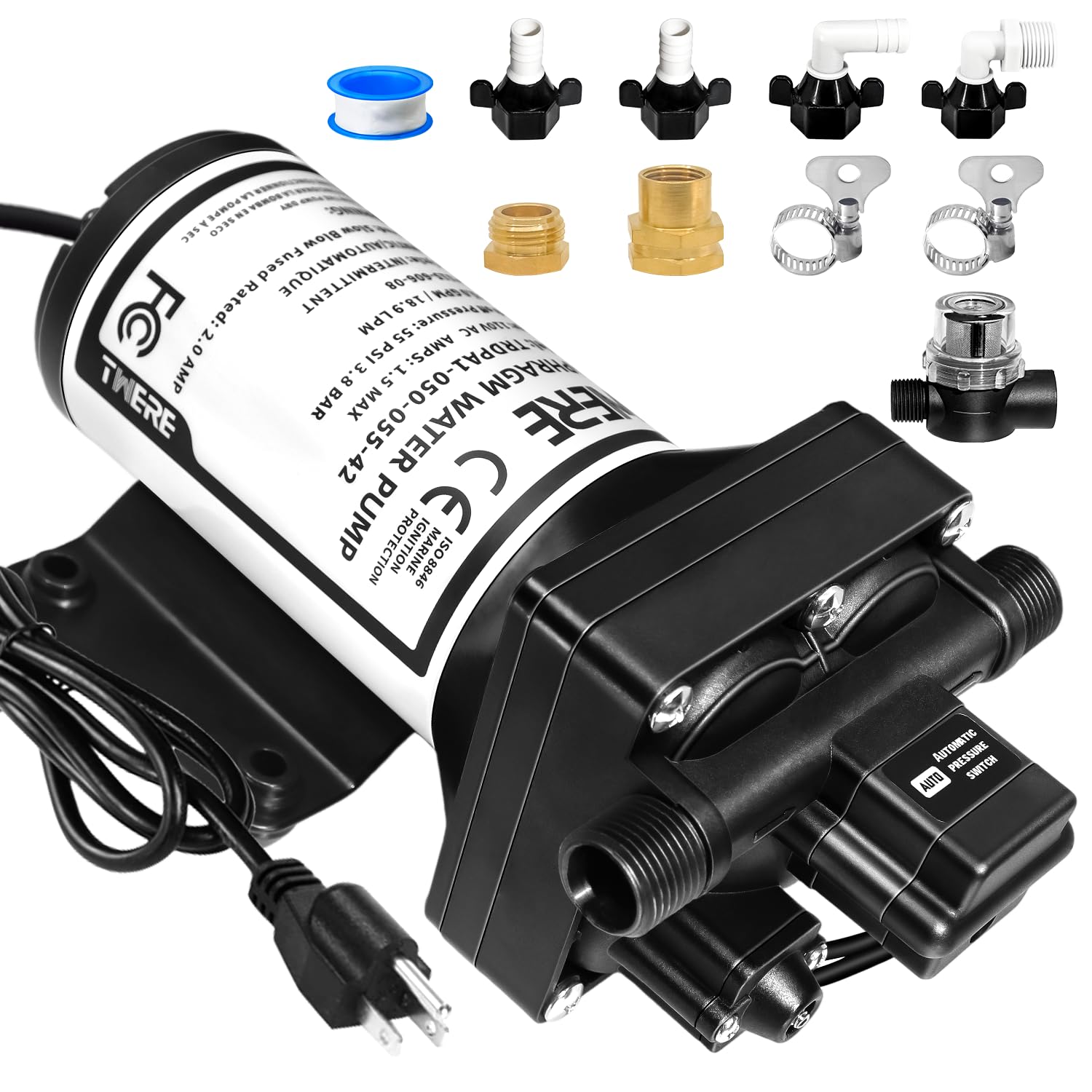
1. TWERE 115V AC Industrial Pressure Water Pump
Our pick — over 4.5★ from 150+ verified ratings; the strongest balance of quality and price.
The quiet powerhouse that replaces an RV pump and handles your garden, too.
This pump runs straight from a standard 115V wall outlet, so you do not need a marine battery or any special wiring. It delivers a 5 GPM flow rate at 55 PSI, and the automatic pressure switch turns the pump on only when you open a faucet. The result is strong, steady water that users rely on for showers, garden hoses, and irrigation systems. Buyers report it runs the shower with no problem, and the consensus is that the installation is straightforward enough for a confident DIYer.
It lifts water up to 148 feet, which is a 60% higher lift than the Anbull pump below and more than enough for a long hose run or a multi-zone sprinkler setup. The pump also includes a dry-run protection feature that cuts power if the water runs out, saving the motor from damage. Its quiet operation is a consistent highlight — many owners moved from louder pumps and noticed the difference immediately.
The one thing to note: while the bolt pattern is a direct match for many older pumps, some owners found the mounting holes are positioned differently from their original unit, so you may need to drill new holes or use the included brackets. This is a minor installation hiccup rather than a performance issue, and most people had it running in under an hour.
Ridiculously Capable: The combination of 5 GPM flow, 55 PSI pressure, and a 148-foot lift height makes this a true all-rounder. It can boost your garden hose, replace an RV water pump, and supply an irrigation system, all in one compact metal-and-plastic unit.
The One Major Catch: The different bolt pattern means you cannot always use your existing mounting holes. Be prepared to drill a fresh bracket or mount it on a small piece of plywood.
Your pump if: you want one device that does it all — garden, RV, and light irrigation — with a proven track record and quiet operation.
Look elsewhere if: you need the absolute highest pressure for a misting system (a 55 PSI limit may not be enough for fine mist).
2. Verbesserte RV Fresh Water Pump 110V
A 75 PSI beast that makes a 100-foot hose feel like a short garden path.
If your garden has a long hose run or an irrigation system with dozens of heads, this is the pump that gets the job done without complaining. It pushes 5.5 GPM at a muscular 75 PSI, which is significantly more force than the standard 45–55 PSI most pumps offer. Owners mention it runs a 100-foot hose without issue and powers a garden system with over 50 heads. The stainless steel construction and 50-mesh filter give it a sturdy feel that inspires confidence.
The self-priming diaphragm design lets it draw water from a rain barrel or tank that sits lower than the pump, and the automatic pressure switch means it only runs when you open a valve. Its maximum lift height of 160 feet is the highest in this lineup — 60 feet higher than the Anbull alternative — so it can push water uphill over a long distance without losing pressure. Buyers comment on just how quiet it is, with many using it in RV settings where noise matters.
The honest trade-off is sensitivity to debris. A few owners found that dirt or sand in the water can clog the filter cup quickly, so you will want a fine mesh pre-filter on the intake if you are pulling from a natural water source like a pond or tank. This is a fairly standard precaution for any diaphragm pump, not a unique flaw, but it is note before you install it.
What Wins People Over
- 75 PSI delivers noticeably stronger pressure than most garden pumps — sprinklers pop up and rotate properly.
- 160-foot lift height beats every other mid-range pump here, making it ideal for long or uphill hose runs.
- Super quiet operation — many owners mention they can barely hear it running.
What to Watch For
- The 50-mesh filter is effective but needs regular cleaning if your water has sediment.
- At 6.6 pounds it is slightly heavier than some competitors (0.7 lbs more than the Anbull), but still easy to carry.
Reach for this if: your irrigation system spans a large area or your hose runs are long — the 75 PSI and 160-foot lift are the real deal.
skip it if: you draw water from a natural pond or a very dirty tank without the ability to pre-filter, as the pump is sensitive to grit.
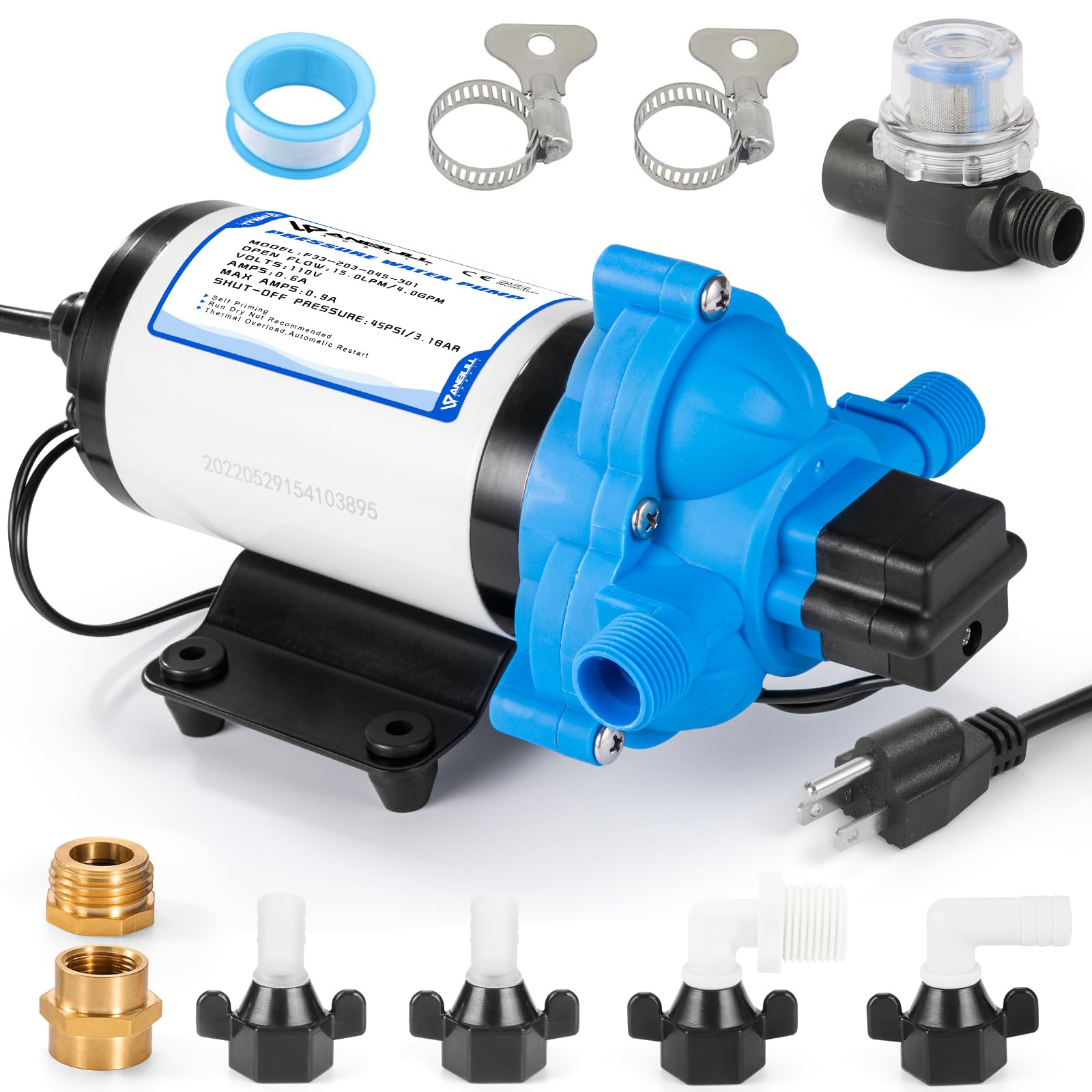
3. Anbull 110V Water Transfer Pump
A reliable workhorse that keeps its nose down and gets the water moving.
This is the pump you grab when you need solid performance at a more accessible price point. It moves 4 GPM at 45 PSI, which is enough to run a standard sprinkler, wash down a driveway, or supply an RV with comfortable pressure. It comes with both 3/4-inch male and female garden hose adapters from the start, so you can connect it to a hose without buying extra fittings. The anti-vibration iron mounting bracket and rubber feet keep the noise down — though the feedback on noise is split, with some calling it very quiet and others finding it loud.
It self-primes from up to 9.8 feet below the pump, and the automatic pressure switch starts and stops it as you open and close a valve. One reviewer noted it drained a 60-gallon aquarium in 15–20 minutes, giving you a real-world sense of its speed. At 4 GPM, it is slower than the 5.5 GPM pumps above, but for a single hose or a small sprinkler zone, the difference is barely noticeable.
The significant caveat here is mixed durability reports. While many owners have used it for months without issues, a small number reported the pump stopped pushing water after about four months. The pump still fires up and makes noise, but no water comes through. This seems to be an occasional manufacturing defect rather than a universal problem, but it means the 180-day warranty is worth keeping handy. The other point of disagreement is the noise — some buyers find it impressively quiet, while others describe it as extremely noisy, so your experience may vary depending on mounting surface.
Honest Value: For the price, you get a fully-featured diaphragm pump with garden hose adapters, a strainer, and auto on/off. It handles small-to-medium jobs with ease.
Just Be Aware: A small but real minority of units fail after a few months. This is a risk worth weighing if you need a pump for a critical, hard-to-reach installation.
Your pump if: you are on a tighter budget or only need to boost pressure for a single hose, a small sprinkler, or an RV — the value is undeniable.
Consider another if: you need a unit you can trust in a permanent installation where failure would be a major hassle; the Verbesserte or TWERE have stronger reliability records.
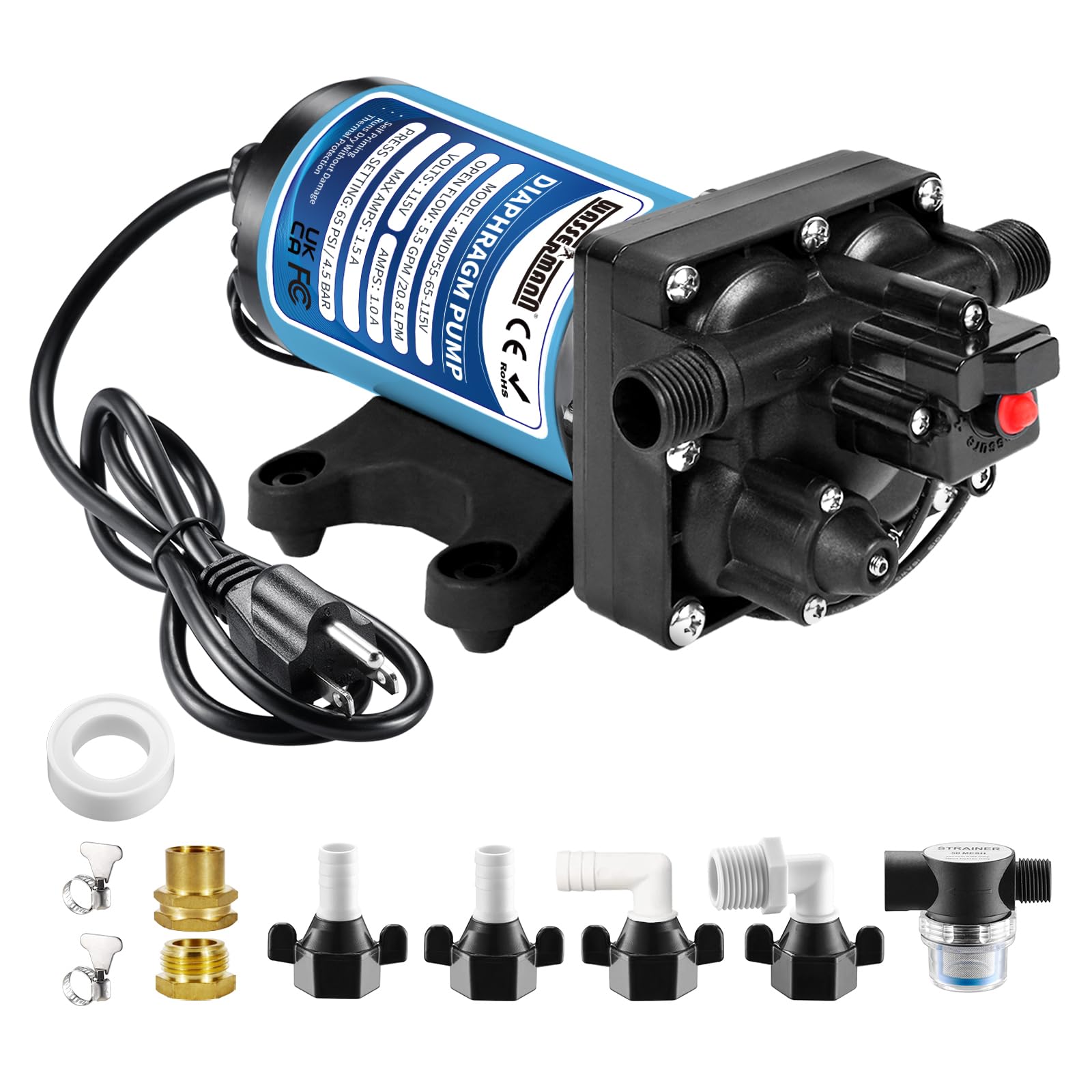
4. WASSERMANN 110V AC Water Pressure Booster Pump
A well-rounded booster that comes with every fitting you could need.
The WASSERMANN lands at a comfortable 5.5 GPM and 65 PSI, sitting right in the balance between enough volume for a garden system and enough force for a satisfying shower. It includes a power cord with a US plug, so you plug it straight into a household outlet, plus all the brass fittings, hose clamps, sealing tape, and an inlet strainer — a complete kit that means no last-minute hardware store runs. The automatic pressure switch is precise, and the thermal overload protection keeps the motor safe during heavy use.
Buyers appreciate the size of this pump, calling it a “great little pump” that is well-made and fits in tight spaces like a small utility closet or under an RV cabinet. It is designed for fresh water boosting in gardens, kitchens, bathrooms, and marine setups. One owner uses it to pump rainwater from a tank to their garden and praises the pressure switch feature. Users agree it works exactly as advertised.
The main frustration is a labeling inconsistency: the pump body has one sticker saying “Runs dry without damage” while another sticker contradicts it. This leaves you guessing about whether the pump is truly safe to run dry. Most buyers simply keep the intake submerged to avoid the question, but if you plan to use it in a situation where the water source might occasionally run out, this ambiguity is annoying. A small number of units arrive dead on arrival or fail after one use, which is a risk at this price point.
What You Get
- Complete kit includes all brass fittings, hose clamps, sealing tape, and a strainer — ready to install from the start.
- 5.5 GPM and 65 PSI is a strong middle ground for both garden and home use.
- Compact size fits easily in tight installation spaces.
What Gives Pause
- Conflicting labels about dry-run capability leave you unsure how to handle potential water outages.
- Occasional failures after one use mean it is not the most consistent option in this range.
Grab this if: you want a ready-to-install kit with all the fittings included and you will keep the intake submerged to avoid the dry-run confusion.
Think twice if: your installation is hard to access or your water source is inconsistent — the labeling issue makes it a less confident pick for those scenarios.
5. Dreyoo Water Pressure Booster Pump 110V

A small silver dynamo that packs 70 PSI into a 9-inch frame.
At just 9.25 inches long and 5.12 inches wide, this pump is among the most compact options here, yet it still delivers 5.5 GPM at 70 PSI — a very respectable pressure that beats the WASSERMANN. It is designed for applications like RV, marine, gardening, and light agricultural use. The galvanized mounting base resists rust, and the pump can run dry without damage, which is a useful safety net if your water source temporarily runs out. It comes with a strainer and brass fittings, so you have everything to get started.
One owner used it for soft washing (cleaning roofs and siding with bleach and soap) from a 35-gallon trash can and found it worked great over two years of periodic use. Another used it as a whole-house booster and said it holds 70 PSI static pressure with good flow. The positive comments consistently mention its compact size and the included hose adapters as major pluses. The automatic on/off switch works reliably, and the pump runs quietly enough for most settings.
The biggest issue is reliability: the most-discussed aspect by far is reliability, and the feedback is mixed. While many units work perfectly, a notable number of customers note failure after two months of daily use, often as a shower pressure booster. Others mention it never builds up pressure properly. The pump also has an inlet pressure limit — it needs less than 30 PSI coming in, which is fine for a cistern or rain barrel but means you may need a pressure regulator if you are tapping into a city water line. If you buy it, do so with the expectation that it may be a lower-duty tool for occasional use rather than a 24/7 workhorse.
Perfectly Sized: The 9.25-inch length makes it easy to tuck into an RV compartment or a small garden shed, and the 70 PSI output is genuinely impressive for its footprint.
Reality Check: The mixed reliability feedback means this is best treated as a portable or occasional-use pump, not a permanent installation you want to run every day.
Best for: portable applications like watering a garden from a rain barrel, soft washing, or draining a pool — jobs where the pump is used a few times a month, not daily.
Not for: being a permanent, daily-driven booster in a whole-house system where a failure would be a major inconvenience.
6. SHYLIYU Pressure Pumps 115V/60Hz

A high-flow 7 GPM unit that keeps your whole house running, not just the garden.
This pump is built differently from the diaphragm pumps above — it uses a brass impeller and an aluminum housing, which is a centrifugal-style design made for continuous, high-volume use rather than intermittent on-demand duty. It moves 7 GPM (gallons per minute — the highest flow in this list) but at a relatively low 21.7 PSI (pounds per square inch — the force behind the water). That means it is excellent for filling a tank or running multiple fixtures at once, but it will not create the strong jet you might want for a pressure washer or a long garden hose. Its maximum lift height is 49 feet.
It comes with a 3/4-inch outlet and a flow switch that turns the pump on and off automatically when water moves through it. The materials are solid: a stainless steel shaft and brass impeller suggest this pump could last a long time in the right application. Some owners found it noticeably boosted pressure for household showers and was easy to install. The one-year warranty gives a bit of reassurance.
The catch is that this is a specialized tool, not a general garden hose booster. Its 21.7 PSI output is far lower than what a diaphragm pump provides, so it will not give you a powerful spray for watering. Several owners also reported leaks — one from a pinhole in the brass housing, another from connector issues. The connector size is a G 3/4 inch, which is a British standard thread, not a standard US garden hose thread (GHT), so you may need adapter fittings to connect it to a regular hose. This is a viable option for boosting pressure inside a home or for a rainwater harvesting system where volume matters more than pressure, but it is not the right choice for most garden hose users.
Where It Shines
- 7 GPM flow rate is the highest here — great for moving large volumes of water quickly.
- Brass impeller and stainless steel shaft suggest long-term durability.
- Includes a flow switch for automatic operation.
Where It Struggles
- 21.7 PSI is very low for garden hose boosting; you will not get a strong spray.
- Threads are G 3/4 (British standard), not standard US garden hose threads — adapters are needed.
- Some units arrive with pinhole leaks in the brass housing.
Ideal for: whole-house pressure boosting where you have a weak municipal supply — 7 GPM keeps multiple fixtures running — or for filling tanks and large containers fast.
Skip for: garden hose use, sprinklers, or any job where you need a forceful spray; its 21.7 PSI is simply too low.
7. Orbit Arizona Mist 92100 Booster Pump

The king of mist — 160 PSI turns a garden hose into a cool, dry fog.
This pump is a different animal entirely. It is designed for one specific purpose: pressurizing a misting system to create a fine, evaporative cooling fog. It boosts line pressure all the way to 160 PSI, which is more than double what any other pump on this list delivers. At that pressure, water turns into a true mist that cools the air without soaking the ground or leaving calcium deposits on your patio furniture. The flow rate is a modest 1.1 GPM, but that is plenty for misting nozzles, which use very little water at high pressure.
The installation is simple: it connects to your mist system and water source with built-in slip-lock fittings. It is quiet enough to run near a patio or a horse stall without being annoying, and the quality of the mist is noticeably finer than what a standard hose provides. One owner in Phoenix, AZ, runs 20 nozzles over 5 horse stalls and says it produces a fine, dry mist that makes a real difference in the heat. The pump also has an auto shut-off and restart feature that prevents overheating during long use.
The limitation is that this is a niche product. It will not work well as a general garden hose booster because the flow rate is too low to run a sprinkler or fill a bucket quickly. You also need to pair it with proper high-pressure 3/8-inch misting line rather than cheap 1/4-inch tubing, which can burst. Some owners recommend adding an RV water pressure reducer on the intake to keep it at a constant 50 PSI for best longevity. If you want a misting system that actually works, this is the pump to buy — but if you just need more pressure for watering, look at the TWERE or Verbesserte instead.
class-leading for Misting: No other pump in this list comes close to 160 PSI. The mist it produces is genuinely fine, dry, and cooling — exactly what a patio mist system promises but rarely delivers.
Use It Only for Its Purpose: This is not a general-purpose booster. The low 1.1 GPM flow makes it completely unsuitable for watering lawns, washing cars, or filling tanks.
The one to get if: you are building or upgrading a patio, barn, or greenhouse misting system and want a true fine mist without wet ground.
Do not buy if: you need a pump for regular garden watering, RV use, or any high-volume application — the flow is too low.
8. TDR Venus 3/4 HP Water Pressure Booster Pump

A 17 GPM jet pump that turns a large lawn sprinkler system into a water cannon.
When you have a large lawn with multiple sprinkler zones or a whole-house water pressure problem, the TDR Venus moves up to 17 gallons per minute (GPM — far beyond the 4–5.5 GPM of typical garden pumps). It uses a jet pump design with a 3/4 HP motor and a maximum lift height of 130 feet, boosting pressure to about 58 PSI. This is the kind of pump you hook up to a shallow well or a large rainwater cistern to feed an entire irrigation network. The electronic sensors automatically start it when water flows and shut it off if it runs dry, protecting the motor from burning out.
Several owners use it for whole-house boost and find it quieter than other pumps they have tried, including one that cost more. The price-to-performance ratio draws praise, especially from buyers who lost several expensive pumps to split casings. With a 180-day warranty, you get a reasonable safety net. The compact design (weighing 24 pounds) is still manageable for a permanent installation.
The critical warning here is that the inlet port cannot connect to a standard soft garden hose. The pump’s powerful self-priming suction will collapse a flexible hose, cutting off water, overheating the pump, and potentially damaging the seal. You must use a dedicated reinforced suction hose on the intake — this is a hard requirement, not a suggestion. The noise level also gets mixed feedback: some find it much quieter than alternatives, while others say it is loud enough to hear throughout the house. A few owners reported receiving units with smashed plastic covers, so the packaging quality is inconsistent.
The Real Power
- 17 GPM flow is massive — this pump can feed multiple lawn sprinklers or a whole house with ease.
- 3/4 HP motor with 130-foot lift handles deep water sources and long runs.
- Automatic dry-run shutoff protects the motor from accidental damage.
Real Talk
- Requires a reinforced suction hose — you cannot use a standard garden hose on the inlet.
- Noise is polarizing: some find it quiet, others loud. Placement matters.
- A few units arrive with cosmetic shipping damage to the plastic cover.
Your pump if: you need to move serious volume for a large lawn sprinkler system, a shallow well, or whole-house pressure boosting — 17 GPM is in a different league.
Not for: casual garden hose use or anyone who wants a simple plug-and-play booster. The reinforced suction hose requirement and jet pump design make it a more involved installation.
9. TDRRICH 3/4HP Water Pressure Booster Pump

The highest flow rate in the list — 18 GPM for serious irrigation duty.
This 3/4 HP jet pump pushes the envelope further with an 18 GPM maximum flow and a 131-foot lift height, making it the highest-volume option here. It is designed for continuous 24-hour operation and can boost water pressure to about 58 PSI (4 bar at max, with a rated discharge of 2 bar). It is self-priming and uses an electric controller to manage the automatic start/stop — a step up from the simple pressure switch on smaller diaphragm pumps. The stainless steel construction is meant to resist corrosion in permanent installations like shallow wells, farms, and large residential water systems.
One owner uses it for pasture irrigation with 4 sprinklers, running 16 hours daily in 100°F+ Texas heat, and reports significant coverage improvement. Another praises it for handling the entire irrigation workload on a hobby farm. The automatic pressure control is a highlight, and the pump is considered easy to install if you have basic plumbing skills. The 180-day warranty adds a layer of protection.
The biggest concerns here are quality control and durability. While the pumping performance gets positive marks, several owners received units with damaged parts — one with a broken fan cover on arrival, another with a circuit board that burned out and was irreparable. Noise is also a recurring complaint: buyers describe it as extremely loud, contradicting the advertisement. The pipe threads are non-tapered, which can cause leaks if you do not use generous amounts of thread tape or sealant. If you get a good unit, it is a powerful machine — but the failure rate and build quality make this a higher-risk purchase than the TDR Venus or the diaphragm pumps above.
Brute Force: 18 GPM and 24-hour continuous operation make this a true workhorse for large-scale irrigation when it works.
But It Is a Gamble: The high rate of shipping damage, component failure, and noise complaints means you may end up dealing with returns or replacements. Consider this only if you are comfortable with that risk and the installation is easy to access.
Choose this if: you need the absolute maximum flow for a large irrigation system or shallow well and you are prepared for potential quality issues and noise.
Look elsewhere if: quiet operation, consistent build quality, and leak-free threads are high priorities — the Verbesserte or TWERE are safer bets for most people.
Understanding the Specs
Flow Rate (GPM)
Gallons per minute tells you how fast the pump moves water. A 1 GPM pump fills a 5-gallon bucket in 5 minutes; a 5 GPM pump does it in 1 minute. For garden use, 4–5.5 GPM is the standard balance. For lawn sprinkler systems covering large areas, 10+ GPM is often needed.
Pressure (PSI)
Pounds per square inch measures the force of the water coming out. Higher PSI makes the stream shoot farther and gives sprinklers the power to rotate and spray properly. Standard home pressure is around 40–50 PSI. A booster pump in the 55–75 PSI range gives a clear improvement.
Self-Priming
A self-priming pump can pull water upward from a source below it (like a rain barrel or shallow well) without you having to manually fill the pump with water first. If your water source sits lower than the pump, this is a must-have feature for easy setup and reliable operation.
Diaphragm vs. Jet Pump
Diaphragm pumps use a flexible membrane to move water. They are quieter, can handle running dry briefly, and are the standard choice for garden hose boosting and RV use. Jet pumps use an impeller and a venturi to create suction. They move larger volumes of water (10–20 GPM) but are louder and more sensitive to running dry.
FAQ
How do I connect a garden hose booster pump to my faucet?
Will a booster pump work with a rain barrel or cistern?
Can a garden hose booster pump increase water pressure for a whole house?
What is the difference between 4 GPM and 5.5 GPM in real use?
Is higher PSI always better for a garden hose?
Can I leave a diaphragm pump plugged in all the time?
How long do garden hose booster pumps typically last?
Can a booster pump run dry and get damaged?
Final Thoughts: The Verdict
For most buyers, the garden hose booster pump winner is the TWERE 115V AC Industrial Pressure Water Pump because it combines a strong 5 GPM flow, 55 PSI pressure, a 148-foot lift height, quiet operation, and a near-flawless reliability record in a single compact package. If you need maximum pressure for a large irrigation system or a very long hose, grab the Verbesserte RV Fresh Water Pump with its 75 PSI and 160-foot lift. And for the absolute highest volume on a large lawn or shallow well, the TDR Venus 3/4 HP pump delivers 17 GPM of serious moving power — just be prepared for a more involved installation and the need for a reinforced suction hose.
How We Picked
We do not accept paid placement. Every pick is matched to a real buyer and a real use-case; we do not hands-on test units.
Sources & Methodology
Specifications: manufacturer listings and product documentation. Review insights: verified customer reviews, as of July 2026. Pricing: not shown on this page (it changes often); check the current price via the retailer link.
As an Amazon Associate, Lawn Gear Lab earns from qualifying purchases. This does not affect which products we feature.