
Specs are compiled from manufacturer listings and verified buyer reviews and can change over time — please confirm the key details on the product page before buying.
That bag of generic garden soil you grabbed from the big-box store is basically dead weight. Real garden compost soil is alive with microbes, packed with organic matter, and built to feed your plants for months, not days. The difference between a so-so harvest and a truly thriving vegetable bed often depends on what is in the bag. This guide cuts through the marketing and points you to the compost that actually delivers — from nutrient-dense worm castings to rich, OMRI-certified (Organic Materials Review Institute, meaning the product meets organic farming standards) blends.
I’m Rikta — the founder and writer behind Lawn Gear Lab. This guide is built by comparing the manufacturers’ published specifications and the patterns across verified customer reviews, so you get each pick’s real strengths and trade-offs instead of marketing spin.
Whether you are planting tomatoes in containers, amending a new raised bed, or trying to revive a struggling flower patch, you need the right garden compost soil for the job — here is exactly how to find it and which bags are worth hauling home.
Our Picks at a Glance

How To Choose The Best Garden Compost Soil
Not every bag labeled “compost” is created equal. Some are lightweight planting mixes meant for containers, while others are dense, nutritionally potent amendments for in-ground beds. The key is matching the product to your specific gardening task.
Start With Your Growing Method
Container gardens need a soil that drains well and doesn’t compact — look for phrases like “potting soil” or “container mix” that include perlite (a lightweight volcanic glass that improves aeration) or peat moss for aeration. In-ground beds and raised rows benefit from a denser compost amendment that improves moisture retention and feeds the existing soil. Using a potting mix in a ground bed is fine but less effective; using a pure compost in a pot can lead to waterlogging. Match the bag to the method.
Read the Ingredient List, Not Just the Brand
The best garden compost soils have a visible mix of ingredients — perlite for drainage, peat moss or coco coir for moisture, and a nutrient-rich base like composted manure or worm castings. Natural slow-release fertilizers such as kelp meal, bone meal, or lobster meal are signs of a premium product. A bag that lists only “organic material” is too vague — you want to see what is actually in it.
Quick Comparison
| Model | Best For | Bag Weight | Volume | Key Ingredient | Amazon |
|---|---|---|---|---|---|
| Coast of Maine Bar Harbor Blend★ Best Overall | Container veggie gardens | 14 Pounds | 16 Quarts | Lobster & crab shell meal | Amazon |
| Back to the Roots Worm CastingsPower Booster | Natural fertilizer boost | 5 Pounds | 80 oz | Worm castings | Amazon |
| Coast of Maine Veg & Tomato Soil | Tomatoes & heavy feeders | — | 20 Quarts | Composted manure | Amazon |
| Uncle Jim’s Worm Castings | Bulk soil building | 4 Pounds | — | Red wiggler castings | Amazon |
| R&M Organics Premium Compost | Rescuing struggling plants | 10 Pounds | 0.31 Cubic Feet | Dairy cow manure | Amazon |
| Espoma Land & Sea | Heavy yields in veg beds | 24 Pounds | 1 Cubic Foot | Lobster & crab meal + mycorrhizae | Amazon |
| Blue Ribbon Organics Compost | Premium raised beds | 32-35 Pounds | 7.9 Gallons | OMRI Certified organic compost | Amazon |
In‑Depth Reviews
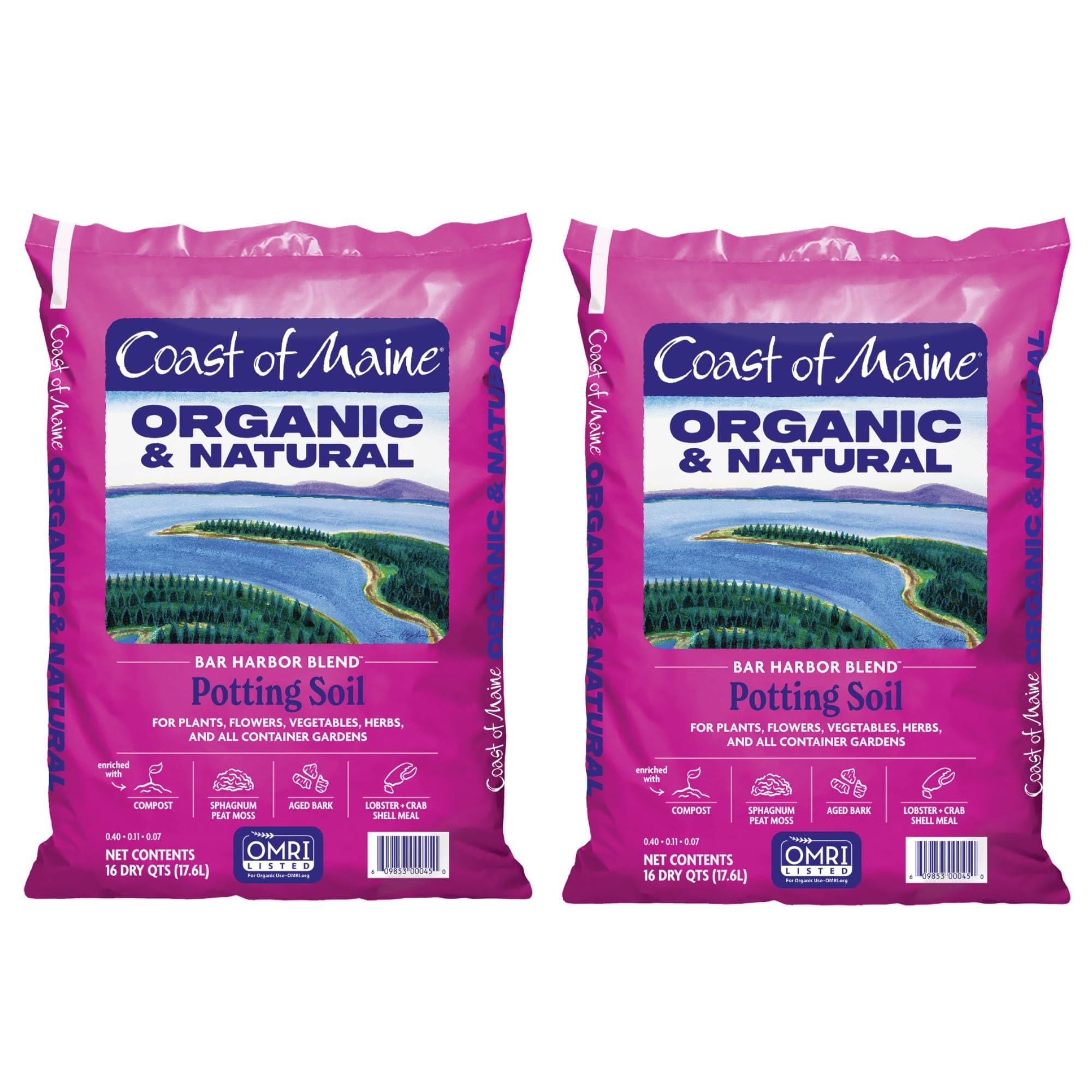
1. Coast of Maine Organic & Natural Bar Harbor Blend Potting Soil
Our pick — over 4.5★ from 550+ verified ratings; the strongest balance of quality and price.
Earns rare 4.8-star praise because it gives you a ready-to-grow mix that feeds plants with lobster and crab meal from day one.
This is the bag that converts people. It combines sphagnum peat moss, compost, perlite (a volcanic glass that keeps soil loose), lobster and crab shell meal, and kelp meal. The perlite stops the soil from compacting in containers, so roots get air. The peat holds moisture through dry spells. The shellfish meals release nitrogen slowly, so leaves stay green for weeks. Buyers report using two bags to mound up 8 potato plants and having extra for 2 more planters. Reviewers consistently mention no unexpected weeds and a rich dark color that signals high compost content.
Compared to the Coast of Maine Veg & Tomato Soil (20 quarts), this Bar Harbor Blend weighs 14 pounds for 16 quarts — a denser, more nutrient-packed mix that leans into the seafood-based ingredients. Hundreds of owners consistently cite quality as the top reason they buy it, with plant growth and nutrition close behind.
What Wins People Over
- Rich, dark mix with visible perlite and no stick debris
- Organic ingredients support both indoor and outdoor containers
- Consistent results across potatoes, tomatoes, peas, and herbs
The Honest Trade-Off
- Heavier than typical potting mixes at 14 pounds per 16-quart bag
- Pest resistance gets mixed feedback — some owners notice gnats
Reach for this if: you are planting a mixed container or raised-bed vegetable garden and want a ready-to-use soil that feeds from day one.
Look elsewhere if: you need a straight compost for amending large in-ground beds — this is a potting mix, not a bulk soil amendment.
2. Back to the Roots Organic Worm Castings
The unsung hero for anyone who wants to supercharge existing soil without buying a truckload — 5 pounds of pure worm castings go a long way.
This 5-pound bag of pure worm castings (worm manure, a concentrated soil amendment) is not a stand-alone soil — it is a concentrated additive that you mix into your potting mix or sprinkle around established plants. The benefit is that worm castings contain beneficial microbes (microscopic organisms that protect seedlings from harmful pathogens) and reduce the need for synthetic fertilizers. Buyers mention using it for milkweed (safe for monarchs), mixing it into chunky soil blends with coco chips and perlite, and seeing yellowing leaves turn green. Quality is the top-cited aspect, followed closely by plant health — 43 positive mentions for quality alone.
Where it beats a generic bagged soil is specificity: you add exactly as much as you need. A light top-dress in spring or a handful in the planting hole can outperform a full soil swap. At 5 pounds it is 5 pounds versus the Coast of Maine Bar Harbor Blend’s 14 pounds, but it is a different tool — a nutrient syringe rather than a full meal.
The whole story: This is the buy for the gardener who already has decent soil and just wants to push their plants over the edge into thriving. The 5-pound bag goes further than you think — “I use a ton of this for my garden” is a common buyer refrain. No odor, no burn risk, and 100% USA vermicompost (compost made from worms).
Grab this for: reviving tired potting mix, top-dressing perennials in spring, or feeding heavy feeders like tomatoes during the growing season.
Pass if: you need a full cubic foot of planting soil — this is a 5-pound additive, not a bulk bag.
3. Coast of Maine Organic & Natural Planting Soil for Vegetables & Tomatoes

Gives you 25% more volume than the Bar Harbor Blend at 20 quarts, making it the smarter pick for large container projects.
This Coast of Maine blend is formulated for vegetables and tomatoes, with composted manure and sphagnum peat moss that create a lightweight mix — exactly what you want for a 5-gallon pot on a patio. Owners mention that tomatoes and zucchini thrive with no stress, and the soil is OMRI-listed (Organic Materials Review Institute) for organic use. At 20 quarts it offers 20 quarts versus the Bar Harbor Blend’s 16 quarts, making it a better pick for large container projects.
The verdict: “Lightweight, high-quality soil; plants (tomatoes, zucchini) thrive in 5-gallon pots with no stress” says it all. A smart mid-range buy for the vegetable gardener who wants a full 20-quart bag without paying premium organic prices.
Best for: container vegetable gardening where volume matters — zucchini, tomatoes, peppers in multiple pots.
Trade-off: bags can arrive wet or contain a few wood chunks; inspect before planting delicate root crops.
4. Uncle Jim’s Worm Farm Black Gold Worm Castings

A brand with a half-century pedigree that claims to deliver castings 7 times richer in phosphates than average lawn soil — a potent additive for serious growers.
Uncle Jim’s raises its worms in beds that are decades old, meaning the worms work all layers of the compost, not just the top few inches. The resulting castings are advertised as 7 times richer in phosphates, 5 times richer in nitrogen, and 11 times richer in potash than average lawn soil. This is a potent amendment — best used sparingly as a top-dress or mixed into potting blends. Buyers rave about seedlings sprouting in 2 days and sunflowers showing no leaf yellowing.
The bag is compact at 4 pounds, so plan for multiple bags if you are amending large beds. Quality and functionality are the top-cited aspects (49 and 20 mentions respectively), but hygiene — meaning the presence of tiny white bugs or living worms — gets mixed feedback. Those tiny bugs are actually beneficial for soil balance, but if the idea bothers you, store the bag in a cool dry place and use promptly.
Why Gardeners Stock Up
- Decades-old worm beds produce exceptionally nutrient-dense castings
- Excellent for compost tea (a liquid made by steeping castings in water) — buyers recommend it for that purpose
- Customer service is famously responsive (replacement bags sent quickly for shipping issues)
Know Before You Buy
- Small 4-pound bag disappears fast in a large garden
- Occasional live worms or tiny bugs in the bag — harmless, but a surprise for new users
Choose this if: you want the most nutritionally dense worm castings available and are comfortable with a “living” product.
Skip if: you need a neutral, zero-bug bag for indoor use — the mixed hygiene feedback makes it better suited for outdoor beds.
5. R&M Organics Premium Organic Compost
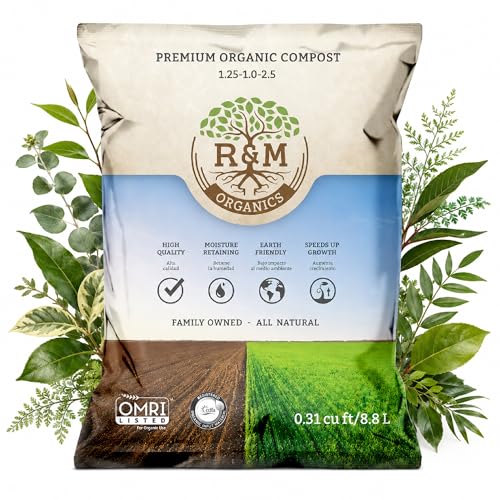
The bag you reach for when a plant is in trouble — made from fully composted dairy cow manure, it is processed with continuous aeration to reduce odor and impurities.
This 10-pound bag is made from fully composted dairy cow manure. The manufacturer processes it with continuous aeration (constant air flow) to cut odor and impurities, resulting in a clean, earthy soil-like scent suitable for indoor and outdoor use. Buyers have used it to rescue azaleas damaged by roof-cleaning chemicals and to revive ailing tomato plants — yellow leaves turned green and new flower buds appeared within a week in a 27-gallon planter. The manufacturer recommends a thin layer of about a quarter inch around plants, and the compact 10-pound bag is easy to store for small to medium applications.
Quality and plant performance are the top-cited aspects (21 and 19 mentions respectively), with buyers noting it “saved azaleas” and “revived a suffering plant.” The main drawback: this compost can stain carpets and patios if spilled, so handle it on soil or a tarp. It is also noted as expensive per pound compared to bulk options, but for targeted use, one long-time gardener called it “worth every dime.”
The honest take: Not the cheapest compost per pound, but if you have a plant that is yellowing, wilting, or struggling after a chemical incident, this bag delivers noticeable results within a week. A Master Gardener recommended it — and it delivered.
Ideal for: targeted rescue applications, container plant revivals, and indoor use where odor matters.
Not ideal for: large-scale raised bed filling — you would need many bags and it gets pricey.
6. Espoma Organic Land and Sea Gourmet Compost

A 24-pound bag of ocean-meets-earth nutrition that serious gardeners say noticeably increased tomato and zucchini fruit size.
Espoma’s Land and Sea blends lobster and crab meal with a proprietary mix of endo and ecto mycorrhizae (beneficial fungi that attach to plant roots and help them absorb water and nutrients). The result is a dry, lightweight compost that customers note noticeably increased tomato and zucchini fruit size and yield, even in reused potting soil. At 24 pounds for a full cubic foot, this is a premium bulk option for the gardener who wants measurable results.
Quality is the top-cited aspect (51 mentions), with plant health following at 38. A buyer who has used it for 3 years is “happy with it,” and multiple reviews mention loving it for hostas. The value-for-money rating is mixed — 23 mentions — because this is not the cheapest compost per pound, but the ingredients (lobster meal + mycorrhizae) justify the premium for heavy feeders.
Why It Earns a Spot in the Garden Shed
- Lobster and crab meal provide slow-release nitrogen and trace minerals
- Mycorrhizae improve root health and nutrient absorption
- Lightweight texture spreads easily and mixes well with existing soil
The Price Catch
- Some buyers feel it contains more mulch than pure compost
- Pricier than standard bagged compost — best reserved for high-value vegetable beds
Go with this if: you are growing heavy feeders like tomatoes, zucchini, and hostas and want a proven yield boost backed by mycorrhizae.
Think twice if: you need a pure screened compost for a fine-seed starting mix — some woody bits can remain.
7. Blue Ribbon Organics OMRI Certified Organic Compost

The compost that earns the highest raw quality count in this guide (54 mentions) because it is OMRI-certified and reviewers point out it contains zero synthetic contaminants.
This is the bag that gets gardeners genuinely excited about dirt. Blue Ribbon Organics produces a 7.9-gallon (32-35 pound) compost that is OMRI-certified (Organic Materials Review Institute) for organic use, meaning every ounce meets the strict organic standards. It is rich, dark, and has an earthy smell with “no sticks, plastic, metal, or glass” according to buyers. Use it at any concentration (it is safe even undiluted), and it pairs well with worm castings or other builders. Buyers who use it for clivias, orchids, and epiphyllums report superior results compared to big-box brands.
Quality is the top aspect (54 mentions, the highest raw count for any product in this guide), and versatility follows at 14 mentions. The downside is price: at roughly twice the cost of standard bagged compost per cubic foot, this is a premium product for the gardener who values purity and results over budget. An occasional note about clump resistance (7 mentions, mixed) means you may need to break it up for very fine seeding mixes.
The final word: “Hands down the BEST compost I’ve ever used” and “If you can get excited about a bag of dirt, this will be one to get excited over” — the reviews speak for themselves. For the organic purist or container gardener who wants the absolute cleanest compost available, this is the bag.
Buy this if: you are an organic gardener who values zero contaminants, or you grow container plants (clivias, orchids) that demand pure, rich organic matter.
Pass if: you are amending a large in-ground bed — the price per cubic foot makes bulk local compost a more practical choice.
Understanding the Specs
Volume vs. Weight
Compost is sold by both volume (quarts, gallons, cubic feet) and weight (pounds). A 20-quart bag of a lightweight potting mix may weigh far less than a 16-quart bag of dense compost. The weight tells you how much actual organic matter you are getting; the volume tells you how much space it will fill in your bed or pot. For filling containers, go by volume. For amending soil, weight is the better guide to nutrient density.
OMRI Certification
OMRI (Organic Materials Review Institute) listing means the product meets organic farming standards — no synthetic chemicals, GMOs (genetically modified organisms), or sewage sludge. It does not mean the product is “better” in absolute performance, but it guarantees the ingredients are what the bag says they are. For vegetable gardens where you will eat the produce, OMRI certification is a strong trust signal.
Worm Castings vs. Compost
Worm castings are a concentrated, microbe-rich additive — think of them as a soil probiotic. They are much lighter per pound than bulk compost and are typically mixed into existing soil at a ratio of 1:10 or 1:20. Bulk compost (manure-based or plant-based) is a complete soil replacement or amendment, providing structure and nutrients in larger volumes. Both are valuable, but they serve different roles.
Mycorrhizae
Mycorrhizae are beneficial fungi that form a symbiotic (mutually beneficial) relationship with plant roots, effectively extending the root system and helping the plant absorb water and nutrients. Products that include endo and ecto mycorrhizae (like the Espoma Land and Sea blend) can give plants a measurable growth boost, especially in poor or depleted soils.
FAQ
Can I use worm castings in place of potting soil?
How do I know if my compost is good quality before opening the bag?
Will compost soil attract bugs or pests to my garden?
What is the difference between potting soil and compost soil?
How much compost do I need for a 4×8 raised bed?
Can I use garden compost soil for indoor houseplants?
Is it safe to use compost soil around pets or children?
Why does my bag of compost smell different from the last brand I used?
Can I mix worm castings with chemical fertilizer?
How long does a bag of compost stay good once opened?
Final Thoughts: The Verdict
For most buyers, the garden compost soil winner is the Coast of Maine Bar Harbor Blend because it delivers a perfect ready-to-use mix of aeration, moisture retention, and slow-release nutrients from lobster and crab meal — with the highest customer satisfaction in its category. If you want a concentrated additive that you mix into your existing soil, grab the Back to the Roots Worm Castings. And for the organic purist who wants the richest, cleanest compost available for a few key containers or a small raised bed, the Blue Ribbon Organics Compost is the one to reach for.
How We Picked
We do not accept paid placement. Every pick is matched to a real buyer and a real use-case; we do not hands-on test units.
Sources & Methodology
Specifications: manufacturer listings and product documentation. Review insights: verified customer reviews, as of July 2026. Pricing: not shown on this page (it changes often); check the current price via the retailer link.
As an Amazon Associate, Lawn Gear Lab earns from qualifying purchases. This does not affect which products we feature.