
Powdery mildew spreads fast in warm, humid conditions, turning vibrant leaves into a dusty white mess and stunting growth before you even notice the first spot. Choosing an effective fungicide means understanding the active ingredient, application timing, and whether the formula treats the existing infection or simply prevents future outbreaks — a distinction that determines whether your garden survives the season.
I’m Rikta — the co-founder and writer behind Lawn Gear Lab. I’ve spent hundreds of hours researching fungicide labels, comparing active ingredients like neem oil extract and Bacillus subtilis, and analyzing real owner feedback to find which products actually stop powdery mildew from returning.
After cross-referencing application rates, disease coverage lists, and user-reported success rates across dozens of products, I’ve built this guide to the best fungicide for powdery mildew so you can make a confident, informed choice this season.
How To Choose The Best Fungicide For Powdery Mildew
Not all fungicides target powdery mildew the same way. Some work by creating a protective barrier on leaf surfaces, while others are absorbed into the plant tissue to stop the fungus from spreading internally. The choice depends on whether you are treating an active outbreak or applying a preventive spray before symptoms appear.
Active Ingredient: Contact vs. Systemic
Contact fungicides like neem oil extract and potassium bicarbonate kill spores on contact but wash off with rain and require reapplication every 7–14 days. Systemic options such as propiconazole and Bacillus subtilis move through the plant’s vascular system, providing longer residual protection — typically 14–21 days — and are more effective against established infections hiding in new growth.
Formulation: Concentrate vs. Ready-to-Spray
Concentrates require mixing with water but offer far more treatments per ounce, making them cost-effective for large gardens or repeated applications. Ready-to-spray bottles attach directly to a garden hose, which saves time but contains more water and delivers less active ingredient per square foot — a tradeoff to consider when covering multiple beds or tall shrubs.
Organic Certification and Harvest Safety
If you are treating edible crops like tomatoes, squash, or berries, check for OMRI listing and the pre-harvest interval on the label. Many organic-certified biofungicides can be applied up to the day of harvest, while synthetic systemic products may require a waiting period of several weeks before fruit is safe to eat.
Quick Comparison
On smaller screens, swipe sideways to see the full table.
| Model | Category | Best For | Key Spec | Amazon |
|---|---|---|---|---|
| Quali-Pro Propiconazole 14.3 | Systemic Concentrate | Lawn & wide-area turf | 32 oz, microemulsion formula | Amazon |
| Grower’s Ally Crop Defender 3 | Triple-Action Organic | Edible gardens & indoor | 8 oz makes 25 gal, OMRI listed | Amazon |
| Lost Coast Plant Therapy | Organic Contact Spray | Houseplants & flowers | 12 oz concentrate, bee-safe | Amazon |
| Monterey Complete Disease Control | Biofungicide Drench | Tomatoes & orchard trees | 16 oz, OMRI listed with spoon | Amazon |
| Southern Ag Biological Fungicide | Bacterial Root Colonizer | High-humidity gardens | 16 oz, Bacillus amyloliquefaciens-based | Amazon |
| Garden Safe Fungicide3 | Neem Oil Trio | Roses & ornamentals | 1 gal RTU, neem oil extract | Amazon |
| Bonide Revitalize Biofungicide | Immune-Response Organic | Indoor/outdoor vegetables | 16 oz concentrate, up to day of harvest | Amazon |
In‑Depth Reviews
1. Quali-Pro Propiconazole 14.3 Fungicide

This 32-ounce systemic concentrate delivers broad-spectrum disease control for cool and warm season turf, trees, shrubs, and flowers — including powdery mildew, dollar spot, and brown patch. The microemulsion formulation reduces odor and provides excellent plant coverage, making it a professional-grade option for large lawns and landscapes.
Users report visible new grass growth within one week of application against brown patch, and the locally systemic mode of action keeps mildew from returning for weeks. The 32-ounce bottle provides multiple seasons of treatment for lawns up to a third of an acre, making the per-application cost significantly lower than ready-to-spray alternatives.
Note that this product is not OMRI listed and carries a pre-harvest interval for edible crops, so it is best suited for ornamental turf, trees, and non-edible ornamentals. Full PPE is recommended during mixing and application.
What works
- Long-lasting systemic protection against powdery mildew on turf and ornamentals
- Highly concentrated — one bottle treats large areas for multiple seasons
- Microemulsion formula sticks to leaves and resists wash-off
What doesn’t
- Not organic — cannot be used on edible crops nearing harvest
- Requires full PPE during mixing and spraying
- Results can be inconsistent — some users see full disease control while others report mixed results depending on timing and coverage
2. Grower’s Ally Crop Defender 3 Concentrate
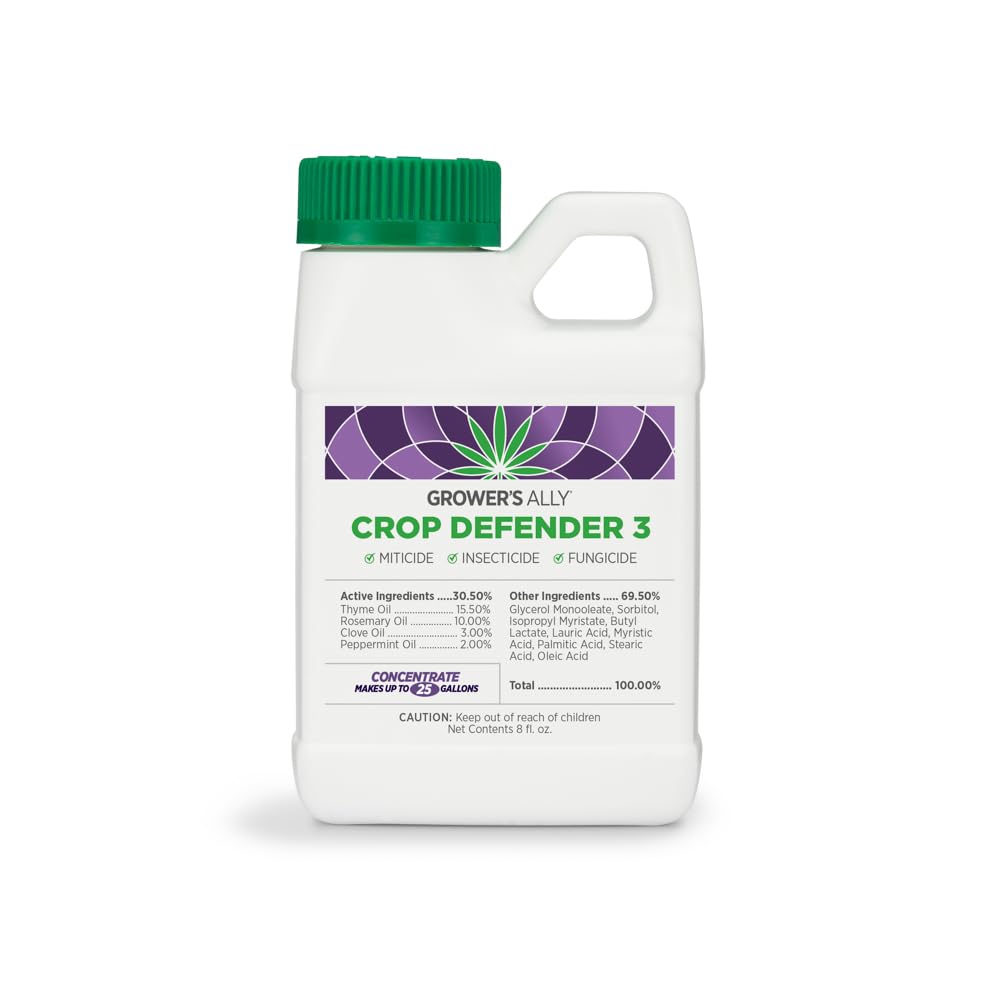
This 8-ounce concentrate makes up to 25 gallons of spray, combining a miticide, insecticide, and fungicide in one bottle. The synergistic blend of botanical oils includes a built-in surfactant for even leaf coverage, and the formula is FIFRA 25(b) exempt and OMRI listed for use in organic gardening.
User reports confirm it eliminates powdery mildew and spider mites after a single application at the elimination rate, with no leaf burn even on sensitive seedlings. The clove-spice scent dissipates after a few days, and the solution can be stored for later use without losing efficacy.
Because it is a contact product, thorough spray coverage — including the undersides of leaves — is essential. It works best as a weekly preventive spray during high-humidity periods.
What works
- Highly concentrated — 8 oz makes 25 gallons of spray for extensive coverage
- Kills powdery mildew and soft-bodied insects without burning leaves
- Safe to use through flowering cycle up to day of harvest
What doesn’t
- Contact action requires complete leaf coverage to be effective
- Premium price per bottle despite high dilution rate
- Leaves a noticeable clove-spice smell for several days
3. Lost Coast Plant Therapy Organic Concentrate

This 12-ounce concentrate mixes with water to create 12 gallons of application spray, using suffocation and dehydration to eliminate powdery mildew and soft-bodied insects on contact. The formula is safe for bees, ladybugs, and praying mantis, making it a strong choice for pollinator-friendly gardens.
Users describe the peppermint scent as a pleasant alternative to the oily smell of neem-based products, and they report no residue left on leaves after application. It has been effective against powdery mildew in high-humidity environments without causing mold issues, and it works through flowering until harvest without affecting flavor.
The contact-only mode of action means you need to reapply every 5–7 days during an active outbreak. It also costs more per gallon of mixed spray than some neem-based competitors.
What works
- Safe for beneficial insects including bees and ladybugs
- Pleasant peppermint scent with no oily residue on leaves
- Can be used up to day of harvest on edible crops
What doesn’t
- Contact spray requires frequent reapplication during active outbreaks
- Higher cost per mixed gallon compared to neem-oil concentrates
- Small 12 oz bottle may not cover large garden areas
4. Monterey Complete Disease Control with Measuring Spoon
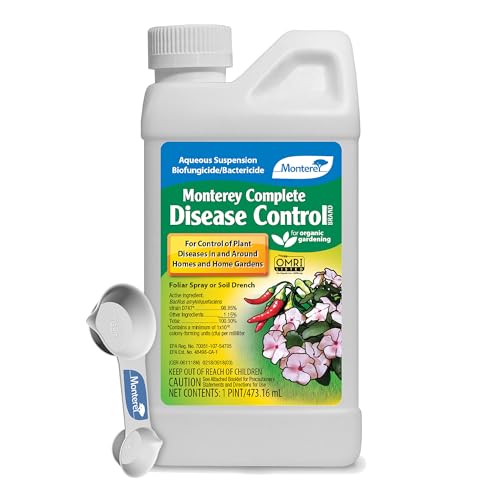
This 16-ounce biofungicide uses a bacterial active ingredient that colonizes root hairs and prevents disease-causing fungi and bacteria from establishing. It can be applied as a foliar spray for powdery mildew control or as a soil drench to protect the root system internally, making it versatile for both preventive and curative use.
Gardners in humid southern climates report that it is their go-to fungicide for tomatoes, especially during periods of heavy rain. The included measuring spoon eliminates guesswork when mixing, and the OMRI listing means you can use it on vegetables, fruits, and nuts up to the day of harvest.
Some users note that it slows disease spread but does not fully eliminate established infections on its own. For heavy powdery mildew pressure, combining it with a contact fungicide in rotation produces better results.
What works
- Systemic root colonization provides internal disease protection
- Can be applied as foliar spray or soil drench for flexible use
- OMRI listed and safe for edible crops up to harvest day
What doesn’t
- Slows but does not fully eliminate established powdery mildew
- Health warning label may concern some home gardeners
- Requires multiple spring applications for tree diseases like peach leaf curl
5. Southern Ag Garden Friendly Biological Fungicide

This 16-ounce biological fungicide is built around Bacillus amyloliquefaciens strain D747, a beneficial bacterium that colonizes the root zone and triggers the plant’s immune response against powdery mildew, blight, and root rot. It works as both a foliar spray and a soil drench, providing a two-pronged defense that is especially effective in high-humidity environments.
Reviewers note that it works out significantly more economical per application than comparable hydroponic root-health products such as Hydroguard, since the concentrate goes a long way when mixed to label rate. It is best applied preventively or at the first sign of infection rather than as a rescue treatment for severe, established outbreaks.
The bottle opening tends to dribble during measuring, and the product works best when applied preventively or at the first sign of infection rather than during severe outbreaks.
What works
- High-concentration Bacillus amyloliquefaciens colonizes roots for systemic protection
- Works as both foliar spray and soil drench for versatile application
- Much more cost-effective than comparable hydroponic products
What doesn’t
- Bottle opening design causes liquid to dribble during measuring
- Requires multiple applications over time to maintain protection
- Best as a preventive — less effective on advanced infections
6. Garden Safe Brand Fungicide3 Ready-to-Use
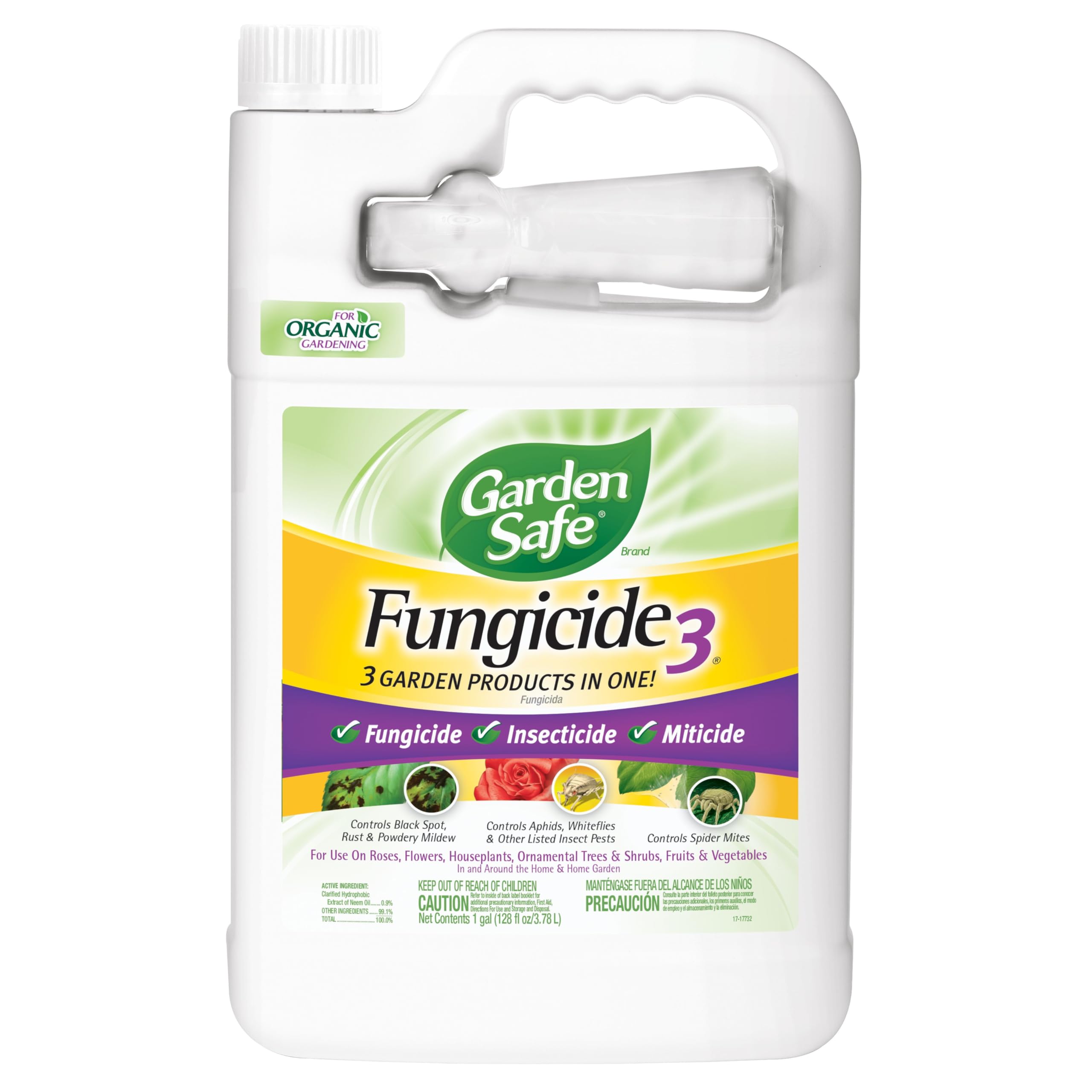
This 1-gallon ready-to-use spray combines fungicide, insecticide, and miticide in one bottle, with clarified hydrophobic extract of neem oil as the active ingredient. It targets powdery mildew, black spot, rust, aphids, whiteflies, and spider mites, making it a convenient all-in-one solution for roses, flowers, houseplants, and vegetables.
Users report that weekly application stopped powdery mildew on hibiscus, roses, tomatoes, and blueberries, and that foliage and fruit yield improved noticeably over the season. The attached sprayer makes application easy for small to medium gardens, though several reviewers found the short coiled hose design frustrating for reaching deep into plants.
Some users experienced minor leaf burn when using the full recommended dose in direct sunlight, so applying it in the evening or at half strength is advisable during hot weather.
What works
- Triple-action formula controls mildew, insects, and mites in one spray
- Ready-to-use bottle with attached sprayer requires no mixing
- Organic neem oil extract is safe for use on edible crops
What doesn’t
- Sprayer hose is too short to reach deep into large plants
- Can cause leaf burn if applied at full strength in direct sun
- Ready-to-use format is less cost-effective than concentrate for large gardens
7. Bonide Revitalize Biofungicide Concentrate

This 16-ounce concentrate triggers an immune response in plants to control and prevent powdery mildew, blight, anthracnose, and black spot. It is approved for organic gardening and can be used on vegetables, fruits, nuts, trees, shrubs, and houseplants both indoors and outdoors, making it one of the most versatile entry-level biofungicides available.
Users find it effective on houseplant fungal issues and report that their tomato septoria leaf spot improved after application. The concentrated formula requires mixing with water according to label directions, and it can be applied as a foliar spray or soil drench depending on the target disease.
Some users note that it has a strong smell during application, and the small 16-ounce concentrate size may require frequent purchases for large outdoor gardens with recurring mildew pressure.
What works
- Immune-response mode of action helps plants resist multiple fungal diseases
- Approved for organic gardening and safe to use up to harvest day
- Works on both indoor houseplants and outdoor vegetables and trees
What doesn’t
- Strong smell during application may be off-putting
- Small bottle runs out quickly for large garden coverage
- Concentrate requires careful mixing according to label directions
Hardware & Specs Guide
Contact vs. Systemic Fungicides
Contact fungicides like neem oil and potassium bicarbonate coat leaf surfaces and kill spores on contact. They wash off with rain and require reapplication every 7–14 days. Systemic fungicides such as propiconazole and Bacillus subtilis are absorbed into plant tissue and provide longer residual protection — typically 14–21 days. Systemic options are better for established infections, while contact products work well as preventive barriers.
Concentration and Coverage Area
A 16-ounce concentrate typically mixes into 8–12 gallons of finished spray, covering 2,000–4,000 square feet depending on the dilution rate. Ready-to-use 1-gallon bottles cover roughly 200–400 square feet per bottle. Understanding the square footage of your garden beds or lawn helps determine whether a concentrate or RTU format is more economical for your specific powdery mildew treatment plan.
OMRI Listing and Pre-Harvest Interval
OMRI-listed products have been reviewed to comply with USDA organic standards, meaning they can be used on certified organic crops. The pre-harvest interval is the number of days that must pass between the last application and harvest. Some synthetic systemic fungicides have intervals of 14–30 days, while many biofungicides allow same-day harvest — a critical distinction for vegetable and fruit gardeners.
Application Method: Foliar Spray vs. Soil Drench
Foliar sprays coat leaves directly and are best for treating visible powdery mildew on leaf surfaces. Soil drenches deliver the fungicide to the root zone, where it is absorbed systemically to protect the entire plant from internal infection. Some biological fungicides can be applied either way, while synthetic systemics typically require foliar application for powdery mildew control.
FAQ
Can I use the same fungicide for powdery mildew on both vegetables and ornamentals?
How often should I reapply fungicide during a powdery mildew outbreak?
Is neem oil or Bacillus subtilis more effective for powdery mildew?
Can I mix different fungicides together for stronger control?
Final Thoughts: The Verdict
For most gardeners dealing with powdery mildew on lawns and ornamentals, the fungicide for powdery mildew winner is the Quali-Pro Propiconazole 14.3 because its systemic microemulsion formula provides long-lasting protection across large areas with fewer reapplications. If you need an organic option safe for edible crops up to harvest, grab the Grower’s Ally Crop Defender 3. And for a budget-friendly ready-to-use solution that handles mildew, insects, and mites on roses and ornamentals, nothing beats the Garden Safe Fungicide3.