
Pecan scab doesn’t just disfigure nuts — it defoliates entire trees, reducing kernel fill and leaving you with empty husks at harvest. The pathogen overwinters on infected shucks and leaf lesions, releasing spores each spring that drive a season-long battle against yield loss.
I’m Rikta — the co-founder and writer behind Lawn Gear Lab. For this guide I pored over university extension bulletins, cross-referenced label rates against pecan-specific pathogen cycles, and analyzed hundreds of verified owner reports to isolate the formulations that actually suppress scab under heavy disease pressure.
Whether you manage a backyard orchard or commercial grove, finding the right active ingredient and application timing makes every difference. This is the complete analysis of the best fungicide for pecan scab available today.
How To Choose The Best Fungicide For Pecan Scab
Pecan scab (Cladosporium caryigenum) is the most destructive disease in pecan production. Choosing a fungicide means understanding three things: the active ingredient’s mode of action, the residual protection window, and whether the label lists pecan scab as a target disease.
Systemic vs. Protectant Chemistry
Systemic fungicides like propiconazole enter the leaf tissue and move internally, offering curative and preventive activity for up to 28 days. Protectants like chlorothalonil or captan form a barrier on the leaf surface and must be reapplied more frequently, especially during wet weather. Most effective pecan programs use both in rotation to delay resistance and cover different infection windows.
Resistance Management
Propiconazole-resistant scab populations have been documented in the southeastern US. Rotating with a multi-site contact fungicide (chlorothalonil) or a different FRAC group (captan, Group M4) is essential. Never rely on a single active ingredient across an entire season.
Formulation and Tank-Mix Compatibility
Liquid concentrates and microemulsions (MEC) mix more easily in the tank than wettable powders, and most label compatibility with insecticides and foliar nutrients for pecan orchards. Low-odor formulations matter less for grove work, but ease of mixing and rainfastness after drying are critical for timing sprays around unpredictable weather.
Quick Comparison
On smaller screens, swipe sideways to see the full table.
| Model | Category | Best For | Key Spec | Amazon |
|---|---|---|---|---|
| Dow Eagle 20EW | Systemic | Curative & preventive scab control | Myclobutanil 20% EC | Amazon |
| Quali-Pro Propiconazole 14.3 | Systemic | Long residual on trees & turf | 14.3% Propiconazole MEC | Amazon |
| Bonide Fung-onil | Protectant | Broad-spectrum preventive coverage | Chlorothalonil 29.6% | Amazon |
| Atticus Gunner 14.3 MEC | Systemic | Rainfast 28-day control | 14.3% Propiconazole MEC | Amazon |
| Select Source Propiconazole 14.3 | Systemic | Value-priced rotation partner | 14.3% Propiconazole | Amazon |
| Monterey Complete Disease Control | Biological | Organic pecan programs | Bacillus amyloliquefaciens | Amazon |
| Southern Ag Captan | Protectant | Scab & brown rot in stone fruit | Captan 50% WP | Amazon |
In‑Depth Reviews
1. Dow AgroSciences Eagle 20EW Fungicide

Eagle 20EW delivers myclobutanil at 20% concentration — a systemic triazole that moves upward through the xylem to protect developing pecan foliage and nut clusters. The label specifically targets scab along with powdery mildew, rust, and leaf spot, making it a precise fit for pecan disease programs where curative kickback is needed after infection occurs.
Owner reports consistently describe it as “potent” and “life-saving” against persistent fungal pressure, especially when copper-based products had already failed. The emulsifiable concentrate requires careful measuring and full PPE, but users with large plantings (red oaks, multiple fruit trees, mixed orchard blocks) confirm visible suppression after one application and full control after two sprays spaced 14–21 days apart.
Against pecan scab specifically, the 20% myclobutanil rate allows lower product volume per acre compared to 14% propiconazole products, which matters when spraying mature trees with high gallonage. The main trade-off is cost per ounce — this sits at a higher tier — but the extended residual and systemic movement often reduce the total number of sprays needed during a wet spring.
What works
- High-concentration systemic with curative activity on active scab lesions.
- Broad ornamental and tree fruit label includes pecan scab as a target.
- Reliable rainfastness once dry; resists wash-off during heavy storms.
What doesn’t
- Requires careful PPE and measuring; not a casual homeowner formulation.
- Premixed tank stability requires following label order-of-mixing strictly.
2. Quali-Pro Propiconazole 14.3 Fungicide, 32oz

Quali-Pro’s 14.3% propiconazole uses a microemulsion concentrate (MEC) that stays suspended in the tank longer than standard emulsifiable concentrates, reducing constant agitation during large orchard sprays. The locally systemic mode of action provides up to 28 days of residual protection — enough to cover the critical infection windows between bud break and nut shell hardening.
Verified buyers treating St. Augustine lawns and Bermuda turf praised it for curing brown patch and silver leaf in one season, but pecan growers specifically value the low-odor profile and tank-mix compatibility with chlorothalonil for resistance rotation. Users treating blackberry orange rust achieved complete suppression after three applications with no recurrence across an entire summer.
For pecan scab, this product fits mid-to-late season rotations when extended coverage matters and tree canopies are fully developed. The MEC formulation also reduces nozzle clogging compared to wettable powders — a practical advantage when spraying tall trees with airblast sprayers.
What works
- Up to 28-day residual protection on treated foliage.
- MEC formulation resists settling; excellent tank-mix partner.
- Low odor, suitable for residential groves near occupied homes.
What doesn’t
- Some users report weaker control on St. Augustine fungus compared to alternatives.
- Annual reapplication needed in areas with recurrent scab pressure.
3. Bonide Fung-onil Multi-Purpose Fungicide, 32 oz

Bonide Fung-onil relies on chlorothalonil, a multi-site contact fungicide that disrupts fungal respiration at multiple points — making it nearly impossible for scab to develop resistance. This is why extension services recommend chlorothalonil as the backbone protectant in pecan fungicide programs, alternating with DMI fungicides like propiconazole or myclobutanil.
The 32-ounce concentrate mixes at rates that treat hundreds of square feet of canopy, and the milky suspension clings to leaf surfaces even during wet weather. Users report it cleared black spot on tomatoes and blight on boxwood after seven-day intervals, and several apply it preventively before rain events to block spore germination.
On pecan trees, this product is best applied from bud break through early nut development as a preventive cover spray. The white residue left on leaves is cosmetic but harmless, and chlorothalonil’s lack of systemic movement means thorough coverage of upper canopy and inner branches is essential for effective scab protection.
What works
- Multi-site mode of action; zero resistance risk for scab populations.
- Excellent rainfastness and leaf adherence after drying.
- Large concentrate size provides high value per application.
What doesn’t
- Leaves visible white residue on leaves and fruit.
- Requires thorough canopy coverage; no curative activity on existing lesions.
4. Atticus Gunner 14.3 MEC Propiconazole, 32 OZ
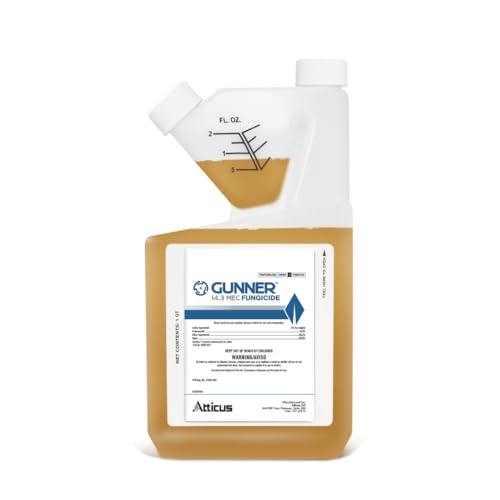
Atticus Gunner packs the same 14.3% propiconazole active as the Quali-Pro product but uses a distinct microemulsion concentrate that the manufacturer claims will not separate or settle after mixing — a genuine advantage when spraying multiple tanks in a row without constant re-agitation. The label targets more than 20 fungal pathogens including scab on labeled trees, though pecan scab is not named explicitly and users should verify state registration.
Owner reports highlight its performance on rose black spot — one application eliminated recurring spots with no return in three weeks — and several buyers use it as a regular rotation partner for large lawns (12,000 sq ft). The low-odor formulation is appreciated by homeowners spraying near patios or vegetable gardens.
For pecan growers, this product fits best as a mid-season systemic when rainfastness and longevity are priorities. The 32-ounce bottle treats a substantial canopy area, and the stable suspension means less nozzle fouling during long spray days. However, because pecan scab may not appear on every state’s supplemental label, always check local registration before relying on it as the primary scab material.
What works
- MEC stays mixed without constant agitation in the tank.
- Rainfast after drying; resists wash-off during wet spells.
- Low odor; good for residential groves.
What doesn’t
- Pecan scab not explicitly on all state labels — verify before use.
- Some Florida/Hawaii/Alaska/Vermont restrictions limit availability.
5. Select Source Propiconazole 14.3, 1 Pint

Select Source Propiconazole 14.3 is the entry-level systemic option that makes propiconazole accessible for small orchards and backyard pecan trees. At 16 fluid ounces, the bottle is compact, but the 14.3% concentration stretches across multiple treatments when mixed at typical rates of 1 to 2 ounces per gallon of water.
Customers managing centipede and Bermuda lawns confirm it breaks brown patch cycles within two weeks, and several specifically combine this with azoxystrobin for a two-class rotation that prevents resistance. The low-odor formulation and EPA compliance make it a straightforward choice for homeowners who want professional-grade chemistry without the premium price.
For pecan scab, this is best used as a rotational partner — not as a standalone program. The 16-ounce size limits coverage on large trees, but for a few mature trees or young saplings, it provides effective systemic protection during the scab-susceptible period from bud break through early nut set.
What works
- Lowest cost per bottle for a propiconazole systemic.
- Excellent tank-mix compatibility with azoxystrobin and other fungicides.
- Low odor and easy mixing for homeowner sprayers.
What doesn’t
- 16-ounce bottle covers limited canopy area on mature pecan trees.
- Not labeled as OMRI organic; conventional use only.
6. Monterey Complete Disease Control, 1 Pint
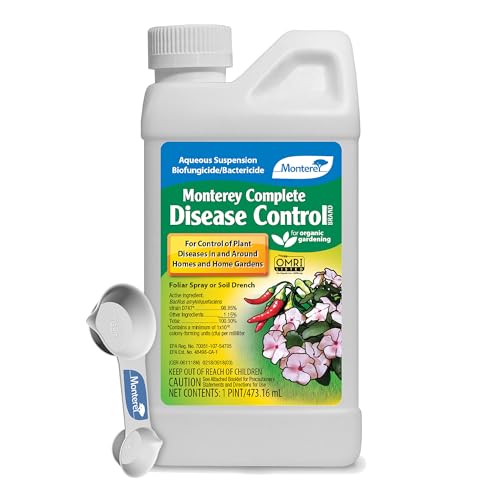
Monterey Complete Disease Control is unique in this lineup — it uses a biological active ingredient (Bacillus amyloliquefaciens strain D747) that colonizes root hairs and leaf surfaces to outcompete fungal pathogens. It is OMRI-listed for organic production, making it the only option here suitable for certified organic pecan operations.
Users in the southeastern US praise it as a “life saver for tomato plants” during rainy seasons, and peach growers confirm it controls leaf curl with multiple spring applications. The product works both as a foliar spray and as a soil drench, allowing systemic colonization that provides internal protection against root-borne pathogens.
Against pecan scab, this biological option is best deployed as a preventive supplement early in the season or as a rotation partner to reduce synthetic fungicide load. It will not provide the same curative punch as propiconazole or chlorothalonil on established scab lesions, so it works best in integrated pest management (IPM) programs where low disease pressure is expected.
What works
- OMRI-listed for certified organic production.
- Can be used as foliar spray or root drench for internal protection.
- Safe for bees, beneficial insects, and edible crops.
What doesn’t
- Slower acting and less curative than synthetic fungicides.
- Requires frequent reapplication under heavy disease pressure.
7. Southern Ag Captan Fungicide, 8 oz

Southern Ag Captan is a wettable powder formulation containing 50% captan, a multi-site contact fungicide in FRAC Group M4. Captan is widely used on fruit and nut trees for scab, brown rot, and botrytis control, and its mode of action provides a strong resistance-management tool when rotated with DMI fungicides like propiconazole.
Montmorency cherry growers specifically praise this product for controlling yellow leaf mold, and peach orchardists confirm it prevents mummy brown rot when applied at label timing. The powder mixes easily, though it requires constant agitation in the tank to stay suspended. Users with pecan trees apply it during early-season cover sprays to reduce initial scab inoculum.
The primary limitation is the small 8-ounce bottle — at the top-tier price, you pay a premium for a concentrated powder that treats a modest canopy area. However, for a few mature pecan trees or small groves, captan provides a proven, resistance-proof contact option that complements any systemic program.
What works
- Multi-site contact chemistry prevents resistance development.
- Broad fruit/nut label includes scab and brown rot control.
- Powder form stores well with long shelf life.
What doesn’t
- Small bottle size limits coverage on large trees.
- Requires constant tank agitation to prevent settling.
- Higher cost per ounce compared to liquid concentrates.
Hardware & Specs Guide
Mode of Action Classification
FRAC (Fungicide Resistance Action Committee) codes tell you which products share the same biochemical target. Propiconazole and myclobutanil are both Group 3 (DMI — demethylation inhibitors). Chlorothalonil is Group M5 (multi-site contact). Captan is Group M4. Rotating between Group 3 and Groups M4/M5 is the standard resistance management strategy for pecan scab.
Active Ingredient Concentration and Carrier
Higher active percentages (20% myclobutanil vs. 14.3% propiconazole) mean less product volume per acre, but the carrier — emulsifiable concentrate (EC), microemulsion concentrate (MEC), or wettable powder (WP) — determines how easily the product mixes, how stable it is in the tank, and whether it leaves visible residue. MEC formulations generally offer the best balance of ease and stability.
FAQ
How often should I spray pecan trees for scab during a wet spring?
Can I use the same fungicide for pecan scab and other orchard diseases?
What is the best rotation strategy to prevent fungicide resistance in scab?
Is there an organic fungicide that works for pecan scab?
Final Thoughts: The Verdict
For most pecan growers, the fungicide for pecan scab winner is the Dow Eagle 20EW because its 20% myclobutanil concentration delivers the systemic curative punch needed when scab pressure is high. If you want long residual coverage with excellent tank stability, grab the Quali-Pro Propiconazole 14.3. And for a resistance-proof contact program on a budget, nothing beats the Bonide Fung-onil with chlorothalonil.