
That first tiny brown or black dot on a leaf might not seem like a crisis, but a full-blown leaf spot infection can defoliate a prized shrub, ruin a row of tomatoes, and turn a lush lawn into a patchy mess in just weeks. The fungi behind leaf spot thrive in damp, humid conditions, and once they take hold, systemic action is required to stop the spread and protect new growth. Choosing the right treatment means matching the active ingredient to the specific host plant and the infection stage, and getting that wrong wastes time and money.
I’m Rikta — the co-founder and writer behind Lawn Gear Lab. I spend my time comparing hundreds of product formulations, studying university extension data on fungicide efficacy, and analyzing aggregated owner feedback to find the treatments that actually halt disease cycles without harming the plant.
Whether you are protecting a lawn, a vegetable patch, or an ornamental tree, this guide to the best fungicide for leaf spot breaks down the top concentrates, ready-to-use sprays, and systemic solutions based on real-world results.
How To Choose The Best Fungicide For Leaf Spot
Not all leaf spot fungi are the same. Septoria, Alternaria, Cercospora, and Entomosporium each respond to different active ingredients. Choosing a fungicide blindly often leads to frustration when the spots keep spreading. Focus on three core factors before buying.
Active Ingredient & Mode of Action
Systemic fungicides like propiconazole and myclobutanil move through the plant’s vascular system and protect new growth, making them ideal for active infections on turf and ornamentals. Contact fungicides containing chlorothalonil or copper remain on the leaf surface and prevent spore germination but do not cure existing infections on new leaves. Biofungicides with Bacillus subtilis trigger the plant’s natural immune response and work best as a preventive measure early in the season.
Plant Safety & Edible Crop Use
A fungicide labeled for roses may burn edible crops, and a product safe for lawns can damage a delicate ornamental shrub. Check the product label for your specific host plant and look for the pre-harvest interval if treating vegetables or fruit. Organic options like neem oil extract are gentle on most plants but require thorough coverage and repeated applications.
Formulation & Coverage
Liquid concentrates offer the best value for large areas but require a dedicated sprayer and careful mixing. Ready-to-use sprays provide convenience for a few potted plants but run out quickly on a full garden bed. Granular fungicides release slowly through watering but are less effective against active foliar infections than direct sprays.
Quick Comparison
On smaller screens, swipe sideways to see the full table.
| Model | Category | Best For | Key Spec | Amazon |
|---|---|---|---|---|
| Quali-Pro Propiconazole 14.3 | Systemic Concentrate | Turf & Ornamental | 14.3% Propiconazole | Amazon |
| Dow AgroSciences Eagle 20EW | Systemic Concentrate | Severe Infections | 20% Myclobutanil | Amazon |
| Bonide Revitalize Biofungicide | Organic Concentrate | Prevention & Edibles | Bacillus subtilis | Amazon |
| Garden Safe Fungicide3 | Neem Oil RTU | General Prevention | 128 oz RTU | Amazon |
| Bonide Captain Jack’s Orchard | Multi-Purpose | Fruit Trees | 32 oz Concentrate | Amazon |
| Ferti-lome Triple Action | 3-in-1 Spray | Roses & Shrubs | 16 oz Concentrate | Amazon |
| Leaf Armor Spray | Natural RTU | Houseplants | 8 oz RTU | Amazon |
In‑Depth Reviews
1. Quali-Pro Propiconazole 14.3

The 14.3% propiconazole concentration in this microemulsion delivers broad-spectrum systemic protection against leaf spot, brown patch, dollar spot, and powdery mildew on both cool and warm-season turfgrasses. Users report visible new grass growth within a week of the first application and significant recovery after a second spray 14 days later. The low-odor formulation mixes easily in tank sprayers and provides excellent plant coverage without clogging nozzles.
This product is also labeled for trees, shrubs, and flowers, making it a versatile addition to any property with mixed ornamental and turf needs. The locally systemic mode of action moves into the plant tissue quickly, offering long-lasting control that holds up between applications. One 32-ounce bottle treats a large area—users with a third of an acre found application rates of 1 to 2 ounces per 1,000 square feet effective.
Some users noted that propiconazole can stress grass if applied during extreme heat, so timing applications during moderate temperatures is essential. The concentrate requires careful measuring and a quality sprayer, but the cost per treatment is significantly lower than box-store ready-to-use alternatives.
What works
- Fast systemic action stops leaf spot and brown patch on turf.
- Treats a very large area per bottle—excellent value per treatment.
- Low-odor formula makes mixing and spraying more pleasant.
What doesn’t
- Can cause turf stress if applied during extreme heat above 85°F.
- Requires full PPE and a dedicated sprayer for proper mixing.
2. Dow AgroSciences Eagle 20EW

Eagle 20EW is an agricultural-grade systemic fungicide formulated with 20% myclobutanil, making it one of the most potent solutions available for severe leaf spot infections. It is labeled for more than 15 fungal diseases including Septoria leaf spot, zonate leaf spot, powdery mildew, and anthracnose on turfgrass, landscape ornamentals, apples, stone fruits, and grapes. The systemic activity works from the inside out, protecting new growth even if some foliage is already infected.
Users consistently report that this product saved plants where copper-based fungicides had failed, including a red oak with blight and multiple plantings with shot-hole disease. The concentrated formula requires careful calculation per 100 gallons of water, and a 16-ounce pint goes a long way for targeted treatments. It is well tolerated by popular turf and ornamental species when used according to label directions.
The potency does require respect—users stress the need for full PPE including respirator, goggles, and gloves during mixing and spraying. The product is not organic and has a pre-harvest interval for edible crops that must be observed. Some users report a strong odor during application that dissipates once dried.
What works
- Extremely effective against stubborn leaf spot and powdery mildew that resist copper.
- Systemic protection covers new growth for long-lasting control.
- Small bottle treats many applications—concentrated and economical.
What doesn’t
- Requires careful calculation and full PPE for safe handling.
- Not suitable for organic gardening; has a pre-harvest interval.
3. Bonide Revitalize Biofungicide

Bonide Revitalize uses the beneficial bacterium Bacillus subtilis to trigger an immune response in plants, helping them resist and control leaf spot, blight, powdery mildew, and black spot. This biofungicide is approved for organic gardening and can be used up until the day of harvest, making it an excellent choice for vegetable gardens and edible crops. The 16-ounce concentrate mixes with water for use as a foliar spray or soil drench.
Users report that it effectively turned around a problem with Septoria leaf spot on tomatoes, and it works on houseplants, fruits, nuts, trees, and shrubs. The product has a noticeable smell that some describe as strong or unpleasant, but the odor dissipates quickly after drying. Multiple users noted that it is the best option for treating fungal problems on houseplants without resorting to harsh chemicals.
The biological mode of action means it works best as a preventive measure or at the first sign of infection. Established or severe infections may require a stronger systemic product. Users also note that results are not instantaneous—it takes several days to a week for the plant’s immune response to visibly halt the disease.
What works
- Safe for organic gardening and edible crops up to harvest day.
- Effective against Septoria leaf spot and powdery mildew on tomatoes.
- Works as both a foliar spray and soil drench for flexible application.
What doesn’t
- Has a strong odor during application that some find unpleasant.
- Slower to show results—best as a preventive rather than a curative.
4. Garden Safe Fungicide3
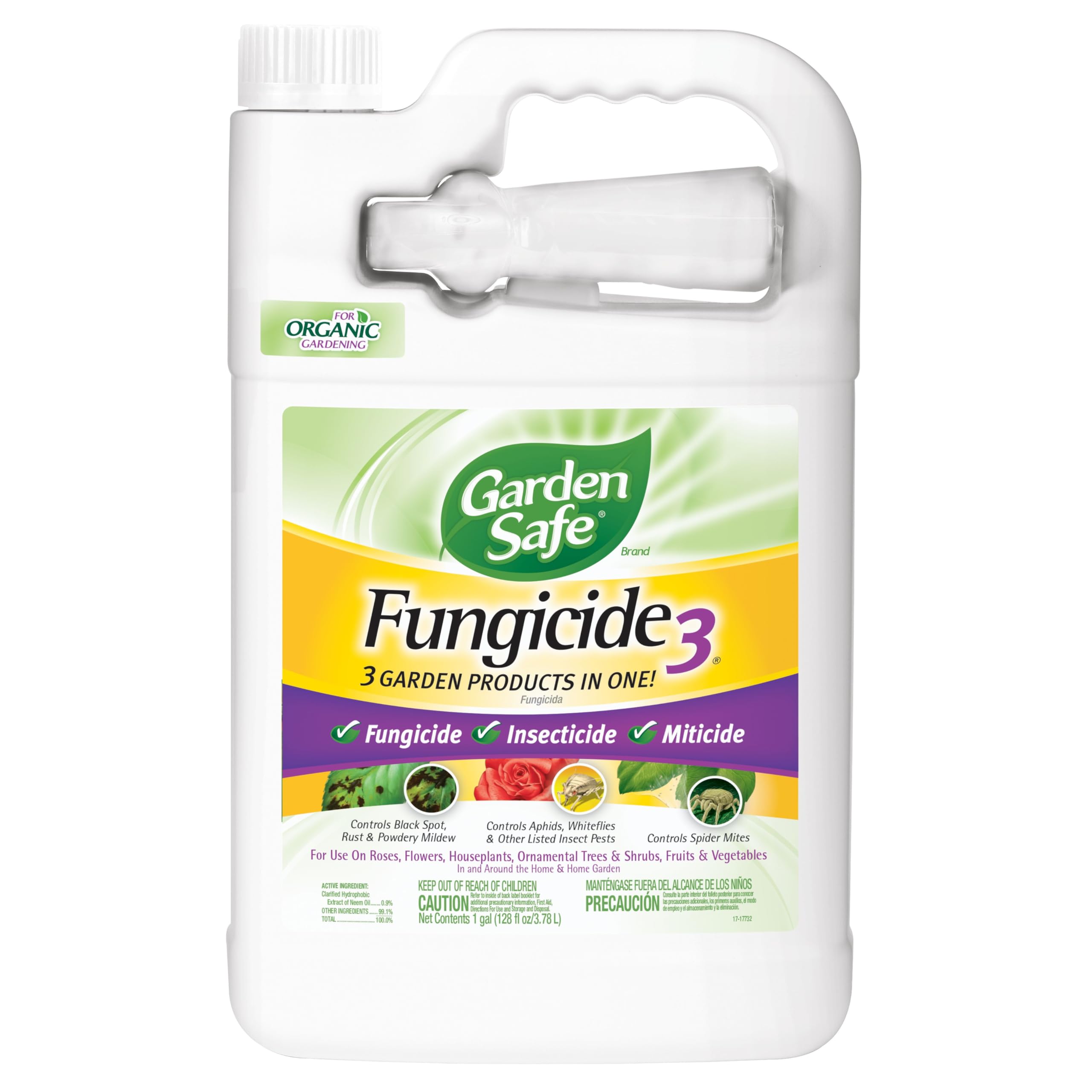
Garden Safe Fungicide3 combines fungicide, insecticide, and miticide in one ready-to-use formula, with clarified hydrophobic extract of neem oil as the active ingredient. The 128-ounce gallon-sized bottle includes a built-in sprayer for convenient application on roses, flowers, houseplants, ornamental trees, and vegetables. It controls black spot, rust, and powdery mildew while also managing aphids, whiteflies, and spider mites.
Users praise its effectiveness against mildew on hibiscus, roses, tomatoes, and blueberries with weekly use. Many report that it prevents recurrence of fungal issues and promotes greener foliage and higher yields. A note of caution: the product can burn sensitive plant tissue if applied in direct sunlight or at full strength—users recommend starting with half the recommended dose and avoiding daytime spraying.
The built-in sprayer is a convenient feature, but some users found the 4-inch pickup tube limiting for reaching plants at the back of a shelf or deep in a garden bed. The neem oil formula leaves a slight residue on leaves, which is normal and fades over time.
What works
- Triple-action formula controls fungus, insects, and mites with one spray.
- Large 128-ounce ready-to-use bottle with built-in sprayer saves mixing time.
- Organic neem oil formulation safe for vegetable gardens and ornamental beds.
What doesn’t
- Can burn plant tissue if applied in full sun or at full strength.
- Built-in sprayer hose is very short, limiting reach.
5. Bonide Captain Jack’s Orchard Spray

Captain Jack’s Orchard Spray is a multi-purpose concentrate that targets both fungal diseases and insect pests in one application. It controls leaf spots, powdery mildew, rust, and blight while also managing beetles, fruit flies, caterpillars, spider mites, and scale. The 32-ounce bottle makes up to 6.4 gallons of finished spray, with dilution rates as low as 2.5 fluid ounces per gallon of water.
Users have reported that leaf spots on apple trees disappeared and the overall foliage became noticeably greener after a few applications. The product is gentle on plants even during active growth and is labeled for use on apples, avocados, citrus, vegetables, roses, and ornamentals. It can be used up to the day before harvest on edible crops, providing flexibility for home orchardists.
The sulfur-based active ingredient leaves a slight powdery residue on foliage after drying, which is normal and washes off at harvest. Some users note that rain can wash the product off quickly, requiring reapplication after heavy storms. The concentrate requires a hose-end or tank sprayer for application, which adds a step compared to ready-to-use options.
What works
- Effectively clears leaf spot and restores green color to fruit trees.
- Controls a wide range of insects and fungal diseases in one product.
- Can be used up to the day before harvest on edible crops.
What doesn’t
- Leaves a light powdery residue on foliage that some find unsightly.
- Can wash off in rain, needing reapplication after storms.
6. Ferti-lome Triple Action
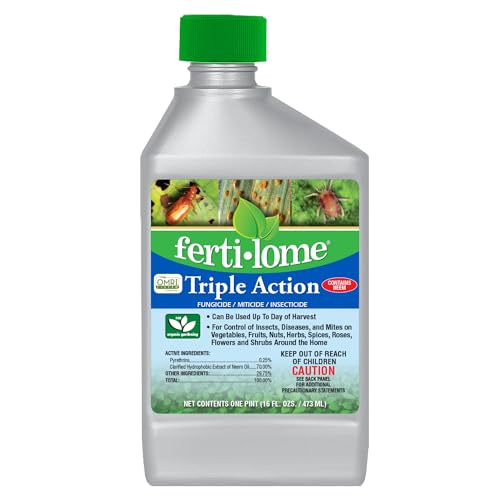
Ferti-lome Triple Action combines insecticide, miticide, and fungicide in a single 16-ounce concentrate, offering protection against leaf spot, powdery mildew, rust, aphids, spider mites, and leafminers. It is formulated for use on fruits, herbs, nuts, vegetables, roses, flowers, and shrubs. The recommended application schedule is every 7 to 14 days for best results, and many users have relied on this product for years on their apple trees and vegetable gardens.
Users report that it is a proven, effective product for maintaining the health of fruit trees and ornamentals throughout the growing season. The organic ingredients, including neem oil, make it a good choice for those seeking a non-synthetic option. However, some users note that it does not work as quickly as synthetic fungicides and requires consistent reapplication to stay ahead of the disease cycle.
The 16-ounce bottle is relatively small and may not be the most economical choice for large properties or extensive gardens. Users with a few trees and a vegetable patch find it a convenient all-in-one solution, but dedicated fungicides may offer better value per gallon of finished spray for broader applications.
What works
- Three-in-one formula simplifies pest and disease management with one product.
- Contains organic neem oil—good for non-synthetic gardening approaches.
- Works well on fruit trees and vegetables with consistent 7-14 day spraying.
What doesn’t
- Slow-acting compared to synthetic systemic fungicides.
- Small 16-ounce bottle offers limited value for larger properties.
7. Leaf Armor Spray for Houseplants

Leaf Armor is a gentle, non-toxic foliar spray designed specifically for houseplants. Formulated with organic-based biopolymers and yucca extract, it helps protect against fungal leaf spots, bacteria, and pathogens while also cleaning dust and debris from leaves. The 8-ounce ready-to-use spray requires no mixing—simply mist clean, dry leaves every 2 to 4 weeks as part of a regular care routine.
Users report that it removed a chalky white film from a shipped fiddle leaf fig, leaving the leaves dark green, glossy, and flexible. Houseplant owners with large collections note that their plants look visibly healthier within 24 hours, with puckered leaves flattening and opening after treatment. The product is safe for use around children and pets when applied correctly and is trusted for fiddle leaf figs, monsteras, philodendrons, and pothos.
The 8-ounce bottle is expensive per ounce compared to concentrates, and some users report a slight white film on leaves if the product is over-applied or not shaken well before use. The manufacturer recommends testing on a single leaf for plants with fuzzy or highly variegated foliage to check for sensitivity.
What works
- Gentle, non-toxic formula safe for indoor use around pets and children.
- Restores natural leaf gloss and removes chalky film from shipped plants.
- No mixing required—simply mist and air dry for quick treatment.
What doesn’t
- Expensive per ounce compared to concentrate alternatives.
- Can leave a white film on leaves if over-applied or not shaken properly.
Hardware & Specs Guide
Systemic vs. Contact Fungicides
Systemic fungicides like propiconazole and myclobutanil are absorbed into the plant tissue and move through the vascular system, protecting new growth from the inside. Contact fungicides like chlorothalonil and copper remain on the surface and kill spores on contact but do not protect unsprayed new leaves. For active leaf spot infections, systemic products generally provide faster and more complete control because they reach the fungus inside the leaf tissue.
Measuring Active Ingredient Concentration
Concentrate labels list the percentage of active ingredient (AI). A 14.3% propiconazole product is more concentrated than a 1.2% ready-to-use spray, meaning you use less product per gallon. Higher AI percentages generally mean better value per treatment, but they also require more precise measuring. Always follow the label rate for your specific plant and disease—over-application can cause phytotoxicity and under-application wastes money.
FAQ
Can I use a lawn fungicide for leaf spot on my rose bushes?
How often should I spray for leaf spot during wet weather?
Will a fungicide cure leaves that already have leaf spot damage?
Final Thoughts: The Verdict
For most gardeners, the fungicide for leaf spot winner is the Quali-Pro Propiconazole 14.3 because it offers powerful systemic protection at a very low cost per treatment across turf and ornamentals. If you want an agricultural-grade solution for severe infections on trees and shrubs, grab the Dow AgroSciences Eagle 20EW. And for an organic option safe for edible crops up to harvest, nothing beats the Bonide Revitalize Biofungicide.