
Specs are compiled from manufacturer listings and verified buyer reviews and can change over time — please confirm the key details on the product page before buying.
If you push a front-wheel-drive (FWD) mower on flat ground, the front wheels dig in and pull the deck forward — you just steer. That is the whole promise. But pick the wrong one and the self-propel slips, the bolts rattle loose, or you are wrestling an 84-pound machine around a wet patch. This guide cuts through that noise to the two models that actually deliver on the FWD idea for a typical flat-to-gentle-slope lawn.
I’m Rikta — the founder and writer behind Lawn Gear Lab. This guide is built by comparing the manufacturers’ published specifications and the patterns across verified customer reviews, so you get each pick’s real strengths and trade-offs instead of marketing spin.
Whether your yard measures a tidy front strip or a full third of an acre, the right front-wheel-drive self-propelled lawn mower saves you time and strain — in this guide you’ll find exactly which one fits your terrain, your grass, and your back.
How To Choose The Best Front-Wheel-Drive Self-Propelled Lawn Mower
Front-wheel-drive mowers pull themselves forward by the front wheels. On flat or softly rolling ground that means you guide, not push. The key factors are the engine or motor, the drive system, the cutting width, and the build quality that keeps the thing running past a single season.
Gas vs Battery — The Runtime Trade
A gas engine runs as long as you keep the tank full. A battery mower gives you a fixed window per charge — typically 50-60 minutes of cutting time, which covers a 1/3-acre lawn for most people. The trade: gas is louder and needs maintenance, but never leaves you short mid-lawn. Battery is quieter, lighter, and starts with a button, but the clock is ticking each session.
Cutting Width and Deck Height
A wider deck (21 or 22 inches) covers ground faster. A narrower deck (20 inches) maneuvers tighter around flower beds. Look for a range of cutting heights — 1.25 to 4 inches is typical — so you can let the grass grow longer in summer heat or trim it short in spring. More positions (six or seven) give you finer control.
The Drive System: CVT vs Fixed Speeds
A CVT (continuously variable transmission) lets you blend smoothly between speeds, matching your walking pace exactly. Fixed-speed models offer several numbered settings — six or seven — that you shift between. Both work; CVT feels more natural on uneven terrain, while fixed speeds are simpler and cheaper to repair.
Quick Comparison
In‑Depth Reviews
1. SENIX 21” Self-Propelled Gas Lawn Mower (FWD)
Our pick — a genuine front-wheel-drive gas mower that starts on the first pull and powers through thick, overgrown grass.
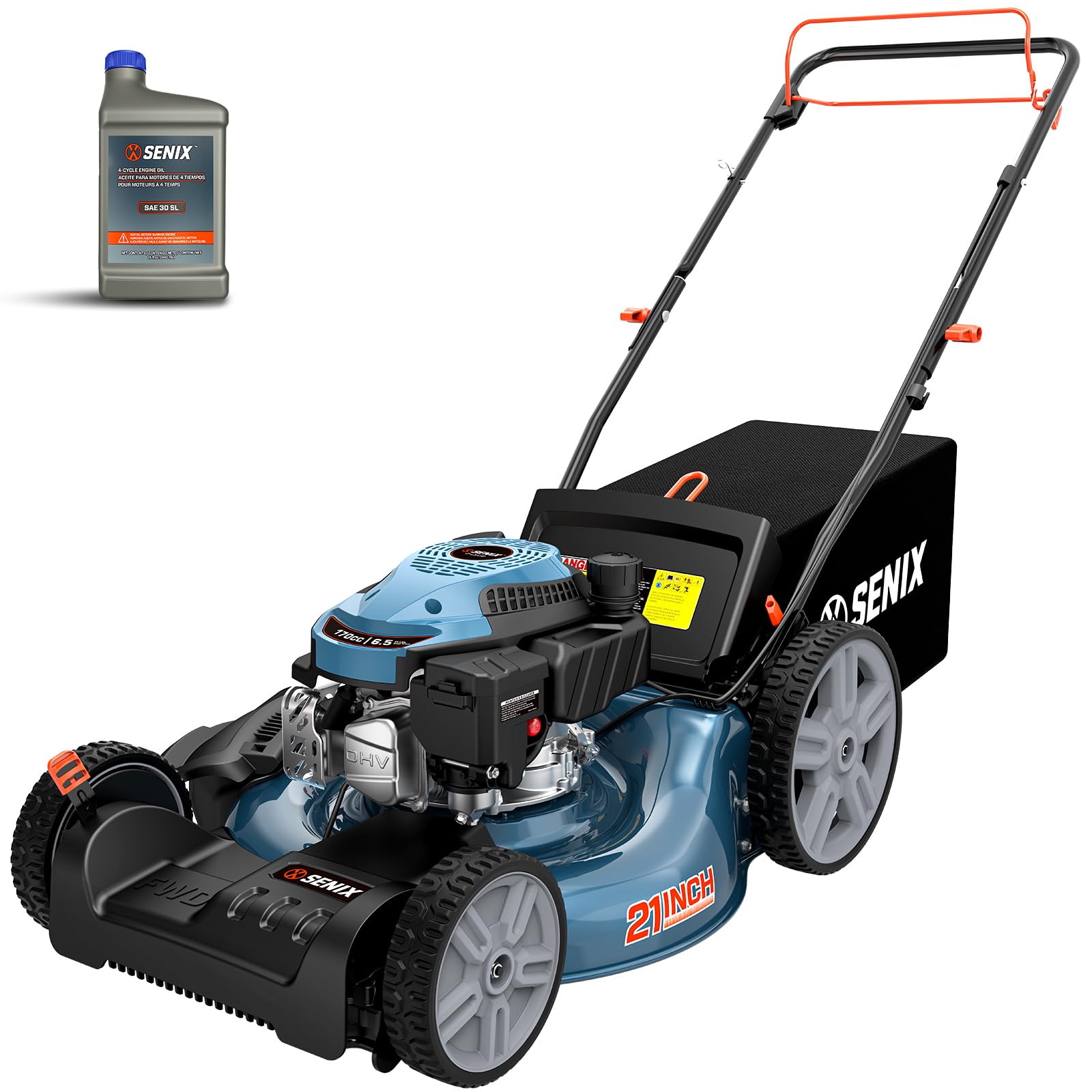
A gas-powered workhorse that starts on the first pull and chews through overgrown grass without slowing.
The 170cc 4-cycle OHV engine delivers 3.8 HP and 6.5 ft-lb of torque — enough to tear through thick foliage and wet patches that make the battery mower above hesitate. With a 21-inch high-strength steel deck and six cutting positions from 1.25 to 3.75 inches, you get a proper gas cut. The 8-inch front and 11-inch rear wheels handle rough terrain well, and the front-wheel drive makes it easy to pivot around trees and flower beds.
The biggest owner win is starting performance (the top-praised aspect by far) — buyers consistently say it fires on the first pull after priming. The 3-in-1 steel deck supports mulching, side discharge, and rear bagging with a 1.7-bushel bagger. The honest catch: a small number of owners mention bolts loosening over time, with one noting “within 5 weeks, bolts loosened and fell out; required replacement and tightening with threadlocker.” That is a real fastening-check pattern worth knowing. For a flat 1/3-acre yard that grows thick and fast, this gas SENIX cuts where the battery mower spins.
The power story: The 170cc engine pulverizes overgrown grass that stalls a 40V battery. The 21-inch deck clears a wide path, and the FWD system lets you swing around obstacles with ease.
The durability note: Check the bolts after the first few mows — a dab of threadlocker solves the occasional loosening issue owners flag.
Reach for this if: You have a flat 1/3-acre yard with thick, fast-growing grass and want a gas mower that starts immediately and cuts hard.
Look elsewhere if: You prefer zero-maintenance starting (battery) or need a very tall cut above 3.75 inches for hot-season grass.
2. YARDMAX 22 in. 201cc Select PACE 6 Speed CVT High Wheel FWD Gas Lawn Mower
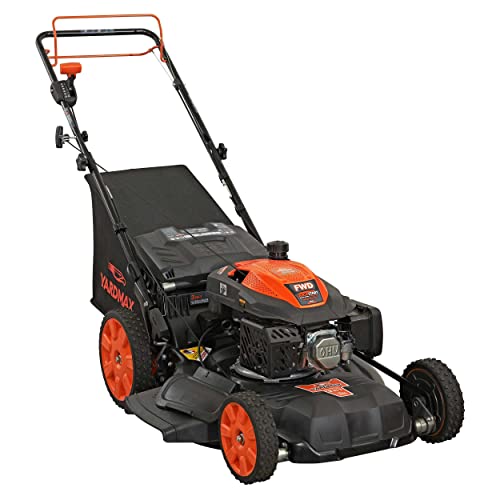
The widest cut and strongest engine here, built for sloped, uneven yards that smaller mowers chug on.
The 201cc engine and 22-inch stamped steel deck give this YARDMAX the biggest bite of the two — you cover more ground per pass and the extra power handles hilly terrain that would bog down a 170cc. Its headline feature is the CVT (continuously variable transmission) with a 6-speed shift lever, which lets you blend smoothly between walking paces rather than jumping between fixed steps. The aggressive spiked rubber tires are designed for traction on slopes and damp grass, and the automatic choke system means no priming or manual choke — just pull and go. Owners say it starts on the second pull consistently.
The catch is weight: at 84.9 pounds (nearly 90 with the bag), this is a heavy machine. The FWD system works well going uphill — buyers praise it for “going up and down the hills in our yard” — but turning on flat ground takes more muscle. A few owners note the speed lever can slip on wet grass, and the bagger removal is awkward. The 2-year residential warranty gives some confidence for the investment. This is the mower you choose when your lawn has real slope and thick grass that needs a larger engine and a wider deck.
The Hill Climber
- CVT transmission gives smooth, gap-free speed matching on slopes
- 22-inch deck covers ground faster than the 20- or 21-inch models
- Automatic choke and easy second-pull starting
The Bulk Trade
- At 84.9 pounds, it is noticeably heavier than the SENIX (61.7 lbs) — harder to maneuver on flat turns
- Speed lever can slip on wet grass; bagger removal is fussy
Best for: Sloped, uneven yards where a 201cc engine and wide deck make the difference — and you do not mind the extra weight for that power.
skip it if: Your lawn is small and flat, or you need to lift and pivot the mower frequently around tight flower beds.
Understanding the Specs
Cutting Width
The width of the blade path determines how many passes you need to cover your lawn. A 20-inch deck fits through narrower gates and maneuvers around landscaping but takes more passes on open lawn. A 22-inch deck cuts a wider swath — fewer passes, faster finish — but is less nimble in tight spaces.
Self-Propel Drive System
Front-wheel-drive (FWD) pulls the mower forward by the front wheels. On flat ground that makes the deck easy to pivot around trees and flower beds because the rear wheels swivel freely. On steep slopes the front wheels can lose traction, which is why FWD is best for relatively flat yards. Rear-wheel-drive (RWD) pushes from behind, giving better hill traction but a wider turning circle.
FAQ
Is a front-wheel-drive mower better for hills?
How long does a battery FWD mower run per charge?
Which is easier to start: gas or battery?
What does CVT mean on a lawn mower?
Can I mulch with both models?
How often should I check bolts on a new gas mower?
What cutting height range should I look for?
How do I store a battery mower in winter?
Will a 20-inch mower fit through a standard gate?
Final Thoughts: The Verdict
For most people, the front-wheel-drive self-propelled lawn mower to beat is the SENIX 21″ Gas because it starts on the first pull and powers through thick, overgrown grass on a typical flat 1/3-acre yard. And for a sloped, uneven property where you need maximum engine and deck size, the YARDMAX 22″ earns its place with a CVT transmission and a 201cc engine that climbs without choking.
How We Picked
We do not accept paid placement. Every pick is matched to a real buyer and a real use-case; we do not hands-on test units.
Sources & Methodology
Specifications: manufacturer listings and product documentation. Review insights: verified customer reviews, as of July 2026. Pricing: not shown on this page (it changes often); check the current price via the retailer link.
As an Amazon Associate, Lawn Gear Lab earns from qualifying purchases. This does not affect which products we feature.