
Specs are compiled from manufacturer listings and verified buyer reviews and can change over time — please confirm the key details on the product page before buying.
You want to grow vegetables, herbs, or flowers deeper into the year — but wind, frost, and hungry pests keep killing your plans. A freestanding greenhouse is the answer: you place it anywhere in your yard, and it gives you a controlled environment to start seeds earlier and harvest later. The hard part is picking a model that won’t collapse in your first real storm..
I’m Rikta — the founder and writer behind Lawn Gear Lab. This guide is built by comparing the manufacturers’ published specifications and the patterns across verified customer reviews, so you get each pick’s real strengths and trade-offs instead of marketing spin.
To pick the right one, you need to focus on three things: what the frame is made of (wood, aluminum, or steel), what the walls are (plastic sheet or rigid polycarbonate panels), and how much space you actually have. This breakdown of the best freestanding greenhouse options cuts through the noise so you can buy with confidence.
Our Picks at a Glance
How To Choose The Best Freestanding Greenhouse
Buying a greenhouse is a long-term investment., and the wrong choice usually shows up within the first season — a bent frame, a torn cover, or poor heat retention. Here is exactly what to look for so you get a structure that lasts.
The Frame Is Everything
The frame carries the entire weight of the cover, the wind load, and sometimes snow. Cedar wood offers natural rot resistance and real strength — but it is heavy and requires a solid foundation. Aluminum is lighter, won’t rust, and is the go-to for mid-range and premium polycarbonate models. Galvanized steel is the strongest for large hoop houses, but buyer reports consistently mention thinner tubing (under 1 inch) bending in moderate winds.
Cover Material: Polycarbonate vs. PE
Polycarbonate panels — especially the twin-wall or 4-wall types — trap heat far better than plastic sheeting and resist tearing, hail, and UV damage. A single sheet of polyethylene (PE) is cheap and lets in light, but it is thin. Buyers report that PE covers on budget-tier greenhouses rip, stretch, and degrade within one season, especially in sunny or windy areas. If you plan to heat the greenhouse for winter use, polycarbonate is the right call.
Size and Your Real Yard Space
Greenhouse dimensions are given in length x width, but what matters is floor area and headroom. A 6×4 foot model is a tight fit for standing and working; an 8×6 foot model gives you room for shelves and a small workbench. Hoop houses can run as long as 20 feet, which suits serious growers but requires a flat, open area. Always measure your yard and gate — the greenhouse has to get to its final spot.
Quick Comparison
| Model | Best For | Frame Material | Cover Type | Floor Area | Amazon |
|---|---|---|---|---|---|
| Backyard Discovery Willow 9’x6′★ Best Overall | Permanent year-round use | Cedar Wood | 4-Wall Polycarbonate | 54 sq ft | Amazon |
| Yardenaler 8×16 FTPremium Wood Pick | Large wooden structure | Wood | Multi-layer Polycarbonate | 128 sq ft | Amazon |
| WUKHG 8×10 FTTech-Forward Pick | Tech-friendly polycarbonate | Aluminum | Twin-wall Polycarbonate | 80 sq ft | Amazon |
| HOOYEAH 6×8 FT | Compact aluminum build | Aluminum | Polycarbonate | 48 sq ft | Amazon |
| Sylviera 6×4 FT | Small budget polycarbonate | Aluminum | Double-wall Polycarbonate | 24 sq ft | Amazon |
| Quictent 20x10x6.6 FT | Large hoop house with doors | Galvanized Steel | PE Mesh | 200 sq ft | Amazon |
| VEVOR 19.36×9.68×6.5 FT | Budget large hoop house | Galvanized Steel | PE | 187 sq ft | Amazon |
| Outsunny 8’x6’x7.5′ | Entry-level pop-up | Alloy Steel | PE | 48 sq ft | Amazon |
In‑Depth Reviews
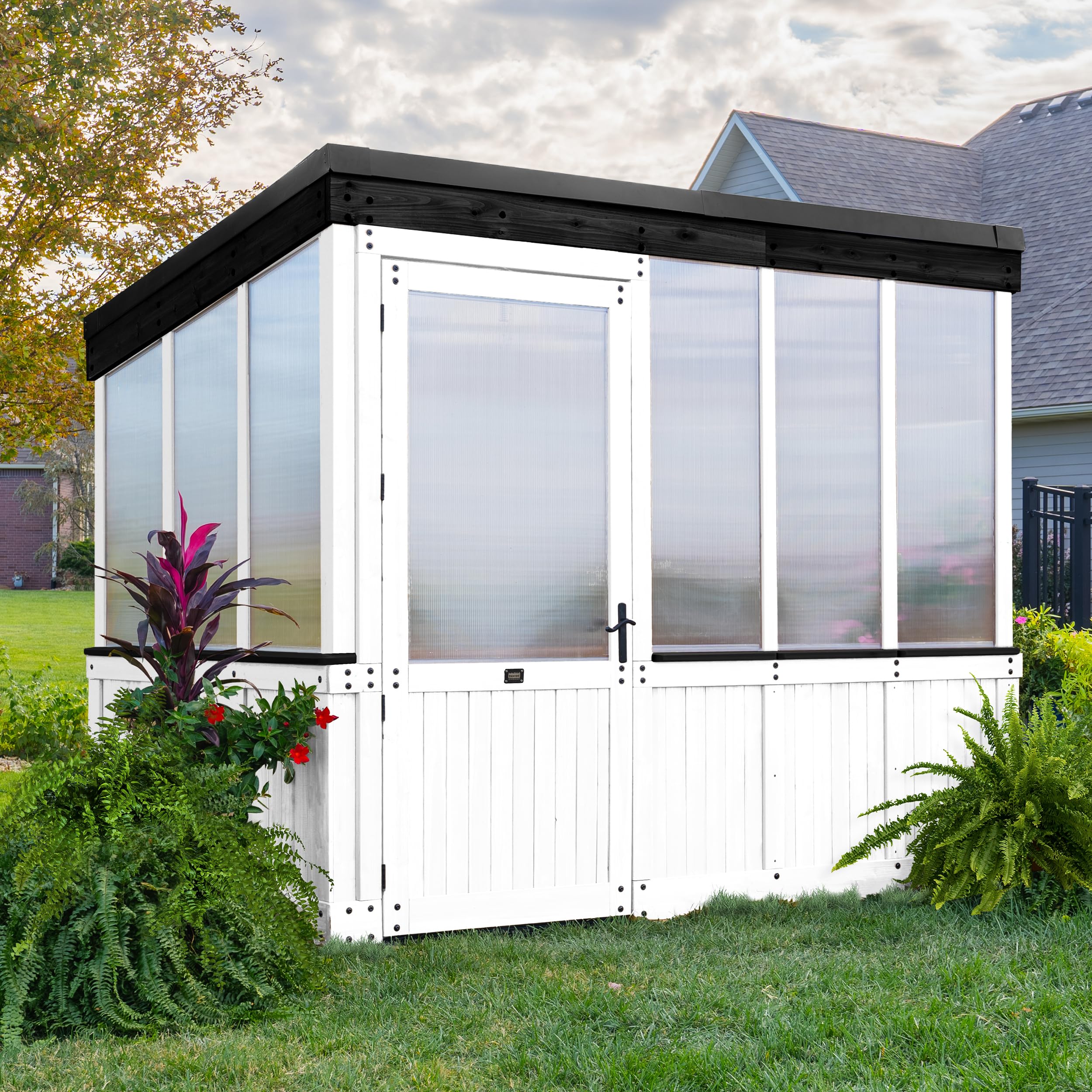
1. Backyard Discovery Willow 9′ x 6′ White Cedar Wood and Polycarbonate Walk-in Greenhouse Kit
Our pick — over 4.5★ from 100+ verified ratings; the strongest balance of quality and price.
The cedar fortress that shrugs off snow loads and keeps plants thriving through winter.
This greenhouse’s 100% cedar frame and 4-wall polycarbonate panels let you grow year-round in heavy snow and wind. It carries a tested snow load capacity of 2,800 pounds (30 inches). — meaning you can leave it standing through a blizzard without worry. It also withstands winds up to 100 mph when properly anchored.. That is a different league from the plastic-and-tube options below.
The build quality wins over owners: pre-cut, pre-drilled, and pre-stained pieces, plus the interactive BILT app guide. Assembly is substantial — owners mention it took about 21 hours solo, and owners say it takes “every bit of time to put together, but it is structured.” The payoff comes at the first heavy storm, when it stands solid.. Its 4-wall polycarbonate panels improve heat retention by 30% over standard double-wall panels., so you get genuine year-round growing potential.
It also brings practical niceties you do not see on budget models: a temperature-activated exhaust fan, a Patented PowerPort with 3 electrical outlets and 3 USB ports, and both exterior and interior hose hook-ups. At 571 pounds, this is a permanent garden structure — not a seasonal tent. The crowd favorite — 4.7 stars across 100+ owners — puts it squarely at the top. This is the model the WUKHG below wants to compete with on tech, but it outclasses it on pure durability.
What Owners Celebrate
- Precision pre-drilling and guides make assembly accurate, if time-consuming
- Survived heavy storms and wind with no issues — owners call it “solid” and “sturdy”
- Plenty of interior space (54 sq ft) with 13 linear feet of fixed staging shelves and a built-in workstation
One Honest Trade-Off
- Assembly is a serious weekend (or multi-weekend) project — clear your schedule
- A few owners received a damaged door panel in shipping, though the manufacturer resolved it quickly
Reach for this if: you want a permanent, weather-defying greenhouse that looks good, works hard, and holds up for years in snow and wind.
Consider something smaller if: you only need a seasonal shelter for a handful of pots and have limited yard space — the 571-pound weight and 54 sq ft footprint are commitment-level.
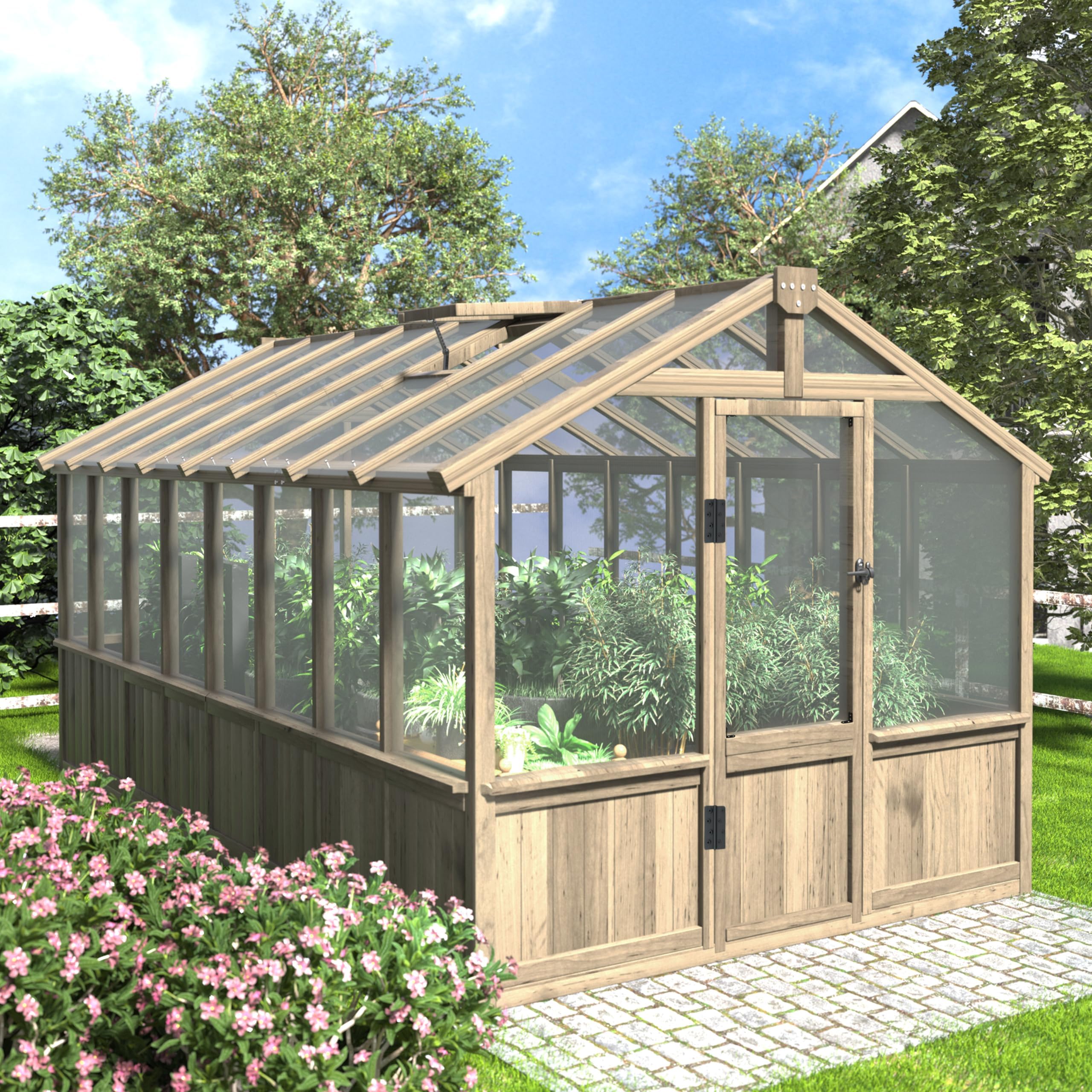
2. Yardenaler 8×16 FT Greenhouse, 6MM Thick Polycarbonate Panel Wooden Walk-in Green House
The spacious wooden grow-house that takes wind and snow in stride.
If the Backyard Discovery is a compact fortress, this Yardenaler is the sprawling pavilion — 8 feet by 16 feet, offering 128 square feet of growing space. The frame is wood (light mocha brown finish), and it uses multi-layer polycarbonate panels that are 6 mm thick, which is notably thicker than the 4 mm panels found on many aluminum models. That extra thickness translates to better insulation and impact resistance.
Buyer reports confirm it survives serious weather — one owner had it survive 60 to 70 mph winds for a full year, and another reported it handled 50 mph gusts plus blizzards with no snow getting inside. The adjustable roof vents open to a maximum angle of 45 degrees, which keeps airflow under control. Assembly feedback is generally positive; owners describe the directions as clear and the parts labeled, though some note the frosted film on the panels may not adhere perfectly over time. A few mention that the wood requires pre-drilling in thin areas and that sealing all seams with caulk is essential for a waterproof result.
This is a next-step greenhouse for a serious gardener who wants room to move, store tools, and even add a sink or heater. At 427 pounds, it is heavy but manageable compared to the 571-pound Backyard Discovery.
The Strong Sell: Huge 8×16 floor plan, 6 mm thick polycarbonate panels, and a wood frame that customers note feels great and smells like cedar.
A Thing to Watch: The frosted film on the polycarbonate can peel with time; a few owners recommend treating it gently or replacing it early.
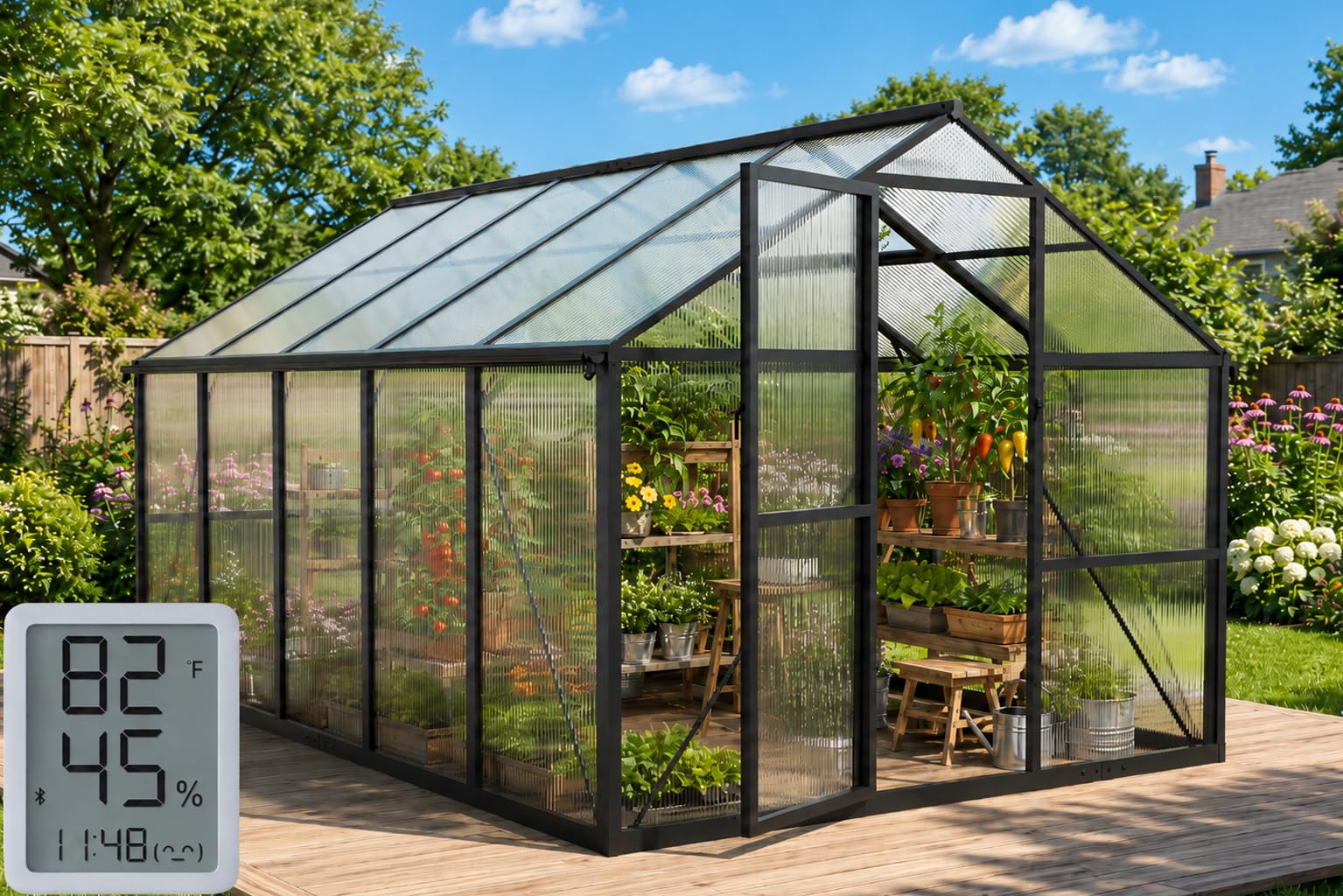
3. WUKHG 8X10FT Enhanced Aluminum Walk-in Greenhouse with Thermometer
The aluminum-framed smart greenhouse that pairs solid construction with real-time climate tracking.
This model brings something most greenhouses skip — an included app-connected thermometer hygrometer (a device that measures both temperature and humidity) that refreshes every 2 seconds, with ±0.54°F accuracy (a very tight margin of error). You get 14-day data graphs and a half-year data export feature right from your phone. For a gardener who obsesses over microclimates, that alone is worth the price of admission.
The frame is high-quality aluminum alloy, combined with 720 g polycarbonate panels (4 mm thick, twin-wall roof panels). The built-in rain gutter on the roof channels water for easy collection — a thoughtful detail for anyone who wants to irrigate from runoff. Ventilation comes from adjustable windows plus a lockable sliding door. Buyers call it “sturdy” and say it holds up well in bad weather. The main trade-off: the roof window has been known to blow out on the first breezy night if not secured well, and a few owners found the instructions unclear, requiring up to three people for assembly. One reviewer noted it heats to 100°F when it is 40°F outside but loses heat by midnight — so it is best for season extension rather than deep-winter heating.
Compared to the Yardenaler, this is a less bulky footprint (8×10 feet vs 8×16 feet), making it more practical for a medium backyard. It is also a smarter pick than the Backyard Discovery if you value remote climate monitoring over raw snow capacity.
Why It Stands Out
- App thermometer with high accuracy (±0.54°F) and 14-day data graphs
- Rain gutter for water collection — handy for eco-friendly watering
- Aluminum frame resists rust and keeps weight manageable
A Caution from Owners
- Roof vent may pop open in wind; reinforce or seal after assembly
- Assembly takes time and ideally three people — not a solo weekend project
Grab it for: the data-driven gardener who wants remote temperature monitoring and a durable, rust-free aluminum frame in a medium 8×10 size.
skip it if: you need a winter heat-retention champ — it cools off quickly after sunset and is better for spring-to-fall growing.
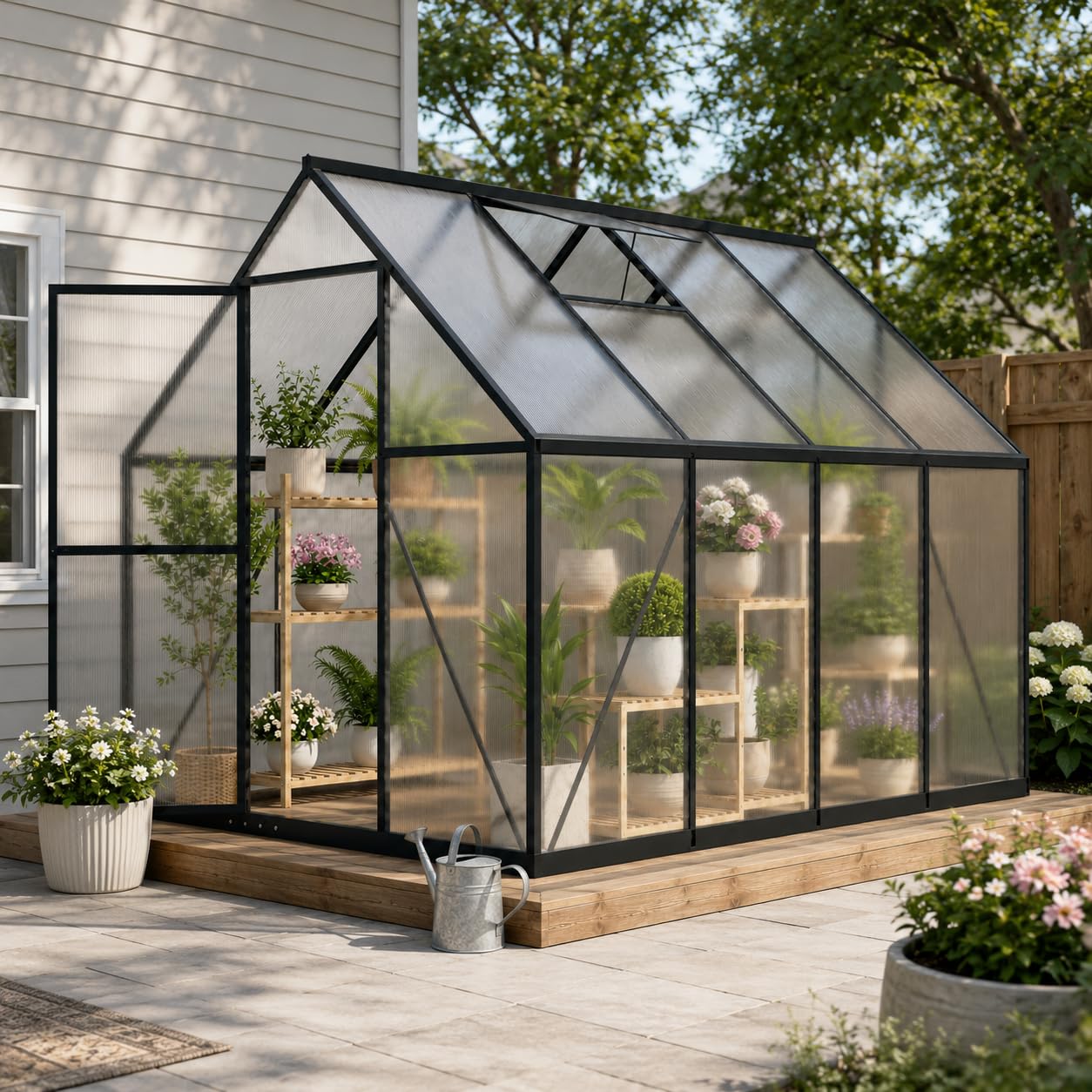
4. HOOYEAH 6×8 FT Polycarbonate Greenhouse, Walk-in Greenhouses for Outdoors
The compact aluminum build that assembles cleanly and holds up without fuss.
At 6 by 8 feet, this HOOYEAH greenhouse is a strong middle-ground option for someone who wants a walk-in polycarbonate structure without the footprint of an 8×10 or larger. The frame is heavy-duty aluminum, and the polycarbonate panels are semi-translucent milky white — they diffuse sunlight evenly, which is ideal for vegetables, herbs, and flowers that scorch under direct UV.
What owners appreciate most is the build quality: the parts are numbered, the packaging is secure, and an experienced builder (even a 70-plus-year-old owner) managed assembly alone. The upgraded lock installs smoothly, and the roof vent is adjustable. The instruction manual has a few gaps near the end — buyers recommend studying the diagrams carefully. A few polycarbonate panels arrived with measurement errors on some units, and one owner reported bent metal framing parts, though the general sentiment is that the final product is well-engineered once assembled. The caveat from the manufacturer is that it is best used in areas with partial wind protection (near fences or shrubs) — not in fully open fields.
If the WUKHG feels like too much tech and too much assembly, this HOOYEAH is a simpler, more straightforward build that still delivers a solid polycarbonate experience. It also occupies a smaller footprint than the WUKHG, at 48 sq ft versus 80 sq ft.
The Core Win: Well-engineered frame with numbered parts and secure packaging — a 70-plus-year-old owner reported building it alone, which says a lot about the design.
One Catch: Not designed for exposed, high-wind locations; place it near a natural windbreak for best results.
5. Sylviera 6x4FT Greenhouse with Hygrometer, Heavy Duty Aluminum Frame Polycarbonate Green House
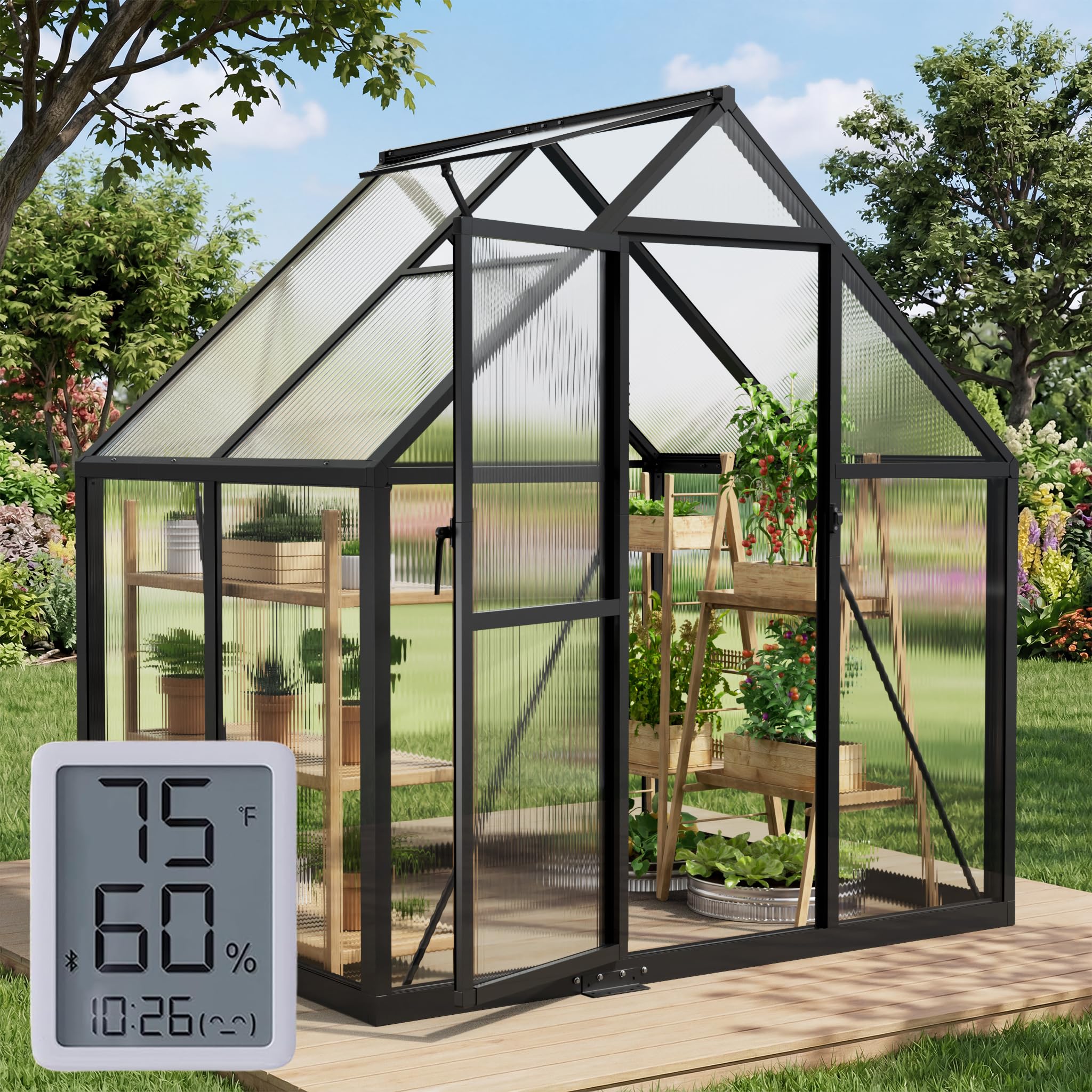
The budget-sized polycarbonate house that surprises owners with real sturdiness.
This is the entry ticket to polycarbonate greenhouses without the premium price tag. The 6×4 foot footprint is compact — about 24 square feet — but the frame is aluminum alloy and the panels are 4 mm double-wall polycarbonate rated at 580 grams. That is the same material class used on greenhouses twice the price. Owners consistently call it “sturdy” and say it withstands storms well, with good UV protection.
The included hygrometer is a nice touch for monitoring conditions, and the adjustable roof vent with a lockable door gives you basic climate control. Assembly feedback is mixed. Several owners found the instructions had errors and note that you must remember to remove the protective film from both sides of each panel — a step the manual apparently omits. One buyer described the materials as “cheap” and the panels as bent or delaminated, though this appears to be an occasional unit issue rather than the norm. Overall, at roughly 4.0 stars across nearly 300 ratings, the value proposition is clear: it is an affordable way to get into a polycarbonate structure that mostly works well.
Compared to the HOOYEAH above, this is smaller (6×4 vs 6×8) and simpler, best for a beginner with a small yard.
What Buyers Praise
- Aluminum frame stays sturdy in wind and rain — owners call it “beautifully made”
- Affordable way to get real polycarbonate panels (4 mm twin-wall)
- Includes a hygrometer for monitoring temp and humidity
Assembly Gotchas
- Instructions skip the crucial step of removing protective film from both panel sides
- Roof vents may need rubber bands to stay propped open — a minor workaround
Best for: the budget-conscious gardener who wants a real aluminum-and-polycarbonate greenhouse in a small 6×4 package.
Reconsider if: you need a larger growing area — 24 square feet is tight for more than a few shelves of pots.
6. Quictent 20x10x6.6 FT Premium Greenhouse with 2 Door Frames, Heavy Duty Walk-in Tunnel
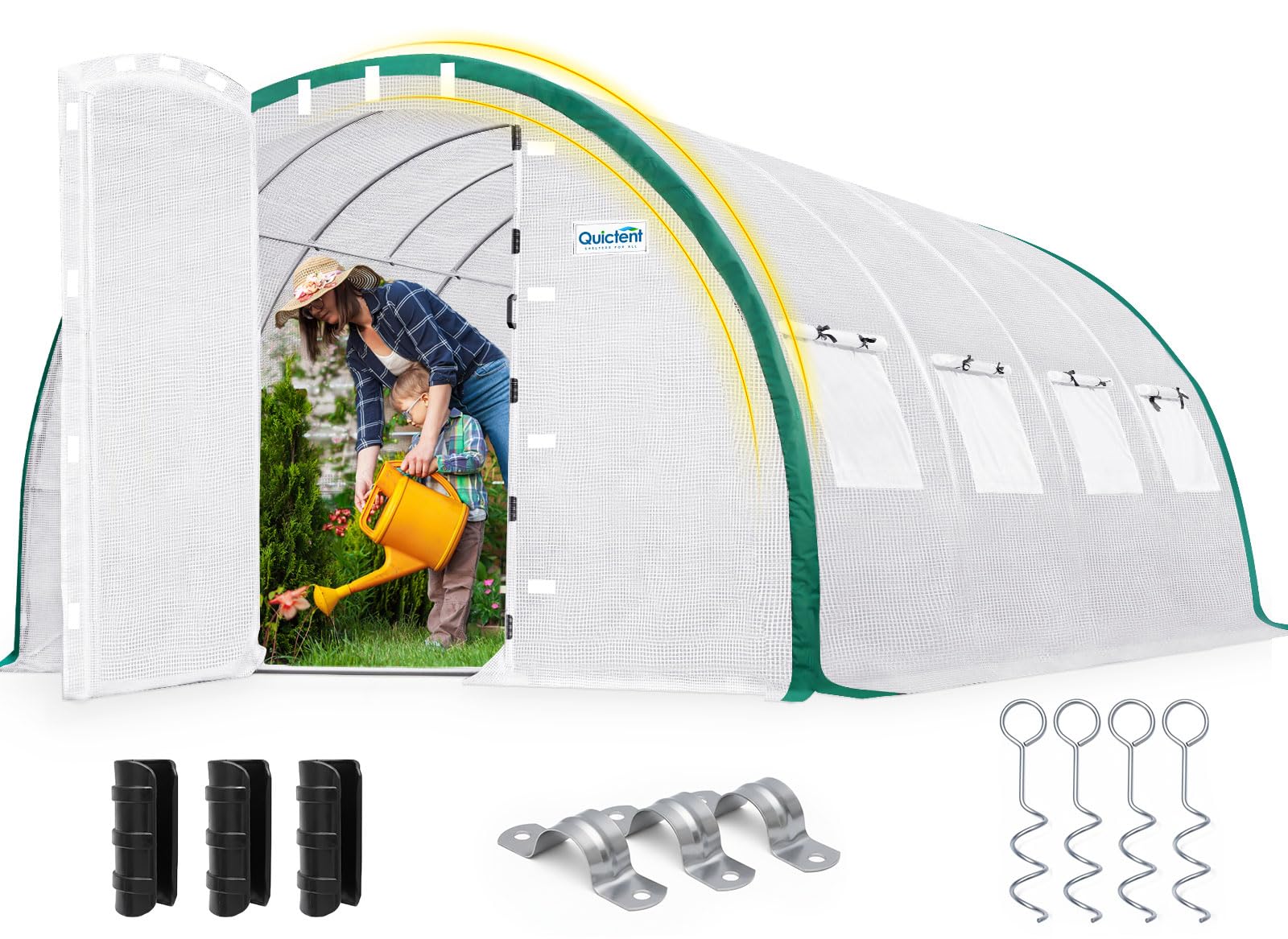
The enormous hoop house with real door frames — no zipper struggle here.
Most large hoop greenhouses use zipper doors that wear out and snag after a season. Quictent solved that with a patented dual swing-door frame that opens 180 degrees, so you can wheelbarrow plants and tools straight in. At 20 feet by 10 feet by 6.6 feet, this is a serious structure for serious growing — 200 square feet of protected space.
The frame uses 0.7 mm thickened galvanized steel with a reinforced top structure featuring extra crossbars to prevent snow or water accumulation. The PE mesh cover is 150 GSM (grams per square meter, a measure of fabric density) with a UV inhibitor and allows 85% sunlight transmission. There are 8 mesh screen windows for controlled ventilation. Owner reports are mostly positive: they describe it as “very sturdy,” “good value,” and note that assembly, while not instant, is manageable alone or with one helper. The manufacturer backs it with a lifetime parts replacement for connectors and stakes, and 365-day complimentary component coverage for main parts. A few owners mention that the interior can hit 140°F in direct sun, requiring shade cloths or fans — and the instructions could be clearer. Compared to the VEVOR below, the Quictent has better structural reinforcements and that critical dual-door system.
The Big Win: Dual swing-door frames that open 180 degrees — a genuine upgrade over zipper doors that fail over time.
Note from Owners: Heats up fast in the sun; plan for shade cloths or extra ventilation if you grow in warm climates.
7. VEVOR Walk-in Tunnel Greenhouse, 19.36×9.68×6.5 ft Hoop House with Galvanized Steel Frame

The low-cost giant that demands serious reinforcement before it faces real weather.
If you want maximum square footage for minimal money, the VEVOR delivers: 19.36 feet by 9.68 feet, with a 6.5-foot peak height. The frame is galvanized steel with 1-inch diameter pipes, and the cover is 140 g/m² high-density PE (polyethylene — a basic plastic sheet). It comes with 12 windows and a zipper door for ventilation. On paper, it looks like a steal.
In practice, the raw number of negative durability reports (79 mentions is the highest aspect count in its data) tells a clear story. Owners consistently say the plastic rips, the frame bends, and the zippers fail within a couple of months unless the buyer reinforces everything — building a double 2×6 base, adding ridge beams, concrete eye bolts, and ratchet straps just to keep it standing in 50 mph winds. One buyer summed it up: “poles bent, straps broke, fabric tore in spring storms; lasted less than 12 weeks.” The interior also overheats quickly, exceeding 120°F even with all vents open. At 70.6 pounds, it is relatively light for its size, but that lightness comes from thin materials. The Quictent above, while pricier, is significantly more sturdy right from the start.
Why Someone Buys It
- Huge 19.36×9.68 ft growing area at a low entry price
- 12 windows and zipper door for maximum ventilation options
The Hard Truth from Owners
- Cover tears and frame bends in moderate wind without extensive DIY reinforcement
- Zipper and velcro failures are common within the first season
- Interior overheats severely (over 120°F) — shade cloth essential
Consider this only if: you are a tinkerer ready to add 2×4 bases, extra poles, and your own wind protection — it is a project, not a ready-to-use greenhouse.
Pass on it if: you want something that works reliably without modifying it right away — the Quictent above is the better bet for a similar size.
8. Outsunny 8′ x 6′ x 7.5′ Walk-in Greenhouse, Outdoor Gardening Canopy with 6 Roll-up Windows
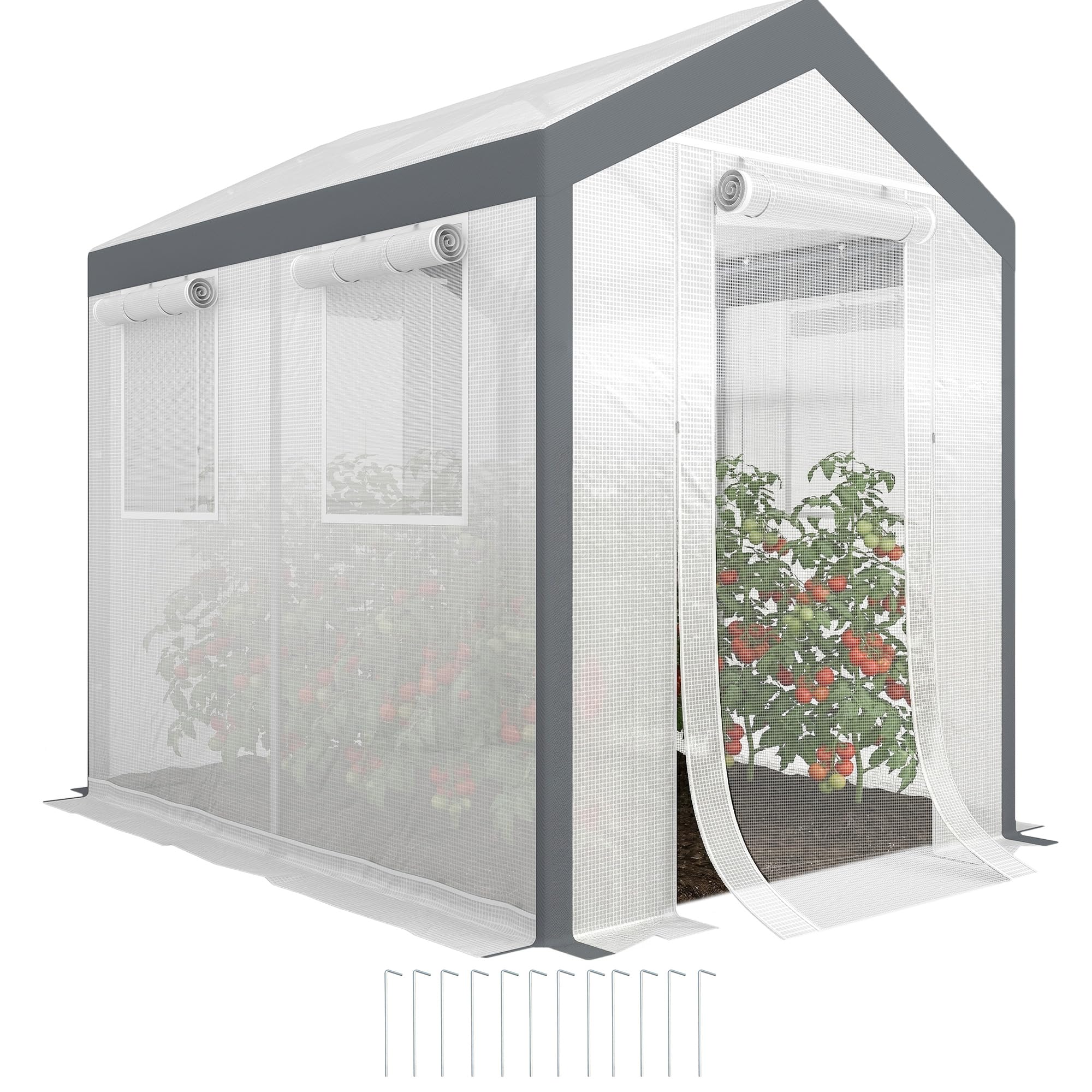
The lightweight starter tent that gets you growing fast — if you protect it from the wind.
At 47.3 pounds, this Outsunny is barely one-twelfth the weight of the Backyard Discovery cedar greenhouse (571 pounds), which tells you exactly what kind of product this is: a seasonal pop-up, not a permanent structure. It measures 8 feet by about 6 feet by 7.5 feet tall, with a PE cover that transmits 85% of sunlight. It has 6 roll-up windows and two zippered doors for cross-ventilation.
Assembly is straightforward — reviewers point out it goes up quickly. The frame is powder-coated alloy steel, and it comes with 12 stakes and 4 ropes. The catch, and it is a big one, is wind resistance. Multiple shoppers say the poles bend, straps break, and the fabric tears in spring storms. One review noted it lasted less than 12 weeks. The manufacturer itself advises: “Please take it down before extreme winds occur.” A few owners had success by anchoring the frame to heavy railroad ties and burying the 6-inch extended edges into soil, turning it into a more stable setup. If you live in a calm, sheltered yard and just want a low-cost space for seedlings, it works. But if your area sees regular storms, this is a temporary solution.
The Appeal: Fast assembly and a low buy-in cost — great for a first-time greenhouse experiment on a calm property.
The Reality: Buyer reports of failures within 12 weeks are not outliers; this is a fair-weather shelter that needs significant anchoring or disassembly before storms.
Understanding the Specs
Frame Material
The frame is the backbone of your greenhouse.. Cedar wood is naturally rot-resistant and very strong, but heavy and expensive. Aluminum is lightweight, rust-proof, and the most common choice for mid-range polycarbonate greenhouses. Galvanized steel is strong for large hoop houses, but the thickness matters — 0.7 mm is more durable than the thinner 0.5 mm tubing found on budget models. Always check the wall thickness and pipe diameter (1 inch is a common minimum for stability).
Cover Type and Thickness
Polycarbonate (PC) panels come in twin-wall (two layers) or 4-wall (four layers) designs. The more walls, the better the heat retention — 4-wall can improve insulation by 30% over double-wall. Thickness is measured in millimeters; 4 mm is standard for budget polycarbonate greenhouses, while 6 mm offers noticeably better insulation. Polyethylene (PE) covers are cheaper but far less durable — they tear, stretch, and degrade in UV light within a year or two. Look for GSM (grams per square meter) ratings — 140 to 150 GSM is the minimum for a PE cover to have a fighting chance.
Snow Load and Wind Rating
Snow load is measured in pounds per square foot or total pounds the roof can hold. A greenhouse rated for 2,800 pounds (like the Backyard Discovery) can handle heavy snow regions. Wind ratings are typically given in mph — 100 mph is premium; budget models have no official wind rating and buyers report failures below 50 mph. If you live in a windy area, frame reinforcement and a strong foundation are non-negotiable.
Ventilation and Accessories
FAQ
Do I need a permit for a freestanding greenhouse?
Can a freestanding greenhouse survive winter snow?
Polycarbonate vs PE cover — which is better for year-round use?
How do I anchor a lightweight greenhouse so it does not blow away?
What size freestanding greenhouse should I get for a beginner?
How long does it take to assemble a freestanding greenhouse?
Can I heat a freestanding greenhouse in the winter?
What is the best foundation for a wooden greenhouse?
How do I prevent my greenhouse from overheating in summer?
Are greenhouses with dual swing doors better than zipper doors?
Final Thoughts: The Verdict
For most people, the best freestanding greenhouse is the Backyard Discovery Willow 9×6 — its cedar wood frame, 4-wall polycarbonate panels, and verified snow load capacity of 2,800 pounds make it the most durable, year-round-ready option at this size. If you want a large polycarbonate structure on a budget, the Sylviera 6×4 delivers real value for a small space. And for truly massive growing area with real door frames, the Quictent 20×10 is the one to reach for — just be ready to manage the heat.
How We Picked
We do not accept paid placement. Every pick is matched to a real buyer and a real use-case; we do not hands-on test units.
Sources & Methodology
Specifications: manufacturer listings and product documentation. Review insights: verified customer reviews, as of July 2026. Pricing: not shown on this page (it changes often); check the current price via the retailer link.
As an Amazon Associate, Lawn Gear Lab earns from qualifying purchases. This does not affect which products we feature.