
Specs are compiled from manufacturer listings and verified buyer reviews and can change over time — please confirm the key details on the product page before buying.
If your lawn mower spins its wheels and slides sideways on a wet hill, you need a four-wheel-drive lawn mower. A 2WD machine loses traction on a slope, slips on uneven ground, and leaves uncut strips at the bottom of every grade. A 4WD mower sends power to all four wheels, so you climb slopes that would stop a push mower cold, cut across bumpy terrain without scalping, and get a consistent trim from the top of the ridge to the drainage ditch.
I’m Rikta — the founder and writer behind Lawn Gear Lab. This guide is built by comparing the manufacturers’ published specifications and the patterns across verified customer reviews, so you get each pick’s real strengths and trade-offs instead of marketing spin.
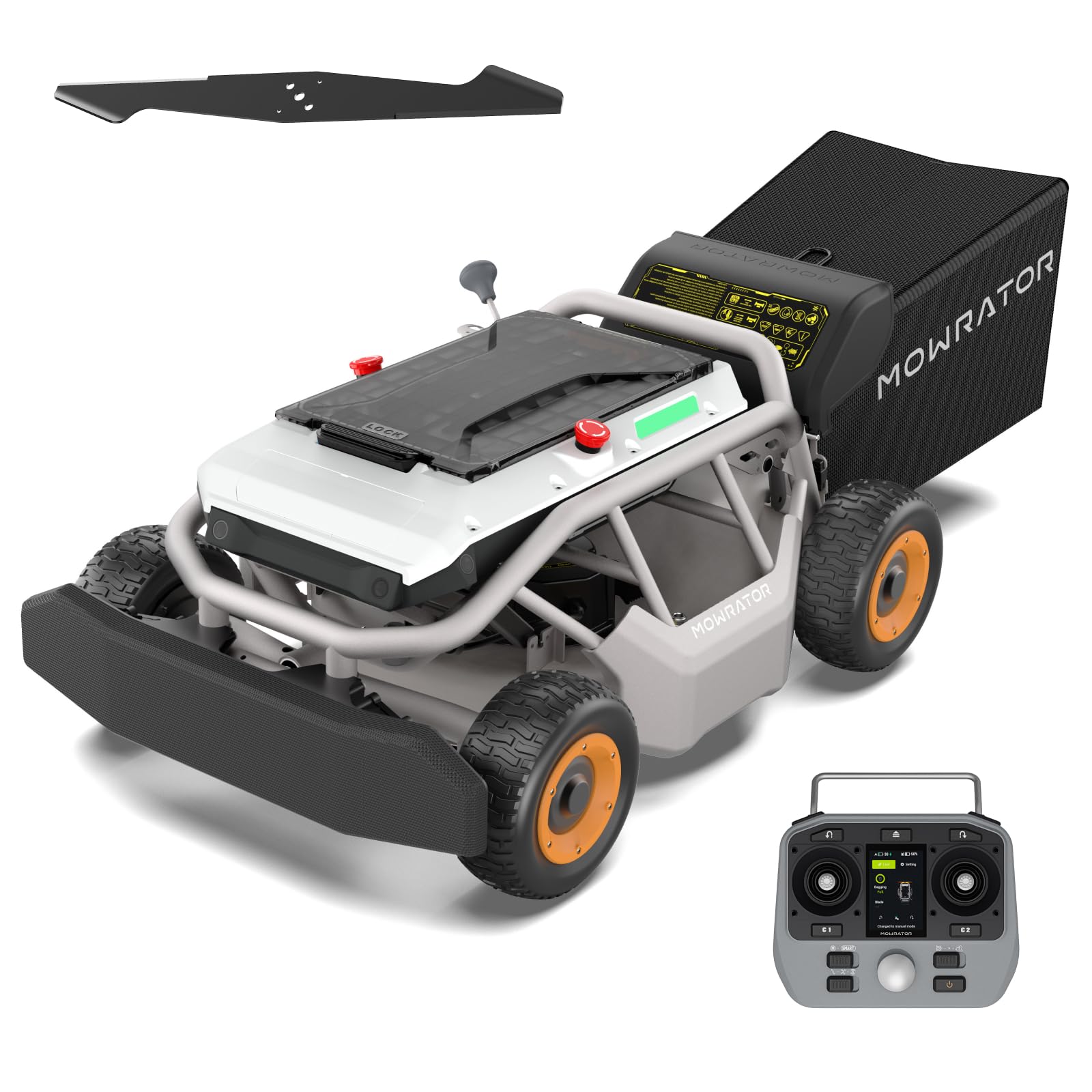
The buyer crowd likes the Mowrator S1 best — 4.4 stars across 50+ owners who call it effective, powerful, and a beast on steep ground. If you want an honest, spec-by-spec breakdown of the best four-wheel-drive lawn mower for your property, this is where to start.
Our Picks at a Glance
How To Choose The Best Four-Wheel-Drive Lawn Mower
Buying a 4WD mower is different from picking a standard push mower. You are looking for a machine that keeps all four wheels gripping the dirt while the blade spins, and that means a few specs matter more than others. Here is what separates a mower that chugs up a 37-degree slope from one that gets stuck halfway.
Slope Capacity and Traction
The slope rating (given as a percentage or degree) tells you the steepest grade the mower can climb while still cutting. Most 4WD models in this guide handle 75 to 84 percent slopes — that is roughly 37 to 40 degrees. Anything flatter than that is easy terrain for these machines. If your yard has a sharp bank next to a pond or a hill that makes you nervous on a riding mower, look for a rating of 80 percent or higher and check whether buyers report good traction on wet grass.
Cutting Width vs. Coverage
A wider cutting deck mows faster, but it also draws more battery power per pass. Mowers with a 15- to 21-inch cutting width balance speed against runtime. A 21-inch blade covers 21 inches per pass, compared to a 7.87-inch robot deck — so a remote-control mower like the Mowrator can finish a half-acre in a single charge that a robot might need two sessions to complete. Match the cutting width to your lawn size: smaller robots suit a quarter-acre lot, while wider decks handle properties approaching a full acre or more.
Battery Life and Charging Speed
A 4WD mower carries a heavier drivetrain than a 2WD model, so battery capacity directly affects how much yard you can cover. Look for the advertised runtime and the charging time with the included charger. A fast charger that tops up the battery in under two hours means you can finish a large yard in a single afternoon even if you need a midday recharge. If the runtime is listed in minutes of actual mowing (not just idle time), that number tells you the real-world limit.
Navigation: Remote Control, RTK, or LiDAR
Three main navigation types exist in this category. Remote-control mowers are the simplest: you steer with a handheld transmitter, no app, no Wi-Fi, no antenna. RTK (Real-Time Kinematic) navigation uses satellite signals and a base station for centimeter-level accuracy — great for robots that need to mow precise patterns and return to a charging dock. LiDAR-based robots use spinning lasers to map the yard and avoid obstacles without an external antenna. Each works well, but your preference depends on if you want to supervise the mow or let it run on schedule.
Quick Comparison
| Model | Best For | Cutting Width | Max Slope | Max Cut Height | Amazon |
|---|---|---|---|---|---|
| Mowrator S1 4WD 18Ah | Best Overall | 21 inches | 75% (37°) | 4.3 inches | Amazon |
In‑Depth Reviews
1. Mowrator S1 4WD 18Ah Remote Control Lawn Mower
The remote-control bruiser that climbs a 75-percent grade like it is flat ground.
You want the widest cut and the most traction on a steep, wet hill without any app setup — that is the Mowrator S1. Its 21-inch cutting width is the widest in this guide, covering roughly 2.7 times more ground per pass than a typical robot deck. The 1000W total 4WD system (four independent wheel motors that each drive one wheel individually) keeps all four tires pulling on uneven terrain, so you climb a 75 percent (37-degree) slope — steep enough to make a riding mower feel dangerous — without losing grip. The blade motor peaks at 1985.6W and spins up to 3200 RPM (adjustable through the remote), giving a max cutting torque of 6 ft·lb — enough to slice through St. Augustine or tall weeds without bogging down.
The 18Ah LiFePO4 battery (lithium iron phosphate — a chemistry that holds steady voltage until nearly empty and recharges faster than standard lithium-ion) lasts about 90 minutes under load, according to buyer reports. The included 600W fast charger recharges the battery from 20 percent in two hours. You adjust the cutting height from 1.5 to 4.3 inches via the remote — low enough for a Bermuda scalp, high enough for tall fescue shade. What owners rave about most is the traction: owners mention it climbs steep inclines without issues, even on wet grass.
The honest trade-off is that the 4WD can tear turf when you make sharp turns on soft ground. A few owners note that the turning radius requires some practice if you want to avoid skid marks. The low-latency remote (response times as low as 5 ms) helps, but you will want to pulse the joystick rather than hold it full left. Multi-layer safety features — ultrasonic sensors (sonar that detects objects), an emergency stop, blade auto-stop, and an impact-absorbing bumper — make it safer around pets and kids than a typical ride-on.
Why owners stand behind it
- 21-inch blade covers ground fast — wider than any robot pick here
- No RTK, no app, no antenna — power on and mow within minutes
- 5-layer safety system stops the blade automatically on obstacle detection
The real-world catch
- Sharp turns can tear turf on soft lawns until you learn joystick touch
- Requires line-of-sight for remote operation on very large properties
Reach for this if: you own a half-acre to full acre with steep hills, wet grass, or rocky terrain and want hand-held control without subscription fees.
Think twice if: you want a fully autonomous robot that mows on a timer — this one needs you at the remote the whole time.
Understanding the Specs
Slope Rating (Percent and Degrees)
Manufacturers express slope capacity two ways: as a percentage (80%) and as a degree angle (38.7°). Both describe the same steepness, just different math. A 100% slope equals a 45-degree angle. For a real-world comparison, an 80% slope (about 38.7°) is significantly steeper than a standard house roof — most lawn tractors struggle past 20 percent. If you have a bank that makes you nervous on foot, a mower rated for 75 to 80 percent gives you real safety margin.
Cutting Height Range
The minimum and maximum cutting heights tell you what grass types the mower can handle. A low setting around 1 to 1.5 inches works for Bermuda and Zoysia lawns that need a tight scalp. A max setting near 4 inches suits tall fescue or St. Augustine that stays healthier when left a bit longer. A wider adjustment range means a single mower can handle different grass types across seasons — you can lower it in spring for a clean crop and raise it in summer heat to protect the roots.
Battery Capacity (Ah) and Chemistry
Amp-hours (Ah) measure how much energy the battery stores. More Ah generally means longer runtime, but the chemistry matters too. LiFePO4 (lithium iron phosphate) batteries hold consistent voltage as they drain, so the blade speed stays high until the battery is nearly empty. They also charge faster and last for more charge cycles than standard lithium-ion batteries. A 12Ah battery typically covers 0.75 acres per charge, while an 18Ah battery covers about 1.125 acres — but actual results depend on grass thickness and slope steepness.
Navigation: Remote vs. RTK vs. LiDAR
Remote-control mowers put you in the driver’s seat literally — you steer with a hand-held transmitter, no mapping, no schedule. RTK (Real-Time Kinematic) uses satellites and a base station for centimeter-level positioning, which lets a robot mow in precise patterns and return to its charger automatically. LiDAR (Light Detection and Ranging) spins a laser beam around 360 degrees to build a 3D map of the yard and detect obstacles without needing an external antenna. Each approach has a different setup effort: remote-control units are ready in minutes, while RTK and LiDAR robots require an initial mapping pass that can take 30 minutes to an hour.
FAQ
Can a 4WD lawn mower climb wet grass without slipping?
Do I need an RTK base station for these mowers?
What is the steepest slope a 4WD lawn mower can handle?
How long does a full charge take on a 4WD robot mower?
Is a 4WD mower good for a flat lawn?
Can these mowers handle tall, thick grass and weeds?
What is the difference between AWD and 4WD on a lawn mower?
How heavy is a typical 4WD remote-control mower?
Do 4WD mowers require more maintenance than 2WD models?
Can I use a 4WD mower for snow removal?
Final Thoughts: The Verdict
For most owners with a sloped half-acre or more, the best four-wheel-drive lawn mower is the Mowrator S1 4WD 18Ah because its 21-inch cutting width covers a full acre per charge cycle, the remote control eliminates bending and pushing, and the traction on 75-percent slopes is exactly what a challenging property demands. If you want a fully autonomous robot that mows on a timer with no manual steering, the Mammotion LUBA 2 or Segway Navimow models are excellent alternatives. And for a budget-friendly entry point that still delivers 4WD climbing ability, the DREAME A3 AWD packs impressive slope performance at a lower upfront investment. Each of these picks handles hills that would stop a 2WD mower cold — the right choice depends on how much control you want over each pass.
How We Picked
We do not accept paid placement. Every pick is matched to a real buyer and a real use-case; we do not hands-on test units.
Sources & Methodology
Specifications: manufacturer listings and product documentation. Review insights: verified customer reviews, as of July 2026. Pricing: not shown on this page (it changes often); check the current price via the retailer link.
As an Amazon Associate, Lawn Gear Lab earns from qualifying purchases. This does not affect which products we feature.