
Specs are compiled from manufacturer listings and verified buyer reviews and can change over time — please confirm the key details on the product page before buying.
Seeing your tree with yellowing leaves, stunted growth, or no fruit is frustrating. But the right nutrition can turn things around, and you do not need a chemistry degree to figure it out. This guide cuts through the marketing noise to show you the specific blends and formulas that deliver stronger roots, fuller foliage, and a better harvest. The best food for trees packs a proven organic formula, a 5-pound bag that gives you more feedings per purchase, and a 6-2-4 ratio that supports roots, leaves, and fruit all at once.
I’m Rikta — the founder and writer behind Lawn Gear Lab. This guide is built by comparing the manufacturers’ published specifications and the patterns across verified customer reviews, so you get each pick’s real strengths and trade-offs instead of marketing spin.
Matching the right formula — organic powder, liquid concentrate, or slow-release spike — to your specific tree type and soil is what makes the difference.
Quick Picks
- Down To Earth Organic Fruit Tree 6-2-4 — Best Overall
- Espoma Organic Tree-Tone 6-3-2 (2-Pack) — Best Value
- Espoma Organic Citrus-Tone 5-2-6 — Citrus Specialist
- FoxFarm Happy Frog Japanese Maple Fertilizer 4-3-4 — Acid-Loving Pro
- TPS Nutrients Tree Fertilizer – Liquid Plant Food for Stronger Roots, 32oz — Fast-Acting Liquid
- TPS Nutrients Fruit Tree Fertilizer – Liquid Plant Food for All Fruit Trees, 32 oz — Orchard Liquid
- Jobe’s Tree Fertilizer Spikes 16-4-4, 30 Count — Set & Forget
How To Choose The Best Food For Trees
Picking the right tree food depends on three things: what your tree needs (more leaves? more fruit?), how you like to apply it (sprinkle, pour, or hammer in), and if you want organic certification. The N-P-K numbers on the bag — which stands for nitrogen, phosphorus, and potassium — tell the story. A high first number (like 16-4-4) pushes leafy growth. A balanced or higher middle number (like 6-2-4 or 4-3-4) supports roots and flowers, so your tree can bloom and set fruit. A higher last number helps with overall hardiness, making the tree more resistant to cold or drought.
Match the format to your routine
Granular powders (like Espoma or Down To Earth) are the most common: you sprinkle them around the drip line, scratch them in, and water. They feed slowly as microbes break them down. Liquid concentrates (like the TPS Nutrients options) act faster — you mix with water and pour — which is great for a quick pick-me-up or for trees in sandy soil that drains fast. Spikes (like Jobe’s) are the hands-off choice: you pound them into the soil once and they release nutrients over the whole season. No measuring, no mixing.
Know your tree’s pH preference
Most trees are happy in neutral soil, but a few are picky. Japanese maples, hydrangeas, and evergreens prefer a lower pH (acidic soil). For those, you need a specialized low-pH formula like the FoxFarm Happy Frog blend (4-3-4) that includes soil microbes to help roots access nutrients in that environment. Using a standard high-nitrogen food on an acid-loving tree can lock out nutrients and cause more harm than good — the tree cannot absorb what it needs.
Quick Comparison
| Model | Best For | N-P-K Ratio | Item Form | Item Weight | Amazon |
|---|---|---|---|---|---|
| Down To Earth Organic Fruit Tree 6-2-4 | Organic home orchards | 6-2-4 | Powder | 5 lb | Amazon |
| Espoma Organic Tree-Tone 6-3-2 | All shade & fruit trees | 6-3-2 | Powder | 4 lb (x2) | Amazon |
| Espoma Organic Citrus-Tone 5-2-6 | Citrus & avocado trees | 5-2-6 | Powder | 4 lb | Amazon |
| FoxFarm Happy Frog Japanese Maple 4-3-4 | Acid-loving trees & shrubs | 4-3-4 | Powder | 4 lb | Amazon |
| TPS Nutrients Tree Fertilizer Liquid | Landscape & shade trees | — | Liquid | 32 oz | Amazon |
| TPS Nutrients Fruit Tree Fertilizer Liquid | Fruit tree orchards | — | Liquid | 32 oz | Amazon |
| Jobe’s Tree Fertilizer Spikes 16-4-4, 30 Count | No-mess season-long feeding | 16-4-4 | Sticks | 30 Count | Amazon |
In‑Depth Reviews
1. Down To Earth Organic Fruit Tree 6-2-4

Bag is 25% heavier than 4-pound competitors, so you get more feedings per purchase.
This all-natural 6-2-4 formula from Down To Earth is listed by the Organic Materials Review Institute (OMRI — a non-profit that verifies a product meets organic production standards), so you can feed with confidence whether you are growing apples, pears, plums, or tropical varieties like mangos and figs. The blend includes feather meal, fish bone meal, and kelp meal, plus added calcium carbonate to help fruit develop properly — so your trees produce harvests, not just leaves.
At 5 pounds, this bag carries 25% more weight than the Espoma Tree-Tone 4-pound and the FoxFarm Happy Frog 4-pound options, giving you more feedings per purchase. It is also specially formulated with langbeinite (a natural mineral) and potassium sulfate to support fruiting canes and shrubs. One detail serious growers appreciate: the manufacturer says the fertilizer does not expire if stored in a cool, dry place, so you can buy in bulk and use as needed.
Buyers report that the 6-2-4 ratio provides primary nutrients for plant growth plus added calcium for proper fruit development, so you can enjoy bountiful crops. To apply, you simply spread the powder around the drip line and water it in — no mixing required.
What it delivers
- OMRI-listed organic for certified organic gardens
- 5 lb bag holds more volume than comparable 4 lb options
- Includes calcium for fruit development and kelp for trace nutrients
- Never expires in storage according to the manufacturer
The trade-offs
- Requires watering in after application
- Not formulated for acid-loving trees like maples
Your best bet if: You have a mix of fruiting trees and shrubs and want one organic, bulk-friendly powder that covers apples through tropical varieties.
Avoid if: You need a specialized low-pH formula for Japanese maples or prefer a no-measure liquid or spike.
2. Espoma Organic Tree-Tone 6-3-2 (2-Pack)
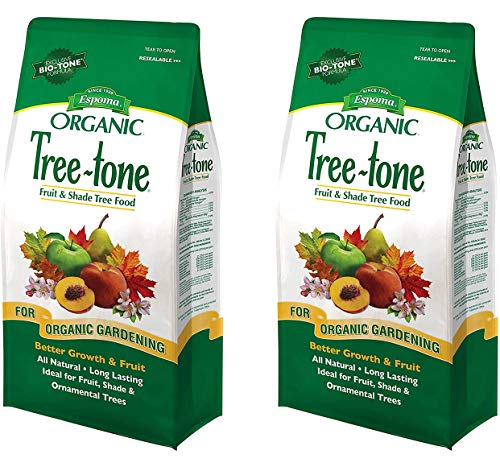
Two bags mean you can feed in spring and fall without reordering — buyers call it the best thing for fruit trees.
This is the set that buyers keep coming back to. One reviewer simply called it the “Best thing for fruit trees,” noting how easy it is to apply, the lack of chemical smell, and the visible difference it makes. The 6-3-2 analysis includes 5% calcium, and the exclusive Bio-tone formula (a proprietary blend of beneficial microbes that helps roots access nutrients more efficiently) speeds up the feeding process. You get two 4-pound bags (128 ounces total), so you can feed in spring and fall without reordering.
Unlike the Down To Earth option, the Tree-Tone mix is marketed for all shade, fruit, and ornamental trees — including apple and peach. Another reviewer mentioned their tree was slow to leaf out, but “1 week after using product entire tree leafed out and looks good.” The powder is ready to use and requires no mixing. Just apply around the drip line and water thoroughly. It is also approved for organic gardening and made in the USA by Espoma, a company that has been in the natural organics business since 1929.
One real-world note from a buyer: dogs are attracted to the organic smell and may eat it, so you might want to bury it slightly to prevent access.
Two-bag value: This 2-pack gives you more coverage than a single bag at a comparable price, and the rave reviews confirm it works across apples, pluots, and ornamentals.
Reach for this if: You want a proven, versatile organic powder for both fruit and shade trees, and the extra bag means you are set for two full feedings. Look elsewhere if: You need a high-nitrogen formula for leafy growth (16-4-4) or a liquid for fast absorption.
3. Espoma Organic Citrus-Tone 5-2-6

Higher potassium (the last number) is the key — it prevents blossom-end rot and improves fruit quality in citrus.
If you are growing lemons, limes, oranges, Meyer lemons, or avocados, a general all-purpose tree food may not give you the best results. This Citrus-Tone formula from Espoma is built specifically for those trees, with a 5-2-6 analysis and 5% calcium to support fruit development and prevent blossom-end rot (a soft, dark spot on the bottom of the fruit caused by calcium deficiency). The higher potassium is key for citrus — it helps with fruit quality and overall tree hardiness during cold snaps or heat waves.
The powder is enhanced with the same exclusive Bio-tone formula found in Tree-Tone, so you get those beneficial microbes working in the root zone. It is approved for organic gardening, contains no sludges or toxic ingredients, and requires no mixing. The manufacturer recommends applying it late winter pre-bloom, then again in spring post-bloom, and in the fall. That three-feed cadence is a little more involved than the spring-and-fall schedule for Tree-Tone, but it matches the active growing and fruiting cycle of citrus.
Unlike the Tree-Tone and Down To Earth blends, this one targets a narrower range of species: citrus, fruit, nut, and avocado trees only. It is not meant for shade trees or ornamentals.
Spot-on for citrus: The 5-2-6 ratio with added calcium is precisely what citrus and avocado trees need to avoid nutrient deficiencies during fruiting.
Best for: Anyone with lemon, lime, orange, or avocado trees who wants an organic, easy-to-apply powder tailored to those specific plants. Not for: General use on shade trees, evergreens, or non-citrus fruit trees like apples and pears — stick with Tree-Tone or Down To Earth for those.
4. FoxFarm Happy Frog Japanese Maple Fertilizer 4-3-4

Standard tree foods can actually harm Japanese maples — this 4-3-4 low-pH blend prevents nutrient lockout.
Standard tree foods can lock out essential nutrients in higher-pH soil for acid-loving plants. This FoxFarm blend solves that with a 4-3-4 ratio designed specifically for low-pH feeders. It goes a step further than most powders by including beneficial microorganisms and mycorrhizal fungi (a type of fungus that attaches to roots and increases water and nutrient uptake). One reviewer wrote that it “brought one plant back to life and I even use these on my smaller plants.” Another said their maple was “almost unrecognizable” after using it for a season — meaning fuller leaves and brighter color.
The application is straightforward: mix 2 tablespoons per 1 gallon of water for container plants or top-dress around in-ground trees. FoxFarm recommends monthly feeding throughout the growing period. The 4-pound bag is the same weight as the Espoma Tree-Tone bag but a full pound lighter than the Down To Earth 5-pound option, which makes sense since this product serves a narrower purpose — you probably do not need as much for a single maple or a few hydrangeas.
Note that this fertilizer is not just for Japanese maples — the manufacturer lists it for evergreens, hydrangeas, junipers, dogwoods, and flowering ornamentals that prefer acidic conditions.
Key strengths
- Specifically formulated for low-pH feeders like maples and hydrangeas
- Contains mycorrhizal fungi to boost root efficiency
- Reviewers report dramatic visual improvements
Limitations
- Not for general fruit or shade trees in neutral soil
- Requires monthly feeding during growing season
Perfect for: Japanese maple owners, hydrangea lovers, and anyone growing acid-loving ornamentals who wants a proven organic formula with microbial support. Skip if: Your trees are standard fruit or shade species in neutral soil — you will get better value from a general-purpose or fruit-specific blend.
5. TPS Nutrients Tree Fertilizer – Liquid Plant Food for Stronger Roots, 32oz
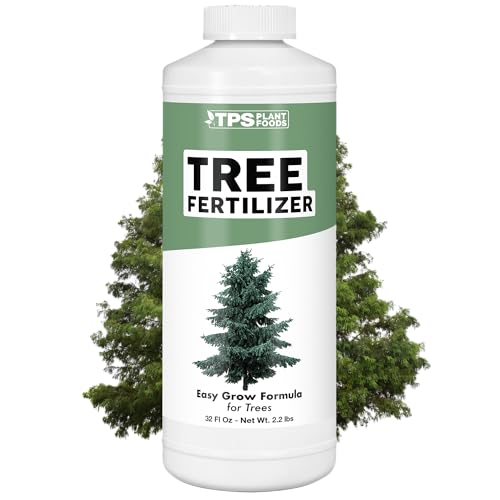
A 1:64 mix ratio with water — one reviewer noted their “almost dead” pine tree came back to life after a full year of feeding.
This 32-ounce liquid concentrate from TPS Nutrients is mixed at a 1:64 ratio with water (about 2 tablespoons per gallon) and poured onto the soil for quick absorption. One buyer shared a compelling story: “My pine tree was almost dead, brown all around bought this product and waited this season it came back stronger and greener.” They emphasized that it “takes time, a whole year,” but the results were clear after consistent every-other-week feeding.
Unlike the granular powders above, liquid fertilizers act faster because the nutrients are already dissolved and ready for roots. This makes the TPS formula ideal for stressed trees, shallow-rooted ornamentals, or any situation where you want a visible response within a few weeks rather than a season. It is made in the USA and designed for shade trees, ornamental trees, and general yard plantings. Another reviewer noted it worked great on emerald junipers, with a “nice healthy deep dark green” visible just three days after fertilizing.
The main trade-off is frequency: you will need to mix and apply this every two weeks during the growing season, unlike a granular or spike that lasts for months.
Quick rescue feed: This liquid is the closest thing to an IV for a struggling tree, with reviews confirming recovery in stressed pines, junipers, and blueberry bushes.
Ideal for: Reviving sick or stressed trees, feeding trees in sandy soil, or anyone who prefers a liquid routine and can commit to biweekly applications. Not for: The “low-maintenance” gardener — you have to mix and water regularly.
6. TPS Nutrients Fruit Tree Fertilizer – Liquid Plant Food for All Fruit Trees, 32 oz
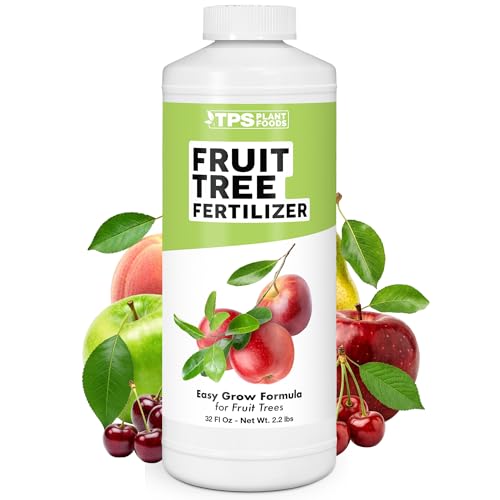
A 32-ounce bottle that one buyer mentioned “lasts spring/summer, good value,” and works as both a soil drench and a leaf spray.
This is the fruit-specific sibling to the TPS liquid above, formulated specifically to encourage consistent fruiting and strong root development in fruit-bearing trees. The mixing ratio is 2 tablespoons per gallon of water, and one owner reported that the large 32-ounce bottle “lasts spring/summer, good value” and was “effective for apple and plum trees needing heavy feeding.” An added versatility: you can apply it as a soil drench or as a foliar spray — spraying it directly on the leaves — for even faster nutrient uptake.
Compared to granular fruit-tree foods like the Down To Earth or Espoma Citrus-Tone, this liquid gives you faster results and the ability to correct nutrient deficiencies mid-season. It is made in the USA and suitable for backyard fruit trees, containers, and small orchards. Reviewer testimonials mention positive results on peach, apple, pecan, and pear trees. One customer observed the leaves and flowers turned “nice and green” soon after the first application.
The main consideration is the same as with the general TPS liquid: it requires more frequent mixing and watering than a seasonal spike or a once-a-season granular spread. But for fruit trees that need steady nutrition through the blooming and fruiting cycle, the extra effort can pay off in heavier yields.
Fruiting frequency: This liquid gives you fine control over feeding during the critical bloom and fruit-set stages, something a one-time granular application cannot match.
Top choice for: Dedicated fruit growers who want to actively manage nutrition through the season and see quick results from foliar or soil feeding. Less ideal for: Low-maintenance yards where you just want to feed once and forget it.
7. Jobe’s Tree Fertilizer Spikes 16-4-4, 30 Count

The 16-4-4 ratio is heavy on nitrogen for lush leafy growth — one user highlighted spikes were effective for drought-stressed trees.
If you dislike dealing with powders, scoops, and liquid jugs, this is your solution. Jobe’s spikes are pre-measured sticks with a 16-4-4 ratio — heavy on nitrogen for lush leafy growth — that you pound into the soil around your tree. The nutrients release slowly below the surface, right where the active roots are, and the manufacturer says they will not burn the tree even in dry conditions. One shopper added they were “effective for drought-stressed trees” and that the tree recovered well after the first year.
The 30-count package covers multiple trees and shrubs, and reviewers confirm they work on hydrangea, lilac, honey buckle, rose of Sharon, and peonies as well. Application is simple: drive the spike into damp soil or pre-drill a hole if the ground is rocky. Once it is in, you are done for the whole season — no reapplication needed. Jobe’s claims the spikes will not burn trees and feed all season long. One reviewer noted that the spikes are “best placed in damp soil or pre-drilled holes to avoid rocks.”
The big difference from the organic powders is the synthetic 16-4-4 formula. That high nitrogen is great for pushing green growth on established trees but is not intended for organic gardening. It also lacks the calcium and microbial additives of the Espoma or FoxFarm blends.
Why it works
- No mixing, no measuring, no watering in
- Feeds for an entire season with one application
- Won’t burn roots; safe for drought-stressed trees according to the manufacturer
Keep in mind
- Not organic; synthetic 16-4-4 formula
- High nitrogen pushes foliage, not necessarily fruit
- Requires pounding into ground — rocky soil needs pre-drilling
Grab these for: The ultimate convenience — no mixing, no mess, one application per season, especially for leafy shade trees and shrubs. Pass if: You need an organic-certified product, or your priority is fruit production rather than foliage growth.
Understanding the Specs
N-P-K Ratio (Nitrogen-Phosphorus-Potassium)
This is the three-number code on every fertilizer bag. The first number is nitrogen, which drives leafy green growth and overall tree size. The second is phosphorus, which supports root development, flowers, and fruit. The third is potassium, which strengthens the tree’s immune system and helps it handle stress like drought or cold. A fruit-tree food like 6-2-4 has moderate nitrogen, lower phosphorus, and higher potassium for fruiting. A foliage-focused spike like 16-4-4 is heavy on nitrogen for trees that need a green-up boost.
Organic vs Synthetic Formulations
Organic tree foods (like Espoma, Down To Earth, and FoxFarm) use natural ingredients such as feather meal, bone meal, kelp, and beneficial microbes. They release nutrients slowly as soil microbes break them down, which builds soil health over time but takes longer to show results. Synthetic formulas (like Jobe’s spikes) use manufactured mineral salts that are immediately available to roots. They work faster but do not improve soil biology. Organic products are OMRI-listed if they meet certified organic production standards.
FAQ
How often should I feed my trees with granular fertilizer?
Can I use the same fertilizer on my Japanese maple and my apple tree?
What does the 5% calcium in Espoma Tree-Tone and Citrus-Tone do?
How long does it take to see results after applying tree fertilizer?
Will tree fertilizer spikes burn my tree’s roots?
Can I use fruit tree fertilizer on my vegetable garden?
What is the difference between a 4-pound bag and a 5-pound bag of fertilizer?
Does tree fertilizer expire if I keep it in my garage?
Can I use liquid fertilizer as a foliar spray on leaves?
What is Bio-tone and why does Espoma use it?
Final Thoughts: The Verdict
For the majority of shoppers, the best food for trees is the Down To Earth Organic Fruit Tree 6-2-4 because it combines a proven organic formula, a 5-pound bag that outperforms 4-pound competitors, and OMRI-listed certification for low-maintenance use on everything from apples to tropical fruit. If you need a specialized blend for acid-loving Japanese maples, grab the FoxFarm Happy Frog 4-3-4. And for the ultimate no-mess convenience with year-long feeding, the Jobe’s 16-4-4 Spikes are your set-and-forget solution.
How We Picked
We do not accept paid placement. Every pick is matched to a real buyer and a real use-case; we do not hands-on test units.
Sources & Methodology
Specifications: manufacturer listings and product documentation. Review insights: verified customer reviews, as of July 2026. Pricing: not shown on this page (it changes often); check the current price via the retailer link.
As an Amazon Associate, Lawn Gear Lab earns from qualifying purchases. This does not affect which products we feature.