
Specs are compiled from manufacturer listings and verified buyer reviews and can change over time — please confirm the key details on the product page before buying.
The problem with most weed killers is that they do not discriminate — they burn everything, including your flowers. A selective flower bed weed killer solves this by targeting only the grassy invaders while leaving your perennials, shrubs, and ornamentals untouched. This guide cuts through the marketing to give you four proven options that actually work, ranked by real-world performance and value.
I’m Rikta — the founder and writer behind Lawn Gear Lab. This guide is built by comparing the manufacturers’ published specifications and the patterns across verified customer reviews, so you get each pick’s real strengths and trade-offs instead of marketing spin.
Whether you are fighting Bermuda grass in your daylilies or crabgrass creeping into your boxwoods, the right formula makes all the difference. This guide highlights the top flower bed weed killer options that kill the weeds without killing your plants.
Quick Picks
- Ortho Grass B Gon Garden Grass Killer, 24-Ounce (3 Pack) — Best Overall
- Syngenta Fusilade II Herbicide — Premium Pick
- Agrisel GrassOut Max Weed Killer — Large Area Champion
- Ortho Grass B Gon Garden Grass Killer, 24-Ounce (2 Pack) — Budget Entry
How To Choose The Best Flower Bed Weed Killer
Picking the wrong weed killer is a costly mistake. A non-selective formula like glyphosate will kill everything it touches, while a selective grass killer targets only the grassy weeds and leaves your flowers alone. Here is what you need to know before buying.
Selective vs Non-Selective
This is the single most important distinction. A selective herbicide kills only specific types of plants — in this case, grassy weeds like crabgrass, Bermuda grass, and quack grass. Non-selective killers wipe out everything, so you would have to spray each weed individually without touching a single petal. Every product in this list is a selective grass killer designed for use around flowers.
Ready-to-Use vs Concentrate
Ready-to-use bottles (RTU) come pre-mixed in a spray bottle and are perfect for small flower beds. Concentrates need to be mixed with water and a non-ionic surfactant (NIS) in a separate sprayer. Concentrates go further per dollar and give you more control over the application rate, but they require more effort to set up.
Rain-Fast Time
Rain-fast time tells you how soon a treatment can handle rain without washing off. A one-hour rain-fast window, which several of these products offer, gives you flexibility — you can spray in the morning and not worry about an afternoon shower ruining the application.
Quick Comparison
| Model | Best For | Form | Liquid Volume | Coverage | Amazon |
|---|---|---|---|---|---|
| Ortho Grass B Gon (3 Pack) | Best Overall Value | RTU Spray | 24 oz per bottle | Grassy weeds | Amazon |
| Syngenta Fusilade II | Premium Power | Liquid Concentrate | 4 fl oz | Perennial & annual grasses | Amazon |
| Agrisel GrassOut Max | Large Area Treatment | Liquid Concentrate | 16 fl oz | 7,272 to 15,294 sq ft | Amazon |
| Ortho Grass B Gon (2 Pack) | Budget Entry | RTU Spray | 24 oz per bottle | Grassy weeds | Amazon |
In‑Depth Reviews
1. Ortho Grass B Gon Garden Grass Killer, 24-Ounce (3 Pack)
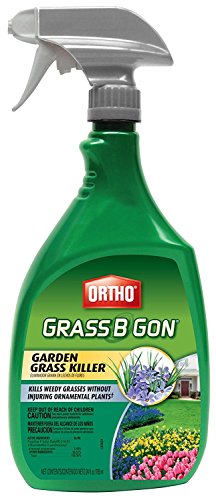
The three-pack that gives you enough coverage to tackle an entire season of grassy weed invasions.
You get three 24-ounce ready-to-use bottles in this pack, which works out to 72 ounces of total liquid — enough to spot-treat a large flower bed repeatedly without running out mid-season. This is a selective spray, meaning you can mist it directly over your daylilies, irises, and shrubs without harming the desirable plants, as long as you follow the label instructions. Reviewers report that Bermuda grass started dying in as little as 3 days, with the flowers unaffected, which is exactly the outcome you want from a flower bed weed killer.
The catch is that this formula only targets grassy weeds — it will not touch broadleaf weeds like dandelions or clover. Some buyers mention that it takes days or even weeks for the grass to fully die, so patience is required. Compared to the 2-pack with two 24-ounce bottles, this 3-pack gives you 72 ounces total versus 48 ounces total. One reviewer noted that after applying it twice, the Bermuda grass in their iris bed was gone without a single iris being harmed.
Volume Champion: Three 24-ounce ready-to-use bottles give you 72 ounces of selective grass killer — enough for persistent weed pressure across a medium-to-large flower bed.
Patience Required: Some users report a slower kill, taking up to a couple of weeks, so do not expect overnight results.
Reach for this if you want the best balance of price, volume, and proven selective action against Bermuda and crabgrass.
Look elsewhere if you need a product that also kills broadleaf weeds or if you prefer a concentrated formula for a larger property.
2. Syngenta Fusilade II Herbicide
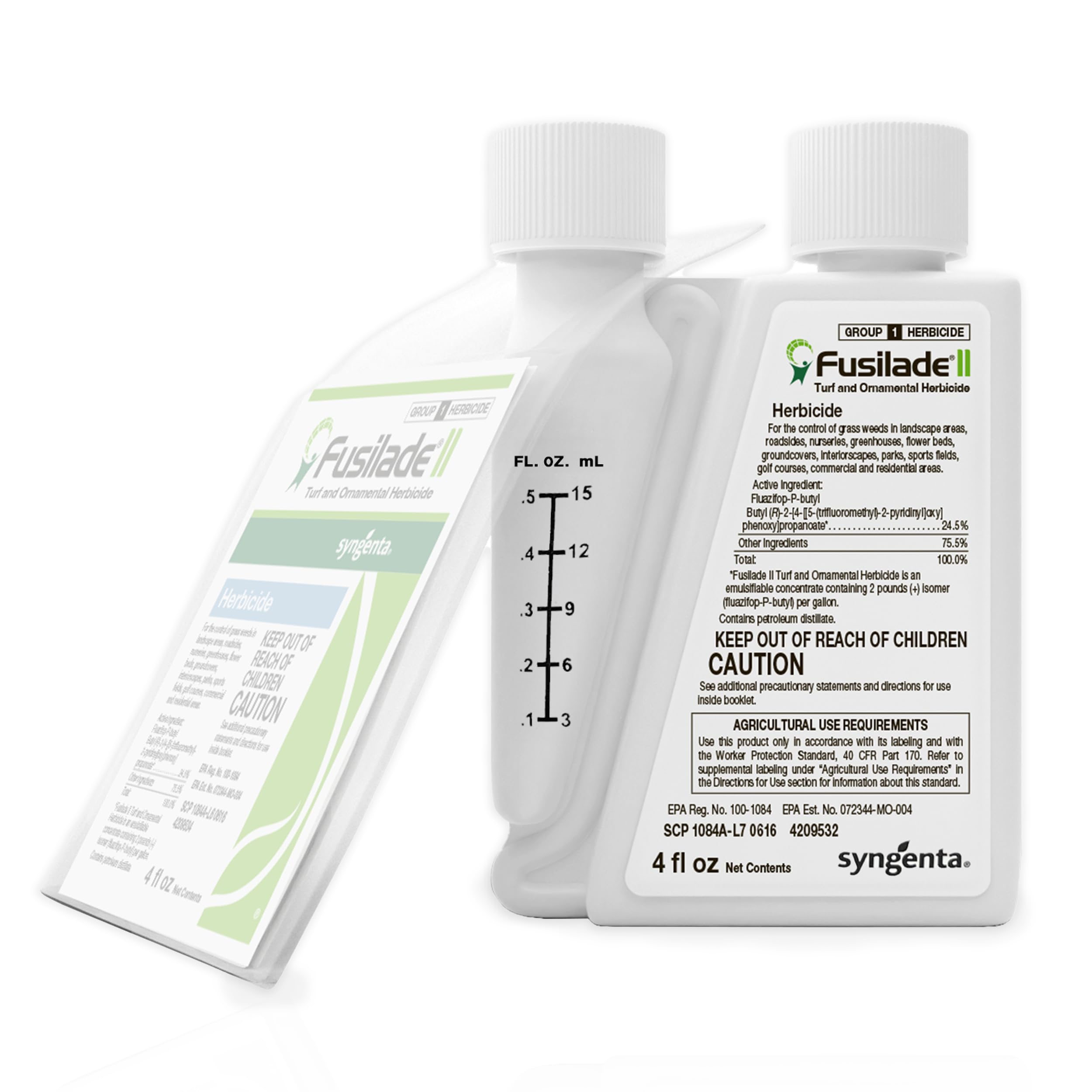
The professional-grade concentrate that tackles tough perennial weeds without touching your ornamentals.
This is not a grab-and-go spray — it is a 4-ounce bottle of concentrated liquid containing 24.5% Fluazifop-P-butyl (the active ingredient) that you mix at a rate of 0.75 ounces per gallon of water, plus 0.5 ounces of non-ionic surfactant. The small bottle looks unassuming, but it is powerful: one reviewer called it “the only stuff that actually killed our tough crabgrass” after three other products failed. Buyers confirm it killed Bermuda grass with overground roots without harming Marathon II fescue, and another user reported it eliminated invasive quack grass that hand-pulling could not stop.
The rain-fast window is just one hour, meaning you can spray and not worry if rain is forecast. The trade-off is worth noting: some users warn that a CA permit is required to purchase, and the label carries a possible carcinogen warning, so full protective gear (long sleeves, pants, gloves) is essential. This bottle contains 4 ounces of concentrate, while the Ortho RTU bottles contain 24 ounces of ready-to-use liquid each — the Syngenta makes less packaged liquid but goes further due to dilution. One reviewer summed it up: “Very powerful stuff, does exactly what I wanted.”
Strengths
- Effective on tough perennial grasses like Bermuda and quack grass
- One-hour rain-fast window for flexible scheduling
- Does not harm flowers, perennials, or shrubs when used correctly
Drawbacks
- Requires mixing with NIS and a separate sprayer
- Safety warnings require full protective gear during application
- Small 4-ounce bottle may seem expensive for the volume
Power user pick — grab this if you have stubborn perennial grasses that cheaper products cannot touch and you are comfortable with mixing and safety precautions.
Pass on it if you want a simple, ready-to-use spray for quick spot treatments without gear or mixing.
3. Agrisel GrassOut Max Weed Killer
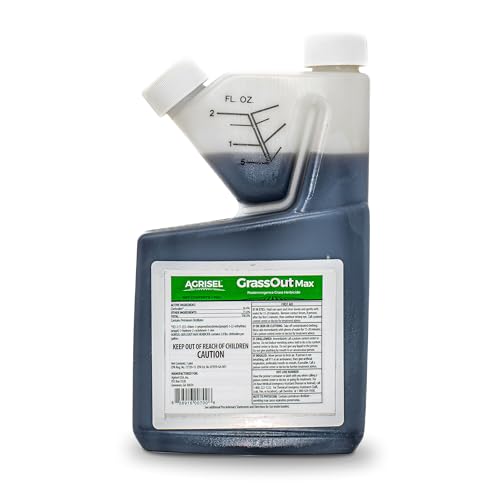
The 16-ounce concentrate that covers up to 15,294 square feet — ideal for sprawling flower beds and shrub lines.
This is the volume-to-coverage king of the list. The 16 ounce bottle treats between 7,272 and 15,294 square feet depending on the application rate (1.1 to 2.3 ounces per 1,000 square feet). That is enough to handle a large property with extensive ornamental beds. The formula targets over 50 types of grassy weeds while leaving your broadleaf plants untouched, and the manufacturer notes it is also effective on more than 40 types of broadleaf weeds — though the primary use case remains grass control.
One important caveat: the label explicitly states “This product kills grass,” so be very careful near your lawn. The “Tip and Pour” bottle design makes it easy to mix without measuring cups, but you will need a separate sprayer since the weed sprayer is sold separately. Buyer reviews on this specific product were limited in the data, so we rely on the specs and manufacturer claims — the EPA-approved status and the precision application rate give it strong credibility for large-scale use.
Coverage king: 16 ounces of concentrate treats up to 15,294 square feet — roughly the size of four basketball courts — making it the best option for large flower beds and commercial-looking landscapes.
Buyer caution: Customer reviews were light at the time of data collection, so rely on the EPA registration and the clear label claims for confidence.
Best for property owners with large flower beds, shrub lines, or ornamental landscaping who want a concentrated formula that goes far while staying affordable per treatment.
Avoid if you have a small bed and do not want the extra step of mixing and using a separate sprayer.
4. Ortho Grass B Gon Garden Grass Killer, 24-Ounce (2 Pack)
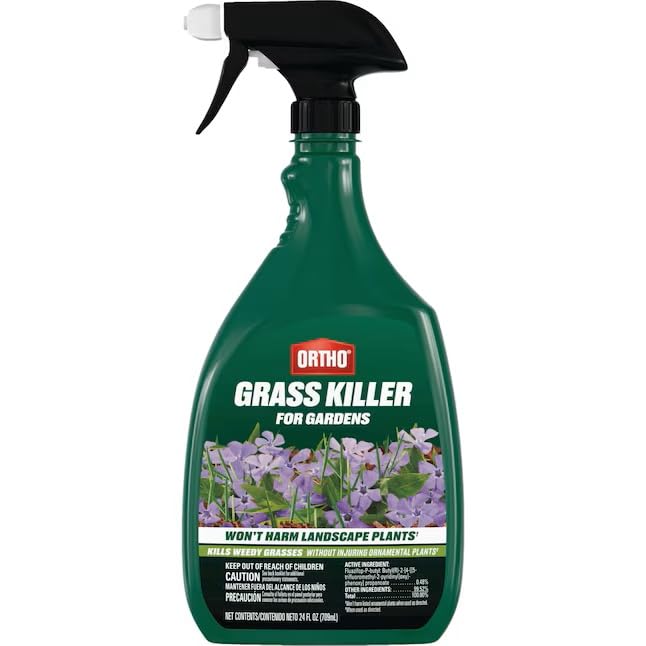
The simplest entry point — two ready-to-use bottles for spot-treating grassy weeds without any mixing.
This twin-pack gives you two 24-ounce bottles of Ortho’s selective grass killer. It is the same formula as the three-pack above, just a smaller bundle. The selling point is simplicity: no measuring, no mixing, no extra sprayer. Just point and spray directly on the grassy weeds in your flower beds. The label promises it will not harm landscape plants, shrubs, or trees, and the treatment becomes rain-fast in just 1 hour. A reviewer noted it “killed the grass in my zero scaped area and did not hurt my flowering shrubs.”
The honest catch: results are inconsistent. One buyer mentioned, “Sprayed this product on the grass I wanted killed and it didn’t kill any of it.” Others say it takes time and may need re-spraying. The strong odor was also mentioned as a downside. For the price, this is the most affordable way to test if a selective grass killer works for your specific weed pressure before committing to a larger bottle or a concentrate. Compared to the three-pack, you get 48 ounces total instead of 72 ounces total.
Pros
- Ready-to-use — no mixing, no measuring, no extra sprayer needed
- Selective formula targets grassy weeds without harming flowers
- Rain-fast in 1 hour for flexible application timing
Cons
- Mixed buyer reviews — some report zero results on certain grass types
- May require multiple applications for tough perennial grasses
- Strong odor noted by several reviewers
Good starting point if you have a small flower bed with light grass pressure and want the easiest possible application — no mixing, just spray.
Skip it if you have tough Bermuda or quack grass that has resisted other treatments, or if you want a single application to solve the problem.
Understanding the Specs
Selective vs Non-Selective
Selective herbicides contain active ingredients (like Fluazifop-P-butyl in Syngenta Fusilade II) that only affect the biological pathways in grasses (monocots) without harming broadleaf plants (dicots) like flowers, shrubs, and trees. Non-selective herbicides like glyphosate kill everything they touch. Always check the label for “selective” or “safe for ornamentals” before spraying near your flower bed.
Rain-Fast Time
This is the window between application and when the formula is dry enough to resist being washed off by rain or sprinklers. The Ortho products and Syngenta Fusilade II both offer a 1-hour rain-fast time, meaning you can spray and feel confident that a passing shower will not undo your work. Longer rain-fast times (like 6-24 hours) reduce your scheduling flexibility.
FAQ
Will this kill my flowers if I accidentally spray them?
How long does it take for a selective weed killer to work?
Can I use a selective grass killer on my lawn to kill crabgrass?
How much do I need for a large flower bed?
Do I need a special permit to buy Syngenta Fusilade II?
What is the difference between a concentrate and a ready-to-use sprayer?
Does rain affect the effectiveness after I spray?
Should I use a surfactant with a selective herbicide?
Can selective weed killers harm my pets?
Will these products kill broadleaf weeds like dandelions?
Final Thoughts: The Verdict
For the majority of shoppers, the flower bed weed killer winner is the Ortho Grass B Gon (3 Pack) because it delivers proven selective action against Bermuda and crabgrass in a simple ready-to-use format, backed by overwhelmingly positive buyer reviews. If you need professional-grade power for tough perennial grasses, grab the Syngenta Fusilade II. And for large properties with extensive flower beds and shrub lines, the standout is the coverage of the Agrisel GrassOut Max.
How We Picked
We do not accept paid placement. Every pick is matched to a real buyer and a real use-case; we do not hands-on test units.
Sources & Methodology
Specifications: manufacturer listings and product documentation. Review insights: verified customer reviews, as of July 2026. Pricing: not shown on this page (it changes often); check the current price via the retailer link.
As an Amazon Associate, Lawn Gear Lab earns from qualifying purchases. This does not affect which products we feature.