
Specs are compiled from manufacturer listings and verified buyer reviews and can change over time — please confirm the key details on the product page before buying.
Choosing the right mulch for your flower beds means the difference between a garden that thrives with minimal work and a weedy, dry mess you’re constantly fighting. The wrong mulch can wash away in the first storm, carry weed seeds into your beds, or break down so fast you are out replacing it every few weeks.
I’m Rikta — the founder and writer behind Lawn Gear Lab. This guide is built by comparing the manufacturers’ published specifications and the patterns across verified customer reviews, so you get each pick’s real strengths and trade-offs instead of marketing spin.
To find the best mulch for your specific garden, you need to weigh water retention against longevity, weed suppression against cost, and organic breakdown against permanent coverage. This breakdown of the best flower bed mulch options walks you through the top contenders in each category so you can match the right material to your soil and your schedule.
Quick Picks
- Plantonix Coco Chips (10lbs) — Best Overall
- Halatool 10LBS Coco Husk Chips — Best Value
- GROW!T JSCC2 Organic Coco Coir Planting Chips — Mold Resistant
- Rubberific Rubber Mulch Bagged Brown — Permanent Coverage
- HealthiStraw GardenStraw (3 cu ft) — Compost Friendly
- Longleaf Pine Straw Roll (Non-Colored) — Natural Elegance
How To Choose The Best Flower Bed Mulch
The right mulch does more than just make your flower beds look tidy. A good layer controls soil temperature, slows evaporation so you water less often, keeps weed seeds from germinating, and slowly feeds the soil as it breaks down. The wrong choice can lock out water, invite pests, or blow away in a stiff breeze.
Water Retention vs. Drainage
Your soil type determines which mulch will help. If you have sandy soil that drains fast, you need a moisture-holding mulch like coconut husk chips that can absorb water and release it slowly. If you garden in heavy clay that stays wet, a more open mulch like pine straw lets air reach the roots and prevents rot.
Longevity and Decomposition
Organic mulches eventually break down and enrich your soil, but they need to be topped off every season or two. Rubber mulch never rots, so it keeps its color and coverage for years — but it does not feed the soil. Straw mulches break down fastest, adding organic matter to your beds within a single growing season.
Weed Suppression and Cleanliness
A thick enough layer — about 2 to 3 inches — blocks sunlight from reaching weed seeds. But the mulch itself must be free of its own seeds. Cheap straw bales often carry grass or wheat seeds that sprout in your beds. Clean, processed options like the ones in this list filter out most of those seeds before they reach your garden.
Quick Comparison
| Model | Best For | Expanded Volume | Dry Weight | Material Base | Amazon |
|---|---|---|---|---|---|
| Plantonix Coco Chips | Best Overall | 15 Gallons | 10 lbs | Coconut Husk | Amazon |
| Halatool Coco Husk | Best Value | 72 Quarts | 10 lbs | Coconut Husk | Amazon |
| GROW!T Coco Coir Chips | Resists Mold | 0.05 Cubic Meters | 5.2 lbs | Coconut Coir | Amazon |
| Rubberific Rubber Mulch | Permanent Coverage | — | — | Recycled Rubber | Amazon |
| HealthiStraw GardenStraw | Vegetable Beds | 3 cu ft | 20 lbs | Wheat Straw | Amazon |
| Longleaf Pine Straw | Natural Look | — | — | Pine Needles | Amazon |
In‑Depth Reviews
1. Plantonix Coco Chips (10lbs)

The 10‑pound brick that drinks up water and aerates your soil.
These compressed coconut chips from Plantonix hit the perfect middle ground for flower beds. The brick expands to 15 gallons once you add water, and each chip is designed to create air pockets in the soil that let oxygen reach the root zone. That aeration — combined with the fact that the chips absorb up to 10x their weight in water — means your flower beds stay evenly moist without getting waterlogged.
Unlike the GROW!T block below, which weighs just 5.2 pounds, this 10‑pound brick gives you nearly double the dry material for a similar footprint. Buyers report the chips maintain a neutral pH, which helps prevent nutrient lock-up, and the high cation exchange capacity (CEC for short — the soil’s ability to hold onto plant food) keeps fertilizer in the root zone instead of letting it wash away.
Why it stands out
- Absorbs up to 10x its weight in water so you water less often.
- Neutral pH prevents nutrient lock-up in the root zone
- Expands to 15 gallons from a single 10 lb brick
One real trade-off
- Compressed brick requires a large container and time to rehydrate completely
- No customer reviews in the data to verify long-term performance
Reach for this if: you want an organic, renewable mulch that improves both moisture retention and soil aeration in a single application.
Look elsewhere if: you need instant, pour-and-go coverage — the brick needs soaking and fluffing before use.
2. Halatool 10LBS Coco Husk Chips
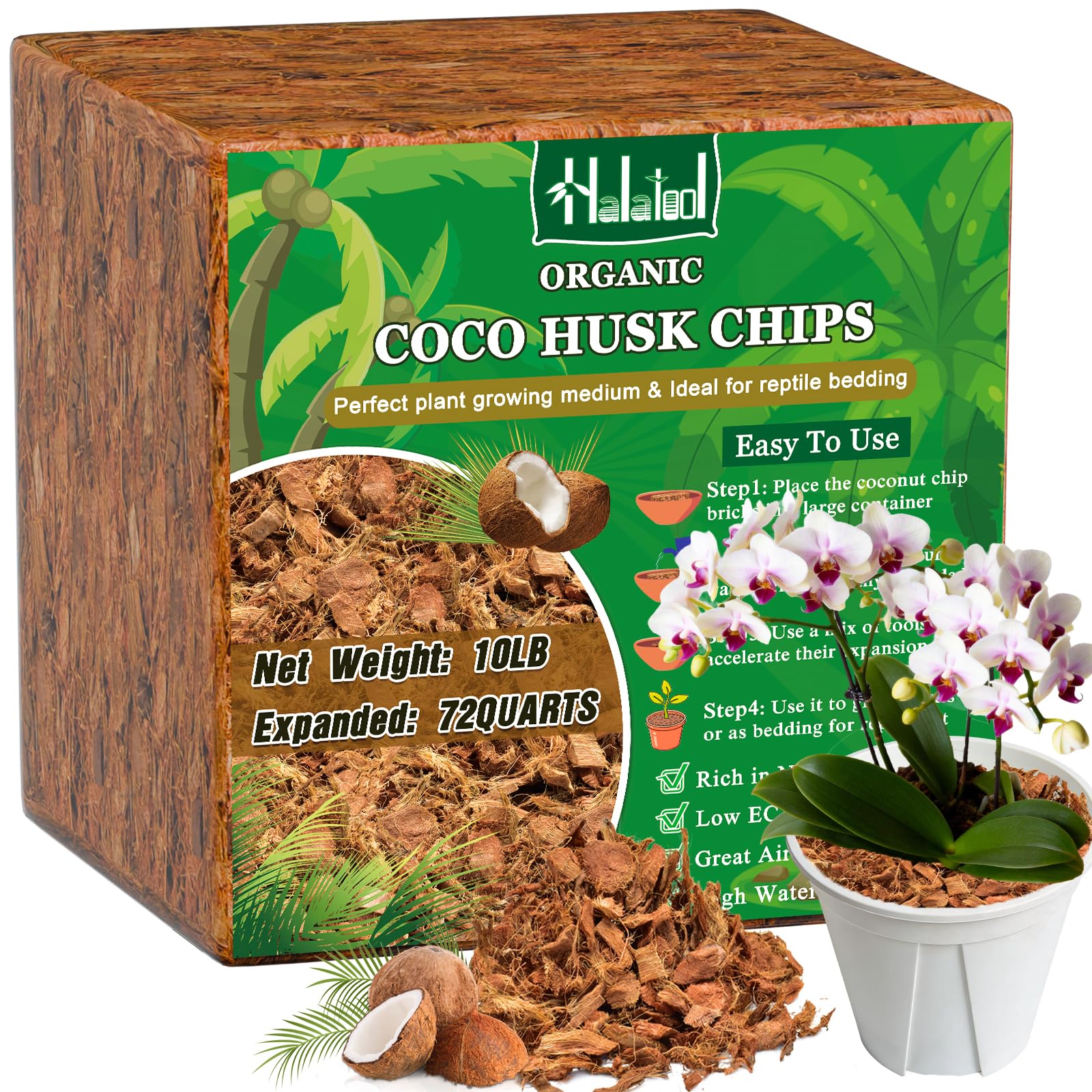
The same 10‑pound weight delivers a massive 72 quarts of fluffy mulch.
Halatool squeezes more volume out of its compressed block than any other coconut option here. The coco husk chips have low electrical conductivity (EC — a measure of salt content), so they won’t burn delicate flower roots the way some raw composts can.
Owners mention the chips stay in place even during high winds and heavy rain, which is a common complaint with lighter mulches. One reviewer noted that after adding water to a single package, they filled three 6-inch orchid pots with leftovers. The chips also carry a natural coconut scent and feel unpleasant to crawl on, so you may see fewer pests settling into your beds.
What works
- 72 quarts expanded volume covers large areas from a single brick
- Low EC prevents salt damage to sensitive flower roots
- Stays in place in wind and rain, according to verified buyers
What to note
- Compressed brick takes time to fully rehydrate before use
- Best used as a top layer, not as a complete soil replacement
Your move: grab this if you are covering a large bed and want the most expanded volume per dollar from a single brick.
Pass if: you prefer a smaller, more manageable block that expands less — this one swells big.
3. GROW!T JSCC2 Organic Coco Coir Planting Chips

The lighter block that swells significantly and resists mold and fungus.
Weighing just 5.2 pounds dry, this GROW!T block is almost half the dry weight of the Plantonix or Halatool bricks (10 lbs each), yet customers note the 5.2-pound compressed block swells significantly after soaking. It holds 0.05 cubic meters of expanded volume — enough for potting tropicals, topping flower beds, or using as a hydroponic medium. The chips are OMRI Listed (the Organic Materials Review Institute — a third-party certification that the product is allowed in organic production), so you can use them with confidence in organic garden beds.
Unlike some coconut products that arrive smelling musty, reviewers point out this block has zero dust, few plastic fragments, and — critically — no mold odor. One reviewer who had received moldy coir from other brands said this one arrived clean. The thick, consistent fibers also resist mold and fungus better than shredded wood mulches, making this a strong pick for flower beds in humid climates.
What buyers like
- OMRI Listed for certified organic gardening
- Zero mold smell on arrival — common issue with other brands
- Thick fibers resist compaction better than other coir products
Watch for
- At 5.2 lbs, the dry block is much lighter than the 10 lb alternatives
- Some buyers found the chips too chunky for mixing into garden soil — better as a top mulch
Best suited for: organic gardeners in humid regions who need a clean, mold-resistant mulch that arrives ready to expand.
Not ideal if: you want the most mulch per pound — the Halatool and Plantonix bricks give you more dry material for the same footprint.
4. Rubberific Rubber Mulch Bagged Brown

The mulch that stays put for years and still looks freshly laid.
Rubberific is not organic — it is made from recycled rubber — but that is the whole point. This mulch never decomposes, never needs topping up, and keeps its brown color season after season. One buyer left a 5-star review saying they replaced the stone in their front garden with this rubber mulch two years ago, and it still looks like fresh mulch was just put down. Another reviewer noted that after a bad storm, not a single shred of mulch was lost.
The trade-off is that rubber mulch does not enrich your soil the way organic mulches do. It sits on top of the bed as a permanent barrier, blocking weeds and holding moisture, but it will not add organic matter or feed the microbes in your soil. It is also more expensive upfront — though multiple shoppers say that the longevity makes the cost worthwhile compared to buying fresh organic mulch every year.
The long view
- Color stays rich for years — one buyer mentioned two years of fresh look
- Stays put in storms — buyers report it does not wash or blow away
- Never needs replacing; no decomposition means no annual top-ups
The honest limit
- Does not feed the soil or add organic matter
- Some buyers found more affordable prices at local hardware stores
Go for this if: you want a low-maintenance mulch that still looks great years later and stays in place through heavy weather.
Skip if: you are building soil health and want your mulch to break down into compost — rubber does not decompose.
5. HealthiStraw GardenStraw (3 cu ft)
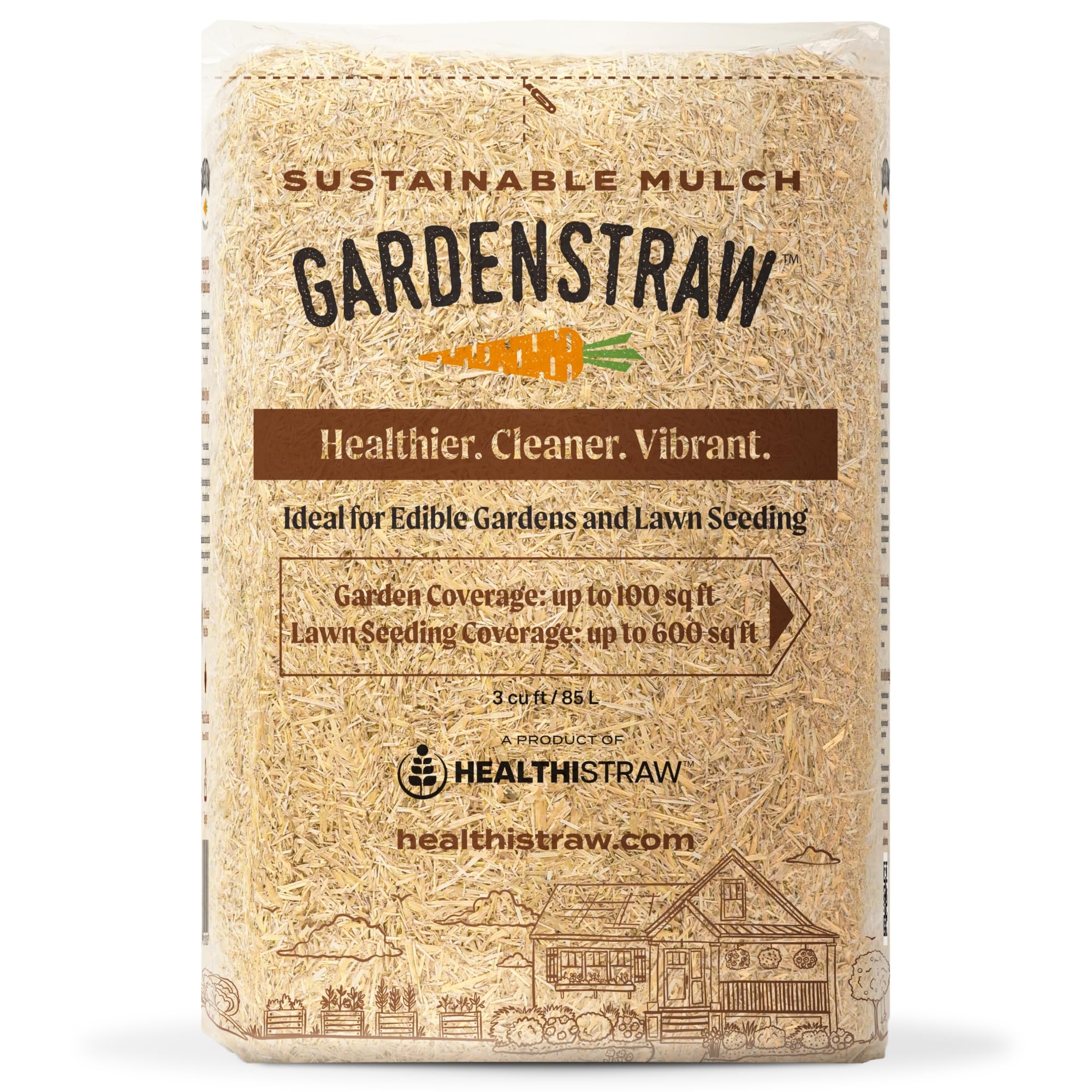
Cleaned wheat straw that cuts watering needs while feeding your soil.
HealthiStraw is not your average bale of hay. This is 100% non-GMO wheat straw that has been naturally filtered to remove dust, dirt, and as many weed seeds as possible — the number one complaint gardeners have about raw straw bales. The 3 cu ft compressed bale covers up to 100 square feet at a 2 to 3-inch layer, and the straw fibers interlock when you water them, creating a mat that stays in place without chemical binders.
The big selling point here is water conservation. HealthiStraw claims it reduces watering needs by up to 50% by retaining soil moisture and limiting evaporation. Buyers confirm the straw holds moisture well and keeps the soil cool. One owner reported it is “a bit costly compared to a bale of straw” but said avoiding the hassle of running a wood chipper makes it worth it. As the straw breaks down, it adds carbon to your compost and naturally enriches the soil for the next season.
The upside
- Naturally filtered to remove dust and most weed seeds
- Reduces watering needs by up to 50% by retaining soil moisture.
- Breaks down into compost that enriches soil for next season
The downside
- More expensive than a standard straw bale from a farm supply
- One buyer still found some grass seeds mixed in
Perfect for: vegetable and flower gardeners who want a clean, compost-friendly mulch that also cuts back on watering.
Not for you if: you need a permanent or semi-permanent mulch — straw breaks down within a single growing season.
6. Longleaf Pine Straw Roll (Non-Colored)

Premium longleaf needles that interlock naturally to cover up to 125 square feet.
Longleaf pine straw is considered the premium natural ground cover in the Southeastern United States, and this roll delivers the real thing. The needles are approximately 14 inches long — significantly longer than slash or loblolly pine straw — which makes them interlock better when layered. This natural matting effect means the straw stays in place on slopes and in windy spots better than shredded bark or wood chips.
Unlike the rubber or straw options above, pine straw is lightweight to spread but heavy enough to suppress weeds when laid at the proper depth. It is fully organic and breaks down slowly over the season, adding organic matter to the soil without creating a dense, water-repelling mat. The roll covers up to 125 square feet, making it a good fit for medium to large flower beds, though the manufacturer notes it is intended for outdoor use in full sun conditions.
Why it works
- ~14-inch long needles interlock to resist wind and water erosion
- Lightweight and easy to spread across large beds
- Organic material that slowly enriches the soil as it breaks down
A few things to consider
- No customer reviews in the data to confirm real-world performance
- Best suited for full-sun beds in the Southeast — may not perform the same in all climates
Ideal for: homeowners in the Southeast who want a traditional, natural-looking mulch that stays put on slopes and feeds the soil slowly.
May not fit if: you garden outside the Southeast or need a mulch that packs a lot of volume for a low upfront cost.
Understanding the Specs
Expanded Volume
This is the amount of mulch you get after soaking a compressed block. It is usually given in quarts or gallons. A block that claims 15 gallons (like the Plantonix) is not the same as one claiming 72 quarts (the Halatool), because 72 quarts equals 18 gallons. Compare the same unit across products to know which delivers more coverage.
Water Retention
Some mulches, like coconut husk chips, can absorb many times their own weight in water. This reduces how often you need to water your flower beds. Rubber and straw also hold moisture at the surface, but they do not soak it up the way coir does. For sandy soil that dries out fast, a mulch with high water retention makes a bigger difference.
Cation Exchange Capacity (CEC)
This is a soil science term that measures how well the material can hold onto plant nutrients (like nitrogen, potassium, and magnesium) and release them over time. A high CEC means fertilizer stays in the root zone rather than washing away with rain. Coconut coir has a naturally high CEC, which is one reason it works well both as a mulch and as a soil amendment.
Compressed vs. Loose Mulch
Compressed bricks or bales (like most coconut blocks and straw bales) save on shipping and storage but require rehydration before you can spread them. Loose mulches (rubber chips, pine straw) come ready to apply. If you are laying mulch on a large area, the compressed option gives you more material per shipment, but you need a large container and some time to let it expand.
FAQ
How deep should I lay flower bed mulch?
Will coconut coir chips attract pests or fungus?
How long does organic flower bed mulch last before I need to replace it?
Can I use coconut coir mulch for vegetable gardens too?
Does rubber mulch get too hot for flower beds in summer?
How do I rehydrate a compressed coconut coir brick?
Will pine straw blow away in high winds?
What is the difference between coco coir chips and coco peat?
Is straw mulch safe for flower beds or does it carry weed seeds?
Can I mix coconut chips into my soil instead of using them as a top mulch?
Final Thoughts: The Verdict
For most people, the flower bed mulch winner is the Plantonix Coco Chips because it delivers the best balance of water retention, aeration, and organic soil enrichment from a single compressed brick. If you want the biggest expanded volume per brick to cover a large area, grab the Halatool Coco Husk Chips. And for a permanent solution that never needs replacing, the Rubberific Rubber Mulch keeps your beds looking fresh for years with zero maintenance.
How We Picked
We do not accept paid placement. Every pick is matched to a real buyer and a real use-case; we do not hands-on test units.
Sources & Methodology
Specifications: manufacturer listings and product documentation. Review insights: verified customer reviews, as of July 2026. Pricing: not shown on this page (it changes often); check the current price via the retailer link.
As an Amazon Associate, Lawn Gear Lab earns from qualifying purchases. This does not affect which products we feature.