
Specs are compiled from manufacturer listings and verified buyer reviews and can change over time — please confirm the key details on the product page before buying.
You spent the weekend planting, and the next morning a gust of wind has turned your frost cover into a tangle of useless fiberglass. That is the exact frustration floating row cover hoops are supposed to solve — keeping netting, shade cloth, or frost blankets suspended above your plants so nothing crushes them. The trick is picking a kit whose connectors actually hold, whose rod count matches your bed size, and whose material won’t snap mid-season.
I’m Rikta — the founder and writer behind Lawn Gear Lab. This guide is built by comparing the manufacturers’ published specifications and the patterns across verified customer reviews, so you get each pick’s real strengths and trade-offs instead of marketing spin.
Whether you are shielding seedlings from a late freeze or keeping deer off your tomatoes, the right best floating row cover hoops boil down to rod thickness, connector style, and the quantity you need to span your beds without sagging.
Our Picks at a Glance

How To Choose The Best Floating Row Cover Hoops
Every hoop kit does the same basic job — bend a rod over your plants and drape something over it. But the difference between a hoop that stays up and one that collapses in the first rain depends on a few specific choices.
Rod Material
Almost all the hoops here use fiberglass, and there is a good reason: fiberglass bends without taking a permanent set, it never rusts, and it is light enough to carry. Some kits add a plastic coating on the outside so the rod is smooth to the touch and won’t splinter your hands. Bare fiberglass can irritate skin during assembly, so a coated rod is worth looking for if you have sensitive hands.
Connector Fit
The rods themselves are rarely the problem. The weak link is almost always the connector — the small tube that joins two rod sections together. Loose connectors let rods slip apart, especially in high wind. Kits with aluminum connectors tend to hold tighter than plastic ones, though plastic connectors sometimes have a better grip surface. If the reviews mention connectors falling apart during assembly, that is a real red flag.
Rod Count and Length
One 8-foot rod does not make a tunnel. You need multiple rods joined together to create a hoop tall enough to clear your plants. A standard 4-foot-wide raised bed needs about 4 to 6 rods per hoop to get 2 to 3 feet of clearance. The more rods in the kit, the more hoops you can make or the longer your tunnel can be. The kits here range from 24 to 72 rods, so match the count to the size of your garden rather than buying the biggest bundle.
Clip Quality
Clips hold your cover material onto the hoop. Plastic clips can snap in the sun, metal clips can tear thin fabric. Some kits include only a handful of clips, forcing you to improvise with clothespins or binder clips. A good kit gives you at least one clip per hoop section, ideally two, so the cover stays taut on both sides.
Quick Comparison
| Model | Best For | Rod Count | Rod Length | Connector Material | Amazon |
|---|---|---|---|---|---|
| 8FT Garden Hoops Grow Tunnel Kit★ Best Overall | Best Overall | 36 | 8 ft | Metal tube | Amazon |
| RIFNY 24 PCS Garden HoopsCompact Pick | Small Raised Beds | 24 | 17 in | Aluminum | Amazon |
| FuBegi 36pcs Garden Hoops | High Wind Resistance | 36 | 17 in | Metal tube | Amazon |
In‑Depth Reviews
1. 8FT Garden Hoops Grow Tunnel Kit – OOTONAT
Our pick — over 4★ from 100+ verified ratings; the strongest balance of quality and price.
The kit that has already survived three seasons and still looks sturdy.
What makes this kit stand out is not the rod count alone — it is the fact that you get 36 fiberglass hoops plus 30 connectors, 24 garden clips, and 12 support bases all in one box. That is enough hardware to build six separate 8-foot tunnels or one long continuous row. The rods are 8 feet long, so a single rod spans a standard 3-foot bed easily when bent. The frame material is fiberglass, which means it bends without cracking and won’t rust even after a full season of rain.
The assembly is truly tool-free: push the support bases into the soil, slot the hoops into them, and connect the rods with the included metal tube connectors. Buyers report that the hoops held up through a full summer and fall, with the plastic clips remaining sturdy and the metal connections working well through seasonal take-downs. The crowd favorite — 4.3 stars across over 100 owners — confirms that this set does precisely what it promises.
The only consistent note of caution is that the connectors could fit a little tighter. A few owners recommend adding a dab of glue at each joint for extra security, especially if you live in an area with strong winds.
What Wins People Over
- Complete 36-piece kit with support bases for soil anchoring
- Rust-free fiberglass bends without permanent damage
- Metal tube connectors hold better in wind than many plastic alternatives
- Has proven durability through three reported seasons of use
The Honest Trade-Off
- Connectors can be slightly loose; some owners add glue for extra hold
- Cover material is not included — you need to supply your own netting or cloth
Reach For It If: You have multiple raised beds and want one complete kit that just works for years without rusting or snapping.
A Fair Caveat: If your soil is very loose or sandy, the support bases may need extra anchoring to keep the hoops upright in a heavy storm.
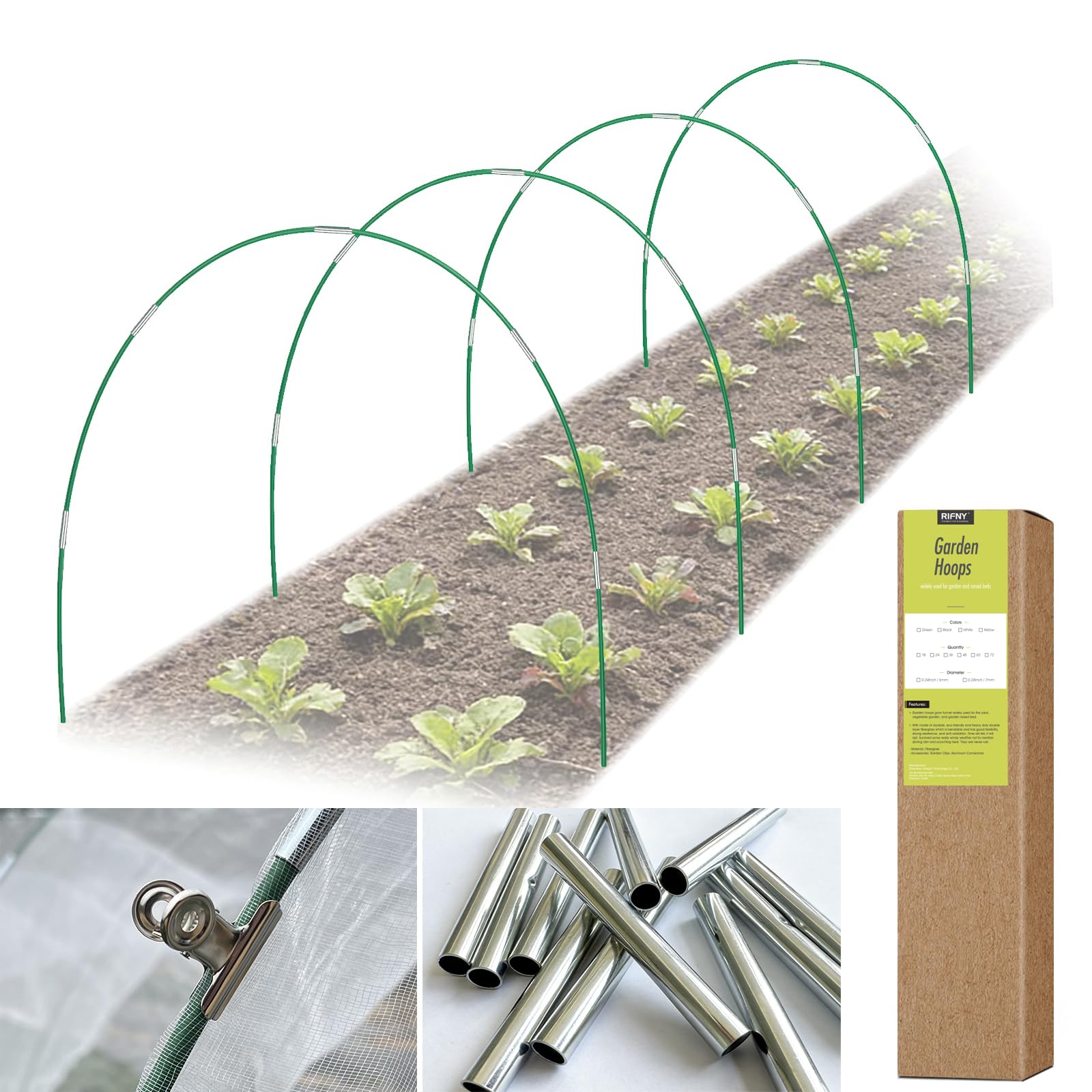
2. RIFNY 24 PCS Garden Hoops for Raised Beds
A 24-piece set that is exactly the right size for a single standard raised bed.
Where the RIFNY kit shines is precision. Each rod is 17 inches long and 0.28 inches in diameter, and by connecting 4 to 6 rods you can create a hoop that spans 2 to 4 feet wide and stands 1.9 to 3 feet tall. That makes this kit ideal if you have one or two raised beds and do not want a massive pile of leftover rods. The connectors are aluminum rather than plain metal, and the clips are stainless steel — both materials that will never rust or oxidize, even if left outside all winter.
Owners mention that assembly is genuinely simple: connect the rods, bend the hoop, and insert both ends into the soil. One owner noted that the 24-piece set was “super easy to assemble” and perfect for a raised bed, surviving its first week including a storm without moving. The rods are a double-layer design — inner fiberglass with an outer plastic coating — which makes them smoother to handle than bare fiberglass and less likely to splinter.
The drawback is that the connectors are loose on the rods. A few owners mention that the rods fall out if you pick up a partial assembly, and wind can cause disassembly if the joints are not seated firmly in the soil. That said, once everything is in the ground and clipped, the structure stays stable. The comparison data shows this kit gives you 24 rods versus the OOTONAT’s 36 — so you trade total coverage for a more manageable, focused kit.
Why Owners Like It
- Stainless steel clips are stronger and easier to use than plastic alternatives
- Aluminum connectors and coated fiberglass will never rust
- Rod length is ideal for standard 3-to-4-foot wide beds
What to Watch For
- Connectors are loose; rods can fall out during assembly or in strong wind
- Kit only includes 12 clips, which may not be enough for full-length tunnel covers
Best For: Gardeners with a single raised bed who want a rust-proof, easy-to-store hoop set that goes up in minutes.
Not If: You need to cover a very long row or multiple beds — the 24-rod count is tight for larger projects.
3. 36Pcs Garden Hoops for Raised Beds – Aierden

A straightforward 36-piece kit with plastic-coated fiberglass rods that resist oxidation and splintering.
Most hoop kits give you rods, connectors, and clips — and that is it. This Aierden kit includes 36 fiberglass hoops, 32 connectors, and 22 clamps. The rods are plastic-coated for smooth handling and offer a good balance of flexibility and strength.
The assembly feedback is mostly positive: owners say the pieces fit together nicely and the kit works well for creating a full 4×8 garden bed hoop structure with shade cloth. One reviewer noted that the plastic connectors grip the poles better than steel connectors, and another reported that a full shade cloth over the hoops withstood heavy winds without issue. The ease of assembly gets consistent praise across reviews.
Durability gets mixed feedback. Some shoppers say that after one winter season, half the poles broke at the connector or an inch away from it. The clips also broke apart easily for a few buyers. The overall rating of 4.1 stars across 370 ratings suggests that many owners are happy, but the breakage pattern is note if you live in an area with harsh winters or high wind. The kit is best considered a seasonal-use system that may need replacement after a year or two, rather than something you install and forget.
What Makes It Different
- Double-layer plastic coating for smooth handling and rust prevention
- Plastic connectors grip the rods tightly for secure joints
- Large 36-rod count is enough for multiple beds
Be Aware
- Some rods and clips break after a single winter season
Good For: A single-season project with a durable kit that includes enough rods and connectors for multiple beds.
Not Ideal For: Long-term permanent installation; the breakage pattern suggests seasonal replacement is likely.
4. FuBegi 36pcs Garden Hoops for Raised Beds

Nearly a thousand owners have put these hoops through wind and heat — and the consensus is strong.
The FuBegi kit is the most popular set in this roundup by volume, with nearly a thousand ratings. That kind of feedback base gives you a very reliable signal about how the product performs across different climates. The kit includes 36 fiberglass hoops (each 17 inches long), 36 connectors, and 24 garden clips. The rods are a double-layer design with an eco-friendly fiberglass core and a heavy-duty outer layer that provides flexibility and oxidation resistance. The frame material is fiberglass, and the connectors are metal — a combination that buyers report has survived high wind, driving rain, and scorching heat.
Buyers consistently praise how easy these are to install and adjust. The height can be changed by adding or removing rod sections, and the metal connectors are more durable than the black plastic connectors that some owners saw melt in a heatwave with other brands. The kit also comes with a one-year warranty against manufacturer defects, which is an added layer of confidence that most budget kits lack.
The recurring complaint is the clips. The green clips hold firmly in high winds, but they are hard to install and can damage thin materials like lightweight row cover fabric. A few owners reported that some fiberglass ends did not fit well into the connectors, and that the rods could fall over in soft ground. The item weight is 1.05 kg, very close to the OOTONAT’s 1.02 kg, so the physical feel is nearly identical in hand.
What Owners Love
- Metal connectors are durable and withstand heat better than plastic alternatives
- Adjustable height lets you customize for tall plants like tomatoes
- 1-year warranty covers manufacturer defects — rare at this tier
The Catch
- Clips are tricky to install and may tear thin fabric if you are not careful
- Some rod ends do not fit perfectly into connectors; occasional wrong parts are reported
Choose It For: The confidence that comes from a product tested by nearly a thousand owners, plus a warranty if something goes wrong.
Be Prepared For: A learning curve with the clips — test them on a scrap piece of fabric before attaching your good row cover.
Understanding the Specs
Rod Count and Length
You need 4 to 6 rods to make one complete hoop tall enough to clear most vegetables. A kit with 24 rods gives you 4 to 6 hoops. A kit with 36 rods gives you 6 to 9 hoops. The 72-rod kit gives you 12 or more. Measure your bed length before buying — a 4×8 foot bed needs roughly 4 hoops spaced 2 feet apart.
Connector Material
Metal connectors (aluminum or steel tube) hold up better in heat and cold than plastic. Plastic connectors sometimes grip better because they are slightly flexible, but they can melt in direct sun or crack in freezing temperatures. Aluminum connectors are the best middle ground: they last, they fit tightly enough, and they do not rust.
Clip Count and Quality
Each hoop needs at least two clips to hold the cover down on both sides. A 36-rod kit that includes 18 clips is barely sufficient. The clips themselves are often the first thing to fail — plastic clips snap, metal clips can rust or tear fabric. Check if the kit has enough clips for your intended tunnel length before you commit.
Fiberglass vs Coated Fiberglass
Bare fiberglass is strong and flexible, but it can splinter and irritate skin during assembly. Coated fiberglass has a plastic layer on the outside that is smooth to the touch, resists oxidation, and is less likely to break when bent sharply. If you plan to assemble and disassemble the hoops every season, a coated rod will feel noticeably better in your hands.
FAQ
How many rods do I need for a standard 4×8 raised bed?
Can these hoops survive high wind and heavy rain?
Are fiberglass hoops better than metal hoops for row covers?
How do I keep the hoops from falling over in soft ground?
Can I leave the hoops outside all winter?
What covers can I use with these hoops?
Do I need to reinforce the connector joints?
Are more clips always better?
Can I use these hoops for climbing plants instead of row covers?
What is the difference between 8-foot rods and 17-inch rods?
Final Thoughts: The Verdict
For most buyers, the best floating row cover hoops winner is the OOTONAT 8FT Garden Hoops Grow Tunnel Kit because it gives you 36 fiberglass rods, metal tube connectors, support bases, and 24 clips in one complete package that has proven durable across three seasons. If you prefer a more compact kit with aluminum connectors that will never rust, grab the RIFNY 24-piece set. And for covering a large garden with a single purchase, the JCKHXG 72-rod kit is the one to reach for — just be prepared for some tolerance variation in the connectors.
How We Picked
We do not accept paid placement. Every pick is matched to a real buyer and a real use-case; we do not hands-on test units.
Sources & Methodology
Specifications: manufacturer listings and product documentation. Review insights: verified customer reviews, as of July 2026. Pricing: not shown on this page (it changes often); check the current price via the retailer link.
As an Amazon Associate, Lawn Gear Lab earns from qualifying purchases. This does not affect which products we feature.