
Nothing ruins a Southern afternoon faster than stepping into a fire ant mound. The swarm response is instant, the sting burns, and the bumps last for days. Stopping the colony requires a bait that workers carry back to the queen — not a contact spray that kills only the scouts on the surface.
I’m Rikta — the co-founder and writer behind Lawn Gear Lab. I’ve spent hundreds of hours analyzing chemical labels (hydramethylnon, indoxacarb, acephate), comparing granular solubility rates, and cross-referencing owner reports on colony knockdown times to find the baits that actually break the brood cycle.
The right formulation targets the queen while the colony remains active enough to distribute the load. After weeks of spec-by-spec analysis, this guide lands on the best fire ant bait for fast knockdown, long residual, and honest value across residential turf and pasture applications.
How To Choose The Best Fire Ant Bait
Fire ant baits work on a delayed-action principle: workers carry the toxic granules back to the colony and feed them to the queen and developing larvae. The active ingredient must remain attractive enough to be transported but potent enough to sterilize or kill the queen. Picking the wrong formulation simply eliminates the foragers while the colony rebounds within weeks.
Active Ingredient Profile
Hydramethylnon is the most common active in consumer baits — it disrupts mitochondrial energy production, killing the queen within 48 hours after ingestion. Indoxacarb, found in premium formulations like Advion, activates only after ingestion (MetaActive effect), which reduces non-target exposure. Acephate is a fast-acting organophosphate that works as both a contact killer and a stomach poison, but its volatility means it degrades faster under high heat.
Application Method: Mound vs. Broadcast
Mound treatment works best for isolated colonies: sprinkle the bait around the base (never on the disturbed mound) and let the workers carry it in. Broadcast application covers preemptive large areas — 3 ounces per 5,000 square feet is the standard rate for most granular baits. Choose mound-specific pre-measured packets for spot treatment and shaker bottles or bags for full-lawn coverage.
Weather and Timing Constraints
Bait acceptance drops sharply when the ground temperature exceeds 95°F or when rain is expected within 24 hours. Apply early morning or late evening when foragers are actively searching. Do not water in the granules — moisture washes away the attractant oils that make the bait palatable. Granules stored in humid environments may clump and lose efficacy; a desiccant pack inside the container helps preserve freshness.
Quick Comparison
On smaller screens, swipe sideways to see the full table.
| Model | Category | Best For | Key Spec | Amazon |
|---|---|---|---|---|
| Advion Insect Granular Bait | Granular Bait | Colony elimination | 0.22% Indoxacarb | Amazon |
| Ortho Fire Ant Mound Blitz | Mound Treatment | Pre-measured spot treatment | 8 pre-measured packs | Amazon |
| Extinguish Plus Fire Ant Bait | Dual-Action Bait | IGR + adulticide combo | 0.365% Hydramethylnon + 0.25% Methoprene | Amazon |
| Hi-Yield Fire Ant Control | Acephate Granules | Fast knockdown | Acephate active ingredient | Amazon |
| Spectracide One Shot Fire Ant Killer | Granular Bait | Single-dose mound control | 1.5 lb canister | Amazon |
| Kill Control Extinguish Fire Ant Bait | Dual-Action Bait | Large-area broadcast | 0.365% Hydramethylnon + 0.25% Methoprene | Amazon |
| Amdro Ant Killer for Outdoor Home Perimeter | Perimeter Granules | Perimeter barrier | Hydramethylnon 0.73% | Amazon |
In‑Depth Reviews
1. Advion Insect Granular Bait

Syngenta’s Advion granular bait uses 0.22% indoxacarb, a non-repellent active that activates only after ingestion — the MetaActive effect reduces the risk of bait shyness and non-target exposure. Professional pest control operators routinely recommend this formulation because the delayed kill gives workers enough time to distribute the bait throughout the entire colony before mortality sets in.
The 1-pound shaker bottle allows precise perimeter banding or spot treatment around mounds. Owner reports confirm that ant swarms take the bait immediately, with complete colony disappearance within 48 hours. The 0.22% concentration is potent enough for fire ant mounds while remaining safe for perimeter banding around ornamentals and turf when applied at the labeled rate.
At a premium price point, this bait delivers the fastest colony knockdown in the lineup with the lowest likelihood of repellency. If you manage multiple mounds across a large property, the 12-pound bag offers a more economical cost per application, but the 1-pound shaker is ideal for homeowners treating a few mounds per season.
What works
- Non-repellent indoxacarb eliminates bait shyness
- Shaker bottle provides even distribution
- Professional-grade colony kill within 48 hours
What doesn’t
- Higher cost per ounce compared to bulk options
- Limited to 1-pound size for homeowners
2. Ortho Fire Ant Mound Blitz

Ortho’s Mound Blitz delivers granular bait in 8 individual pre-measured packs, each designed for a single mound treatment. No measuring, no mixing — just open the pack and pour the contents over the mound. The fine powder consistency ensures the bait penetrates the colony structure rather than sitting on top of the soil where birds or wind could scatter it.
Customer reviews consistently note overnight colony elimination, with the active ingredient working through both contact and stomach ingestion. Unlike some granular baits that require the mound to remain undisturbed for days, this product shows visible results within 24 hours. The pre-measured format eliminates guesswork for homeowners who treat only a few mounds per season.
Packaging is compact enough to store in a garage shelf, and the airtight seals keep each dose fresh until use. If you have a moderate infestation of 4 to 8 mounds, one box covers the entire property without leftover granules losing potency in a half-used container.
What works
- Zero measuring required for mound treatment
- Overnight colony disappearance reported
- No offensive odor during application
What doesn’t
- Fine powder may drift in wind
- 8-pack insufficient for large properties
3. Extinguish Plus Fire Ant Bait
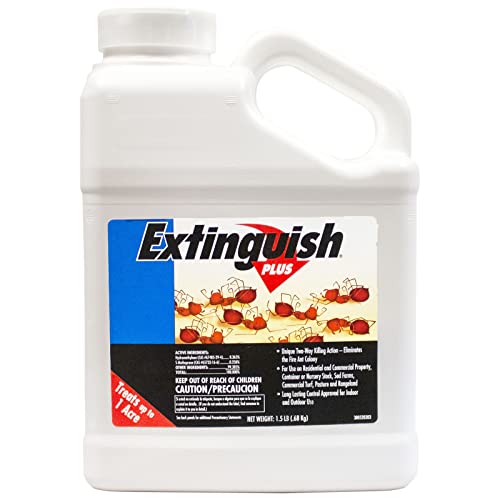
Extinguish Plus pairs 0.365% hydramethylnon with 0.25% methoprene, an insect growth regulator that prevents larvae from molting into adult workers. This dual-action approach kills the current queen while simultaneously starving the colony of new replacements — a strategy that extends control for months beyond a single application.
The granular bait is nearly odorless, making it viable for use around bee hives and poultry runs where strong chemical smells could cause problems. Owner reports from Texas and the Southeast confirm that heavy infestations of fire ants, leaf cutters, and harvester ants respond well to broadcast applications at the labeled rate of 3 ounces per 5,000 square feet.
Packaging arrives in a loose plastic jug, and some users note that the container can arrive partially filled due to settling during shipping. The formulation itself is proven reliable over multiple seasons, though a few reports indicate that new mounds can reappear within a week after treatment — typically because the existing colony absorbed the bait but a satellite queen survived underground.
What works
- IGR component prevents colony rebound
- Safe for use near beehives when applied correctly
- Odorless granules do not deter foraging
What doesn’t
- New mounds may appear if satellite queens survive
- Plastic jug packaging can arrive underfilled
4. Hi-Yield Fire Ant Control with Acephate
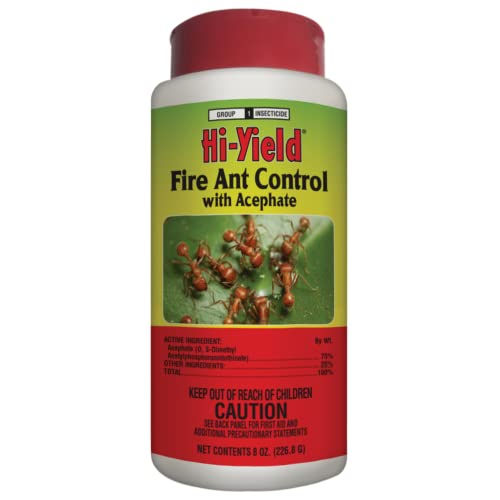
Hi-Yield’s acephate-based formulation works differently from the typical delayed-action baits — acephate is a fast-acting organophosphate that kills on contact and through ingestion. For homeowners who need immediate relief from aggressive mounds, this product shows knockdown within 24 to 48 hours after drenching the mound with a 2-tablespoon-per-gallon mix.
The 8-ounce liquid concentrate treats a moderate number of mounds, and the formula handles well in pump sprayers or watering cans. Users report that the product also eliminates German roaches, spiders, and other perimeter pests when applied along baseboards and door thresholds, making it more versatile than a dedicated fire-ant-only bait.
On the downside, the acephate odor is noticeably strong, and some batches have shown inconsistent potency — a few recent reviews describe a cheese-like smell and reduced effectiveness. Acephate also degrades faster under high heat compared to hydramethylnon, so applications during peak summer may require more frequent re-treatment.
What works
- Fast contact and ingestion kill within 24 hours
- Controls multiple pest species beyond fire ants
- Liquid formulation penetrates deep into mound
What doesn’t
- Strong chemical odor during application
- Inconsistent batch quality reported
5. Spectracide One Shot Fire Ant Killer

Spectracide One Shot markets granular bait that controls fire ants for up to three months from a single application. The active ingredient kills worker ants slowly enough that they transport the granules back to the colony before dying, and the label specifies a 4-tablespoon mound treatment that does not require watering in.
Owner reports confirm that the odorless granules do not blow away easily, and most users see ant activity disappear within 1 to 2 days. The 1.5-pound canister treats roughly 6 to 8 mounds depending on mound size, making it one of the most cost-effective options per mound in this lineup. Application is straightforward: shake the granules around the mound opening but avoid dumping directly on top of the disturbed nest.
While the product works well on individual mounds, it is less effective for broadcast treatment because the granules are designed for spot application rather than even perimeter distribution. For homeowners with only a few scattered mounds, this is a simple and affordable solution that does not require additional equipment.
What works
- Low cost per mound treatment
- Odorless granules resist wind scatter
- No watering-in step required
What doesn’t
- Not designed for broadcast applications
- Three-month residual depends on weather
6. Kill Control Extinguish Fire Ant Bait

This 1.5-pound jug from Kill Control delivers the same dual-action Extinguish Plus formula — 0.365% hydramethylnon paired with 0.25% methoprene — but at a slightly higher price point than the standard Extinguish Plus jug. The formulation is identical, meaning it provides both adulticide and insect growth regulator activity for long-term colony suppression.
For broadcast applications, the label recommends 3 ounces per 5,000 square feet, which works out to roughly 8 treatments per jug on a quarter-acre lot. In mound treatment mode, 2 to 5 level tablespoons per mound are sufficient. Users in Texas report that small nests die within a week after a single sprinkling, though larger mounds may require a second treatment after 10 to 14 days.
Some customers report dissatisfaction with the fill level — the jug can arrive looking half-empty due to granule settling during shipping. The product itself performs well when applied correctly on dry ground with no rain forecast for 24 hours, but the inconsistent fill volume is a recurring complaint that impacts perceived value.
What works
- Dual-action formula prevents colony rebound
- Covers large areas for broadcast application
- Safe for use around bee hives
What doesn’t
- Jug often arrives underfilled
- Large mounds may need re-treatment
7. Amdro Ant Killer for Outdoor Home Perimeter

Amdro’s 0.73% hydramethylnon granular bait is marketed specifically for perimeter barrier protection — you apply a 1-foot band around the foundation of the house rather than on individual mounds. This approach intercepts foraging ants before they enter the structure, and the delayed kill ensures the workers carry the bait back to satellite colonies hidden in walls or under slabs.
The 24-ounce container covers roughly 200 linear feet of perimeter when applied at the recommended rate. Customer reviews confirm that indoor ant problems — including Argentine ants, odorous house ants, and pharaoh ants — stop completely within 1 to 2 days after perimeter application. The formula is weather-sensitive: it must remain dry for 24 hours after application, and rain or sprinkler runoff significantly reduces efficacy.
Amdro has been a trusted name in perimeter ant control since 1980, and the hydramethylnon concentration here is higher than many competing baits. However, it is not specifically optimized for fire ant mound treatment — the granular size and attractant base are tuned for general ant foraging rather than the specific feeding preferences of Solenopsis invicta.
What works
- Prevents ants from entering the house
- Effective against 25 ant species
- Granules remain attractive for days
What doesn’t
- Not optimized for fire ant mound treatment
- Requires 24-hour dry window
Hardware & Specs Guide
Active Ingredient Chemistry
Hydramethylnon and indoxacarb are the two most effective non-repellent actives for fire ant bait. Hydramethylnon (0.365%–0.73%) inhibits mitochondrial energy production, killing the queen within 48 hours after ingestion. Indoxacarb (0.22%) activates only inside the insect’s gut, making it safer for non-target organisms. Acephate is a fast-acting organophosphate that provides contact kill but degrades faster under UV exposure and high temperatures.
Granule Size and Attractant Base
The bait’s particle size directly affects foraging acceptance — fire ants prefer granules between 1.5 and 2.5 mm. Soybean oil and corn grit bases are the most common attractants. Oils oxidize over time, so baits stored in humid environments or beyond their labeled shelf life lose palatability. Vacuum-sealed or nitrogen-flushed packaging extends bait freshness significantly compared to basic plastic jugs.
FAQ
Should I apply fire ant bait directly on top of the mound?
How long after applying fire ant bait can I water my lawn?
Can I use fire ant bait alongside fertilizer or other lawn treatments?
Final Thoughts: The Verdict
For most gardeners, the best fire ant bait winner is the Advion Insect Granular Bait because the 0.22% indoxacarb delivers non-repellent colony kill with the fastest knockdown times reported by owners. If you want pre-measured convenience for spot treatments, grab the Ortho Fire Ant Mound Blitz. And for long-term IGR protection across a large property, nothing beats the Extinguish Plus Fire Ant Bait.