
Specs are compiled from manufacturer listings and verified buyer reviews and can change over time — please confirm the key details on the product page before buying.
Walking out to a vegetable patch full of yellow leaves and stunted fruit is frustrating. Nine times out of ten the problem starts in the soil, not the seed you chose. The right fertilizer fixes that imbalance, but the aisle is packed with bottles and bags that each promise something different. The real difference is the NPK ratio (the balance of nitrogen, phosphorus, and potassium that each plant needs at different stages). This guide cuts through the noise to show you exactly which product delivers what your specific crop is hungry for.
I’m Rikta — the founder and writer behind Lawn Gear Lab. This guide is built by comparing the manufacturers’ published specifications and the patterns across verified customer reviews, so you get each pick’s real strengths and trade-offs instead of marketing spin.
Whether you are feeding heavy-yield tomatoes, leafy greens, or a mix in raised beds, there is an option here that fits your routine. This is your complete breakdown for the best fertilizers for vegetable garden success this season.
Our Picks at a Glance


How To Choose The Best Fertilizers For Vegetable Garden
Picking a fertilizer is really about matching the numbers to what you are growing. Leafy greens like lettuce and kale need a higher first number (nitrogen) to push out big leaves. Fruiting plants like tomatoes and peppers want a higher middle number (phosphorus) and last number (potassium) to set flowers and swell fruit. Once you know your crop type, the next steps are form, ingredients, and coverage.
Form: Granules, Liquids, or Compost
Granular fertilizers are the set-it-and-water-it crowd pleaser. You sprinkle them on the soil and they break down slowly over weeks. Liquids, like fish emulsion, work fast — you see green-up in days — but need more frequent application. Compost and worm castings improve the soil structure itself, which means they feed the ecosystem that feeds your plants. A good strategy is to use a granular base feed and supplement with a liquid when plants look stressed.
Organic vs. Synthetic
Organic fertilizers come from plant or animal matter — bone meal, fish scraps, manure, or mined minerals. They feed the soil microbes that in turn feed the plant, which builds long-term fertility. Synthetic fertilizers deliver nutrients in a salt form that plants absorb immediately, but they can burn roots if over-applied and do little for soil biology. For a vegetable garden you eat from, organic is the safer, slower, richer path.
Calcium and Blossom End Rot
That ugly black spot on the bottom of a tomato is blossom end rot, and it is almost always a calcium deficiency. If your soil is light on calcium, pick a fertilizer that lists it on the label — some blends include 5% or 6% calcium, which is enough to stop the rot before it starts. This matters most for tomatoes, peppers, and squash.
Quick Comparison
| Model | Best For | NPK Ratio | Form | Weight | Amazon |
|---|---|---|---|---|---|
| Organic Fish Fertilizer★ Best Overall | Fast green-up | 2-3-1 | Liquid | 128 fl oz | Amazon |
| Back to the Roots Worm CastingsBest Value | Soil building | — | Granules | 5 lb | Amazon |
| True Organic Tomato & VegetableCalcium Champion | Blossom rot prevention | 4-5-6 | Granules | 8 lb | Amazon |
| Down To Earth All Purpose | Versatile all-rounder | 4-6-2 | Granules | 5 lb | Amazon |
| FoxFarm Happy Frog All Purpose | Microbe-rich feeding | — | Granules | 4 lb | Amazon |
| FoxFarm Happy Frog Tomato & Veg | Heavy fruiting | 5-7-3 | Granules | 4 lb | Amazon |
| Espoma Organic Garden-Tone | Monthly top-dress | 3-4-4 | Granules | 4 lb (x2) | Amazon |
| R&M Organics Compost | Rescue weak plants | — | Solid | 10 lb | Amazon |
| Jobe’s Organics All Purpose | Big volume feeding | 4-4-4 | Granules | 16 lb | Amazon |
In‑Depth Reviews
1. Organic Fish Fertilizer for Vegetable Garden – The Grow Co
Our pick — over 4.5★ from 600+ verified ratings; the strongest balance of quality and price.
A liquid that stinks like the sea but turns yellow leaves deep green in days.
If your vegetable patch is nitrogen-starved, this is the fastest fix. The Grow Co uses sustainably sourced fish emulsion (100% cold-pressed to retain nutrients) in a 2-3-1 NPK ratio — the middle number (3) is higher in phosphorus than most fish formulas, so it drives flower and fruit development rather than just leaves. A single 128-ounce bottle covers over 160 gallons when mixed at the 1:100 ratio, so it stretches further than any bag of granules you can buy.
Buyers report seeing new shoots on avocado and persimmon trees after just a couple of applications. The one non-negotiable trade-off is the smell — it is a genuine, pungent fish odor. As the review pages put it, “it smells like fish because it’s made from fish,” and if it did not smell, it would not be real. This is not a fertilizer to mix indoors or store next to the back door. Use it as a soil drench or a foliar spray during the active growing season and the results, as owners mention, are worth the aroma.
The Fast Fix
- Works quickly — visible green-up in days
- High phosphorus (3) encourages fruit set
- Covers over 160 gallons per bottle
The Reality Check
- Strong fish smell lingers for hours after application
- Not suitable for indoor use because of the odor
Grab this if: you want a quick-acting organic feed that pushes flowers and fruit — and you do not mind a strong fish smell for a day.
Think twice if: you garden on a balcony, in a small apartment space, or anywhere the aroma will bother neighbors or household members.
2. Back to the Roots Organic Worm Castings
Pure worm castings that feed the soil microbe army, not just the plant.
This is the gentlest entry into organic gardening because worm castings cannot burn roots no matter how much you use. The 5-pound bag of pure vermicompost (USA-sourced) contains beneficial microbes that protect seedlings from soil-borne pathogens while slowly releasing nutrients. It has no strong smell — just a clean earthy soil scent — which makes it the rare fertilizer you can keep in the garage without complaints.
Buyers consistently say it is “high quality for the money” and many use it as a year-round staple for everything from milkweed (safe for monarch butterflies) to citrus trees. It blends easily into chunky potting mixes without compacting the soil. The trade-off among owners is that the cost per volume feels higher than a granular concentrate, and a few bags have included a stray piece of debris (like a small steel cable), so it pays to inspect before use.
Soil Builder
- No smell — just a natural earthy scent
- Cannot burn plants; safe for seedlings and tender herbs
- Adds slow-release nutrients and beneficial microbes
The Catch
- Volume per dollar is lower than granular concentrates
- Occasional debris reported; check before mixing into soil
Reach for this if: you are new to fertilizing and want a no-brainer, no-burn product that builds soil health underneath your plants.
Consider another if: you need a high-NPK boost for heavy feeders like corn or tomatoes in poor soil.
3. True Organic Tomato & Vegetable Food
The bag that puts 6% calcium right where blossom end rot starts.
If you have ever pulled a ripe tomato off the vine only to find a black, leathery bottom, you know the heartbreak of blossom end rot. True Organic solves this by packing 6% calcium into a 4-5-6 NPK blend that also includes 1% sulfur and 3% slow-release nitrogen. The 8-pound bag covers 140 square feet, and you apply it monthly during the growing season. One owner who has used it for over five years says small doses in every watering produced the best balcony tomatoes he has ever grown through eastern-exposure heat.
The formula gets strong praise for improving harvest size and plant strength, but the recurring owner note is the smell — buyers describe it as “pretty strong” and “horrible,” though they universally say the results are worth it. It smells less fishy than the liquid emulsion above and more like a barnyard; the odor typically fades after watering it in.
Fruit Defender
- 6% calcium stops blossom end rot on tomatoes, peppers, and squash
- Covers 140 sq. ft. per bag — easy to measure for raised beds
- Slow-release nitrogen feeds steadily without burning
Honest Note
- Has a strong barnyard smell for a day or two after application
- Best for monthly feeding, not a quick fix for immediate nutrient deficiency
Buy this when: your tomatoes, peppers, or eggplants have a history of blossom end rot — the calcium is the specific cure.
skip it if: you only grow leafy greens or herbs that rarely suffer from calcium deficiency.
4. Down To Earth All Natural All Purpose Mix 4-6-2

A five-pound box that replaces fifteen separate bottles and bags in the shed.
Down To Earth blends Fish Bone Meal, Blood Meal, Feather Meal, Rock Phosphate, Langbeinite, Greensand, Humates, and Kelp Meal into a single 4-6-2 mix that is gentle enough to avoid burning transplants. It is OMRI-listed for organic production and designed for everything from tomatoes and peppers to container plants and kitchen gardens. The 6 in the middle means this is a phosphorus-forward formula, which supports strong root development and flower set across the board.
Owners with large gardens report that a 15-pound bag lasts nearly a full season. The thing people rave about is quality — 46 buyers single it out. The smell, while present, dissipates in a few days, and many find it less offensive than fish-based or manure-based options. One owner revived pale, flimsy tomato plants within two weeks of application and felt “petty and competitive” about the turnaround.
Versatile Power
- Eight different organic ingredients for balanced feeding
- Phosphorus-rich (6) for strong roots and heavy blooms
- Smell fades within days — manageable for most gardeners
The Trade-Off
- Price per pound is higher than supermarket synthetic blends
- Not a quick liquid feed — granules need soil moisture to activate
Pick this if: you want one bag that handles your entire garden — vegetables, herbs, flowers, shrubs, and containers — without buying multiple products.
Look elsewhere if: you need a water-soluble fertilizer for weekly foliar feeding or quick corrections.
5. FoxFarm Happy Frog All Purpose Fertilizer

A gentle OMRI-listed feed that wakes up the biology sleeping in your soil.
Happy Frog packs beneficial soil microbes and mycorrhizal fungi (fungi that attach to plant roots and help them pull more water and nutrients from the surrounding soil) into every granule. These organisms effectively extend the root system’s reach. The 4-pound bag is small, but owners of houseplant collections report it works exceptionally well on fussy Monstera varieties — Thai Constellation, Albo, and others — while vegetable gardeners say it revived yellowing tomato and zucchini plants within a week.
The most honest owner note is that it “stinks like poo big time” — the manure-based smell sticks around for a day or two after watering, especially noticeable if you use it in container gardens. That said, the explosive growth results are the reason half a bag can last a careful gardener a full year. It is an excellent supplement to worm castings if you want a microbial boost without switching to a liquid.
Root Team
- Contains mycorrhizal fungi and soil microbes for nutrient uptake
- Works on vegetables, ornamentals, and even rare houseplants
- Gentle — safe for container gardens and Green Stalk systems (used sparingly)
The Reality
- Strong manure odor for 1-2 days after watering in
- Small 4 lb bag goes quickly if you have a large in-ground garden
Choose this for: improving soil biology in raised beds and containers — especially if you grow a mix of ornamentals and edibles together.
pass on it if: you have a large vegetable patch and need a bulk bag; find Jobe’s or True Organic for bigger volume.
6. FoxFarm Happy Frog Tomato & Vegetable Fertilizer

The 5-7-3 blend built for the heavy eaters that fill your dinner plate.
If you grow tomatoes, peppers, berries, or squash, this is the specialized version of the all-purpose Happy Frog above. The NPK ratio of 5-7-3 puts phosphorus front and center (7) to push flower formation and fruit swelling, while calcium is included to guard against blossom end rot. Mycorrhizal fungi in the formula support root efficiency — meaning each watering pulls more nutrition into the plant.
Reviewers consistently call it “one of the best dry fertilizers around” and report dramatic turnarounds: a tiny cherry tomato sprig became a “tomato-producing tree” after feeding, and a struggling zucchini plant put out new blooms within a single application. Unlike many organic options, owners note this one has “no chemical or fishy smell,” which makes it the most pleasant to store and use. The only real limit is the 4-pound bag size — large gardens will want the 8-pound or bigger options instead.
Fruit Machine
- High phosphorus (7) for flower and fruit development
- Calcium included to prevent blossom end rot
- Mild smell — no fish or manure odors
Size Note
- Only 4 lb bag available — not economical for large in-ground gardens
- Pricier per pound than bulk granular options
Buy this for: your heavy-feeding tomato and pepper plants when you want a precise, odorless organic boost that targets fruit yield.
Consider True Organic instead if: you need more volume per dollar or higher calcium for an existing rot problem in a large patch.
7. Espoma Organic Garden-Tone 3-4-4 (Pack of 2)

A classic monthly granule from a company that has been making organic feeds since 1929.
Espoma’s Garden-Tone comes as a two-pack of 4-pound bags (8 pounds total) with a 3-4-4 NPK analysis that includes 5% calcium. The formula is a rich blend of natural ingredients enhanced with Espoma’s proprietary Bio-tone microbes. You apply it monthly around the drip line of plants — lettuce and kale for cool-season gardens, tomatoes and peppers for warm season — and water it in. It is OMRI-listed and approved for organic production.
Buyers in hot climates (zone 10b) report that regular use kept annuals alive through late July heat and sustained vegetable harvests into September. One urban gardener credits Espoma for a record year: 400 pounds of tomatoes and 100 pounds of carrots from a city plot. The 3-4-4 ratio is slightly lower in nitrogen than some competitors, which means it is safe for repeated monthly use without risking leafy overgrowth at the expense of fruit.
Monthly Workhorse
- Pack of two bags gives good coverage for the season
- Bio-tone microbes support root health and nutrient cycling
- 5% calcium helps prevent blossom rot on fruit crops
Trade-Off
- Some owners find the smell unpleasant, though it fades after watering
- Requires monthly reapplication; not a one-and-done feeder
Grab these if: you want a trusted brand with a long history and a balanced monthly feed that works across cool and warm season vegetables.
Pass if: you need a high-nitrogen formula for leafy greens or a liquid for fast foliar feeding.
8. R&M Organics Compost Soil Amendment
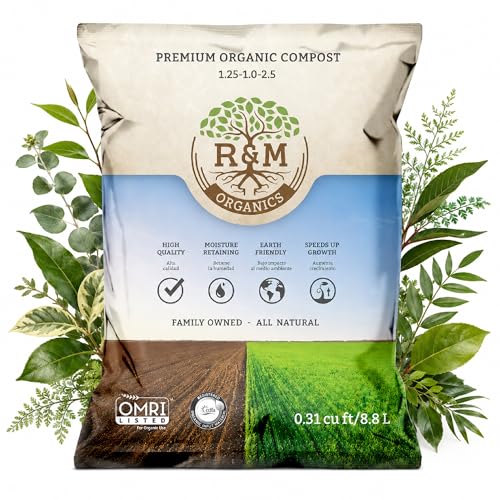
A fully composted cow manure rescue squad for plants that look beyond saving.
When your plants look sad and you are not sure whether it is a nutrient deficiency or just depleted soil, this 10-pound bag of dairy cow manure compost is a broad-spectrum solution. It is processed through a complete, aerated composting method that keeps the odor low — it has a clean, earthy scent rather than a barnyard punch. You apply a thin quarter-inch layer around struggling plants or mix it directly into the soil for new beds.
One owner saved azaleas that were dying after a roof-cleaning incident; a sister-in-law who is a Master Gardener recommended it. Another revived a tomato plant in a 27-gallon planter within a week — yellow leaves turned green and new flower buds appeared. The material is fine (like topsoil), easy to work, and does not clump. The honest caveat is that it can stain concrete and carpet if spilled, and the price per bag feels premium for what is basically composted manure.
Soil Saver
- Very low odor — no strong manure smell during or after application
- Improves moisture retention so you water less often
- Easy to spread; works for indoor and outdoor plants
Watch For
- Can stain patios, carpets, or concrete if spilled wet
- Price per bag is high for a basic compost amendment
Reach for this when: a plant looks genuinely sick and you want a gentle, broad-spectrum organic amendment that will not burn it further.
Choose a granular fertilizer instead if: your plants are healthy and just need a targeted NPK boost for more fruit or flowers.
9. Jobe’s Organics All Purpose Granular Fertilizer 16 lb

A 16-pound bag of balanced 4-4-4 that keeps a big garden fed all season long.
If you have a large in-ground vegetable patch, go through a lot of product, and want a balanced feed without buying a new bag every other month, Jobe’s delivers. The 16-pound bag uses a 4-4-4 NPK formulation that is OMRI-listed for organic gardening and contains no synthetic chemicals. It works on vegetables, flowers, shrubs, and trees. Application is straightforward — measure, sprinkle around the base, and water in every 2-3 weeks during the growing season.
Owners praise how quickly it works: granular top-dressing shows visible results in a day or two, and one gardener reports neighbors “kept asking us how we did it” after a season on Jobe’s. Some buyers make a liquid tea by steeping one cup of granules in a gallon of dechlorinated water for 24 hours, then diluting it further for weekly watering — that method produced squash and cucumber harvests so large the family “got really sick of eating squash.” The consistent owner note is that the granules smell strongly of chicken manure for a couple of days, though the smell fades as they break down into humus.
Season Supply
- 16 lb bag lasts a large garden for a full growing season
- Can be used dry as a top-dress or steeped into a liquid tea
- Balanced 4-4-4 ratio works on edibles and ornamentals
Know This
- Strong chicken-manure smell for about 48 hours after applying
- Granules are fine and dusty; wear gloves and a mask when handling
Get this if: you have a large garden and want the best cost-per-pound for a season-long organic feed that is easy to apply and store.
Pick something lighter if: you only have a few containers or raised beds — 16 pounds is more than a small garden needs in one season.
Understanding the Specs
NPK Ratio — The Three Numbers
The three hyphenated numbers on a fertilizer bag (like 4-6-2) stand for Nitrogen, Phosphorus, and Potassium. Nitrogen (first) pushes green leaf growth. Phosphorus (middle) supports roots, flowers, and fruit. Potassium (last) builds overall plant health and disease resistance. Leafy greens want a high first number; tomatoes and peppers want a high middle number.
Slow-Release vs. Fast-Release
Slow-release granules break down gradually as soil microbes digest them, feeding plants steadily over weeks. Liquids like fish emulsion enter the plant tissue almost immediately, giving a fast green-up. Slow-release is safer (less burn risk) and requires fewer applications. Liquid is better for correcting a sudden deficiency or giving seedlings a quick start.
FAQ
What does the NPK ratio actually mean for my vegetable garden?
Can I use a tomato fertilizer on all vegetables?
How often should I fertilize my vegetable garden during the season?
What is blossom end rot and how do I stop it with fertilizer?
Is fish emulsion fertilizer better than granular fertilizer?
How do I know if my soil needs more nitrogen or more phosphorus?
Can I use a fertilizer meant for flowers on my vegetable garden?
What does OMRI-listed mean on a fertilizer label?
Final Thoughts: The Verdict
For most gardeners, the best fertilizers for vegetable garden pick is the Organic Fish Fertilizer from The Grow Co because it delivers fast, visible results across a huge coverage area for the price. If you prefer a no-smell soil builder that cannot hurt your plants, grab the Back to the Roots Worm Castings. And for stopping blossom end rot in its tracks during a heavy tomato season, the True Organic Tomato & Vegetable Food is the one to reach for.
How We Picked
We do not accept paid placement. Every pick is matched to a real buyer and a real use-case; we do not hands-on test units.
Sources & Methodology
Specifications: manufacturer listings and product documentation. Review insights: verified customer reviews, as of July 2026. Pricing: not shown on this page (it changes often); check the current price via the retailer link.
As an Amazon Associate, Lawn Gear Lab earns from qualifying purchases. This does not affect which products we feature.