
Specs are compiled from manufacturer listings and verified buyer reviews and can change over time — please confirm the key details on the product page before buying.
You can see it in the leaves first. A yellowing lawn, a faded tomato plant, a citrus tree that just looks tired — that pale color is often a two-part problem: your soil is short on iron for rich green color and short on nitrogen for strong growth. Most standard fertilizers give you one or the other, but the products here deliver both in a single bag or bottle, so you skip the guesswork and get a single, effective feeding routine.
I’m Rikta — the founder and writer behind Lawn Gear Lab. This guide is built by comparing the manufacturers’ published specifications and the patterns across verified customer reviews, so you get each pick’s real strengths and trade-offs instead of marketing spin.
The key is finding the right balance for your specific plants, and that is exactly what this roundup of the best fertilizer with iron and nitrogen will help you do — whether you are feeding a patchy lawn, potted citrus, or a bed of acid-loving hydrangeas.
Our Picks at a Glance
How To Choose The Best Fertilizer With Iron And Nitrogen
Picking the right iron-and-nitrogen blend means matching the nutrient profile to what you are growing. A lawn recovering from summer heat needs different ratios than a potted lemon tree or a row of tomato plants, and getting this wrong can mean lots of leaf growth with no fruit or a lawn that stays yellow despite regular feeding.
N-P-K ratio: the three numbers that matter
Every fertilizer bag shows three numbers, like 16-0-8 or 24-0-6. The first number is nitrogen (for green growth), the second is phosphorus (for roots and blooms), and the third is potassium (for overall plant health). A high-first-number blend like 24-0-6 is built for lawns that need a fast green-up, while a balanced 20-20-20 works for general garden use. For fruiting plants like tomatoes or citrus, you want a middle number (phosphorus) that is equal to or higher than the first, like 5-10-10, to encourage flowers and fruit instead of just leaves.
Quick-release vs slow-release: how fast do you need results?
Quick-release nitrogen gives you visible greening within days but can burn grass if over-applied, and it fades fast. Slow-release nitrogen feeds steadily over weeks — the Andersons Professional PGF uses a mix of both, so you get immediate color plus feeding that lasts up to 8 weeks. For potted plants or acid-loving shrubs, slow-release granules prevent the surge-and-crash cycle that stresses roots.
Iron content and form: what makes that deep green
Iron is what turns a pale lawn a rich blue-green. The Yard Mastery 24-0-6 Flagship delivers 3% iron for a dramatic color shift, while the GardenWise 8-4-8 Acidic Fertilizer uses iron alongside magnesium and manganese to prevent chlorosis (yellowing between leaf veins) in acid-loving plants. Chelated iron stays available to plants longer than non-chelated forms, which matters if your soil pH is high.
Quick Comparison
| Model | Best For | N-P-K Ratio | Iron Content | Release Type | Amazon |
|---|---|---|---|---|---|
| The Andersons PGF 16-0-8★ Best Overall | Phosphorus-sensitive lawns | 16-0-8 | Yes (micronutrient blend) | Quick + Slow (up to 8 weeks) | Amazon |
| Yard Mastery 24-0-6 FlagshipLawn Color King | Deep lawn greening | 24-0-6 | 3% | Slow-release | Amazon |
| GARDENWISE Citrus 6-4-6Citrus Champion | Citrus and fruit trees | 6-4-6 | Yes (micronutrient blend) | Slow-release | Amazon |
| GS Plant Foods 20-20-20 | All-purpose feeding | 20-20-20 | Yes (micronutrient blend) | Water-soluble (quick) | Amazon |
| Sunday Lawn Kickstart 22-0-2 | Spring lawn kickstart | 22-0-2 | Yes | Liquid (quick) | Amazon |
| GARDENWISE 8-4-8 Acidic | Acid-loving plants | 8-4-8 | Yes (micronutrient blend) | Slow-release | Amazon |
| Cz Garden 5-10-10 | Tomatoes and vegetables | 5-10-10 | 2% | Granular (quick-ish) | Amazon |
| Yard Mastery 7-0-20 Stress | Summer lawn stress | 7-0-20 | 3% | Slow-release | Amazon |
| The Andersons Green Shocker 7-1-2 | Quick green-up fix | 7-1-2 | Yes | All fast-release nitrogen | Amazon |
In‑Depth Reviews
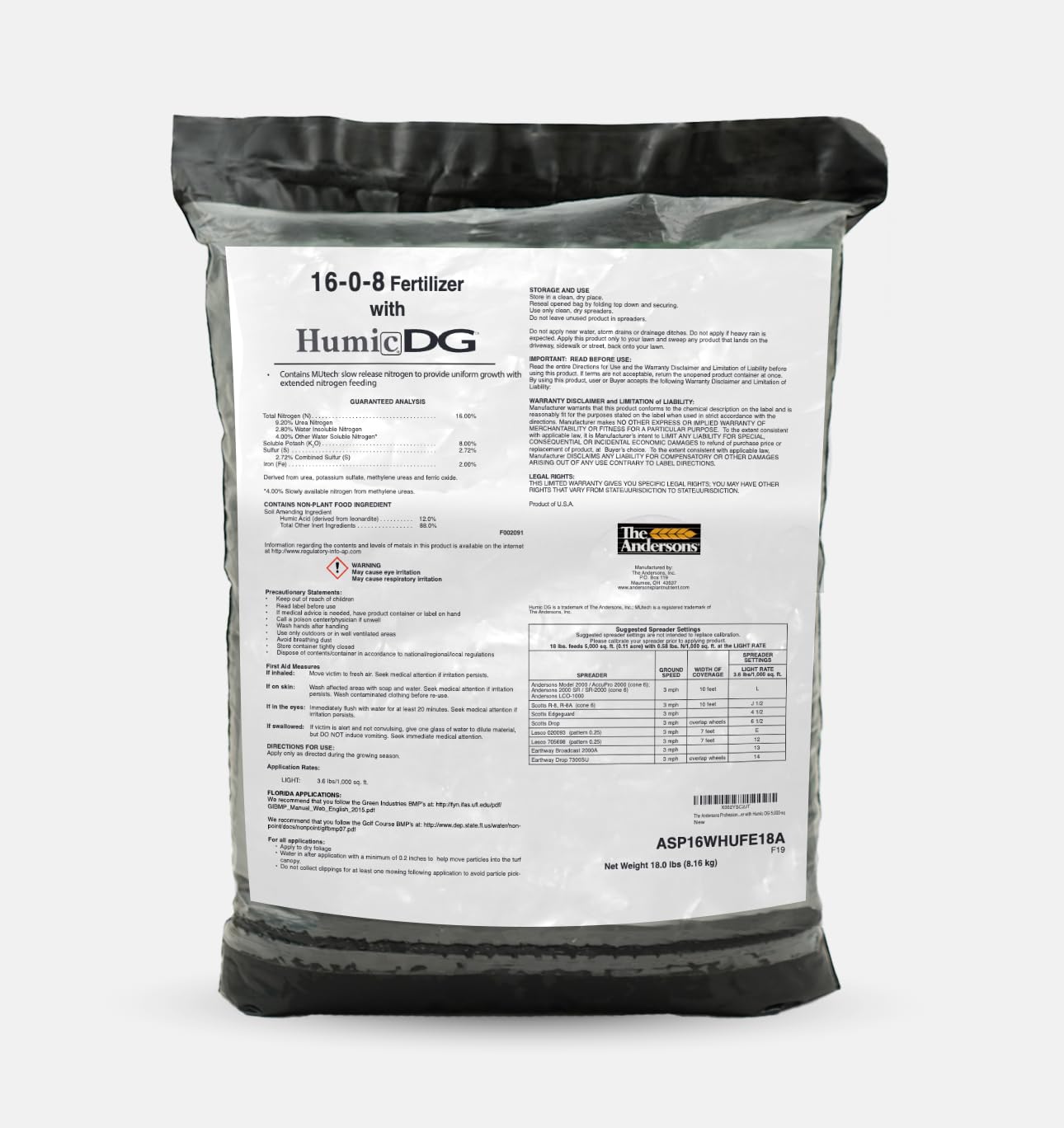
1. The Andersons Professional PGF 16-0-8 Fertilizer with Humic DG
Our pick — over 4.5★ from 900+ verified ratings; the strongest balance of quality and price.
The lawn-care pro’s secret weapon for phosphorus-heavy soil.
This 18-pound bag of granules delivers a 16-0-8 ratio — zero phosphorus, which is a lifesaver if your soil test (or local ordinance) says your yard already has enough. The nitrogen comes in both quick-release and slow-release forms, so you see greener grass within days and keep getting feeding for up to 8 weeks. Buyers report it “dramatically improved lawn quality (greener, healthier)” and note that the super-fine particles give you roughly twice the number of granules per square foot compared to standard fertilizers, meaning more even coverage without clumpy stripes.
The Humic DG (a soil-conditioning ingredient that helps roots absorb nutrients) is mixed right into the bag, so you get a root-health boost without a separate application. The trade-off is that it is not sold in California or Oregon, and at 18 pounds it is a substantial lift — expect to use a spreader, not a hand-held shaker. Owners who watched “How to with Doc” on YouTube discovered it that way and stayed loyal through multiple seasons, a sign of real repeat-buyer trust.
What owners love
- Phosphorus-free formula solves soil test issues immediately
- Quick + slow-release nitrogen gives fast green and long feeding
- Tiny particles mean even, stripe-free distribution
The honest trade-offs
- Not available in CA or OR — check local regs before buying
- Premium price reflects pro-grade formulation
Reach for this if: you have high-phosphorus soil, want professional-grade results, and do not mind spending a little more for a formula that feeds for up to 8 weeks.
Look elsewhere if: you need a general-purpose garden fertilizer or live in California or Oregon where this cannot ship.
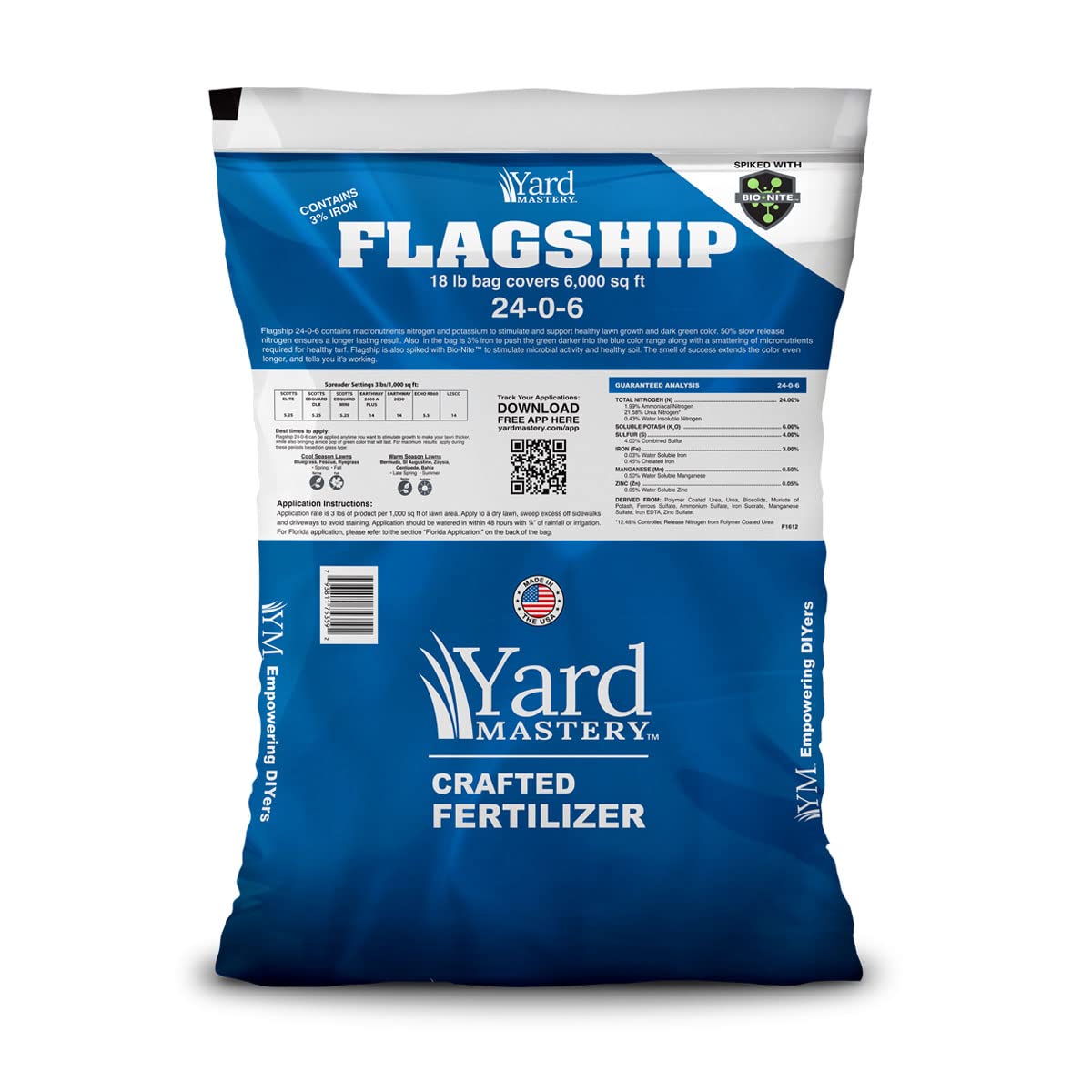
2. Yard Mastery 24-0-6 Flagship Granular Lawn Fertilizer with 3% Iron
The bag that makes neighbors ask which lawn service you hired.
With a hefty 24-0-6 N-P-K ratio and a full 3% iron, this 18-pound bag is engineered for one main job: turning a tired lawn a deep blue-green fast. It is a slow-release formula that includes Bio-Nite (a natural organic additive that feeds soil microbes) plus micronutrients like boron, copper, manganese, molybdenum, and zinc. The coverage is 6,000 square feet, so one bag handles a decent-sized yard. Owners mention that a lawn that was “dead, patchy brown” came back “full, deep green in one week” — and the story shows up in multiple reviews, not just one outlier. A couple of neighbors of one owner even asked which lawn care company they used, and got the answer: “I bought this product on Amazon.”
The catch is the price — this sits at the upper end of the range — and the fact that a bag this nutrient-dense requires careful spreader calibration to avoid over-application on small lawns. It also lacks phosphorus, so it is not the right pick if your soil test shows a phosphorus deficit or if you are feeding flowering garden plants. But for straight lawn greening, the consensus is clear: “Scott’s has gone downhill over the past 20 years so this is my new lawn fertilizer.”
What owners love
- 3% iron delivers visible blue-green color in about a week
- Slow-release nitrogen prevents the burn-and-fade cycle
- Micronutrient blend covers trace elements most bags skip
The honest trade-offs
- No phosphorus — not for flowering plants or phosphorus-poor soil
- Premium price per bag; small lawns may need a different spreader setting
Pick this for: the deepest lawn color you can get from a granular product, especially if you have Bermuda or a warm-season grass that responds to high iron.
skip it if: you need a balanced feed for ornamentals or your soil is already low in phosphorus.
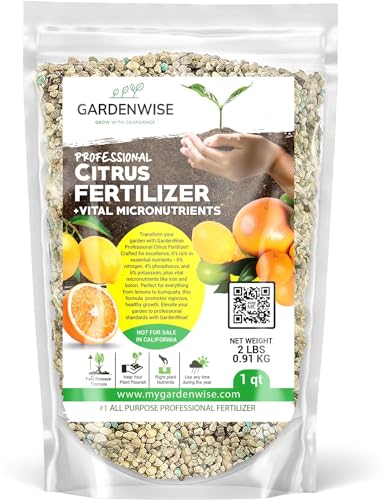
3. GARDENWISE Professional Citrus Fertilizer 6-4-6
Potted lime trees burst to life in under a week.
This 32-ounce bag of slow-release granules uses a 6-4-6 ratio — 6% nitrogen for leafy growth, 4% phosphorus for blooms, and 6% potassium for fruit quality — plus a full lineup of micronutrients: magnesium, zinc, copper, iron, and boron. The idea is that each granule dissolves a little with every watering, delivering a steady stream of nutrients for up to two months per application. A buyer reports that their lime tree “caused tons of new growth within 1 week,” and the same story repeats across owners of citrus in pots: a Cara Cara orange tree in a 15-gallon pot gave “leaves green, healthy, shiny” when combined with weekly fish emulsion. The company’s customer service gets specific praise for being responsive, which matters when you are trying a new product on a tree you have had for years.
At just 2 pounds, this is a compact bag — you get 32 ounces of granules, which is enough for a few trees but not a whole orchard. The 9x weight gap compared to the Andersons PGF (2 pounds vs 18 pounds) tells you this is designed for focused feeding, not broad lawn coverage. Over-fertilizing potted citrus is a real risk; the instruction to follow a 6-8 week schedule is worth heeding, especially in containers where salts build up faster.
Who it fits: home growers with a few potted citrus trees (lemon, lime, orange, avocado) who want a slow-release granule they can sprinkle and forget for two months.
The limitation: one bag covers only a small number of trees, and the slow-release pace means impatient gardeners may not see the color change as fast as a water-soluble feed.
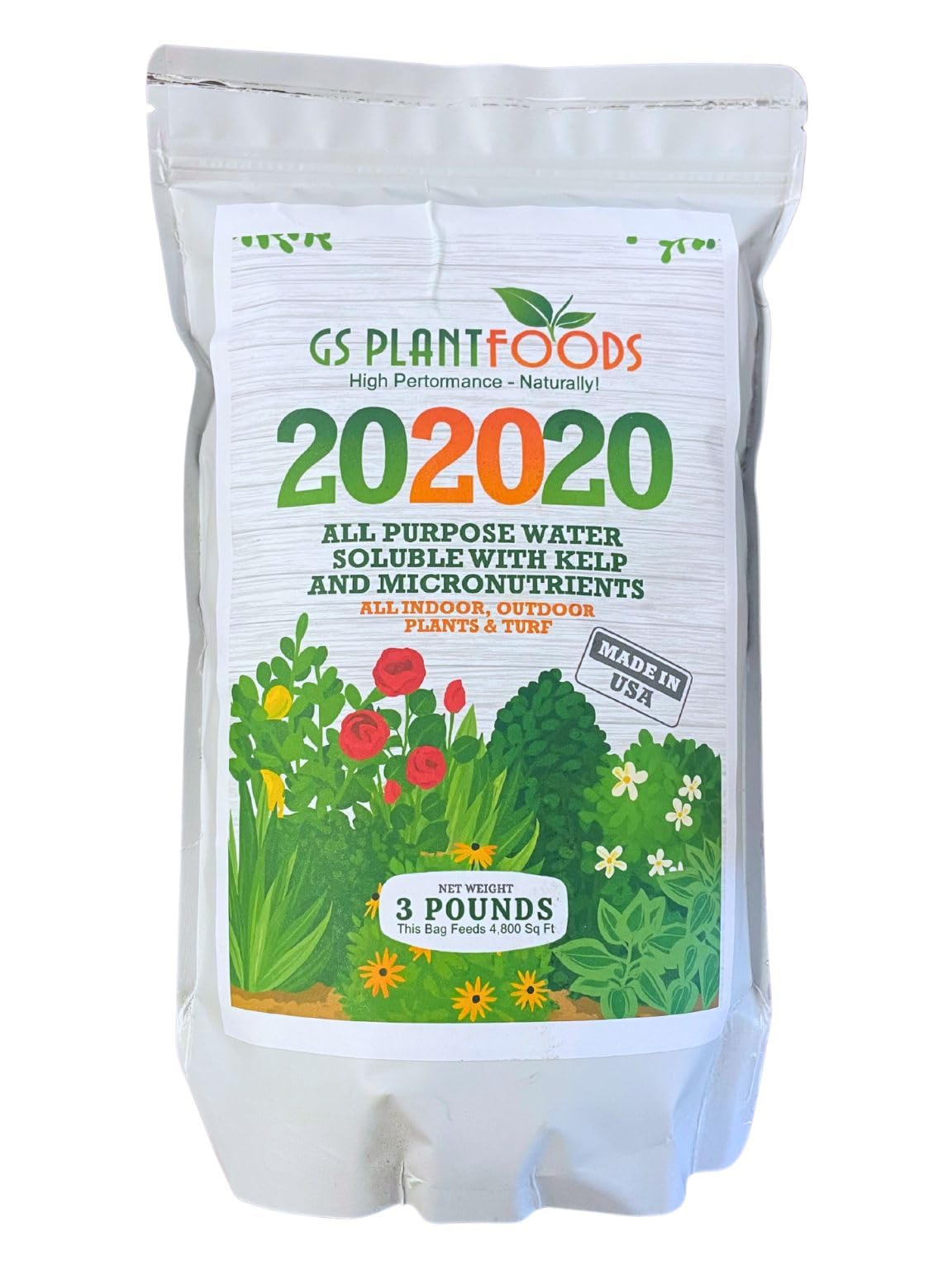
4. GS Plant Foods All Purpose Water Soluble 20-20-20
One scoop, any plant, instant feeding — the definition of versatile.
This water-soluble powder dissolves completely in water and delivers an equal 20-20-20 ratio, making it a universal tool for houseplants, vegetables, ornamentals, and turf. The 3-pound bag covers up to 4,800 square feet of lawn when mixed per the label, and the formula includes kelp (Ascophyllum nodosum) as a natural growth stimulant along with micronutrients like iron, manganese, copper, zinc, boron, and molybdenum. One owner fed a sick Purple Orchid tree and saw “dark green leaves and shoots” within a week, while the untreated tree stayed yellow and brown. Another reports using it weekly on all plants: “It will not burn your plants if you use it according to the instructions.”
The balanced ratio means it is not ideal for specific jobs — a tomato plant setting fruit needs more phosphorus, and a lawn in recovery needs more nitrogen. Owners note that it “promotes overall growth but overpowers blooms” on flowering plants, so you may want a bloom-specific formula for heavy-flowering perennials. But for anyone who uses one fertilizer for everything, this is the closest to a set-and-forget solution.
Best for: the gardener who waters everything from the same bucket — houseplants, vegetable beds, lawn patches, and ornamentals.
Not for: targeted bloom-boosting or correcting a specific soil deficiency; use a specialty blend for those jobs.
5. GARDENWISE 8-4-8 Acidic Fertilizer for Azaleas, Hydrangeas & Blueberries
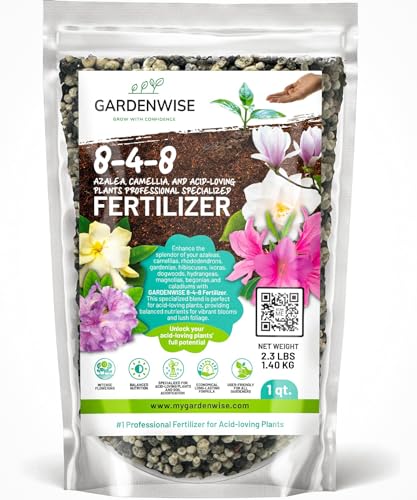
A 24-hour turnaround for a sad rhododendron.
This 32-ounce bag of slow-release granules is formulated for plants that thrive in acidic soil — azaleas, camellias, hydrangeas, blueberries, gardenias, magnolias, and evergreens. The 8-4-8 ratio delivers moderate nitrogen for foliage, a solid dose of phosphorus for blooms, and potassium for root strength, while the added magnesium, manganese, and iron target chlorosis (that yellowing between leaf veins). One owner’s rhododendron was “looking quite sad” and within 24 hours of application it looked “75% better” — by the next day it was “looking very healthy.” Another reports a gardenia bush that had been failing for years came back to full health after a single feeding. The slow-release format means only three feedings per year are needed, which fits neatly into a seasonal routine.
The main limitation is that this is not for neutral or alkaline soil plants — its acidifying nature is intentional, so using it on vegetables or lawns could lower the pH too far. The bag is also on the smaller side for the price; owners with a large bed of azaleas may need multiple bags. But for targeted care of acid-lovers, the results are remarkably fast.
Ideal for: anyone with hydrangeas that stay pink instead of turning blue, or gardenias that refuse to bloom — the iron and acidification directly address those issues.
Bear in mind: limited to acid-loving plants; not a general-purpose feed, and the small bag size goes fast across a large bed.
6. Cz Garden 5-10-10 Tomato & Vegetable Fertilizer with 2% Iron

The same bag year after year for “huge tomatoes.”
This 4-pound resealable bag uses a 5-10-10 N-P-K ratio, which is deliberately low in nitrogen and high in phosphorus and potassium to push energy into flowers and fruit rather than leaves. It contains 2% iron plus micronutrients, making it a targeted feed for heavy-fruiting vegetables like tomatoes, peppers, and squash. A long-time user reports: “I’ve used this on my vegetables for years. It’s great and has never burned my plants. Just follow easy directions and you won’t be sorry for the huge tomatoes you’ll get.” The resealable pouch is a practical touch — you scoop out 1-2 tablespoons per plant and store the rest for the season.
The low nitrogen ratio means this is not the right choice for leafy greens like lettuce or spinach, which need more nitrogen for leaf growth. Owners also note it does not seem to help watermelon plants, suggesting the formula is best for solanaceous fruiting crops. At 4 pounds, the price per pound is higher than a big lawn bag, but for a targeted vegetable feed the results speak for themselves.
Reach for this if: your tomato plants are all leaves and no fruit — the high phosphorus kicks flowering into gear.
Think twice if: you grow mostly leafy greens or root vegetables that need a different ratio.
7. Sunday Lawn Kickstart 22-0-2 Liquid Lawn Fertilizer

A liquid shot of energy for lawns coming out of winter.
This two-bottle pack (84.6 total fluid ounces) covers up to 10,000 square feet with a 22-0-2 liquid formula that includes nitrogen, iron, and potassium. The idea is to “kickstart recovery” after winter dormancy — the liquid format means it goes to work immediately, and customers note visible improvement in about 2 weeks and good results by week 5. The hose-end sprayer included in the pack makes application straightforward: you attach, spray the yard, and put the bottles away. The brand Sunday is known for natural-leaning lawn care, and the mix is designed to be gentler than synthetic heavy-hitters.
Where this falls short is consistency — opinions on effectiveness are split, with some owners seeing “exceptional results” and others saying “no noticeable results.” The sprayer mechanism itself also gets mixed feedback, with a few units not dispensing evenly. It works best when applied as a first-of-season feed (the manufacturer suggests following it with their Green Machine 4-6 weeks later), so it is part of a bigger system rather than a standalone fix. For a straightforward liquid feed that is easy to spray, it is a solid option; for gardeners wanting guaranteed results, the granular picks above offer more predictable performance.
Good for: the lawn owner who prefers spraying to lugging a spreader and wants a gentle spring-starting feed.
Not for: someone with deep-seated lawn problems like compaction or thatch, where a liquid kickstart alone will not be enough.
8. Yard Mastery 7-0-20 Summer Lawn and Turf Stress Blend with 3% Iron

The high-potassium rescue for heat-pounded lawns.
This 18-pound bag is built for a specific season: summer, when high heat and drought stress turn lawns yellow and thin. The 7-0-20 ratio is low in nitrogen and very high in potassium, which strengthens cell walls and roots against heat stress, plus 3% iron for a green “pop of color” without pushing tons of new growth that would just need more water. It covers 6,000 square feet and includes Bio-Nite for soil microbial health. Reviewers point out that centipede and zoysia lawns on the coast made a full recovery from summer yellowing, and one owner says their “grass perked up within 4 days.”
The main caveat is that this is a hot-weather specialist. Do not apply it when temperatures are over 80°F (one owner stresses watering for 3-4 days after application if temps are high), and it is not the right feed for spring green-up or fall preparation. It also has zero phosphorus, so it will not help with bloom production or root establishment in new lawns. But for keeping a lawn alive and green through a brutal summer, it is exactly what the name promises.
Use this for: July and August feeding when your lawn is visibly suffering from heat — the potassium is the key ingredient here.
Hold off if: you are in the middle of a drought with watering restrictions; dry soil + this granular feed can cause burn.
9. The Andersons Green Shocker 7-1-2 Fertilizer with Humic DG
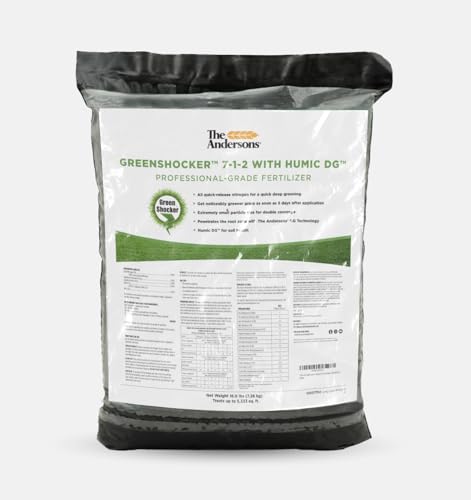
Green grass in 3 days — the name is not marketing hype.
The “Green Shocker” name comes from its all fast-release nitrogen formula, which is designed for one job: giving you a dramatic green-up as soon as 3 days after application. The 7-1-2 ratio is mild enough to use as a “spoon feed” between major fertilizer applications, and it includes Humic DG to help roots use nutrients efficiently. One owner applied it to a lawn that had resisted foliar sprays and other fertilizers all season, and says there was a “visible difference in an hour, deep blue-green color in 3 days.” Another uses it all year and reports: “My lawn gets so green when I use this product throughout the year. My neighbors are jealous!!”
The fast-release nature means the color boost is temporary — it fades faster than a slow-release feed, so you will need to re-apply more frequently for sustained results. It also has very low phosphorus (only 1%), so it is not for bloom support, and it cannot ship to California. But as a quick pick-me-up for a special event or for spot-treating yellow patches between scheduled feedings, it works exactly as advertised.
Reach for this when: you need a lawn to look its best for a party or open house within the same week.
Do not expect: season-long feeding — this is a supplement, not a complete lawn care program.
Understanding the Specs
N-P-K Ratio
The three numbers on a fertilizer bag (e.g., 16-0-8) tell you the percentage by weight of nitrogen, phosphorus, and potassium in that order. Nitrogen drives leafy green growth and is what makes grass shoot up fast. Phosphorus supports root development and flower/fruit production. Potassium strengthens the plant against stress, disease, and temperature swings. A high first number (24-0-6) is a lawn feed; a high middle number (5-10-10) is for fruiting vegetables; a balanced ratio (20-20-20) is for general use.
Iron Content & Chlorosis
Iron is a micronutrient that plants need for chlorophyll production — without enough iron, leaves turn yellow while the veins stay green (a condition called chlorosis). Fertilizers that list iron as a separate ingredient (like 3% iron on the Yard Mastery 24-0-6) are specifically targeting that deep green color. Chelated iron stays available to plant roots longer than non-chelated forms, which is especially important in alkaline soils where iron tends to lock up and become unusable.
Slow-Release vs Quick-Release Nitrogen
Quick-release nitrogen dissolves fast and gives a visible green-up in a few days, but it can burn grass if over-applied and washes out of the soil quickly. Slow-release nitrogen is coated so it breaks down gradually over weeks or months, providing steady feeding without the burn risk. Many premium blends (like The Andersons PGF 16-0-8) combine both types: quick-release for immediate color, slow-release for sustained feeding that lasts up to 8 weeks.
Humic DG & Soil Conditioners
Humic DG (dispersing granule) is a soil amendment made from organic matter that helps roots absorb nutrients more efficiently. When a fertilizer includes Humic DG (as The Andersons products do), it is essentially a two-in-one: you get the N-P-K feeding plus a soil conditioner that improves root zone biology. You see it listed on the bag as an ingredient, not as a separate product, and it can reduce the number of separate amendments you need to buy.
FAQ
Can I use a lawn fertilizer with iron on my garden vegetables?
How much iron is too much for a lawn?
Should I use a fast-release or slow-release fertilizer with iron?
Can I use an acid-loving plant fertilizer on my regular garden?
What if my soil already has enough phosphorus?
Is a water-soluble fertilizer better than granular?
How often should I apply a fertilizer with iron and nitrogen?
Can I mix iron fertilizer with other lawn products like weed killer?
Final Thoughts: The Verdict
If you want one dependable pick, the best fertilizer with iron and nitrogen winner is The Andersons Professional PGF 16-0-8 because its phosphorus-free formula, dual-release nitrogen, and Humic DG soil conditioner handle the two most common lawn problems — high soil phosphorus and shallow roots — in one bag. If you want the deepest blue-green color your lawn has ever had, grab the Yard Mastery 24-0-6 Flagship with 3% iron. And for targeted vegetable or citrus feeding, the Cz Garden 5-10-10 or GARDENWISE Citrus 6-4-6 are the ones to reach for, each built for the specific nutrient demands of fruiting and flowering plants.
How We Picked
We do not accept paid placement. Every pick is matched to a real buyer and a real use-case; we do not hands-on test units.
Sources & Methodology
Specifications: manufacturer listings and product documentation. Review insights: verified customer reviews, as of July 2026. Pricing: not shown on this page (it changes often); check the current price via the retailer link.
As an Amazon Associate, Lawn Gear Lab earns from qualifying purchases. This does not affect which products we feature.