
You want fruit, not just leaves — so you need a spike that puts nutrients straight to the roots without mixing bags or guessing amounts. fertilizer spikes for fruit trees do exactly that: you hammer them into the ground near the drip line (the circle under the outer branches), and they release a balanced meal over months.
I’m Rikta — the co-founder and writer behind Lawn Gear Lab. This guide is built by comparing the manufacturers’ published specifications and the patterns across verified customer reviews, so you get each pick’s real strengths and trade-offs instead of marketing spin.
This guide covers seven spike options, from a compact pack for a single potted citrus to a landscaper’s case of 70 spikes for a full home orchard. You will see the exact NPK ratios (the three numbers for nitrogen, phosphorus, and potassium), the number of spikes per pack, and what real buyers experienced after a season of use — all to help you find the best fertilizer spikes for fruit trees for your specific yard.
How To Choose The Best Fertilizer Spikes For Fruit Trees
The biggest mistake is picking a spike meant for lawns or evergreens. Fruit trees need a different balance. Here is what to look for.
Read the NPK Ratio — It’s Your Tree’s Recipe
The three numbers on the package (for example 9-12-12) stand for nitrogen (N), phosphorus (P), and potassium (K). Nitrogen drives leaf and branch growth. Phosphorus supports root development and flowers. Potassium boosts fruit size and quality. A spike with higher phosphorus and potassium and lower nitrogen is usually best for fruit trees, because you want more fruit, not just more leaves.
Match the Spike Count to Your Orchard Size
A single small tree might only need 2–3 spikes per feeding. A full-size apple tree can need 8–12. Check the package to see how many spikes you get per box—and how many spikes the maker recommends per inch of trunk diameter. A “5 Count” box is fine for one small potted tree, while a “70 Count” case covers a serious home orchard.
Slow Release Means Less Work
All spikes on this list are slow-release, which means they dissolve gradually over weeks or months. You feed the tree twice a year — once in early spring and once in late fall — and the spike handles the rest. This avoids the risk of burning roots that comes with quick-dissolving granular fertilizers.
Consider Organic vs. Synthetic
Some spikes use synthetic chemicals for fast results. Others use OMRI-listed ingredients (certified by the Organic Materials Review Institute for organic gardening). If you grow food for your family and want to avoid synthetic chemicals, look for the organic label. If you just want maximum fruit production and don’t mind synthetic, a high-NPK synthetic spike may give you the biggest harvest.
Quick Comparison
On smaller screens, swipe sideways to see the full table.
| Model | Category | Best For | Key Spec | Amazon |
|---|---|---|---|---|
| Jobe’s 15 Count | Mid-Range | Versatile feeding of 2–3 trees | 9-12-12 NPK ratio | Amazon |
| Jobe’s 5 Count | Mid-Range | Single small tree in a pot or yard | 9:12:12 NPK ratio, 16 oz | Amazon |
| Power Spike 10 Pack | Mid-Range | Feeding multiple young fruit trees | 3.2 lb total weight | Amazon |
| Jobe’s Organics 6-Pack | Premium | Organic container or in-ground trees | 3-5-5 NPK, OMRI listed | Amazon |
| SimplyGro 12 Spikes | Premium | Reliable feed for medium orchards | 8-4-8 NPK, 3 lb weight | Amazon |
| Miracle-Gro 2-Pack | Premium | Fruit production in established trees | 10-15-15 NPK, 24 spikes total | Amazon |
| Winchester Gardens 70 Pack | Premium | Large home orchard (10+ trees) | 8-18-18 NPK, 18 lb weight | Amazon |
In‑Depth Reviews
1. Jobe’s Garden Fertilizer Spikes, Fruit and Citrus, 15 Count

15 spikes with a 9-12-12 NPK ratio that feeds both foliage and fruit without burning — the most versatile balance we found. For most home growers with 2 or 3 trees, it is the best pick because you get enough spikes for a full season (two applications) in one box, and the 9-12-12 ratio works for oranges, lemons, apples, and pears alike.
Buyers report that the spikes “revived a struggling loquat tree within months, leading to fruit harvest.” The pre-measured sticks go right to the root zone, so you get zero runoff and no smell. At 12 ounces total weight, the box is light and easy to store — you simply hammer a spike into the soil around the drip line and let the slow release work for about 6 months.
The only limit is that 15 spikes cover roughly 2–3 mature trees; if you have a larger orchard you will need a bigger case. For the vast majority of home growers, this single box solves the feeding problem for an entire year with no mixing, no mess, and no guesswork. That is why it is our top pick.
Why it’s great
- High 9-12-12 NPK ratio promotes heavy fruit production.
- 15 spikes cover a full year for 2–3 trees.
- Zero runoff or odor — safe for kids and pets.
Good to know
- Not enough spikes for a large home orchard (6+ trees).
- Not OMRI listed — contains synthetic ingredients.
2. Jobe’s 01002 Fertilizer Spikes, Fruit and Citrus, 5 Count

If you have only one young or potted fruit tree, this 5-pack gives you the exact same 9:12:12 NPK ratio as our top pick but for less upfront cost and no leftover spikes.
One buyer wrote that after spacing these around their neglected orange tree “a few inches deep and a foot or two away from the trunk, in two months the leaves looked better and the next harvest was better than it had been in years.” The slow release system works the same way — you push them into damp soil twice a year and forget about them.
If you are feeding a single tree in a container or a small yard with just one apple or citrus, pick this 5-pack instead of the larger box. It is the most economical way to start with spikes, and you won’t have leftover spikes sitting in your garage.
Where it shines
- Same proven 9:12:12 NPK ratio as the top pick.
- Larger individual spikes (16 oz total) for deeper feeding.
- Perfect for a single tree — no wasted product.
Worth noting
- Only 5 spikes — you will need to buy more packs for multiple trees.
- Not organic — synthetic formula.
3. Power Spike for Fruit Trees, 10 Spikes (3.2 Lbs)
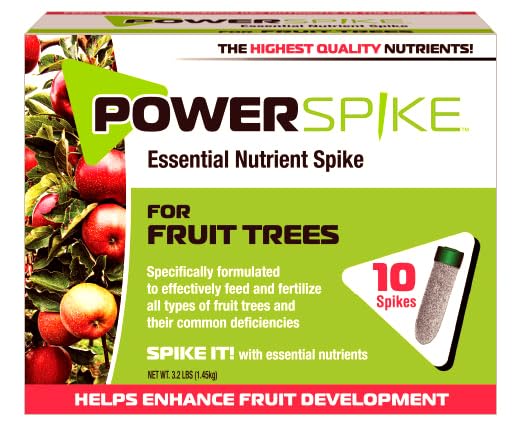
If you just planted a few young fruit trees (apples, peaches, or plums) and need to get their root systems established, this 10-spike pack from Power Spike is a practical choice. Its included plastic pounding cap sets it apart from the Jobe’s 5-pack, which expects you to hammer directly into the spike itself — a process that can crack them.
One reviewer noted that “I made a huge difference with my care tree at 96 pairs on the first time using the stakes.” The spikes come with a pounding cap, which makes it easy to drive them into the ground without them crumbling. Because they feed at the root zone directly, young feeder roots absorb the nutrients quickly, which is critical in the first year of growth.
The standout feature here is the included pounding cap — most other spikes expect you to hammer directly into the spike itself, which can crack them. This simple plastic cap means you get all 10 spikes into the ground intact, and the 3.2-pound density gives you more material per spike than almost any other mid-range option.
What stands out
- Includes a protective pounding cap — spikes don’t break on installation.
- 3.2 lb total weight means dense, nutrient-rich spikes.
- Formulated to fix common deficiencies in young fruit trees.
The trade-offs
- Some users reported no visible improvement in mature trees.
- NPK ratio is not listed on the package — less precise than competitors.
4. Jobe’s Organics Fruit & Citrus Tree Fertilizer Spikes, 3-5-5, 6 Spikes per Package (3)

For organic growers, the single number that matters most is the OMRI listing (the certification that guarantees no synthetic chemicals). This Jobe’s Organics pack scores perfectly on that, with a 3-5-5 NPK ratio that is deliberately low in nitrogen to prioritize flower and fruit production over leaf growth. The NPK gap here is 3.0x lower nitrogen than the standard 9-12-12 spike, which is exactly what you want for a tree that is already mature and just needs fruit support.
The catch you accept is the lower spike count — each package holds only 6 spikes, so you may need 3 or more packages for a full-size tree. Buyers confirm the results: one buyer mentioned “I get an abundance of juicy, sweet lemons every year!” The spikes also include Jobe’s Biozome, a proprietary microorganism (a beneficial bacteria) that breaks down organic matter faster in the soil, which improves root access to nutrients.
Price per spike is higher than synthetic options, but if you are growing food for your family and want to keep it chemical-free, this is the most reliable organic spike on the market. The certified organic label and the Biozome soil improvement make it worth the premium for the health-conscious grower.
The upsides
- OMRI listed — certified organic by USDA.
- Low nitrogen (3-5-5) encourages fruit instead of leaves.
- Biozome microbes improve long-term soil health.
Keep in mind
- Only 6 spikes per package — you will need multiple packs for mature trees.
- Higher cost per spike compared to synthetic alternatives.
5. SimplyGro Fertilizer Spikes for Citrus & Fruit Trees & Shrubs, 12 Spikes (3 Lbs)
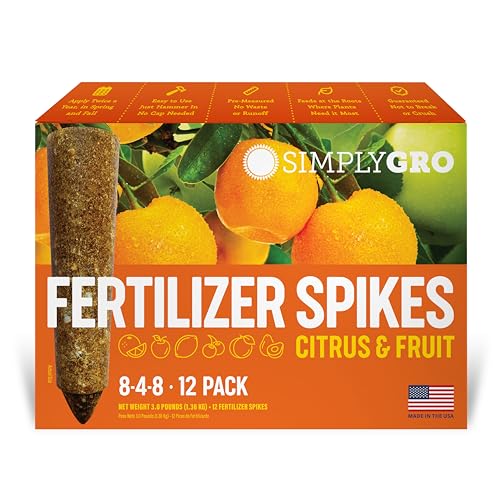
At this price tier you get 12 spikes with a specialized 8-4-8 NPK formula that is higher in potassium (the last number) to support fruit size and sweetness. The spikes are significantly denser than budget options — they weigh 3 pounds in total — and they are patented “TruSpikes” that the manufacturer guarantees will not break or crush when you hammer them in, so you never need a plastic cap like the Power Spike pack requires.
What that money actually buys you is a true “set it and forget it” system: each 5-inch spike feeds the tree continuously for up to 3 months. Reviewers report that the product “fertilizes apple and peach trees well” and that “2 of 3 peach trees will produce fruit this summer, loaded with small peaches.” The 8-4-8 ratio is particularly good for established trees because the high potassium directly boosts the quality of the fruit.
The one reason to choose SimplyGro over the competition is the break-resistant guarantee. Other spikes can crumble when you drive them into hard, dry soil. TruSpikes are engineered to stay intact, which means every spike delivers its full nutrient load instead of snapping into useless pieces. This is the perfect pick for the budget buyer who wants a no-fuss, durable spike that will not waste a single nutrient dose.
Why we’d pick it
- High potassium (8-4-8 NPK) drives bigger, sweeter fruit.
- Patented TruSpikes — guaranteed not to break during installation.
- 12 spikes cover multiple trees per season.
A few caveats
- Not OMRI listed — conventional synthetic fertilizer.
- Some users report slower results in the first month.
6. Miracle-Gro Fruit & Citrus Plant Food Spikes, 10-15-15 NPK, 12 Spikes (2-Pack)

This pick is perfect for the owner of mature, established fruit trees who wants the most aggressive NPK punch available in a spike — the 10-15-15 formula delivers intense phosphorus for root and flower development plus potassium for fruit quality. With 24 spikes total in this 2-pack, you can feed up to 4 large trees twice a year, making it a stronger option than the Jobe’s 15-pack for a larger established orchard.
The feature that serves that heavy-feeding buyer best is the proven Miracle-Gro formulation, which has been refined for decades. One long-time user noted that “these work great. Use them every fall on all of my fruit trees. Lots of fruit, and always sweet.” The spikes are easy to install by stepping on them or using a rubber mallet, and the slow-release mechanism feeds trees for months per application.
The honest limit is that some owners mention the spikes break easily if the soil is dry or rocky, so you may need to water the ground the day before installation to soften it.
Strong points
- Highest NPK ratio (10-15-15) for maximum fruit output.
- 24 spikes cover a large orchard for a full year.
- Trusted Miracle-Gro formulation — consistent results.
Before you buy
- Spikes can crumble in dry or compacted soil.
- Not organic — synthetic formula may not suit all growers.
7. Winchester Gardens Landscaper Pack, 8-18-18, 70 Spikes

When you compare price per spike across the whole field, this 70-count case from Winchester Gardens is the most economical option for anyone with 10 or more trees. The 8-18-18 NPK ratio has the highest phosphorus and potassium on our list, which is specifically designed for bearing fruit trees — it tells the tree to put energy into fruit, not foliage.
What that money actually buys you is a full year of feeding for a home orchard of about 8 to 12 mature trees. The spikes weigh 18 pounds combined, giving you dense, heavy stakes. One buyer with a 50-tree orchard wrote, “Ideal for bearing fruit trees. Low nitrogen ratio promotes fruit over foliage. Very affordable vs. garden centers. Produced largest apple haul.” The spikes are child and pet-friendly once installed, and they produce zero runoff.
The field-vs-this value line is simple: if you have more than 5 trees, buying individually boxed packets becomes wasteful and expensive. This single case solves the entire problem in one purchase with the lowest cost per spike and a ratio that is optimized for trees that are already established and bearing.
What we like
- Highest phosphorus and potassium ratio (8-18-18) for heavy fruiting.
- 70 spikes — lowest cost per spike in this roundup.
- Child and pet-friendly with zero runoff.
The downsides
- Overkill for a single tree — you will have spikes for years.
- Hard to install in dry soil; best applied after rain.
Understanding the Specs
NPK Ratio
These three numbers are the most important spec on the box. The first number (N) is nitrogen for leaf growth. The second (P) is phosphorus for roots and flowers. The third (K) is potassium for fruit size and sweetness. Fruit trees generally need more P and K than N — look for ratios where the last two numbers are higher, like 9-12-12 or 8-18-18.
Spike Count Per Pack
Each spike feeds a specific area around the tree’s drip line (the circle under the outer edge of the branches). A small tree (2-inch trunk diameter) might need 2–3 spikes. A large tree (6-inch trunk) could need 8–10. Match the pack size to your number of trees and their sizes to avoid overbuying or underfeeding.
Slow Release Duration
Most spikes are formulated to release nutrients over 2 to 6 months. This prevents root burn (which happens when the tree gets too much fertilizer at once) and means you only need to apply spikes twice a year — once in early spring and once in late fall.
Organic Certification
OMRI-listed spikes (certified by the Organic Materials Review Institute) guarantee no synthetic chemicals. If you grow fruit for your family and want to avoid synthetic fertilizers, look for this label. Synthetic spikes usually have higher NPK numbers, but organic spikes improve soil health over time.
FAQ
How many fertilizer spikes do I need per tree?
Can I use regular garden fertilizer spikes on fruit trees?
When is the best time to apply fertilizer spikes to fruit trees?
Do fertilizer spikes work as well as granular fertilizer?
Can I use fertilizer spikes on potted fruit trees?
Final Thoughts: The Verdict
When it comes down to it, the fertilizer spikes for fruit trees winner is the Jobe’s 15 Count because it offers the best balance of spike count (15), proven NPK ratio (9-12-12), and real-world results for 2–3 trees. If you want an organic option that protects your soil and fruit from synthetic chemicals, grab the Jobe’s Organics 6-Pack. And for a large home orchard where per-spike cost matters most, the Winchester Gardens Landscaper Pack of 70 gives you the lowest cost per spike with an 8-18-18 NPK ratio designed for heavy bearing trees.