
Specs are compiled from manufacturer listings and verified buyer reviews and can change over time — please confirm the key details on the product page before buying.
Putting down the right winter fertilizer is what separates a lawn that bounces back green in early spring from one that stays patchy and weak through April. The wrong mix either washes away before your grass uses it or pushes growth at the wrong time, leaving your turf vulnerable to frost damage.
I’m Rikta — the founder and writer behind Lawn Gear Lab. This guide is built by comparing the manufacturers’ published specifications and the patterns across verified customer reviews, so you get each pick’s real strengths and trade-offs instead of marketing spin.
Below, you will find the four best fertilizers for winter grass that actually deliver on their promises, along with a simple breakdown of what the nitrogen-phosphorus-potassium numbers mean and when to apply each bag for a thick, healthy lawn next year.fertilizer for winter grass.
Quick Picks
- Jonathan Green (12414) Winter Survival Fall — Best Overall
- Scotts Turf Builder WinterGuard Fall Lawn Food — Top Performer
- Green Thumb GT58105 Winterizer Lawn Fertilizer — Best Value
- Scotts Turf Builder WinterGuard Fall Weed & — Weed Killer Combo
How To Choose The Best Fertilizer For Winter Grass
Winter grass fertilizer — often called winterizer — works differently from your summer or spring blends. While summer food pushes leaf growth and green color fast, a winter formula focuses on root development and energy storage so your lawn can survive cold stress and come back strong. Here is what to check before you buy.
Check the N-P-K Ratio: Potassium is Key
The three numbers on the bag represent nitrogen (N), phosphorus (P), and potassium (K). A good winterizer has higher potassium (the third number) and very little or no phosphorus because phosphorus runoff is restricted in many areas. Look for a high K value, such as 10-0-20 or 32-0-10, which encourages deep root growth and helps the grass store carbohydrates for the winter.
Coverage Area vs. Your Lawn Size
Winterizer bags cover vastly different areas — some treat 4,000 square feet while a premium bag can cover 15,000 square feet. Measure your lawn’s square footage (multiply length by width for rectangular areas) and choose a bag that matches your yard. A single bag might not be enough for a half-acre lawn, so check the coverage number on the label.
Weed and Feed vs. Straight Fertilizer
If your lawn has visible winter weeds like clover or dandelion, a weed-and-feed winterizer can clear them while feeding the grass. But you must apply it when weeds are actively growing and air temps are between 60°F and 90°F — a narrower window than straight winterizer. Straight fertilizer is more forgiving with timing and works on all grass types without risk of damaging nearby flowers or shrubs.
Quick Comparison
| Model | Best For | N-P-K Ratio | Coverage | Weight | Amazon |
|---|---|---|---|---|---|
| Jonathan Green Winter Survival | Large lawns & early spring green-up | 10-0-20 | 15,000 sq. ft. | 45.1 lbs. | Amazon |
| Scotts WinterGuard Fall Lawn Food | Universal compatibility & root strength | 32-0-10 | 12,000 sq. ft. | 32.3 lbs. | Amazon |
| Green Thumb Winterizer | Budget-friendly & slow-release feeding | 32-0-10 | 5,000 sq. ft. | 12.6 lbs. | Amazon |
| Scotts WinterGuard Fall Weed & Feed₃ | Weed control plus fall feeding | N/A | 4,000 sq. ft. | 11.4 lbs. | Amazon |
In‑Depth Reviews
1. Jonathan Green (12414) Winter Survival Fall Lawn Food

A big 45-pound bag that preps an entire large lawn for winter in one trip.
The slow-release nitrogen keeps grass greener later into fall without pushing growth so fast that it damages easily. Buyers report applying this in early November in the Northeast and seeing a visibly healthier lawn by mid-December compared to areas they left untreated.
The weight is 45.1 pounds, so expect a heavy bag, but it means you do not need a second one for a standard yard. The granules are large enough that some users found their spreader needed a higher setting to avoid streaks. One reviewer noted they plan to use a higher dose next year because their spreader applied it unevenly on the first pass.
The recommended schedule is an application early in fall followed by a second one in the first week of November for the best early spring green-up. It works on any turfgrass type.
What sells it
- Enormous coverage of 15,000 sq. ft. saves time and money per application
- High potassium (20) promotes deep rooting and winter storage
- Works as a repair product for summer-damaged lawns before cold sets in
What to watch for
- Heavy bag at 45.1 lbs. is tough to carry across a large yard
- Large granules can cause uneven coverage with some rotary spreaders
Who this fits: Homeowners with a quarter-acre or larger lawn who want a single bag to handle the whole job and are willing to calibrate their spreader carefully.
Where it falls short: If your spreader struggles with large particles or you prefer a lighter bag for easy handling, the more compact options below will be easier to manage.
2. Scotts Turf Builder WinterGuard Fall Lawn Food

A straightforward winterizer that works on any grass type with no guesswork.
While the Jonathan Green leads on coverage, the Scotts WinterGuard Fall Lawn Food uses a 32-0-10 formula — that is a high-nitrogen approach for root recovery from summer stress while still delivering potassium for winter hardiness. It covers 12,000 square feet from a 32.3-pound bag, at 32.3 lbs versus the Jonathan Green’s 45.1 lbs for slightly less but still generous coverage. One reviewer in a colder climate reported that this fertilizer brought their grass to life in late fall, and even at 25 degrees outside the grass stayed bright green without growing wild.
The real strength is simplicity: apply it to a wet or dry lawn in the fall and it works on any grass type, including thin or newly established lawns. Another buyer noted that it helped stabilize a freshly grown lawn that only gets a few hours of sun a day, keeping it healthy through the cold months. Unlike weed-and-feed products, this has no temperature restrictions — you can spread it later in the season right before the ground freezes.
One weakness versus the top pick is coverage: the 12,000 sq. ft. is 25% less than the Jonathan Green’s 15,000 sq. ft., so very large lawns may need two bags.
Reasons to grab it
- Versatile formula works on every grass type, including newly seeded areas
- 32.3 lb. bag is easier to carry than 45 lb. options
- Supports deep root growth even under low-light conditions
Things to know
- Covers 12,000 sq. ft. vs the 15,000 sq. ft. of the top pick
- Higher nitrogen means careful timing to avoid overfeeding in very mild winters
Best for: Those who want a reliable, no-surprise winterizer that mixes easily with their existing lawn care routine and works on patchy or new grass.
skip it if: You need a larger single-bag coverage for a big yard — the Jonathan Green above is a better fit.
3. Green Thumb GT58105 Winterizer Lawn Fertilizer
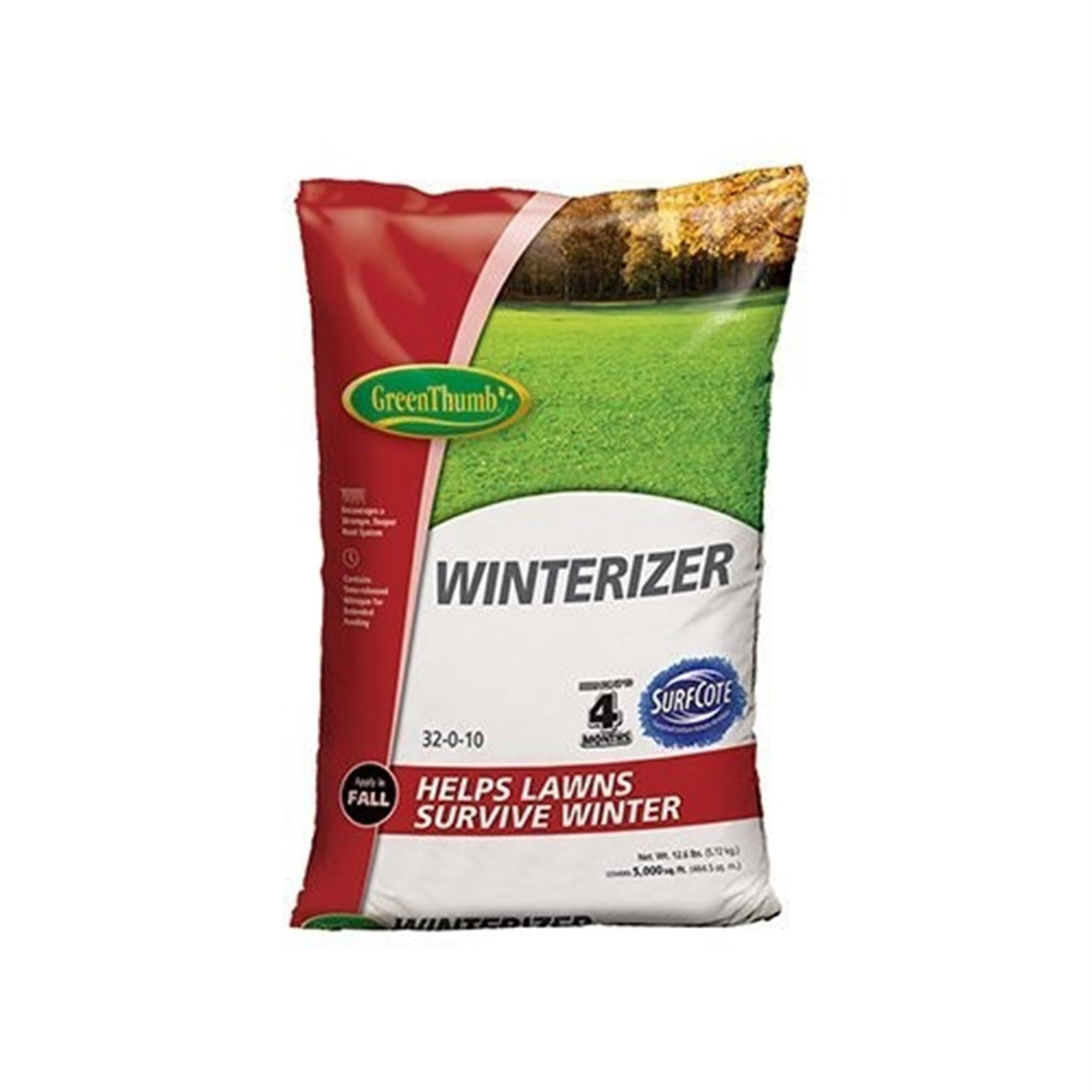
A 5,000-square-foot bag that feeds slowly for up to 16 weeks through the cold season.
The Green Thumb Winterizer is a budget-friendly 32-0-10 powder formula that includes 50% controlled-release nitrogen and 2% iron for deep greening. That is a third of the Scotts Fall Lawn Food’s coverage, so you will need three bags if you have a 15,000-square-foot lawn, though the lower upfront cost per bag makes that trade-off manageable for smaller yards.
The controlled-release nitrogen means it continuously feeds for up to 16 weeks, so a single late-fall application can carry your lawn through winter without a second spread. Buyers who applied this in late November reported that the springtime green-up was just as promised. One buyer mentioned that it spreads easily with balanced nutrients and performs comparably to other winter fertilizers at a reasonable cost per use.
The big limitation versus the Scotts and Jonathan Green bags is coverage. For any yard over 6,000 square feet, you will need to buy multiple packs, which may eat into the value advantage.
Why it works
- Controlled-release nitrogen feeds for up to 16 weeks over winter
- 2% iron gives visible deep greening in early spring
- Light 12.6 lb. bag is easy to lift and carry
Where it falls short
- Covers only 5,000 square feet — large lawns will need multiple bags
- Powder form may clump in humid conditions if not stored dry
Perfect for small to medium lawns: If your yard is 5,000 square feet or smaller, this bag gives you slow-release feeding all winter at a low entry price.
Think twice if: You have a large lawn (over 8,000 square feet) — the coverage gap versus the top picks makes the larger bags more practical.
4. Scotts Turf Builder WinterGuard Fall Weed & Feed₃

A dual-action bag that kills weeds and feeds grass at the same time.
The Scotts WinterGuard Weed & Feed₃ is the one to grab if your lawn has visible clover, dandelion, plantain, or other broadleaf weeds heading into winter. It kills over 50 listed lawn weeds while supplying fall nutrients at the same time. Buyers confirm that it effectively killed clover within weeks, though one owner reported dead grass streaks caused by spreader overlap, so careful application matters.
The trade-off is timing. Unlike a straight winterizer you can apply late in the season, this weed-and-feed works best when temperatures are consistently between 60°F and 90°F and weeds are actively growing — which in many regions means early to mid-fall rather than late November. It works on Bahiagrass, Bermudagrass, Bluegrass, Centipedegrass, Fescue, Ryegrass, and Zoysiagrass.
If you miss that temperature window or your lawn has only a few weeds, the straight winterizer options above give you more flexibility for late-fall application.
What stands out
- Kills over 50 weed types, including clover and dandelion
- Combines weed control and fertilization in one application
- Works on 7 common grass types
What to plan for
- Coverage of only 4,000 sq. ft. — smallest bag in this list
- Requires a narrow temperature window (60°F–90°F) for effectiveness
- User error with spreader can cause dead grass streaks
Reach for this if: Your lawn has visible clover or dandelion in early fall and you want to knock out weeds while feeding the grass in one pass.
Look elsewhere if: You missed the 60–90°F weather window or your lawn is weed-free — straight winterizers give you more coverage and later application flexibility.
Understanding the Specs
N-P-K Ratio (Nitrogen-Phosphorus-Potassium)
These three numbers are the backbone of any fertilizer. The first number (N) pushes green top growth. The second (P) supports root development in new lawns but is banned in many states due to runoff concerns — winterizers often use 0 here. The third number (K) is the winter star: potassium strengthens cell walls and helps grass store carbohydrates so it survives frost and drought stress. A good winterizer has a high third number, like 20 or 10.
Coverage Area (Square Feet per Bag)
This tells you how much ground a single bag treats. Bags range from 4,000 sq. ft. (smaller, lighter bags ideal for narrow yards) up to 15,000 sq. ft. (heavy bags that cover an entire standard property). Measure your lawn once and match it to the bag’s coverage — buying too small means you will run short mid-application, buying too large means you are storing half a bag of granules that may clump by next winter.
Controlled-Release Nitrogen
Also called slow-release nitrogen, this type of nitrogen breaks down gradually over weeks or months rather than all at once. For winter use, controlled-release is valuable because it feeds the lawn slowly through late fall and into early winter without causing a sudden growth spurt that would then get damaged by frost. Some bags specify the duration — up to 16 weeks — which means one application can cover the entire dormant season.
Weed & Feed vs. Straight Winterizer
A weed-and-feed product contains a herbicide mixed with fertilizer. It saves you a step if you have broadleaf weeds, but it requires precise temperature conditions (typically 60°F–90°F) and the weeds must be actively growing. A straight winterizer has no herbicide, so you can apply it later in the season, even when temperatures have dropped, without worrying about damaging nearby plants or missing the weed-killing window.
FAQ
What does a winterizer fertilizer actually do for my lawn?
When should I apply fertilizer for winter grass?
Can I use a regular high-nitrogen lawn fertilizer in winter?
How many square feet does a typical winterizer bag cover?
Do I need to water in winter fertilizer after applying it?
Will winter fertilizer make my grass grow when it is snowing?
Can I apply winter fertilizer on new grass seed or sod?
What does 32-0-10 or 10-0-20 mean on the bag?
Do I need to apply winter fertilizer every year?
Can I use a winterizer on my pasture or field instead of just my lawn?
Final Thoughts: The Verdict
For most homeowners, the fertilizer for winter grass you can rely on is the Jonathan Green Winter Survival (12414) because it covers the most ground per bag at 15,000 square feet and its high-potassium 10-0-20 formula builds the strongest root system for spring. If you want a high-nitrogen winterizer that works on any grass type, grab the Scotts WinterGuard Fall Lawn Food. And for smaller lawns that need slow-release feeding at a lower upfront cost, the Green Thumb GT58105 delivers controlled-release nitrogen for up to 16 weeks without the heavy bag or high price.
How We Picked
We do not accept paid placement. Every pick is matched to a real buyer and a real use-case; we do not hands-on test units.
Sources & Methodology
Specifications: manufacturer listings and product documentation. Review insights: verified customer reviews, as of July 2026. Pricing: not shown on this page (it changes often); check the current price via the retailer link.
As an Amazon Associate, Lawn Gear Lab earns from qualifying purchases. This does not affect which products we feature.