
Specs are compiled from manufacturer listings and verified buyer reviews and can change over time — please confirm the key details on the product page before buying.
You want lush, vibrant growth from your aquatic plants without turning your tank into a pea-soup mess or, worse, harming your fish. The problem is that most general plant foods dump in phosphates and nitrates that fuel algae and can stress your aquarium’s delicate residents. This guide breaks down the best liquid and tablet formulas that feed your plants while keeping the water clear and your critters safe.
I’m Rikta — the founder and writer behind Lawn Gear Lab. This guide is built by comparing the manufacturers’ published specifications and the patterns across verified customer reviews, so you get each pick’s real strengths and trade-offs instead of marketing spin.
Whether you keep a nano shrimp tank, a sprawling koi pond, or a high-tech planted aquarium, the right nutrition makes all the difference. Here is our deep dive into the best fertilizer for water plants.
Our Picks at a Glance

How To Choose The Best Fertilizer For Water Plants
Your aquatic plants need different food depending on where they grow — a still koi pond has very different needs than a CO2-injected aquarium. Here are the three factors to weigh before you buy.
Liquid All-in-One Versus Root Tablets
Liquid fertilizers get absorbed directly through leaves and stems, making them ideal for floating plants, mosses, and any plant with roots that don’t reach substrate. Root tabs, on the other hand, are pushed into the gravel or soil and feed the root system directly. Pond lilies and heavy root-feeders like Cryptocoryne demand tabs; stem plants and floaters respond faster to liquids. Many aquarists use both — a liquid weekly dose plus a fresh tab every few months.
Safety for Fish, Shrimp, and Snails
Copper is toxic to invertebrates at surprisingly low levels, so shrimp keepers must check the label. Many brands now advertise “shrimp safe” or “zero copper.” The same goes for phosphates and nitrates — a fertilizer that adds these can trigger algae blooms in a tank that already has fish waste. The best formulas either leave them out or balance them precisely so your plants use every bit before algae can.
Concentration and Tank Size
A highly concentrated liquid, like one that doses 2,500 gallons from a single 500 ml bottle, goes a lot further than a weaker mix. For a small nano tank, a few drops per week may last months. For a 75-gallon planted display, you want a formula that doesn’t require you to buy a new bottle every other week. Check the dose-per-gallon spec: larger tanks reward concentrated solutions, while small tanks benefit from a formula that is easy to measure in tiny amounts.
Quick Comparison
| Model | Best For | Form | Volume / Count | Dosing Rate | Amazon |
|---|---|---|---|---|---|
| ThriveS Shrimp All‑in‑One★ Best Overall | Shrimp Tanks | Liquid | 500 ml | Pump per directions | Amazon |
| Crystalpro Flora Multi MineralsAlgae Buster | Algae-Free Growth | Liquid | 16.9 fl oz | 5 ml per 30 gal | Amazon |
| MICROBE-LIFT All in OneSolid Performa | General Aquariums | Liquid | 16 fl oz | 1 tsp. per 30 gal | Amazon |
| CrystalClear Thrive Pond | Pond Lilies & Lotus | Tablets | 60 Count | 1-2 per gal of soil | Amazon |
| Aquarium Plant Root Tabs | Root-Feeding Aquarium Plants | Tablets | 40 Count | Slow-release tab | Amazon |
| Pondtabbs 60ct | Koi Ponds & Water Gardens | Tablets | 60 Count | Once a month | Amazon |
| 2HR Aquarist APT 3 | High-Tech CO2 Tanks | Liquid | 300 ml | 3 ml per 100L | Amazon |
| Thrive+ All in One | Aggressive Growth | Liquid | 500 ml | Pump per directions | Amazon |
| 2HR Aquarist APT 1 | Fish-Heavy Tanks | Liquid | 600 ml | Pump per directions | Amazon |
In‑Depth Reviews
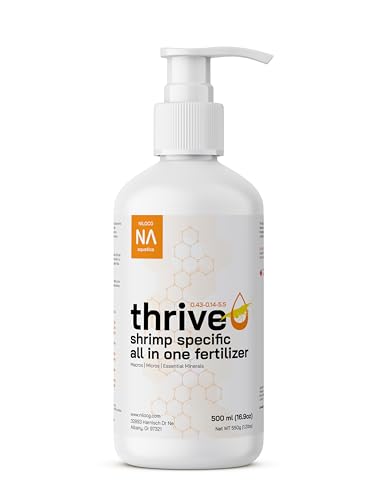
1. ThriveS Shrimp All‑in‑One Aquarium Fertilizer
Our pick — over 4.5★ from 900+ verified ratings; the strongest balance of quality and price.
The crowd favorite that revives dying plants without upsetting a single shrimp.
This fertilizer is built specifically for shrimp tanks with live plants, so you get all the macro and micro nutrients your greenery needs without changing your water change schedule or harming invertebrates. Each 500 ml bottle is concentrated enough to dose 2,500 gallons of water — that is serious mileage from one bottle.
Buyers report it revived near-dead water lettuce in a 20-gallon Walstad tank suffering from nitrogen deficiency, with owners noting plants went from withered to bursting with new growth in under a week. The shrimp health aspect is the most-discussed feature alongside sheer effectiveness. A single pump dispenses the right dose, and the instructions on the bottle take the guesswork out. One owner of a 4.5-gallon nano tank sums it up: “my shrimp are not bothered by it… my plants are nice & green. SHRIMP SAFE!”
What wins people over
- Brings yellowing, near-dead plants back in days — buyers call it “the best fertilizer they’ve tried.”
- Requires no mixing or measuring; the pump bottle makes weekly dosing trivial.
- Proven safe for neocaridina shrimp, snails, and all fish in the tank.
The honest trade-off
- Some owners on the fence about value-for-money note it is pricier per bottle than basic brands.
- Not ideal for ponds or root-feeding plants that need substrate tabs.
Reach for this if: you keep shrimp or sensitive inverts and want a liquid feed that grows plants fast without risking your colony.
Look elsewhere if: you need a pond tablet or are on the tightest possible budget and don’t mind mixing your own dry salts.
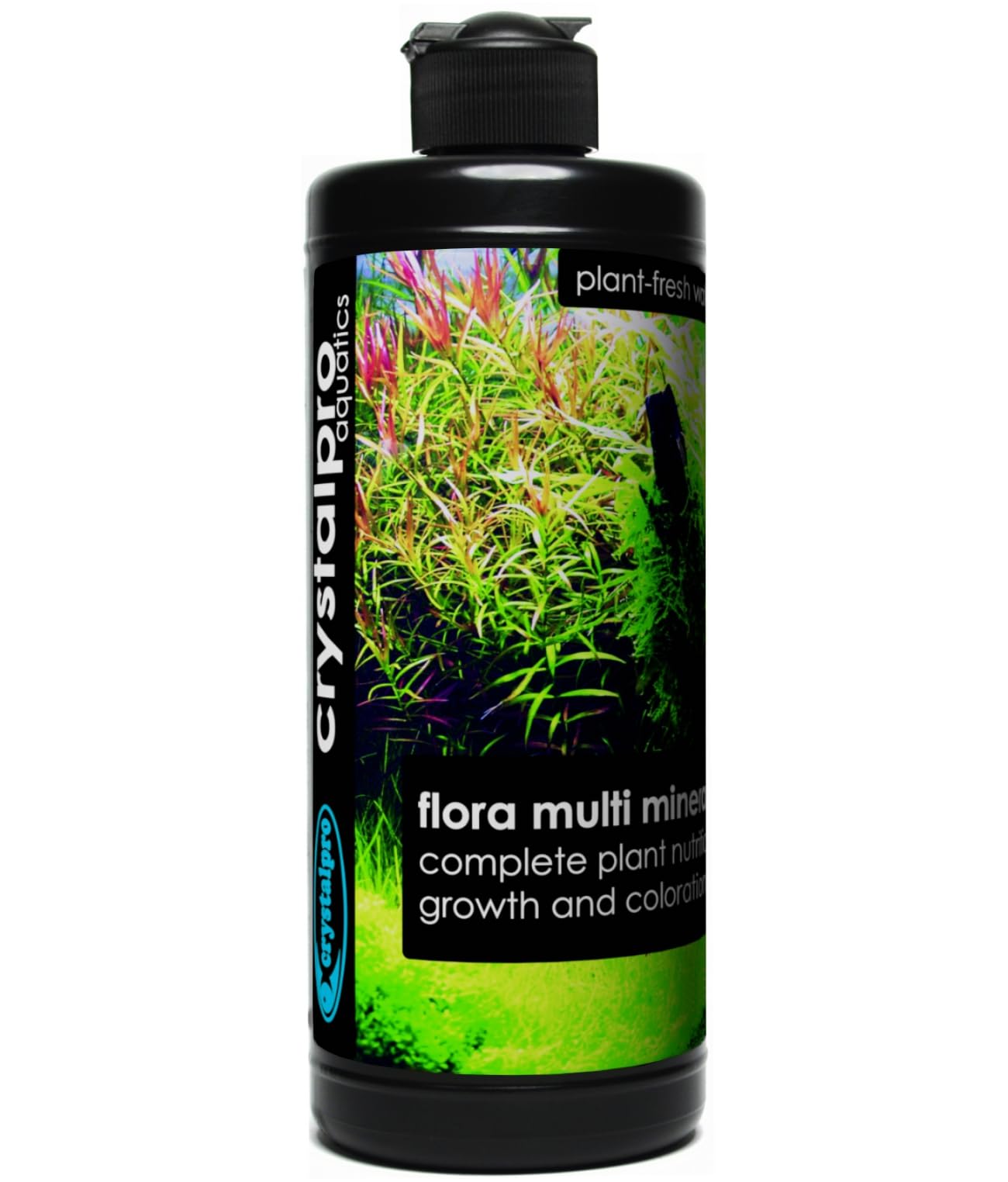
2. Crystalpro Flora Multi Minerals All-in-One
The formula that cleans up green water while making plants explode with color.
The bottle holds 16.9 fluid ounces. The dosing is simple: add 5 ml per 30 gallons once or twice a week. The only recurring note from owners is that the bottle lacks clear frequency instructions, so new aquarists should jot down the schedule themselves. For the price, it is tough to top the value.
Best for tanks battling algae: the zero-phosphate, zero-silicate approach stops blooms before they start.
One caveat: the missing dosage-frequency label means you’ll need to look up the instructions online or remember your own schedule.
Grab this when: your tank has persistent green water or algae and you want a fertilizer that won’t make it worse.
skip it if: you prefer a pre-printed dosing schedule right on the bottle.
3. MICROBE-LIFT All in One Aquatic Plant Fertilizer
The unassuming bottle that keeps shrimp tanks lush and roots deep.
MICROBE-LIFT focuses on what happens below the substrate. Its formula is specifically designed to promote root and plant growth, improving the coloring of your aquatic greenery by supporting a healthy bacterial level in the tank. The 16 fl oz bottle weighs 473 g and holds 473 ml of liquid. A single teaspoon doses 30 gallons, so the bottle stretches far.
Reviews from planted shrimp tank owners (15 gallons) confirm it works well without harming the colony. The brand’s customer service also gets high marks — a leaking bottle was replaced promptly and without hassle. The honest trade-off, as one long-time user puts it, is that it is “almost as good” as their usual premium line, but not quite at the top tier. If you want a dependable, no-drama liquid feed that won’t break the bank, this delivers.
A reliable workhorse: proven effective for root growth and general plant health in community and shrimp tanks.
The honest limit: enthusiasts with high-tech CO2 setups may find it slightly less potent than specialized premium blends.
Stick with this if: you want a straightforward liquid fertilizer with great customer support and a track record for shrimp safety.
Consider something else if: you run a high-energy CO2 tank and want the absolute fastest growth rates.
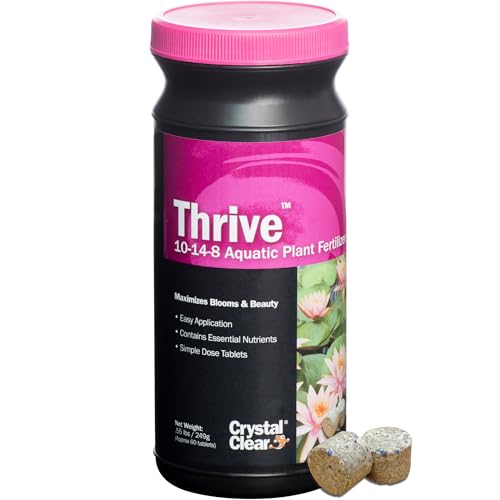
4. CrystalClear Thrive Pond Plant Food
The tablet that turns a struggling pond lily into a blooming machine.
Stepping outside the aquarium, this is the pick for outdoor water gardens. CrystalClear Thrive comes as 60 tablets with a 10-14-8 NPK ratio — meaning it is high in phosphate to fuel massive flower blooms. Each tablet is pushed into the aquatic soil near the plant’s roots; use 1-2 per water lily and 4 per lotus. Owners mention water lilies that hadn’t bloomed in years put out spectacular flowers within three weeks of the first dose. The water stays clear, and the tablets are safe for koi, goldfish, frogs, and snails.
The drawback the data flags is durability: several owners note the tablets are soft and can crumble into powder during handling, making them a bit fiddly to insert without breaking. The effectiveness and plant growth are the top praised aspects, though. For the price, this is a strong buy for any pond owner who wants more blooms with less effort.
Perfect for ponds: the high phosphate content drives lily and lotus blooms like nothing else at this price.
The catch: the tablets are fragile and can crumble — handle them over the pot, not the ground.
Use this for: outdoor water gardens with lilies, lotus, and other flowering aquatic plants where you want visible blooms in weeks.
Pass on this if: you have a small indoor aquarium — these are pond tabs, not for tank use.
5. Aquarium Plant Root Fertilizer Tabs 40 Count

A cube-based tab that won’t crumble or float away during insertion.
These root tabs are a different beast from the pond tablets above. They are designed for aquarium substrate — gravel, sand, or aquasoil — and come in a slow-release form that supplies nitrogen, phosphorus, potassium, iron, magnesium, and a suite of trace elements. The stand-out design feature is that the tabs are cubes, not powders pressed into tablets, so they do not crumble when you poke them into the substrate. They also sink and stay put rather than floating back up.
In a 20-gallon tank, customers note the tabs dramatically accelerated growth of crypts and java fern. The honest warning from some owners is that the phosphate release can trigger a brown algae outbreak, especially in tanks without algae-eating fish like otocinclus. The effectiveness and plant growth are the most-discussed positives by a large margin. For root-feeding plants that struggle to get nutrients from the water column, these tabs are a straightforward fix.
What owners love
- Cube design stays intact, doesn’t crumble like pressed tablets, and sinks without floating.
- Dramatic growth improvement for heavy root-feeders like crypts and java fern.
- Balanced micronutrient blend covers N, P, K, Fe, Mg, Mn, Zn, Mo, B, Co, Ni.
What to watch for
- Phosphate in the formula can trigger brown algae blooms in some tanks.
- Value-for-money and durability get mixed feedback — some tabs dissolve faster than expected.
Buy these for: heavy root-feeders in aquariums where liquid fertilizers alone leave plants pale and stunted.
Skip them if: you already struggle with algae and do not have clean-up crew fish like otos or nerite snails.
6. Pondtabbs 60ct

The pellet that keeps its shape and triples your pond blooms.
Pondtabbs is a long-standing name in the water garden world, and these slow-release tablets are built for koi ponds, water gardens, fountains, and natural ponds. Each tablet packs a high concentration of nitrogen, phosphorus, and potassium (with a 10-14-8 ratio) to push lush foliage and bright flowers. Reviewers point out that, unlike competitor products that disintegrate into dust, these pellets hold their shape, making them easy to push into the soil near the base of your plants.
One owner says they “tripled my blooms” using the tabs once a month during warm weather. The quality and effectiveness are the top-rated aspects by a wide margin. The predictable downside — as with many pressed tablets — is durability: some units arrive as dust or crumble during handling, which is the single most-discussed negative. If you get a solid batch, they work exceptionally well for lilies, lotus, and marginal pond plants.
Proven pond performer: the 10-14-8 NPK ratio is spot-on for driving huge blooms in water lilies and lotus.
The known risk: some containers arrive with broken or powdered tablets — buy from a seller with good packaging feedback.
Best for: pond owners who want a reliable, slow-release tablet that doesn’t dissolve instantly and delivers visible bloom results.
Not ideal if: you want a 100% dust-free guarantee — occasional breakage is a known issue.
7. 2HR Aquarist APT 3 / Complete (300ml)

The fertilizer that makes demanding red plants pop without fueling algae.
This is the specialist’s choice. APT 3 is a 100% comprehensive all-in-one fertilizer with macro NPK plus micro iron, magnesium, and vital trace minerals. It is designed for high-energy tanks with CO2 injection and strong lighting. The dosing is precise: 3 ml per 100 liters of water. Owners using it in CO2-injected tanks report that stem plants grow noticeably faster and red coloration deepens within weeks. One long-time aquarist calls it “some of the best ferts on the market.”
The formula is designed so that algae does not increase when you dose correctly — a claim that the review pages back up, with many owners noting a reduction or complete lack of algae. The 300 ml bottle weighs 340 g, lighter than the MICROBE-LIFT. The trade-off for this performance is that the bottle is smaller and costs more than many competitors. It is also best suited to tanks with balanced lighting and CO2; low-tech tanks may not see the same dramatic results.
For the planted tank enthusiast: APT 3 open up the full potential of demanding species and delivers vibrant reds and fast stem growth.
The catch: it requires a balanced CO2 and lighting setup to truly shine, and the 300 ml bottle runs out faster than cheaper bulk options.
Choose this if: you run a CO2-injected high-tech tank and want the best color and growth from your plants without algae.
pass on it if: you have a low-tech tank or a tight budget — you will not see the full benefit and the cost per dose is high.
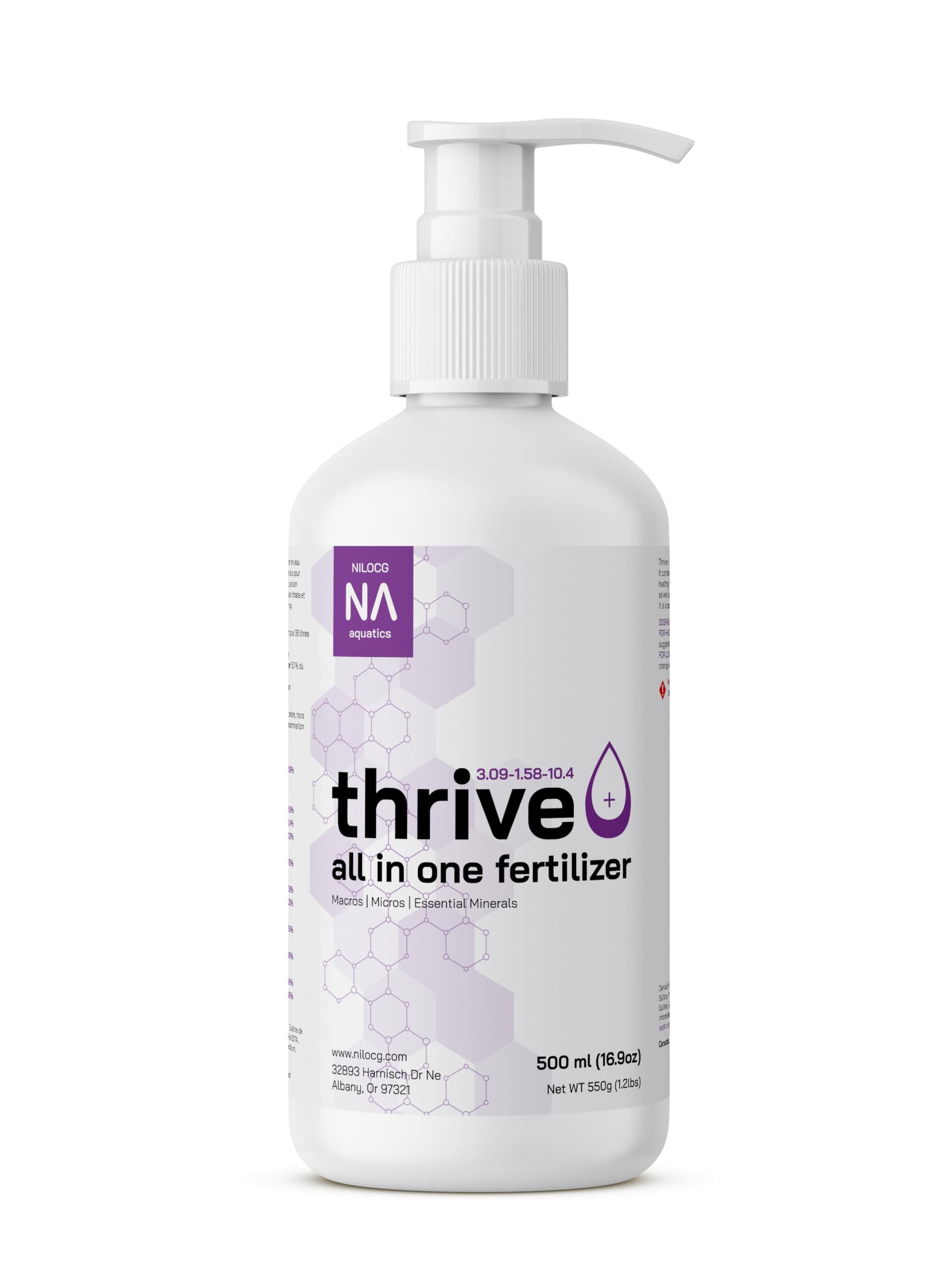
8. Thrive+ All in One Liquid Aquarium Plant Fertilizer
The all-in-one that replaces five bottles and turns Java fern into a jungle.
Thrive+ is the sibling of the ThriveS formula but designed for tanks without invertebrate concerns. It packs macro and micro nutrients into a concentrated 500 ml bottle that doses up to 2,500 gallons of water — the same stunning coverage as its shrimp-safe cousin. Each pump delivers a precise dose, and the formula is suitable for both high-tech setups (pH under 7) and low-tech tanks. Buyers frequently report that it replaces four or five separate Seachem products, simplifying the dosing routine to one bottle.
The plant health and effectiveness are the top praised aspects. One owner of a 75-gallon tank says the floaters “have taken over” after regular use. However, the data flags a mixed verdict on fish health: a small number of owners reported that the fertilizer killed some fish, likely from over-dosing or a tank that was already unstable. The manufacturer recommends starting with a low dose and increasing slowly. For most, the explosive growth and easy pump bottle make it a daily-driver favorite.
Why it’s a top seller
- One product replaces multiple specialized bottles — the ultimate simplification for busy aquarists.
- Highly concentrated: the 500 ml bottle handles up to 2,500 gallons.
- Pump dispenser makes dosing mess-free and repeatable.
What to be careful about
- A minority of shoppers say fish deaths linked to the fertilizer — start with a low dose.
- Can cause an explosion of floating plants that may need manual thinning.
Reach for this if: you want a powerful all-in-one that delivers fast, visible results and simplifies your tank maintenance.
Be cautious if: you have a new or unstable tank — start with half the recommended dose to avoid shocking fish.
9. 2HR Aquarist APT 1 (600ml)

The zero-nitrate, zero-phosphate formula for tanks that are already full of fish waste.
APT 1 is the sibling formula to APT 3 and is designed for tanks with a heavy fish load. The key difference is that it introduces macro and micro nutrients plus iron, magnesium, and trace minerals but with zero phosphates and zero nitrates. That is critical because in a tank with lots of fish, the fish waste already provides phosphate and nitrate; adding more from fertilizer feeds algae. This formula gives plants exactly what the fish waste does not provide, without pushing the water parameters out of balance.
Owners switching from other brands report a stunning difference — “no more sludge, algae, or film” and plants growing huge and fast within two weeks. The top positive aspect is algae resistance, followed closely by effectiveness. The 600 ml bottle is the largest in the 2HR range and weighs 750 g. The honest downside is the cost: daily dosing for a large tank adds up quickly, and a few owners note it is “costly” for a 75-gallon setup. But for a tank that is plagued by algae whenever you add regular fertilizer, this is the reset button.
Perfect for fish-heavy tanks: the zero-N, zero-P approach prevents the algae blooms that standard ferts trigger.
The honest trade-off: daily dosing means the bottle empties faster than you’d like, and the price per dose is higher than basic all-in-ones.
Best for: heavily stocked community tanks where algae is a constant battle and standard fertilizers make it worse.
it’s not for you if: your tank has few fish and you need a source of nitrates and phosphates to feed the plants.
Understanding the Specs
NPK Ratio (Nitrogen, Phosphorus, Potassium)
These three numbers tell you what the fertilizer prioritizes. A high first number (nitrogen) pushes leaf and stem growth — great for floaters and stem plants. A high middle number (phosphorus) drives root development and flower blooms, which is why pond lily tabs often have a 10-14-8 ratio. A high last number (potassium) supports overall plant health and disease resistance. If your tank already has fish waste, you want a formula with zero or low phosphorus and nitrogen to avoid algae.
Liquid vs. Root Tabs
Liquid fertilizers are absorbed through leaves and are best for stem plants, mosses, and floaters. They spread evenly through the water column. Root tabs are pushed into the substrate and feed the root system directly, which is essential for plants like crypts, swords, and lilies that draw most of their nutrition from the roots. Many aquarists use both: a weekly liquid dose for the water column plus a fresh root tab every couple of months for heavy root-feeders.
FAQ
Can I use a pond fertilizer tablet in my aquarium?
How often should I dose liquid fertilizer in a planted tank?
Will fertilizer with copper kill my shrimp?
What is the difference between APT 1 and APT 3 from 2HR Aquarist?
How long does a 500 ml bottle of liquid fertilizer last?
Do root tabs cause algae?
Can I use aquarium fertilizer in a pond?
What do the numbers in “10-14-8” mean on a fertilizer label?
Is it okay to double the dose for faster plant growth?
Final Thoughts: The Verdict
Across the board, the best fertilizer for water plants winner is the ThriveS Shrimp All‑in‑One because it combines explosive plant growth with proven shrimp safety in a mega-concentrated 500 ml bottle. If you want a formula that actively stops algae while feeding your plants, grab the Crystalpro Flora Multi Minerals. And for outdoor pond owners chasing huge water lily blooms, the CrystalClear Thrive Pond Tablets are the ones to reach for.
How We Picked
We do not accept paid placement. Every pick is matched to a real buyer and a real use-case; we do not hands-on test units.
Sources & Methodology
Specifications: manufacturer listings and product documentation. Review insights: verified customer reviews, as of July 2026. Pricing: not shown on this page (it changes often); check the current price via the retailer link.
As an Amazon Associate, Lawn Gear Lab earns from qualifying purchases. This does not affect which products we feature.