
Specs are compiled from manufacturer listings and verified buyer reviews and can change over time — please confirm the key details on the product page before buying.
Strawberries are heavy feeders — they pull a lot from the soil to pump out those sweet, juicy berries. Pick the wrong fertilizer and you get giant leaves with tiny fruit or, worse, burned roots. What you really want is a formula that nudges the plant toward blossoms and berries, not just green growth. This guide breaks down the specific numbers and real-world trade-offs so you can match a fertilizer to your soil type, growing style (in-ground vs. container), and budget.
I’m Rikta — the founder and writer behind Lawn Gear Lab. This guide is built by comparing the manufacturers’ published specifications and the patterns across verified customer reviews, so you get each pick’s real strengths and trade-offs instead of marketing spin.
Whether you are tending a backyard patch or a few pots on the patio, finding the right fertilizer for strawberries depends on understanding the NPK ratio (the three numbers on the bag for Nitrogen, Phosphorus, and Potassium), how often you want to apply it, and whether your soil needs a pH adjustment (a measure of how acidic or alkaline it is) to keep those runners healthy.
Our Picks at a Glance

How To Choose The Best Fertilizer For Strawberries
Strawberries need a balanced diet, but they are picky about the proportions. A fertilizer that works wonders for your tomato plants can turn your strawberry patch into a leafy jungle with hardly any fruit. Here are the three specs you should check before you buy.
NPK Ratio — The Three Numbers
The first number (Nitrogen) drives leaf and stem growth. The second (Phosphorus) supports root development and flowering. The third (Potassium) boosts fruit size and overall plant health. For strawberries, you want a middle or slightly higher phosphorus number — think a 4-3-4 or a 5-4-4. Too much nitrogen (a high first number like 20-10-10) pushes leaves at the expense of berries.
Form: Granules vs Liquid vs Water-Soluble Powder
Granules (like Espoma Berry Tone or True Organic Berry Food) are slow-release — you sprinkle them around the plant and water them in. They feed over several weeks. Liquids (like TPS Nutrients or Bloom City) deliver a quick dose that the roots absorb immediately, which is useful for a mid-season boost or for container plants that get leached by frequent watering. Powders (like Masterblend) dissolve in water and are the go-to for hydroponic setups (growing plants in a water-and-nutrient solution instead of soil) or anyone who wants precise control over each feeding.
Organic vs Synthetic
Organic options (worm castings, seabird guano, crab shell meal) build soil biology and release nutrients slowly as microbes break them down. They are gentler on the plant and the soil, but they work slower in cool soil. Synthetic or salt-based formulas provide nutrients instantly — great for a quick correction, but over-application can burn roots and leave salt deposits in containers.
Quick Comparison
| Model | Best For | NPK Ratio | Form | Unit Count | Amazon |
|---|---|---|---|---|---|
| True Organic Berry Food★ Best Overall | Best Organic Granules with Sulfur | 5-4-4 | Granules | 4 lbs | Amazon |
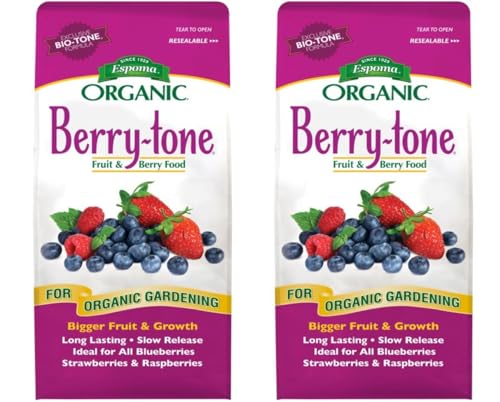
| Espoma Berry ToneAlso Great | Best Overall Organic Granules | 4-3-4 | Granules | 64.0 oz | Amazon |
| TPS Nutrients Strawberry | Best Liquid for Quick Feeding | 1:128 mix | Liquid | 32 fl oz | Amazon |
| Bloom City Organic Berry | Best Organic Liquid for Berries | — | Liquid | 32 fl oz | Amazon |
| HiThrive Strawberry | Best Low-Cost Liquid Starter | — | Liquid | 16 fl oz | Amazon |
| Masterblend Strawberry | Best for Hydroponics & Precision | 9-12-34 | Powder | 16.0 oz | Amazon |
| Doter Worm Castings | Best Soil Amendment | — | Granules | 35.2 oz | Amazon |
In‑Depth Reviews
1. True Organic Berry Food
Our pick — over 4.5★ from 800+ verified ratings; the strongest balance of quality and price.
A granular organic that doubles as a soil pH adjuster for acid-loving berries.
Strawberries prefer slightly acidic soil (pH 5.5 to 6.5), and this fertilizer tackles that directly. It contains sulfur, which naturally lowers soil pH, making essential micronutrients like iron and manganese more available to the roots. The 5-4-4 NPK ratio is a touch higher in nitrogen than the Espoma Berry Tone, but it is still well-balanced for fruiting — the phosphorus sits high enough to support blooms and berry set.
The ingredient list reads like a soil-building recipe: seabird guano, shrimp and crab shell meal, and other organic inputs. These materials break down slowly, feeding the soil microbes as much as the plant. The 4-pound bag covers up to 58 square feet, and the maker recommends applying it monthly during the growing season. Because it is a granular form, it works equally well for in-ground beds and container plants, though you will want to scratch it lightly into the top inch of soil in pots. Reviews consistently mention that the sulfur component helped correct leaf yellowing in plants that were struggling with high-pH tap water — a common household gardening headache.
One thing to note: the 4-pound weight is exactly the same as the Espoma Berry Tone, but the unit count is listed as the bag weight (4 pounds) rather than ounces, and it covers a slightly smaller area (58 sq. ft.) despite having a similar bag size. The sulfur content means it is a poor fit if your soil is already acidic (below pH 5.5), as you risk locking out nutrients.
What Works
- Contains sulfur to gently lower soil pH for acid lovers
- Made with seabird guano and crab shell meal for soil biology
- Versatile for both in-ground and container plants
What to Watch
- Monthly re-application is more frequent than the twice-per-season Espoma
- Sulfur can push already-acidic soil too far
Choose this for: strawberry beds sitting in neutral or slightly alkaline soil that need a pH nudge along with steady feeding.
Skip it for: already acidic soil or if you prefer a single spring application.
2. Espoma Berry Tone Plant Food
The 4-pound bag that hits the balance between organic richness and simple to use simplicity.
Your strawberry plants get a balanced 4-3-4 NPK ratio (the three numbers that tell you how much Nitrogen, Phosphorus, and Potassium is inside) without you having to mix or measure anything. You just sprinkle the granules around the base and water them in. The bag covers both spring and late-spring feedings — the maker suggests feeding twice a year for most berries — and the 4-pound weight means it lasts a full season for a typical backyard patch.
The Bio-tone formula (a proprietary blend of beneficial microbes and organic ingredients) helps roots access nutrients even in cooler soil, which is a common pain point for early-spring strawberry growers. The granules are approved for organic gardening, so you can use them without worry if you are trying to keep your patch chemical-free. Unlike the liquid options that need re-application every week or two, this granular form releases slowly, cutting down your chore schedule significantly.
Buyers report that after one application, their plants produced noticeably larger berries and that the 4-3-4 ratio did not trigger excessive leaf growth — a common frustration with higher-nitrogen fertilizers. One reviewer noted that the 4-pound bag was enough to feed a 4×8-foot raised bed for the entire season.
Why It Wins
- Organic with a proven Bio-tone microbial booster
- No mixing required — ready-to-use granules
- 4-3-4 ratio is nearly ideal for fruiting, not leaves
The Trade-Offs
- Slow-release means it won’t correct an acute deficiency overnight
- Contains 5% sulfur, which may lower pH more than needed in already-acidic soils
Reach for this if: you want a set-it-and-water-it organic granular that feeds your strawberry bed all season without mixing up batches.
Look elsewhere if: you need a fast-acting liquid to perk up plants that are already showing signs of deficiency.
3. TPS Nutrients Strawberry Fertilizer
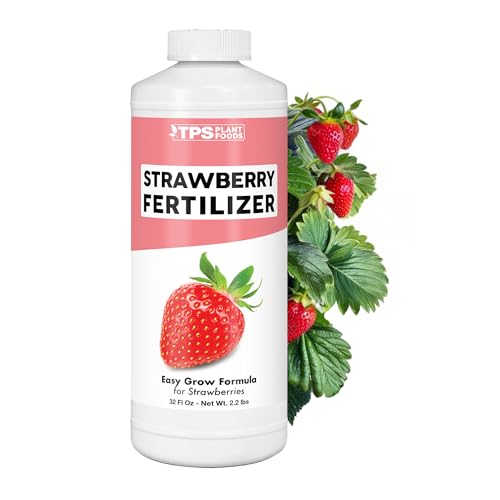
The liquid food that hits the roots in hours, not days, with a 1:128 dilution ratio.
If your strawberry plants look pale or the berries are staying small, a quick liquid feed can turn them around fast. TPS Nutrients formulated this specifically for strawberries — not a general berry blend. It supports flowering, fruit set, and root runners without forcing excessive leaf growth. The liquid form means the nutrients are immediately available to the roots, which is a big advantage for container strawberries that get leached by frequent watering.
The 32-ounce bottle makes a lot of dilute solution — the 1:128 mixing ratio means one ounce of concentrate makes 128 ounces (1 gallon) of feed. That is 32 fluid ounces versus the 16-ounce HiThrive bottle. It is designed for garden beds, raised beds, and containers alike, and the manufacturer recommends feeding every 1-2 weeks during the growing season. Owners mention that consistent use through the flowering stage produced a longer harvest window compared to the burst-and-fade pattern they saw with granular-only feeding.
The catch is the routine: you have to mix and apply a batch every week or two, which some growers find tedious compared to scattering granules twice a year. Also, because it is a liquid, it does nothing to build soil structure or add organic matter — it feeds the plant, not the soil. The NPK ratio is not printed as a three-number label but as a 1:128 concentrate dilution, so you cannot compare it directly to the granular ratios at a glance.
The Quick-Fix Specialist: Perfect for growers who want hands-on control and a fast response from their plants.
Grab this if: you are growing in containers or need to correct a mid-season slump with fast-acting nutrition.
Pass if: you prefer a low-maintenance sprinkle-and-water approach.
4. Bloom City Organic Berry Fertilizer

A liquid organic that feeds both the strawberry plant and the soil biology at the same time.
Most liquid fertilizers are synthetic salts that feed the plant directly but do little for the soil. Bloom City breaks that pattern — it is an organic liquid (made in the USA) that supports root development and fruit production while also adding microbial food to the soil. The 32-ounce bottle is formulated specifically for blueberries and strawberries, which means the nutrient profile is tuned for acid-loving fruiting plants rather than general garden use.
It works well for backyard patches, raised beds, and potted berries. Unlike the granular organics that need soil microbes to break them down, this liquid gives the plant a faster dose while still carrying organic ingredients. Compared to the TPS Nutrients liquid, it is less precise (no printed dilution ratio) but more approachable for beginners who just want to squirt and go. Reviewers highlight that it produces good runner growth in the first season, which helps your patch fill in faster. The 32-ounce size matches the TPS bottle exactly, but the brand targets it at berry beds rather than strawberries alone, so it is a hair less specialized.
The down side is the price: it sits in the premium tier for a liquid, and because it is organic, it can have a mild smell during storage. You also do not get the convenience of a pre-measured mixing ratio — you will need to follow the label instructions loosely unless you want to risk over-feeding.
What Stands Out
- Organic liquid that feeds both plant and soil microbes
- Sized at a full 32 fl oz
- Good for both in-ground and container berry plants
The Drawbacks
- No printed NPK ratio or precise mixing instructions
- Premium price per ounce compared to granular options
Best for: gardeners who want a ready-to-use organic liquid that supports soil health and berry production without synthetic salts.
Consider another if: you need a precise NPK ratio or a budget-friendly option for large beds.
5. HiThrive 16oz Strawberry Fertilizer
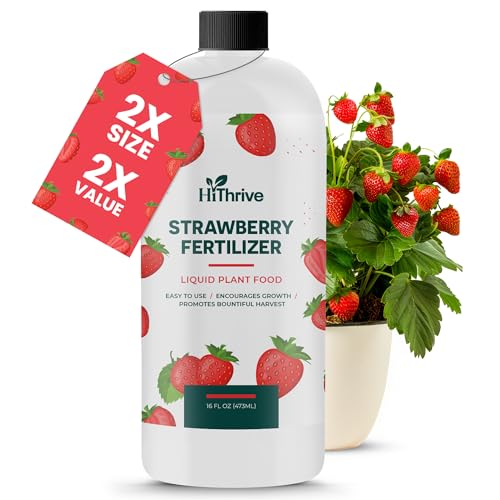
A 16-ounce bottle that stretches to 16 gallons of feed — perfect for the budget-conscious pot grower.
HiThrive designed this liquid concentrate specifically for strawberries — it lists Albion, Chandler, Seascape, and Ozark Beauty as compatible varieties. The bottle packs essential macronutrients along with micronutrients like calcium, magnesium, and zinc, which are common deficiencies in strawberries grown in potting mix. The 16-ounce bottle makes 16 gallons of ready-to-use fertilizer, giving you a low-cost entry point into liquid feeding without committing to a bigger jug.
The application schedule is simple: mix with water and apply every 1-2 weeks during the growing season, then every 4 weeks during cooler months. The reverse-nutrient-deficiency claim is backed by the calcium and magnesium content — these two elements help prevent blossom-end rot and leaf-edge browning, which new growers often mistake for disease. Buyers mention that the 16-ounce size is enough to get a small patio container garden through a full season without running out.
There are a few trade-offs. The liquid volume is 16 fluid ounces, versus the 32-ounce TPS and Bloom City bottles, so you get half the concentrate for less money but you will reorder sooner if you have a large bed. The brand name (HiThrive) is not as established as Espoma or TPS, so the long-term formulation consistency is less documented. Also, it is a liquid synthetic blend, not organic, so it will not contribute to building healthy soil biology.
Why It Works
- Low initial cost makes it easy to try liquid feeding
- Includes calcium, magnesium, and zinc for common deficiencies
- Designed for specific strawberry varieties
Limitations
- Smaller bottle (16 fl oz) runs out faster than 32-oz options
- Synthetic formula does not improve soil structure
Ideal for: a first-time strawberry grower with a few pots who wants a cheap, easy liquid feed with micronutrients built in.
Not for: organic gardeners or anyone feeding a large in-ground bed.
6. Masterblend Strawberry Formula 9-12-34

A high-potassium powder built for hydroponic setups where every ppm of nutrient is controlled.
This is the most specialized entry on the list. The NPK ratio is 9-12-34 — notice the third number (Potassium) is dramatically higher than the first two. Potassium drives fruit size, sugar content, and disease resistance, which is why this formula is so high. The phosphorus (the middle number, 12) supports flowering. The nitrogen (9) is moderate to keep leaf growth in check while the plant focuses on berries. It is 100% water-soluble, meaning it dissolves completely with no sediment, which is essential for hydroponic systems (growing in water) where clogging drippers is a real problem.
The 1-pound bag holds 16.0 ounces of powder, versus the 4-pound Espoma bag — so you get a smaller physical amount, but a little goes a long way because it is concentrated. Masterblend recommends using it in soil or hydroponics, but the high potassium content makes it especially effective for soilless media where you are controlling every element. It is also a solid choice for outdoor container growers who want to customize their feed program by mixing their own calcium nitrate separately.
The main downside is the learning curve. If you are used to pouring liquid or scattering granules, weighing out powder and mixing calcium nitrate separately can feel like a chemistry set. The 9-12-34 ratio is also too high in potassium for a standard soil bed that already has good fertility — you risk locking out calcium and magnesium if you apply it too frequently without monitoring your soil levels.
The Precision Tool: Built for growers who measure and mix every feeding — not for casual sprinkle-and-go gardeners.
Buy this for: hydroponic strawberries or for advanced container growers who want to fine-tune potassium during fruit development.
Avoid it if: you want a simple all-in-one feed or you are growing in rich in-ground soil.
7. Doter Worm Castings Organic Fertilizer

Pure worm castings that feed the soil first, and the strawberries second, with zero odor.
Worm castings (earthworm poop) are not a quick-fix fertilizer — they are a soil conditioner. The organic matter improves water retention, introduces beneficial microbes, and provides a gentle, well-balanced nutrient release that is nearly impossible to overdo. Doter’s 2.2-pound bag (35.2 ounces) is completely nontoxic and odor-free, which is rare for organic soil amendments. The granules are already broken down by the worms, so the nutrients are in a form plants can absorb without the risk of burning roots.
This product is best used as a top dressing or blended into the soil at planting time. It reduces carbon in the soil, helps buffer extreme pH levels (preventing them from swinging wildly), and increases nitrogen availability over time. The maker claims it enhances seed germination, flowering, and fruit production through improved soil biology. Because it is a natural soil amendment, it pairs well with any of the liquid fertilizers on this list — use the worm castings as a base to build soil health, then supplement with a liquid during fruiting.
The limitation is clear: worm castings are mild. They will not correct a severe nutrient deficiency quickly, and the NPK value is low and variable (it is not printed on the label). You cannot rely on worm castings alone for heavy-feeding strawberries in containers; you will need additional fertilizer for a full harvest. The 2.2-pound bag also covers a smaller area than the 4-pound granular bags from Espoma or True Organic. Customers note that the real benefit shows up in the second season, after the castings have had time to improve the soil structure.
The Strengths
- Nontoxic and safe around children and pets — no chemical worries
- Improves soil structure, water retention, and microbial life
- Odor-free, unlike many manure-based soil amendments
The Weaknesses
- Low nutrient concentration — not enough as a standalone strawberry feed
- Results are slow, taking weeks to months to show
Use this as: a non-burning soil base mixed into the bed at planting time to support long-term soil health and root development.
Do not use alone: for heavy feeders in containers or for growers who need visible results in the first season.
Understanding the Specs
NPK Ratio — The Three Numbers
Every fertilizer label shows three numbers (like 4-3-4 or 9-12-34). The first is Nitrogen (N), which drives green leaf growth. The second is Phosphorus (P), which supports root development and flower formation. The third is Potassium (K), which helps with fruit size, flavor, and disease resistance. For strawberries, you want a middle number (P) that is about equal to or higher than the first number (N), and a third number (K) that is the highest of the three — this encourages the plant to put energy into berries rather than leaves.
Form: Granules vs Liquid vs Powder
Granules are slow-release — you sprinkle them and water in, and they feed for weeks or months. Liquids are fast-release — the plant absorbs them within hours, but you need to re-apply every 1-2 weeks. Powders (water-soluble) dissolve in water and give you precision, ideal for hydroponics (growing in water) or custom mixing. Your choice depends on your schedule: granular for low-maintenance, liquid for quick correction, powder for precise control.
FAQ
What is the best NPK ratio for strawberries?
Can I use tomato fertilizer on strawberries?
How often should I fertilize strawberry plants?
Is organic or synthetic fertilizer better for strawberries?
What does sulfur do in strawberry fertilizer?
Can I fertilize strawberries in containers the same way as in-ground beds?
How much fertilizer does a strawberry plant need per season?
Can I use Epsom salt on strawberry plants?
What is the difference between 4-3-4 and 9-12-34 fertilizer for strawberries?
Should I fertilize strawberries while they are fruiting?
Final Thoughts: The Verdict
If you want one dependable pick, the best fertilizer for strawberries is the Espoma Berry Tone Plant Food because it combines an ideal 4-3-4 NPK ratio with organic ingredients and a twice-per-season schedule that fits any gardener’s routine. If you want a fast-acting liquid for container plants or a mid-season boost, grab the TPS Nutrients Strawberry Fertilizer. And for precise, high-potassium feeding in a hydroponic (water-based) or controlled setup, the standout is the Masterblend Strawberry Formula 9-12-34.
How We Picked
We do not accept paid placement. Every pick is matched to a real buyer and a real use-case; we do not hands-on test units.
Sources & Methodology
Specifications: manufacturer listings and product documentation. Review insights: verified customer reviews, as of July 2026. Pricing: not shown on this page (it changes often); check the current price via the retailer link.
As an Amazon Associate, Lawn Gear Lab earns from qualifying purchases. This does not affect which products we feature.