
Raspberries are heavy feeders that demand a specific balance of nitrogen, phosphorus, and potassium — along with a slightly acidic soil pH — to produce plump, flavorful fruit rather than leggy, unproductive canes. The wrong fertilizer can push all energy into leaves at the expense of berries, or worse, burn the shallow root system that defines this bramble crop.
I’m Rikta — the co-founder and writer behind Lawn Gear Lab. I’ve spent hundreds of hours cross-referencing NPK ratios, analyzing pH impact data, and reading through thousands of verified owner experiences to build a guide that helps you choose with confidence, not guesswork.
Whether you need a slow-release granular to feed all season or a fast-acting liquid for a mid-summer boost, this guide evaluates the top options to help you find the most effective fertilizer for raspberries for your patch.
How to choose the best fertilizer for raspberries
Raspberries are not like tomatoes or peppers. Their perennial root crowns and biennial canes require a feeding strategy that supports both first-year vegetative growth and second-year fruit production. Selecting the right product means understanding three key factors that determine how your patch performs over multiple seasons.
NPK ratio and what it means for brambles
Raspberries need a balanced supply of nutrients, but they respond best to formulations where the middle number (phosphorus) is roughly equal to the first (nitrogen) and third (potassium). A ratio like 4-3-6 or 5-4-4 is ideal. Too much nitrogen pushes excessive leaf growth and weak canes, while insufficient potassium leads to small, bland berries. Always check the NPK on the bag before buying.
Slow release versus liquid feed
Granular slow-release fertilizers provide a steady nutrient supply over weeks or months, which matches the raspberry’s continuous feeding habit during the growing season. Liquid fertilizers deliver an immediate boost, useful when you spot signs of deficiency or want to support the fruiting phase. Many experienced growers use a granular base in spring and supplement with liquid during fruit set.
Organic inputs and soil pH
Raspberries thrive in slightly acidic soil, ideally between pH 5.6 and 6.2. Organic fertilizers often contain ingredients like seabird guano, crab shell meal, or elemental sulfur that naturally lower pH and improve micronutrient availability. Avoid synthetic high-nitrogen salts that can acidify too aggressively or burn feeder roots. If your soil test shows alkaline conditions, look for a product that includes sulfur or is formulated for acid-loving plants.
Quick comparison
On smaller screens, swipe sideways to see the full table.
| Model | Category | Best for | Key spec | Amazon |
|---|---|---|---|---|
| Espoma Berry Tone | Granular Organic | Balanced long-season feeding | 4-3-4 NPK with Bio-tone | Amazon |
| True Organic Berry Food | Granular Organic | Soil pH adjustment | 5-4-4 NPK + sulfur | Amazon |
| Bloom City Organic Berry Fertilizer | Liquid Organic | Large patch coverage | 1 gallon concentrate | Amazon |
| Down To Earth Acid Mix | Granular Organic | Low pH lovers | 4-3-6 NPK slow release | Amazon |
| Big A Berries Fertilizer | Powder Organic | Rapid visible results | 13.5 oz resealable pouch | Amazon |
| TPS Raspberry Fertilizer | Liquid | Raspberry-specific formula | 32 oz liquid concentrate | Amazon |
| TPS BlackBerry Fertilizer | Liquid | Blackberry cane vigor | 32 oz liquid concentrate | Amazon |
In‑depth reviews
1. Espoma Berry Tone Plant Food 4-3-4
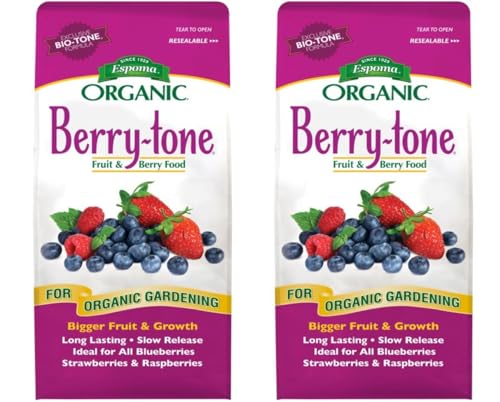
Espoma Berry Tone delivers a tightly balanced 4-3-4 NPK ratio that matches the raspberry’s seasonal demand curve — moderate nitrogen for cane growth early, steady phosphorus for root and flower development, and adequate potassium for fruit sizing. The 4-pound bag covers multiple established bushes for a full season, and the inclusion of 5% sulfur helps maintain the acidic soil pH that brambles crave.
The Bio-tone formula includes beneficial microbes that break down organic matter in the root zone, improving nutrient uptake efficiency without the risk of salt burn. Multiple reviewers on verified berry patches report dramatically higher yields and better fruit flavor after switching from generic 10-10-10 blends. The granules release nutrients over several weeks, reducing the need for reapplication through the critical flowering window.
This product is approved for organic gardening and is made in the USA by a company with nearly a century of horticultural experience. It works on raspberries, blackberries, blueberries, and strawberries, making it a versatile staple for anyone running a mixed berry patch.
What works
- Balanced 4-3-4 NPK optimized for raspberry fruiting
- Bio-tone microbes enhance root zone activity
- Sulfur content supports ideal acidic soil pH
What doesn’t
- 4-pound bag may run out quickly for larger patches
- Granules can attract pets if not worked into soil
2. True Organic Berry Food 5-4-4

True Organic Berry Food uses a 5-4-4 analysis with sulfur and seabird guano to address the two most common raspberry soil problems: low nitrogen during early growth and rising pH from alkaline water or compost. The 4-pound bag covers 58 square feet, making it economical for larger patches without forcing you to buy industrial-sized bags you cannot use in a season.
The organic inputs — shrimp shell meal, crab shell meal, and seabird guano — break down slowly, feeding soil microbes while gradually acidifying the root zone. Growers with neglected patches have reported that this product revived older canes and produced fruit where none had appeared in years. The granules are easy to broadcast around the base of each plant without root disturbance.
It is 100% organic and made in the USA, with a monthly application schedule that simplifies summer feeding. If your soil test shows pH creeping above 6.5, this is the product that pulls it back into the ideal range while providing consistent nutrition.
What works
- Sulfur content actively lowers soil pH
- Seabird guano provides broad micronutrient profile
- 58 sq. ft coverage is generous for the bag size
What doesn’t
- Requires monthly reapplication for best results
- Smell may be strong immediately after application
3. Bloom City Organic Berry Fertilizer 1 Gallon
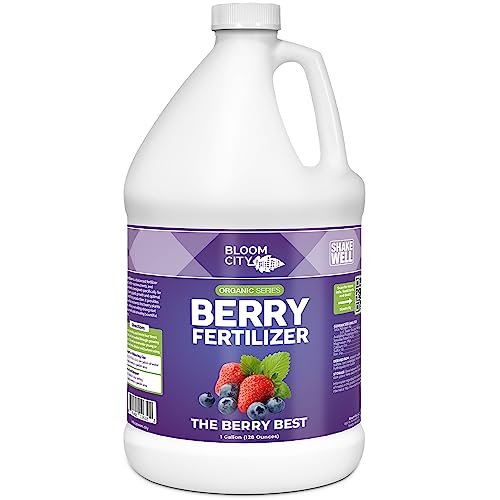
Bloom City’s liquid concentrate in the 1-gallon jug is the best cost-per-feed option for raspberry growers with large patches. The formula is designed for berries and provides balanced nutrition that works well when applied every two weeks during the growing season. A single gallon can feed two mature bushes for several months when mixed at the recommended 3 tbsp per gallon of water.
Liquid feeding allows you to spoon-feed your raspberries exactly when they need it — early spring for cane emergence, right after flowering for fruit set, and again when berries begin to color. Reviewers with blueberry and strawberry patches report vigorous new growth and larger fruit after switching to Bloom City, with one user noting their potted blueberries developed fruit within three weeks of first application.
It is certified organic, made in the USA, and comes in a large jug that eliminates the need for frequent repurchasing. The mild odor dissipates quickly once worked into the soil, and the application process takes only minutes per watering session.
What works
- 1-gallon size offers excellent cost per feeding
- Fast absorption supports immediate fruiting response
- Suitable for in-ground and container raspberries
What doesn’t
- Requires mixing and frequent application
- Smell is noticeable before dilution
4. Down To Earth Acid Mix 4-3-6
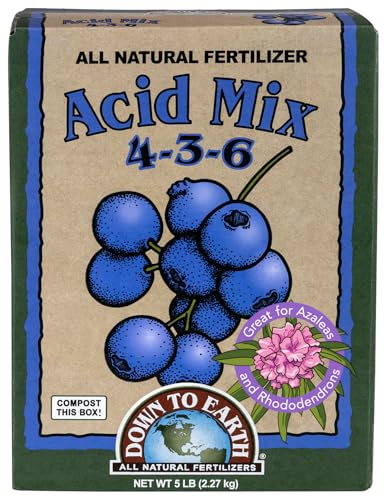
Down To Earth Acid Mix uses a 4-3-6 ratio with the highest potassium content on this list, which directly supports fruit size and flavor development in raspberries. The 5-pound bag is the largest granular option here, providing enough material for multiple seasons in a moderate-sized patch. The slow-release granules feed continuously without the risk of root burn that haunts synthetic fertilizers.
This mix is formulated specifically for acid-loving plants, making it a perfect fit for raspberries that prefer soil pH between 5.5 and 6.5. Ingredients are all-natural and sustainably sourced, and the product has no synthetic additives or fillers. Reviewers highlight that one early spring application followed by a second when blooms appear delivers steady results through harvest.
The resealable bag keeps moisture out between uses, and the granules spread easily by hand or with a broadcast spreader. If your raspberries have shown signs of potassium deficiency — leaf edge burn, small fruit, or weak canes — this formula directly addresses that gap.
What works
- Highest potassium (6) for fruit quality
- 5-pound bag provides multi-season supply
- Slow-release granules prevent burn
What doesn’t
- Pungent smell can attract dogs
- Too large for very small container gardens
5. Big A Berries Fertilizer 13.5 oz

Big A Berries comes as a fine powder in a 13.5-ounce resealable pouch, making it a convenient option for growers who want visible results within days rather than weeks. The organic mineral and vitamin blend delivers nutrients that plants can uptake almost immediately, which is particularly useful when you spot yellowing leaves or stunted cane growth mid-season.
Users at high elevations with short growing seasons report that two applications — one in mid-May and another a month later — produced raspberries that were dramatically larger and more abundant than in previous years. The powder mixes easily into the top layer of soil or can be dissolved in water for a quick drench. It works on raspberries, blackberries, blueberries, and strawberries, and even on mixed berry patches.
The pouch includes detailed instructions and growing tips, which is helpful for newer growers who are still dialing in their feeding schedule. It is certified organic and made with premium ingredients that are safe for edible crops.
What works
- Visible improvement in berry size within days
- Resealable pouch keeps product fresh
- Effective for high-elevation and short-season patches
What doesn’t
- Small pouch runs out quickly on large patches
- Higher cost per pound compared to granular options
6. TPS Raspberry Fertilizer 32 oz
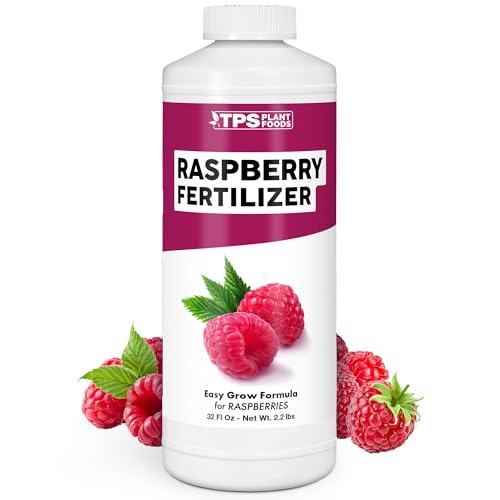
TPS Nutrients formulated this 32-ounce liquid concentrate specifically for raspberries, with a 3.6-3-5.1 NPK profile that prioritizes winter hardiness and flower development. The ratio is weaker in nitrogen than standard all-purpose fertilizers, which is precisely what raspberries need to avoid excessive foliage at the expense of fruit. Each bottle is highly concentrated — the recommended mix ratio uses only a small dose per gallon, so a single bottle lasts for many applications.
The formula includes vitamins and micronutrients aimed at strengthening cane walls and improving berry firmness. Users with red, yellow, and black raspberry varieties report stronger cane growth and fuller foliage after switching to this targeted blend. The liquid form allows you to apply it through a watering can or hose-end sprayer for even distribution around the root zone without disturbing the soil.
It is made in the USA and comes with clear instructions that make dosing simple even for first-time berry growers. The versatility across all raspberry varieties makes it a strong choice if you grow multiple types in the same bed.
What works
- Raspberry-specific NPK ratio prevents nitrogen overload
- Highly concentrated, small dose per gallon
- Supports winter hardiness and flower set
What doesn’t
- Small bottle may seem pricey relative to volume
- Results may take time on severely deficient plants
7. TPS BlackBerry Fertilizer 32 oz
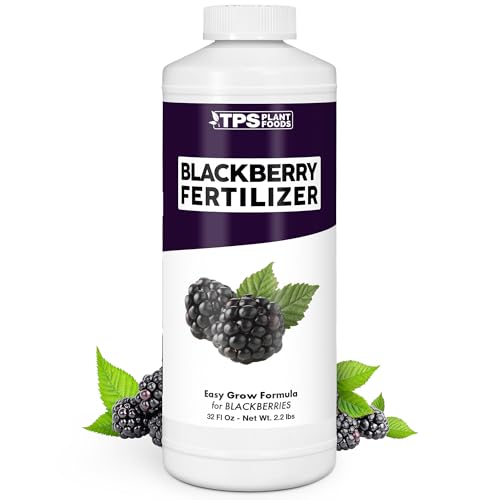
While formulated for blackberries, the TPS BlackBerry Fertilizer works equally well on raspberries thanks to the similar nutritional requirements shared by both Rubus species. The liquid concentrate in the 32-ounce bottle focuses on root strength and cane vigor, which is critical for raspberry patches coming out of a harsh winter or recovering from pest damage.
The formula promotes healthy cane development and flowering, leading to better yield in the second year. Users with struggling patches report that consistent weekly feeding turned thin, pale canes into thick, green growth with visibly larger fruit. The liquid can be applied directly to the soil around the crown without disturbing the shallow root system, and the clear mixing instructions make it easy to adjust dose based on plant size.
Made in the USA, this fertilizer is a reliable choice for mixed bramble patches where you manage raspberries and blackberries together. The bottle is compact but highly concentrated, so the value extends well beyond the initial purchase.
What works
- Strengthens canes and improves winter survival
- Works well on both raspberries and blackberries
- Concentrated formula covers multiple feeding cycles
What doesn’t
- Requires weekly application for best results
- Bottle may leak during shipping if cap is not secured
Hardware & specs guide
NPK ratio explained
The three numbers on a fertilizer label represent nitrogen (N), phosphorus (P), and potassium (K). For raspberries, a balanced ratio such as 4-3-4 or 5-4-4 is ideal. Nitrogen drives leaf and cane growth but must be moderate to avoid soft, disease-prone canes. Phosphorus supports root development and flower formation. Potassium is critical for fruit size, sugar content, and winter hardiness. Avoid formulas where the first number is more than double the others.
Slow-release vs. liquid delivery
Granular slow-release fertilizers use organic matter or coated prills to meter nutrients over weeks. This matches the raspberry’s continuous feeding habit and reduces the risk of nutrient leaching. Liquid fertilizers deliver nutrients directly to the root zone for immediate uptake. Use slow-release as your base in early spring and switch to liquid for targeted support during fruiting. Each method has its place, and many growers combine both across the season.
pH management through fertilizer choice
Raspberries prefer soil pH between 5.6 and 6.2. Fertilizers that contain elemental sulfur, seabird guano, or crab shell meal naturally acidify the soil as they break down, improving iron and manganese availability. If your soil is alkaline (pH above 7.0), choose a product labeled for acid-loving plants. Regular soil testing — at least once per season — helps you track whether your fertilizer choice is moving pH in the right direction.
Organic certification and safety
Organic fertilizers use plant and animal by-products rather than synthetic salts. They feed soil biology alongside the crop, improving long-term soil structure and water retention. For edible crops like raspberries, organic inputs reduce the risk of chemical residue on fruit and are safer for pollinators when applied correctly. Look for OMRI-listed or approved organic input materials to ensure the product meets certified organic standards.
FAQ
When should I start fertilizing my raspberries in spring?
Can I use tomato fertilizer on raspberries?
How much fertilizer does a single raspberry bush need?
Should I fertilize raspberries after they finish fruiting?
What happens if I use too much fertilizer on my raspberry patch?
Final thoughts: The verdict
For most gardeners, the fertilizer for raspberries winner is the Espoma Berry Tone because its 4-3-4 NPK ratio with Bio-tone microbes and sulfur delivers balanced, long-lasting nutrition that supports both cane vigor and fruit production across the entire season. If you need to actively lower soil pH and revive a neglected patch, grab the True Organic Berry Food. And for growers with large patches who prefer the flexibility of liquid feeding, nothing beats the value of the Bloom City Organic Berry Fertilizer in the 1-gallon size.