
A privet hedge that looks thin, pale, or leggy is almost always starving for the right nutrition. Unlike general garden fertilizers that feed the soil as a whole, a targeted fertilizer for privet hedge must deliver a precise balance of nitrogen for dense leaf growth, potassium for root strength, and often a touch of sulfur to keep the soil slightly acidic—conditions privet roots devour. Without this specific ratio, you’ll water and weed all season watching the hedge stay exactly where it is.
I’m Rikta — the co-founder and writer behind Lawn Gear Lab. I’ve spent hundreds of hours comparing N-P-K ratios, studying organic versus synthetic release rates, and analyzing thousands of verified buyer reports to build this guide on the best fertlizer for privet hedge.
A privet hedge that lacks vigor often simply lacks the correct nutrient profile. Whether you are planting new whips or feeding a mature boundary, choosing the right fertilizer for privet hedge can be the single factor that turns a sparse line into a thick, green screen.
How To Choose The Best Fertilizer For Privet Hedge
Privet hedges are heavy feeders that respond dramatically to the correct blend of macronutrients. Selecting the wrong ratio leads to lots of soft growth with weak stems, or all root growth with no leafy density. Focus on these specific factors that matter most to a privet’s annual cycle.
Prioritize Nitrogen for Leaf Density
A privet hedge is grown almost entirely for its foliage screen. The first number (N) in the N-P-K ratio drives chlorophyll production and leaf expansion. Look for a formula where the nitrogen value is the highest number — options in the 15-5-10 or 19-8-10 range will push dense, dark green leaves faster than a balanced 10-10-10 blend. Slow-release nitrogen sources like polymer-coated urea or natural organics prevent the flush of weak growth that liquid feeds can cause.
Match the Form to Your Routine
Granular fertilizers like the ferti-lome 19-8-10 use a penetrating action that moves nutrients directly to the feeder roots without digging holes — ideal if you have a long established hedge line. Spikes from brands like Jobe’s or Miracle-Gro eliminate measuring and drifting, making them the best choice for new, spaced plantings where you can hammer one spike per plant. Organic granules such as Espoma’s Evergreen-tone require no mixing and feed the soil biology, but they work slower than synthetic spikes.
Check the Phosphorus and Potassium Balance
Phosphorus (the middle number) helps with root establishment and flowering, but privet is rarely grown for blooms. A moderate phosphorus level (3-5) is sufficient. Potassium (the last number) should be equal to or slightly below nitrogen — it strengthens cell walls and helps the hedge withstand winter stress and drought. Ratios like 16-4-4 or 13-3-3 provide a solid potassium backbone without pushing unnecessary flower energy.
Quick Comparison
On smaller screens, swipe sideways to see the full table.
| Model | Category | Best For | Key Spec | Amazon |
|---|---|---|---|---|
| Espoma Evergreen-tone | Organic Granules | Deep root feed for established hedges | 4-3-4 with 5% Sulfur | Amazon |
| Jobe’s 16-4-4 Spikes | Fertilizer Spikes | No-measure single plant feeding | 16-4-4 Time Release | Amazon |
| Miracle-Gro 15-5-10 Spikes | Fertilizer Spikes | Quick green-up for deciduous shrubs | 15-5-10, 12 spikes per pack | Amazon |
| Old Farmer’s Almanac 13-3-3 | Fertilizer Spikes | Clay soil tough placement | 13-3-3 with molasses | Amazon |
| Ferti-lome 19-8-10 | Granules | High-nitrogen for thin hedges | 19-8-10 penetrant action | Amazon |
| Espoma Holly-tone 4-3-4 | Organic Powder | Acidifying for alkaline soil hedges | 4-3-4 with Bio-tone | Amazon |
| The Andersons PGF 16-0-8 | Professional Granules | Phosphorus-free soil correction | 16-0-8 with Humic DG | Amazon |
In‑Depth Reviews
1. Espoma Organic Evergreen-tone 4-3-4

Espoma’s Evergreen-tone pairs a 4-3-4 N-P-K with 5% sulfur, a specific shift that keeps soil pH in the 5.5–6.5 range privet hedges prefer. The Bio-tone microbial inoculant speeds organic matter breakdown into plant-available nitrogen, which means a single spring application carries the hedge through the active growing season without a hard synthetic spike. Verified buyers report that evergreens turn a noticeably brighter green within two weeks of application, and the slow-release granules do not require digging or mixing—just spread under the drip line and water.
This is an 18-pound bag, which covers a substantial 450–500 linear feet of hedge at the recommended rate. The analysis is lower in nitrogen than synthetic options, but the natural organics feed the soil food web, building long-term tilth rather than producing a quick flash of growth. Users who switched from chemical spikes to Evergreen-tone consistently note fewer burned leaf tips and a more uniform canopy from base to top.
The barnyard smell from the chicken manure base is the trade-off — several buyers mention the odor lingers for a day or two after application. If your hedge runs along a patio or entryway, you may want to time the application before a rain. Despite that, the consistent performance across seasons makes this the single most versatile option for a privet hedge that needs steady, natural feeding.
What works
- 5% sulfur helps maintain ideal acidic soil for privet roots
- Bio-tone microbes increase nutrient cycling without burning
- Large 18 lb bag offers excellent per-foot coverage value
What doesn’t
- Strong manure smell lingers for 1-2 days after spreading
- Lower immediate nitrogen won’t correct severe deficiency as fast as synthetics
2. Jobe’s 16-4-4 Fertilizer Spikes (30 Count)

Jobe’s 16-4-4 fertilizer spikes deliver the highest nitrogen ratio of any product in this review, making them the fastest way to push leaf density in a hedge that has gone thin or pale. The time-release formulation meters the 16% nitrogen down into the root zone over a full season with zero risk of runoff, which is critical when you are feeding a long row of privet without wanting granules washing into the neighbor’s lawn. Each spike is driven into the soil around the drip line — one spike per three feet of hedge height is the general rule.
The pack contains 30 spikes, enough to treat a 30-foot hedge in a single application. Verified buyers note that spikes are best installed in damp soil or after pre-drilling with a metal rod if your ground is rocky — the spikes themselves are dense and require hammering. Once placed, the nutrients stay put, and users report seeing tighter internodal spacing (more leaves per inch of stem) within three to four weeks. The 4% phosphorus is moderate, supporting root anchoring without pushing unnecessary flower energy.
Some owners mention that the spikes can be difficult to drive straight into compacted clay — the plastic coating can crack if you strike at an angle. A second concern is the heavy nitrogen content: if you already have high-nitrogen soil (test over 40 ppm), this can lead to soft growth that flops under rain. For a standard privet that simply needs more green mass, however, Jobe’s spikes are the most direct tool.
What works
- Highest nitrogen (16%) for rapid leaf density improvement
- Zero runoff or drift — ideal for dense hedge rows
- No mixing or measuring; just hammer into soil
What doesn’t
- Difficult to install in hard, compacted, or rocky ground
- Can stimulate overly soft growth if soil nitrogen is already sufficient
3. Miracle-Gro Fertilizer Spikes 15-5-10

Miracle-Gro’s 15-5-10 spikes are the most widely available option and the simplest way to feed a privet hedge if you want to set it and forget it for an entire season. The ratio leans heavily on nitrogen (15%) with a moderate potassium (10%) boost that improves winter hardiness and drought tolerance in the privet’s root system. Each spike is pre-formulated for deciduous trees and shrubs, and the manufacturer recommends using two spikes per plant for a hedge that is three to four feet tall — a 12-spike pack handles six plants in spring and six more in fall.
Verified users consistently bring up the same result: yellowing leaves that turn dark green within two to three weeks after installation. One buyer in Texas reported that the spikes held color through 12 hours of direct summer sun when the hedge had been fading badly by mid-July. The spikes require no digging — just cap them with the provided plastic top and hammer them flush with the soil surface. Because the nutrient release is triggered by soil moisture and temperature, privet hedges avoid the nitrogen flush-and-die cycle that can happen with water-soluble powders.
The biggest catch is the package size: 12 spikes is a relatively small count for a long hedge. For a row of 20 privets, you’ll need to buy multiple boxes to cover spring and fall applications. Also, the spikes are harder to place once the privet roots have knitted together into a dense mat — driving a spike into an established root zone can be difficult without damaging surface roots.
What works
- Reliable 15% nitrogen corrects leaf yellowing rapidly
- Pre-capped spikes require no measuring or mixing
- Potassium boost improves privet’s cold and drought resilience
What doesn’t
- 12 spikes per box is too few for a long hedge row
- Difficult to insert into mature root mats without damage
4. The Old Farmer’s Almanac 13-3-3 TruSpikes
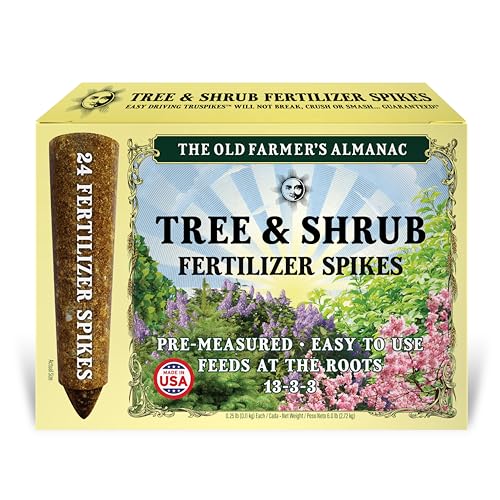
The Old Farmer’s Almanac 13-3-3 TruSpikes are engineered with molasses as a natural carbon source that feeds beneficial soil bacteria while releasing nitrogen, phosphorus, and potassium directly into the privet root zone. The 5-inch spike length is noticeably longer than standard stakes, which pushes nutrients deeper into the soil column — a real advantage when your privet hedge sits in hard clay that typically sheds surface-applied granules. The manufacturer states the spikes will not break, crush, or shatter, and verified buyers confirm the claim, even when hammering them into rocky ground.
This box contains 24 spikes, making it the most economical spike option for longer hedge runs. With a recommended spacing of one spike per 3 feet of hedge, a single box covers about 72 linear feet per application. Buyers who applied these after hurricane damage reported their trees and shrubs greened up and produced more flowers than in previous seasons — for privet, the 13% nitrogen pushes strong leaf recovery while the 3% potassium helps the hedge rebuild structural integrity in damaged stems.
The trade-off is that the spikes can still crack if you hammer them in without pre-drilling in extremely hard soil. While the molasses content is a unique benefit for soil microbiology, the 13-3-3 ratio is less nitrogen-dense than Jobe’s 16-4-4, so if your hedge is severely nitrogen-starved, you may see slower initial results. For normal maintenance and long-term soil health, this is a premium choice.
What works
- Molasses feeds soil biology while delivering NPK directly to roots
- 24 spikes per box offers best per-unit value for long hedges
- Claimed shatter-proof design survives hammering into tough ground
What doesn’t
- Spikes can still crack in extremely hard clay without pre-drilling
- 13% nitrogen is lower than competing synthetic spike options
5. Ferti-lome 19-8-10 Tree and Shrub Food

Ferti-lome’s 19-8-10 granular formula is the highest nitrogen concentration in this review, and its penetrating action is designed to move the fertilizer directly to the feeder roots without requiring you to dig holes along your hedge row. This is a synthetic blend, so the nitrogen is immediately available — privet hedges that are yellowed and stunted often respond within a week. The 4-pound bag is compact but concentrated: at the recommended rate for established shrubs, it treats roughly six to eight mature privet plants, making it an excellent choice for spot-feeding sections of the hedge that lag behind.
The granular form allows precise distribution around each plant’s drip line, and because you apply it dry to the soil surface, there is no mixing or dilution. Several verified buyers mention they have been using this product for three years straight on the same trees and shrubs, applying twice per year (early spring and early fall) with steady improvements in canopy fullness. The 8% potassium supports root vigor, which is critical for privet hedges that are trimmed frequently — heavy pruning stresses root reserves, and potassium aids recovery.
The small bag size is the main limitation for long hedge rows. If you need to feed 100 linear feet of privet, you will need four or five bags to maintain the correct application rate, which makes this less economical than the larger bags (Espoma Evergreen-tone at 18 lb) for full-hedge coverage. Also, synthetic nitrogen can burn foliage if accidentally applied to wet leaves or if heavy rain immediately follows application.
What works
- Highest nitrogen concentration (19%) for extreme deficiency correction
- Penetrating action moves nutrients to feeder roots without digging
- Dry granules allow precise spot-feeding of weak sections
What doesn’t
- 4-pound bag is too small for long hedge rows
- Synthetic nitrogen can burn if applied to wet foliage
6. Espoma Organic Holly-tone 4-3-4 (Pack of 2)
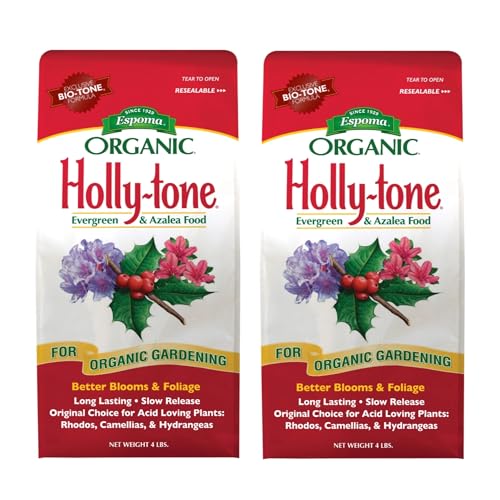
Holly-tone is the original organic acidifying fertilizer, and while it is marketed for azaleas, rhododendrons, and hydrangeas, its 4-3-4 ratio with 5% sulfur is a solid match for privet hedges growing in alkaline soil. Privet can tolerate a pH up to 8.0, but it reaches its maximum leaf density between 5.5 and 6.5. If your hedge shows interveinal chlorosis (yellowing between leaf veins), the high sulfur content in Holly-tone gradually lowers the soil pH while the slow-release organic nitrogen feeds the foliage. The Bio-tone microbial blend accelerates breakdown so the nutrients become available over a four to six-week window rather than all at once.
This listing is a pack of two 4-pound bags — a total of 8 pounds of product. For a 20-foot privet hedge, that is roughly one bag per feeding, allowing two applications (spring and fall) per package. Verified buyers report that acid-loving shrubs like gardenias and hydrangeas bloom significantly larger after switching to Holly-tone, and for privet, the key benefit is the prevention of nutrient lockout caused by high soil pH. If your hedge is growing in clay or limestone-influenced soil, this is the one to reach for.
The primary drawback is the odor — the organic ingredients produce a strong, barnyard-like smell that many users find unpleasant. One reviewer specifically warned against letting dogs eat the granules, which is a legitimate concern with any organic fertilizer. Additionally, the 4-3-4 analysis provides less nitrogen than synthetic options, so if your hedge is critically nitrogen-deficient, you may see a slower response than with a high-ratio synthetic spike.
What works
- 5% sulfur actively lowers soil pH for chlorosis correction
- Bio-tone microbes improve nutrient cycling in poor soils
- Pack of 2 provides enough for a full season on a standard hedge
What doesn’t
- Strong barnyard smell from organic ingredients
- Lower nitrogen content may not correct severe deficiency quickly
7. The Andersons Professional PGF 16-0-8
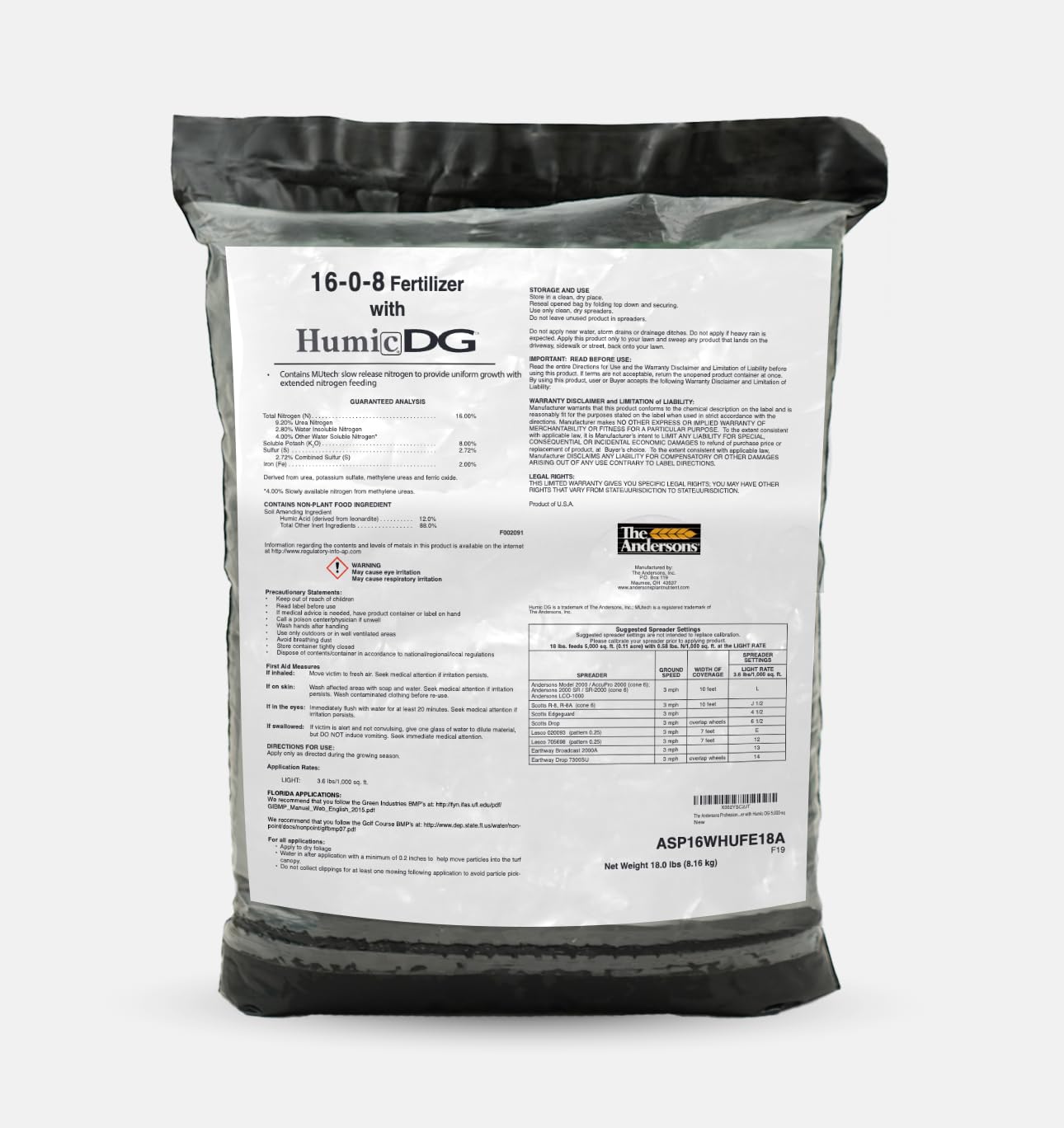
The Andersons Professional PGF 16-0-8 is a specialty granular fertilizer designed for situations where soil phosphorus levels are already high — a common scenario when privet hedges are planted in former lawn areas that have been over-fertilized with balanced blends. With zero phosphorus and 16% nitrogen plus 8% potassium, this formula pushes dense, dark green leaf growth without adding to the phosphorus buildup that can lock out micronutrients. The inclusion of Humic DG, a dispersing granule, ensures the super-fine particles are distributed evenly across the soil surface, giving you twice the number of particles per square foot compared to standard prills.
The 18-pound bag covers up to 10,000 square feet at the maintenance rate, which is far more than any single hedge row will need — making this a smart option if you are feeding both your privet hedge and your lawn or other plantings with one product. The quick- and slow-release nitrogen blend provides immediate green-up while also feeding the hedge for up to eight weeks after a single application. Verified users report dramatic lawn improvements, and hedge owners who have used this around established shrubs note that the leaf color deepens noticeably within two weeks.
The biggest limitation is that this product is explicitly not sold in California or Oregon, so if you reside in those states, you cannot purchase it directly. Additionally, the zero-phosphorus formula is a niche solution — if your soil test shows low phosphorus, using this could actually create a deficiency in a hedge that is being pushed hard for growth. Always test your soil before choosing a phosphorus-free blend.
What works
- Zero phosphorus prevents buildup in high-test soil
- Humic DG technology ensures even distribution without clumping
- 18 lb bag covers large areas — hedge plus lawn in one pass
What doesn’t
- Not available in California or Oregon
- Zero phosphorus can cause deficiency if soil P levels are already low
Hardware & Specs Guide
N-P-K Ratio for Privet
The three-number analysis on a fertilizer bag tells you the percentage by weight of nitrogen (N), phosphorus (P), and potassium (K). For privet hedges, the first number (N) is the most important because it drives leaf production. A ratio like 19-8-10 or 16-4-4 prioritizes foliage density over flowering. The third number (K) supports stem strength and stress tolerance, which matters when you trim your hedge multiple times per year. The middle number (P) should be kept moderate—privet rarely needs high phosphorus.
Slow-Release vs. Quick-Release
Slow-release nitrogen is coated to dissolve gradually, feeding the hedge over weeks or months without a growth spike. Quick-release nitrogen is immediately available and can green up a plant in days, but it risks burning roots if over-applied. For privet hedges, a blend of both (often labeled “time release”) provides the fastest visible improvement with the lowest risk of harm. Organic fertilizers like Espoma’s line are naturally slow-release because soil microbes must break them down first.
Granules vs. Spikes
Granules (such as ferti-lome and The Andersons) must be spread evenly around the hedge’s drip line and then watered in. They are best for long, continuous hedge rows where you can calibrate a hand spreader or broadcast by hand. Spikes (Jobe’s, Miracle-Gro, Old Farmer’s Almanac) are hammered into the ground at specific intervals — one spike per plant. Spikes eliminate runoff drift and are simpler for spaced plantings, but they cannot be removed once installed and can be difficult to place in rocky or root-dense soil.
Soil pH Considerations
Privet hedges grow best in slightly acidic soil with a pH of 5.5 to 6.5. When the pH drifts above 7.0, iron and manganese become less available, causing chlorotic yellowing between leaf veins. Fertilizers that include sulfur (such as Espoma Holly-tone or Evergreen-tone) help acidify the soil over repeated applications. If your privet is planted near a concrete foundation, the leachate from the concrete can push soil pH alkaline — sulfur-rich fertilizers become essential in that scenario.
FAQ
Can I use lawn fertilizer on my privet hedge?
How often should I fertilize a privet hedge each year?
Do I need to water after applying granular fertilizer to privet?
What N-P-K ratio is best for a newly planted privet hedge?
Final Thoughts: The Verdict
For most gardeners, the fertilizer for privet hedge winner is the Espoma Organic Evergreen-tone 4-3-4 because its sulfur-acidified blend matches the privet’s preferred pH range while feeding the soil food web with natural organics — no burn risk, no runoff, just steady green growth. If you want the fastest possible leaf density correction on a thin hedge, grab the Jobe’s 16-4-4 fertilizer spikes for a season-long nitrogen pulse. And for a tough clay-soil hedge where granules run off and regular spikes crack, nothing beats the Old Farmer’s Almanac 13-3-3 TruSpikes, whose molasses-infused design delivers nutrition deep into the root zone.