
A pothos that stays stagnant, drops lower leaves, or turns pale green is almost always starved for nitrogen. These epiphytic aroids evolved under a canopy of tree branches, constantly bathed in organic debris that leached a steady trickle of nutrients. Recreating that gentle but consistent feeding schedule indoors is the difference between a sparse, leggy vine and a cascading curtain of heart-shaped foliage. The wrong fertilizer — especially one too high in phosphorus — can lock out micronutrients and trigger tip burn, a mistake that sends beginners into a cycle of flushing and underfeeding.
I’m Rikta — the co-founder and writer behind Lawn Gear Lab. I’ve spent hundreds of hours dissecting NPK ratios, analyzing trace-mineral bioavailability, and cross-referencing owner reports to isolate exactly which liquid and soluble fertilizers deliver the safest steady-state growth for epipremnum aureum without accumulating toxic salt residues in the pot.
Whether you’re rooting cuttings in water or managing a mature topiary, picking the right fertilizer for pothos boils down to understanding the specific nitrogen-to-potassium balance these foliage-driven plants crave and avoiding the common high-phosphorus trap that marketing has normalized for blooming plants.
How To Choose The Best Fertilizer For Pothos
The shelf of plant foods at any garden center looks similar at first glance, but the internal chemistry changes dramatically from one bottle to the next. Pothos — a foliage-first, low-light survivor — demands a fundamentally different nutrient profile than a flowering rose or a fruiting tomato. Three factors separate a pothos-friendly formula from a bloom-booster that will slowly degrade your vine’s health.
NPK Ratio and the Nitrogen-Heavy Requirement
Pothos builds its entire visual appeal through leaves, not flowers, so its primary dietary need is nitrogen — the N in NPK. A ratio around 3:1:2 or 6:2:4 delivers roughly three times more nitrogen than phosphorus, matching what the plant would absorb from decomposing leaf litter in its native tropical understory. High-phosphorus bloom formulas (like 15-30-15) force the plant to redirect energy toward root and flower development that pothos rarely expresses indoors, often at the cost of leaf size and internode spacing. Check the middle number — if it exceeds the first number, the product was designed for flowering annuals and should be avoided for your pothos.
Liquid vs. Water-Soluble Powder vs. Slow-Release
The delivery method determines how consistently the nutrients reach the root zone. Liquid concentrates mix instantly and are easiest to dilute to a weak, weekly feeding schedule that mimics the constant low-level nutrition pothos naturally prefers. Water-soluble powders like the classic 24-8-16 all-purpose formulas work well as long as you halve the recommended dose to avoid salt accumulation in potting mix. Slow-release spikes and granules are the poorest fit for pothos: they release a burst of nutrients that can burn sensitive aerial roots and often contain urea nitrogen that builds up in confined containers without adequate microbial breakdown.
Micronutrients and Organic Additives
Beyond the primary NPK trio, pothos benefits from chelated iron (which prevents interveinal chlorosis in lower-light corners), magnesium (for chlorophyll production), and trace elements like zinc and manganese. Products that include cold-processed sea kelp — rich in auxins and cytokinins — support root branching and faster recovery from transplant shock. Avoid formulas with added dyes or perfumes that leave a visible residue on the soil surface; a clean, faintly earthy odor after mixing is the sign of a formula that won’t stress your plant’s root microbiome.
Quick Comparison
On smaller screens, swipe sideways to see the full table.
| Model | Category | Best For | Key Spec | Amazon |
|---|---|---|---|---|
| HiThrive 32oz (B0CSQT7BFJ) | Liquid Concentrate | Best Overall — longest runtime per dollar | 6-2-4 NPK, 175+ gallons | Amazon |
| Grow Queen Organic (B0FVWRCCW7) | Organic Liquid | Eco-friendly, microbe-boosting formula | 5-5-5 NPK + sea kelp | Amazon |
| Houseplant Resource Center (B07K2K34DZ) | Organic Liquid | Premium — urea-free, chelated micronutrients | 3-1-2 NPK, non-burning | Amazon |
| Miracle-Gro 3lb (B000BZ8HNG) | Water-Soluble Powder | Proven classic for large collections | 24-8-16 NPK, 1,200 sq ft | Amazon |
| Farmer’s Secret Pothos (B09ZDGX3FD) | Species-Specific Liquid | Targeted pothos formulation | 6-5-3 NPK, 1:128 mix | Amazon |
| EZ-gro Professional (B0CDMCLNK8) | Liquid Concentrate | pH-control for high-alkalinity water | 3-1-2 NPK, high acidity | Amazon |
| HiThrive 16oz (B0CVZWC7BV) | Liquid Concentrate | Budget-friendly introduction | 6-2-4 NPK, 85+ gallons | Amazon |
In-Depth Reviews
1. HiThrive 32oz Houseplant Fertilizer
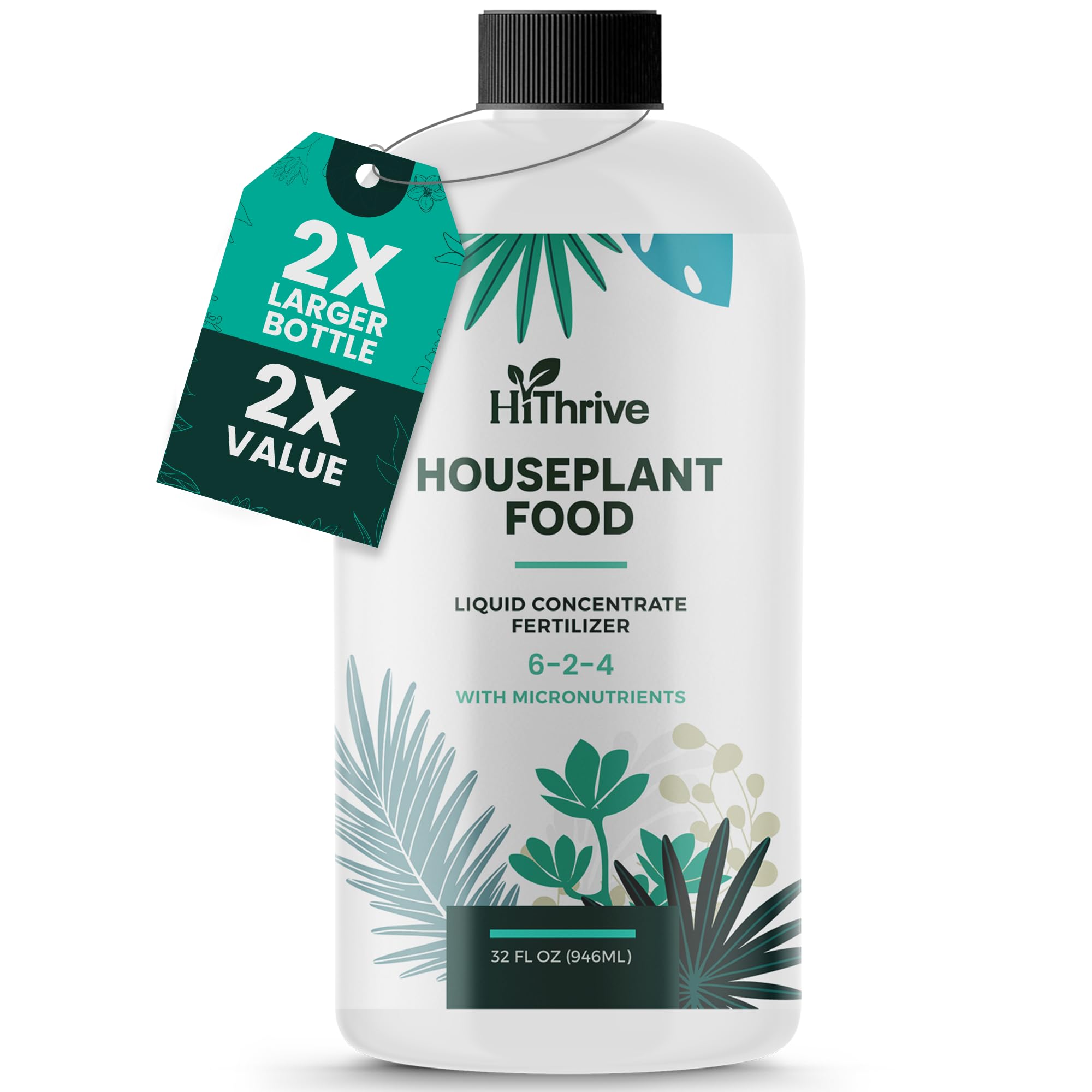
The 32-ounce HiThrive concentrate delivers a 6-2-4 NPK that pours three times as much nitrogen as phosphorus — precisely the foliage-first profile pothos demands. One half-capful per gallon produces over 175 gallons of feeding solution, making it the highest-volume-per-bottle option in this roundup, and the 4 in the potassium slot supports the cell-wall strength pothos needs when vines stretch across a wall. Users consistently report that their plants “perk up” within a week and that the formula doesn’t cause the tip burn common with high-ammonia fertilizers.
The liquid form mixes instantly with tap water and works equally well for soil drenches and bottom-watering routines. Because pothos is sensitive to salt buildup from synthetic fertilizers, the instruction to feed at every watering actually assumes you’re diluting to a very weak concentration — beginners should still alternate with plain water every third feeding to flush the pot. The included dropper-style cap makes measuring straightforward even for growers who don’t use a dedicated measuring spoon.
Available in both 16oz and 32oz, the larger bottle offers roughly double the value without any difference in chemistry. A single purchase covers a pothos collection of twenty to thirty mature pots for six to eight months, depending on watering frequency. Some users note that the bottle lacks a child-resistant seal, but the formula itself carries no strong odor and won’t attract pests if stored properly.
What works
- Delivers the highest feeding volume per bottle at an entry-level cost
- 6-2-4 ratio matches pothos leaf-production physiology
- No detectable odor and dissolves completely in seconds
What doesn’t
- All-purpose label mentions multiple plant types but the formula is foliage-optimal
- Requires consistent weekly feeding to maintain results
2. Grow Queen Organic Liquid Fertilizer 5-5-5
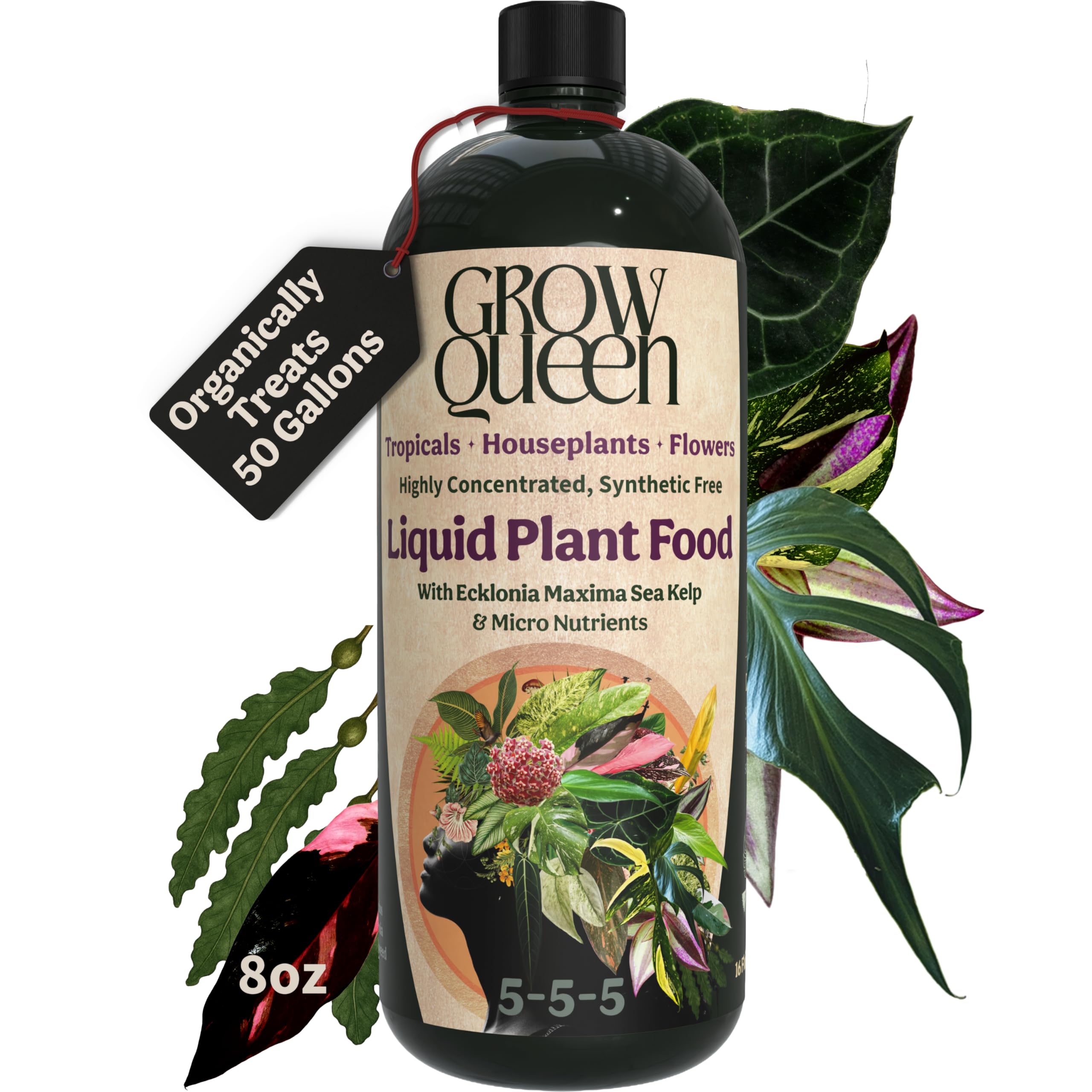
The Grow Queen formula stands apart because it’s a true 5-5-5 organic liquid — not a diluted 1-1-1 masquerading as concentrated. The nitrogen content is still abundant enough to sustain pothos leaf production, while the phosphorus and potassium create balanced support for root vitality and stress tolerance. Cold-processed Ecklonia maxima sea kelp contributes auxins that stimulate root branching, a benefit for pothos grown in water propagation or in pots where roots circle the container walls.
Because the formula is organic and includes living microbial food sources, it improves soil biology over time rather than just dumping synthetic salts. Users with sensitive plants — including peace lilies, calatheas, and monstera — report zero burn even when using the solution weekly. The faint marine scent from the kelp disappears within minutes after watering, so it won’t linger in a living room or office setting.
The mixing rate of one serving per gallon renders 50 gallons total, which sits at the middle of the pack for value. The biggest differentiator here is the organic certification and the explicit emphasis on feeding soil microbes: for growers who practice no-till potting, continuous wet-dry cycles, or living-soil setups, this product integrates directly into the broader biological system. The one trade-off is that the 5-5-5 ratio, while balanced, doesn’t deliver the extreme nitrogen spike some growers prefer for rapid leaf expansion.
What works
- True organic 5-5-5 with kelp-derived growth hormones
- Odor-free, burn-safe, and suitable for water propagation
- Boosts microbial activity in older potting mix
What doesn’t
- Nitrogen is not as concentrated as synthetic foliage-specific formulas
- Bottle yields fewer total gallons than the top-tier value option
3. Houseplant Resource Center Liquid Indoor Plant Food
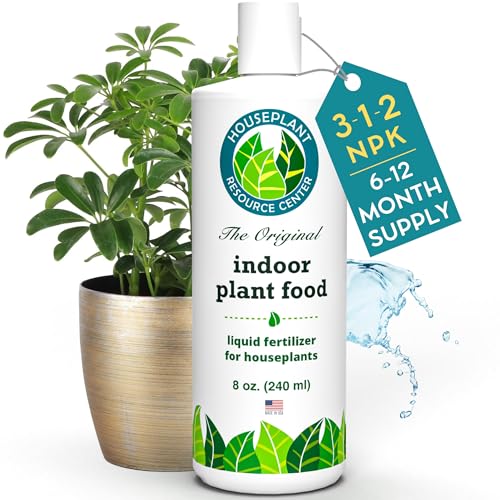
Houseplant Resource Center’s formula uses a tight 3-1-2 NPK ratio — almost half the total nitrogen of the 6-2-4 options — but compensates with chelated micronutrients that stay bioavailable longer in the root zone. This is especially useful for pothos grown under low light, where the plant’s metabolic rate slows and unchelated iron or manganese would rapidly oxidize into unusable forms. The urea-free formulation eliminates the risk of ammonia burn that occurs when urea breaks down in warm, damp potting mix.
Owner reports highlight that mature pothos responded within two weeks with deeper green coloration and new growth points at multiple nodes. The non-burning characteristic is crucial for aerial roots that trail through the soil surface — some liquid fertilizers with high salt indices desiccate these delicate tendrils, but this product’s gentle electrolytic profile avoids that entirely. Users also appreciate the absence of chemical scent, making it safe for desktop plants in closed offices.
The main consideration is cost per gallon: at roughly 40 mixed gallons per bottle, it’s the lowest yield among the premium options reviewed here. However, the 8-ounce bottle lasts several months for a moderate collection, and the formula’s compatibility with both soil and hydroponic setups means a single bottle covers all your propagation jars and potted plants alike. A few customers expressed that the small bottle size feels expensive compared to the commodity fertilizers on the next shelf, but the biochemical quality justifies the premium for growers with sensitive or historic plants.
What works
- Chelated micronutrients ensure absorption even in low-light conditions
- Urea-free design prevents salt and ammonia burn on sensitive roots
- Versatile enough for soil, hydro, and water propagation
What doesn’t
- Lowest total yield per bottle in its price tier
- Some packaging seals are fragile and can leak in transit
4. Miracle-Gro Water Soluble All Purpose 24-8-16

This blue powder is the most widely recognized plant food on the market and its 24-8-16 ratio translates to a nitrogen-dominant feed that, when diluted at half the recommended strength, lines up well with pothos nutritional needs. The chelated iron and trace elements help prevent the yellowing that often appears on older pothos leaves in lower-light positions. One three-pound container covers roughly 1,200 square feet of garden area or, in houseplant terms, about thirty standard 6-inch pots applied twice a month for six months.
The key to using this product on pothos without burning is dilution discipline: the label’s indoor recommendation of ½ teaspoon per gallon is already conservative, but for growers with small pots or high-frequency watering schedules, cutting that back to ¼ teaspoon per gallon prevents the salt accumulation that causes leaf-edge necrosis. The powder dissolves rapidly in warm water, and many users report visibly greener leaves within a week of first application. The fine blue particles can stain fabric and skin, so mixing outside or in a sink with splash protection is wise.
Pothos grown exclusively in water — without soil to buffer salt levels — should not be fed this synthetic powder at full strength because urea nitrogen can spoil clear propagation jars and stress floating roots. For soil-based pots with good drainage, however, the performance is reliable and the cost per feeding is exceptionally low. Some growers worry about the “chemical” reputation, but the only practical downside is the need to measure precisely every time.
What works
- Extremely cost-effective when diluted half-strength for multiple pots
- High nitrogen content drives rapid leaf expansion in soil-grown pothos
- Dissolves instantly and works in standard watering cans
What doesn’t
- Fine powder can stain hands, clothes, and porous surfaces
- Urea-based nitrogen can cause rot in water-only propagation setups
5. Farmer’s Secret Pothos Liquid Plant Food 6-5-3
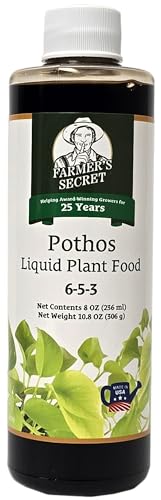
Farmer’s Secret designed this 6-5-3 liquid specifically for pothos, and while the phosphorus level is slightly higher than the foliage-ideal 3:1:2 benchmark, the 5 in the middle position supports root anchorage for vining plants that climb or trail from high shelves. The company recommends different dilution rates for young cuttings (½ teaspoon per two cups of water) versus mature vines (one teaspoon per four cups), a practical acknowledgement that young pothos roots are more sensitive to salt than established root systems.
Multiple repeat buyers report that their pothos showed measurable new growth within two weeks and that vines grew visibly longer — one customer noted a “largest one will have vines growing across the wall” after only a few weeks of biweekly feeding. The cap doubles as a measuring cup, which eliminates the need for separate spoons and reduces the chance of over-dosing. The liquid is relatively thin and pours cleanly, and there is no artificial coloring added, so the soil surface stays free of blue or green staining.
The main trade-off is the 8-ounce bottle volume, which yields fewer gallons than larger value-bottle concentrates — about 6 to 8 gallons depending on the dilution chosen. This means more frequent repurchasing for collections larger than ten pots. Additionally, the 6-5-3 ratio, while functional, still carries more phosphorus than some foliage-purist growers prefer, so feeding every other watering rather than weekly can keep that middle number from accumulating in the pot.
What works
- Labeled specifically for pothos with species-specific dilution guidance
- Measuring cap reduces error and mess
- Users see visible vine extension in under two weeks
What doesn’t
- Higher phosphorus than foliage-optimal 3:1:2 ratio
- Small bottle requires more frequent repurchase for large collections
6. EZ-gro Professional Liquid Pothos Fertilizer 3-1-2
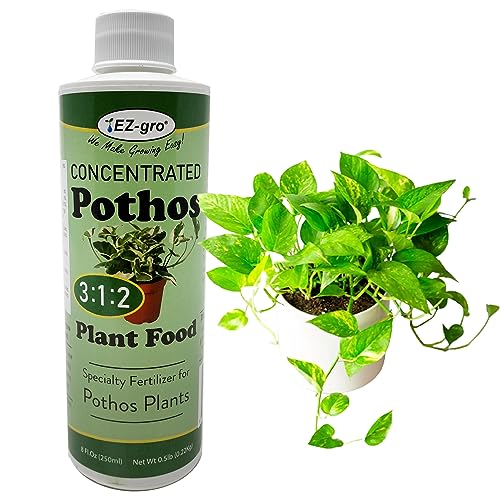
EZ-gro markets this as a “professional blend” for tropical foliage, and the 3-1-2 NPK aligns perfectly with the consensus ratio that plant physiologists recommend for foliage-dominant aroids. The standout design element is the high-potential acidity of the concentrate, which helps neutralize alkaline tap water — a common problem for growers whose municipal water pH sits above 7.5, causing iron and manganese to precipitate out before the pothos can absorb them. The 3-1-2 ratio keeps nitrogen dominant without the extreme spike of a 24-8-16 powder.
Each bottle contains 8 fluid ounces and the manufacturer recommends adding 2 tablespoons per gallon — a slightly stronger dose than other liquids, but the formula is balanced to be safe at every watering. Users who applied it to snake plants and peace lilies alongside their pothos saw consistent improvement across all species, which reinforces the broad foliage-plant compatibility. The liquid has a slight mineral tang rather than any organic odor, and it blends completely clear so there’s no staining if you use a clear glass watering can.
The 8-ounce bottle yields roughly 6 to 7 gallons, placing it in the same volume tier as the Farmer’s Secret. The acidity feature is genuinely valuable for growers treating pothos in hard-water regions, but for those already using filtered or rainwater, the pH-lowering effect is unnecessary and could slightly shift the soil chemistry over many months. Some users found the “professional” branding misleading given the straightforward watering-can application, but the chemistry is sound and the results support the claim.
What works
- 3-1-2 ratio is the physiologically ideal profile for pothos foliage
- High acidity counters alkaline tap water to prevent micronutrient lockout
- Works across multiple foliage species without adjustment
What doesn’t
- Small bottle volume yields fewer gallons per purchase
- pH adjustment is unnecessary for growers using rainwater or RO water
7. HiThrive 16oz Houseplant Fertilizer 6-2-4

This is the smaller sibling of the top-ranked 32-ounce HiThrive, using the exact same 6-2-4 NPK formulation but in a 16-ounce bottle that yields 85+ gallons — still a generous volume per dollar for a single-plant collection. The nitrogen-heavy profile is perfectly suited for pothos, and the potassium at 4 supports disease resistance and structural strength as vines lengthen. Users who started with this size and upgraded to the 32-ouncer report identical results, confirming that the chemistry is consistent across the product line.
The lower entry cost makes this an ideal starting point for someone new to liquid fertilizing who isn’t sure they want to commit to a large bottle. The mixing instructions (1 teaspoon per gallon) are simple, and the liquid can also be used as a foliar spray for pothos leaves, which is particularly useful when you want to encourage glossiness on mature foliage. Several customers noted that their pothos “have never bloomed as much as when I use this regularly” — while pothos rarely blooms indoors, the improved overall vigor does sometimes trigger spathe production in very happy specimens.
The only meaningful limitation is that, over time, buying the 16-ounce bottle repeatedly costs more per gallon than the 32-ounce version, so any grower with more than five pots should consider the larger size after the trial period. The plastic bottle is lightweight and the flip-top spout meters cleanly, though reviewers caution against storing it above 90°F as heat can degrade the liquid concentrate’s biological availability.
What works
- Lowest upfront cost to test a proper 6-2-4 foliage formula
- Also works as a foliar spray to polish leaves and deliver quick nutrients
- Simple 1 tsp per gallon dosing reduces calculation errors
What doesn’t
- Small bottle becomes cost-inefficient for growers with many pots
- Heat-sensitive storage means it shouldn’t sit near a sunny window
Hardware & Specs Guide
Choosing the right concentration and form factor matters as much as the NPK numbers themselves. The specs below explain the physical properties that determine how a fertilizer behaves in the pot.
NPK Ratio — What Those Three Numbers Actually Mean
The three numbers always represent the percentage by weight of Nitrogen (N), available Phosphate (P2O5), and soluble Potash (K2O). For pothos, the first number should be at least double the second number. A 6-2-4 formula supplies 6% nitrogen, 2% phosphorus, and 4% potassium. The remaining 88% is inert carrier or organic matter. Always check the guaranteed analysis panel on the back label — products that list only “0.5-0.5-0.5” are too weak to produce noticeable growth in a mature pothos vine.
Gallons per Bottle — The Real Cost Metric
Liquid concentrates are sold by fluid ounces, but the relevant spec is the “mixing yield” — the number of gallons of feeding solution the bottle creates at the recommended rate. A 32-ounce concentrate that makes 175 gallons is far more economical than an 8-ounce bottle making 6 gallons, even if the smaller bottle costs less upfront. For a single 6-inch pothos pot consuming roughly ½ gallon of water per week, 175 gallons lasts over six years of weekly feeding.
Water-Soluble Powder vs. Liquid Concentrate
Powders like Miracle-Gro 24-8-16 must be completely dissolved before watering — undissolved granules sit on the soil surface and can create localized salt hotspots. Liquids dissolve instantly but require proper sealing between uses to prevent evaporation that changes the concentration. Neither form is inherently superior for pothos; the choice depends on whether you prefer scooping powder or counting capfuls, and whether you need the versatility of a foliar spray (easier with liquid).
Organic vs. Synthetic — Not a Morality Question
Organic fertilizers (e.g., fish emulsion, kelp, compost tea) release nutrients through microbial activity and are less likely to cause salt burn, but they also require a living soil biome that may be absent in sterile potting mixes. Synthetic fertilizers (e.g., 24-8-16, 6-2-4) deliver immediate salts in plant-available form and work reliably in any potting medium, but over-application leads to root scorch and white crust on clay pots. For pothos in standard peat-based mix, either works as long as you respect the dilution.
FAQ
Should I use a higher nitrogen ratio for pothos grown in low light?
Can I use the same fertilizer for pothos and succulents interchangeably?
How often should I fertilize a pothos growing in water only?
What is the best way to measure liquid fertilizer for a single small pot?
Final Thoughts: The Verdict
For most gardeners, the fertilizer for pothos winner is the HiThrive 32oz 6-2-4 because it delivers the ideal nitrogen-heavy ratio, mixes instantly, and yields 175 gallons — providing years of consistent feeding for a modest one-time investment. If you want an organic formula that feeds the soil microbes and includes sea-kelp rooting hormones, grab the Grow Queen 5-5-5. And for a premium, urea-free option with chelated micronutrients that thrive in low light, nothing beats the Houseplant Resource Center 3-1-2.