
Philodendrons are some of the most forgiving indoor plants, but even these hardy aroids hit a growth wall when their potting mix runs out of nutrients. Yellowing lower leaves, leggy stems, and leaves that stay stubbornly small are all signs your plant is starving. The right liquid or tablet feed restores that deep green color and pushes out those fenestrated leaves you’ve been waiting for.
I’m Rikta — the co-founder and writer behind Lawn Gear Lab. I’ve spent hundreds of hours analyzing fertilizer labels, cross-referencing NPK data with real-world owner results, and sorting through thousands of reviews to find the formulas that actually deliver visible growth for philodendron varieties.
After comparing ratios, bioavailability, and ease of use across dozens of options, I’ve narrowed it down to the seven formulas that consistently earn their place on the shelf. Here’s my take on the best fertilizer for philodendron you can buy right now.
How To Choose The Best Fertilizer For Philodendron
Philodendrons are heavy feeders during their active growing season, but they’re also sensitive to over-fertilization. The wrong NPK balance can scorch roots or produce weak, leggy growth. Here’s what to look for.
N-P-K Ratio: Higher Nitrogen for Foliage
Philodendrons prioritize leaf production over flowering, so they need a fertilizer with a higher nitrogen percentage relative to phosphorus and potassium. A ratio around 3-1-2 or 4-2-3 works well. Balanced formulas like 3-3-3 also perform adequately, especially if the soil already has good organic matter.
Liquid vs. Slow-Release vs. Tablets
Liquid concentrates give you the most control over feeding frequency — you can dilute and apply weekly during spring and summer. Slow-release granules or tablets are better for low-maintenance schedules but can dump nutrients unevenly in small pots. Foliar sprays are useful as a supplement but shouldn’t replace root feeding.
Micronutrients & Biostimulants
Sea kelp extract, humic acid, fulvic acid, and vitamin B1 can improve root development and nutrient uptake. These additives aren’t strictly necessary, but they help stressed or recently repotted plants recover faster. Chelated trace elements (iron, manganese, zinc) prevent interveinal chlorosis.
Concentration & Dilution Ease
Some fertilizers require exact measuring and mixing; others are pre-diluted or come as easy-drop tablets. For beginners, a pre-measured format reduces the risk of overfeeding. For experienced growers, a concentrated liquid offers better cost-per-gallon value.
Quick Comparison
On smaller screens, swipe sideways to see the full table.
| Model | Category | Best For | Key Spec | Amazon |
|---|---|---|---|---|
| Growth Technology GT Foliage Focus | Premium Liquid | Serious collectors & hydro setups | 946 ml; 3-5 ml per liter | Amazon |
| TPS Nutrients Philodendron Fertilizer | Liquid Concentrate | Water propagation & large bottle value | 32 oz; 5-10 drops per 4 oz water | Amazon |
| Houseplant Resource Center Philodendron Fertilizer | Biostimulant Blend | Targeted philodendron care | 8 oz; 3-3-3 NPK + sea kelp | Amazon |
| Houseplant Resource Center Monstera Plant Food | Premium Liquid | Big-leaf aroids & fenestration support | 8 oz; 5-2-3 NPK concentrate | Amazon |
| Instant Biologics Self-Dissolving Tablets | Slow-Release Tablet | No-mess, low-maintenance feeding | 4 tablets; 4-3-6 NPK each | Amazon |
| HiThrive 16oz Houseplant Fertilizer | All-Purpose Liquid | Budget-friendly multi-plant feeding | 16 oz; 6-2-4 NPK makes 85+ gallons | Amazon |
| Gardenera Plant Superfood for Philodendron | Foliar Spray | Root shock recovery & quick leaf boost | 8 oz; B1 vitamin + glucose spray | Amazon |
In‑Depth Reviews
1. Growth Technology GT Foliage Focus
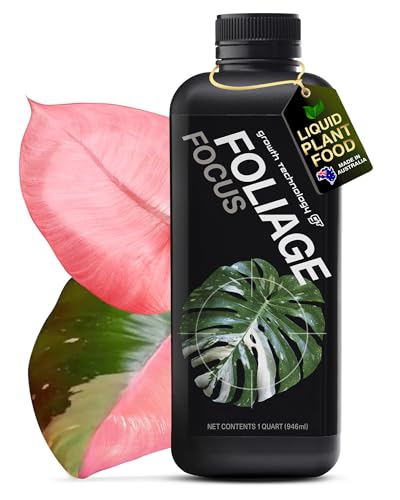
Growth Technology’s Foliage Focus is the most technically complete fertilizer on this list, formulated specifically for aroids, philodendrons, and other leafy tropicals. Its nitrate-nitrogen base avoids the ammonia-driven stretch that can make philodendrons leggy, while the added calcium, magnesium, and chelated trace elements support chlorophyll density and leaf turgor. The 1-quart bottle is concentrated — just 3–5 ml per liter for soil feeding or 5–7 ml per liter for hydroponics — so it lasts months even for a large collection.
Owner feedback consistently highlights rapid new growth and noticeably larger leaves within two to three weeks of regular use. The pH-buffered formula means you don’t have to adjust your water’s pH separately, and it works equally well in potting mix, semi-hydro setups like LECA, and as a foliar spray. The manufacturer recommends a monthly flush with plain water to prevent salt buildup, a simple precaution that protects roots in small pots.
The only consistent complaint is the bottle’s cap seal, which can leak during shipping if the bottle is jostled. A few users also note the price feels steep upfront, but the concentration makes the cost-per-feeding lower than most 8-oz premium liquids. For collectors running multiple rare aroids in varied setups, this is the most versatile and scientifically grounded choice.
What works
- Nitrate-nitrogen base prevents ammonia burn and leggy growth.
- Versatile across soil, hydro, semi-hydro, and foliar application.
- Concentrated formula delivers low cost per feeding.
- Contains calcium, magnesium, and chelated trace elements.
What doesn’t
- High upfront cost for the bottle.
- Seal can leak during shipping if not packed carefully.
- Requires measuring syringe or dropper for accurate dosing.
2. TPS Nutrients Philodendron Fertilizer
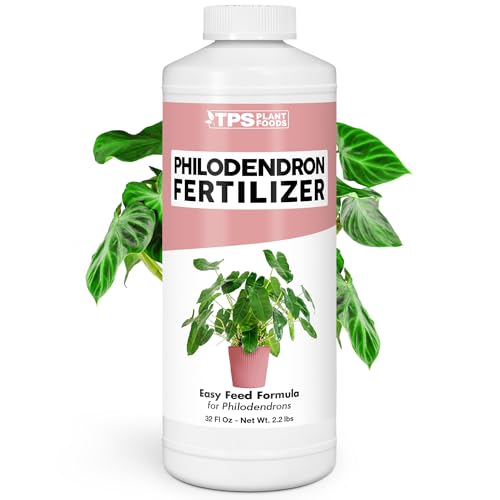
TPS Nutrients delivers the largest liquid volume on this list — a full 32 ounces — making it the obvious pick for anyone maintaining a substantial philodendron collection or feeding multiple plants every week. The company doesn’t publish a fixed NPK ratio, but the formula is designed for tropical foliage plants and focuses on steady, sustainable growth rather than a quick nitrogen spike. The dosing instructions call for 5–10 drops per 4 ounces of water, which makes it exceptionally economical per gallon.
Reviewers consistently note visible results in days, not weeks, with philodendrons pushing out new leaves faster and showing deeper green color. Several owners report using it successfully in water propagation — a scenario where many fertilizers cause algae growth or root burn. The gentle droplet-based dosing reduces the risk of overfeeding, especially for beginners who might otherwise pour too much concentrate into a small watering can.
The main drawback is the lack of a transparent NPK analysis on the label, which makes it hard to compare nutrient density against other formulas. A few customers received bottles with loose caps, resulting in minor leakage inside the shipping bag. Still, the sheer volume and the concentrated drop-dose design make this the best value for heavy users who feed weekly.
What works
- 32-ounce bottle offers the best volume-to-price ratio.
- Ultra-concentrated; just 5–10 drops per 4 oz of water.
- Safe for philodendrons growing in water or semi-hydro.
- Fast visible results reported within days.
What doesn’t
- No published NPK ratio for direct comparison.
- Bottle cap seal can leak in transit.
- Dropper-style dosing may feel imprecise for some users.
3. Houseplant Resource Center Philodendron Fertilizer

The Houseplant Resource Center formula is one of the few fertilizers on the market that’s explicitly labeled for philodendrons, and it backs that claim with a balanced 3-3-3 NPK ratio supplemented by sea kelp extract, humic acid, and fulvic acid. Those biostimulants increase nutrient uptake efficiency, which is especially valuable for philodendrons growing in suboptimal soil or recovering from repotting stress. The 8-ounce bottle comes with an induction seal and a flip-top cap for easy one-handed dosing — 1 teaspoon per cup of water for weekly feeding.
Owner reports are overwhelmingly positive, with many users noting that previously stalled plants started pushing new growth after two or three applications. One reviewer described a philodendron that had been stuck at two leaves for three years finally producing new foliage. The formula is gentle enough to use every watering without salt buildup, and the included care webinar and e-book add real educational value for less experienced growers.
A few customers felt the per-ounce cost was high, and one user saw no difference after a month of use — possibly because their soil already contained adequate nutrients. The 3-3-3 ratio is less nitrogen-heavy than some alternatives, so fast-growing varieties in low-light conditions may benefit from a higher-N mix instead. For a targeted philodendron feed with proven biostimulant support, this is a solid mid-range choice.
What works
- Specifically formulated and labeled for philodendrons.
- Sea kelp, humic acid, and fulvic acid boost nutrient uptake.
- Gentle enough for every watering; no burn risk.
- Free care guide and webinar included.
What doesn’t
- Higher cost per fluid ounce compared to all-purpose options.
- Some users saw no short-term results.
- 3-3-3 ratio may not be nitrogen-rich enough for some fast growers.
4. Houseplant Resource Center Monstera Plant Food
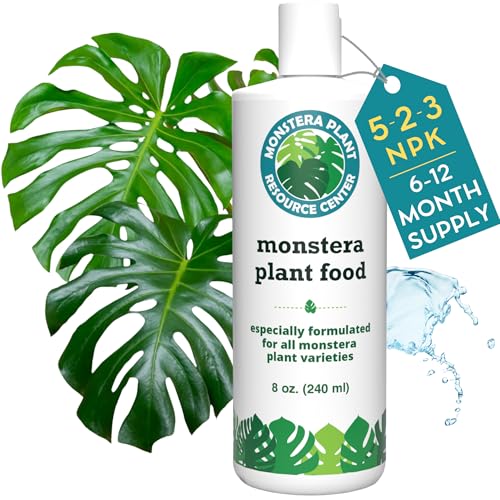
Designed primarily for Monstera but just as effective on large-leaved philodendrons like Philodendron gloriosum or Philodendron pastazanum, this 5-2-3 NPK formula delivers a significantly higher nitrogen load than typical balanced fertilizers. That extra nitrogen drives rapid foliage expansion and deeper green coloration, while the chelated nutrient complex ensures the minerals remain bioavailable even in alkaline tap water. The 8-ounce concentrate is diluted at 1 teaspoon per 2 cups of water, and users report it is safe for weekly use without leaf tip burn.
Real-world results from owners include dramatic growth spurts in previously dormant plants, with one reviewer noting a Monstera Albo that had not pushed a leaf in five months produced new growth within weeks. Multiple users mentioned their plants grew “out of control” after switching to this feed, which is high praise for anyone wanting a lush, full look. The formula is made in the USA by a family-run business, and the bottle packaging is sturdy with a clear dropper-style cap.
The main hesitation is the price per ounce, which puts it in the premium tier. Some buyers also found the instructions ambiguous — “1 teaspoon to at least 2 cups of water” leaves room for interpretation. For collectors growing large, mature philodendrons and monsteras that need consistent high-nitrogen feeding, this is one of the most effective single-bottle solutions available.
What works
- High 5-2-3 NPK ratio pushes large, fast leaf growth.
- Chelated nutrients remain available in various water types.
- Proven to revive dormant aroids within weeks.
- Gentle enough for weekly use with no burn reported.
What doesn’t
- Premium price per fluid ounce.
- Dilution instructions could be clearer.
- Not ideal for slow-growing small philodendron varieties.
5. Instant Biologics Self-Dissolving Tablets
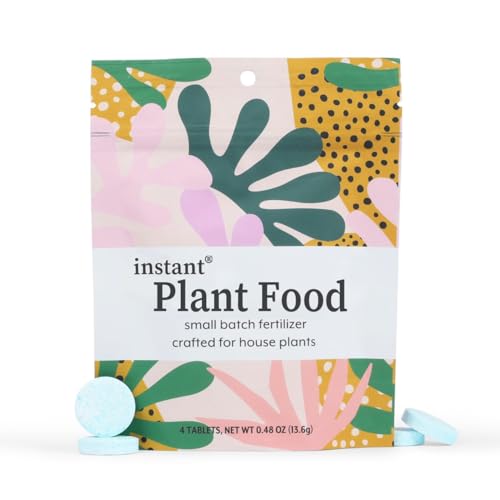
Instant Biologics solves the mess and guesswork of liquid fertilizers with pre-measured self-dissolving tablets. Each tablet contains a 4-3-6 NPK ratio — slightly higher in potassium to support root strength and stress resistance — and feeds a large houseplant or several smaller ones for up to three months. You simply drop one tablet into your watering can, let it dissolve, and water as usual. No measuring spoons, no sticky concentrates, no risk of pouring the wrong amount.
Owner feedback is overwhelmingly positive, with beginners especially praising the simplicity and lack of odor. Several users reported reviving “withering” plants within days of the first feeding. The formula is derived from naturally occurring minerals and a live fermentation process, and the company is certified vegan and cruelty-free with 1% of sales donated to environmental causes. The tablets are also compact for storage and travel.
The 4-count pack covers only a few feedings, so heavy users will need to restock frequently. Some reviewers noted that the tablet takes a few minutes to fully dissolve in cold water, and a few found the per-tablet cost higher than liquid alternatives. For low-maintenance plant parents or anyone who hates measuring, this is the most convenient format available.
What works
- Zero measuring or mixing required.
- Odorless and mess-free application.
- Each tablet feeds a large plant for up to 3 months.
- Derived from natural minerals; vegan certified.
What doesn’t
- Only 4 tablets per pack; needs frequent reordering.
- Higher cost per feeding than liquid concentrates.
- Tablets dissolve slowly in cold water.
6. HiThrive 16oz Houseplant Fertilizer

HiThrive’s 6-2-4 NPK concentrate is the highest-nitrogen formula on this list, delivering a serious macronutrient punch for philodendrons in active growth. One 16-ounce bottle makes over 85 gallons of feed when mixed at a rate of 1 teaspoon per gallon of water — that’s enough to support a large collection through multiple growing seasons. The extra nitrogen is ideal for pushing bushier growth and darker green leaves, especially in varieties like Philodendron hederaceum or Philodendron Brasil that rely on dense foliage for their visual appeal.
Customer reports are consistently positive, with owners noting that their plants “perked up” and “bloomed more” after switching to this feed. The liquid can also be used as a foliar spray for propagation cuttings, and the manufacturer provides a separate dilution rate for water-rooted plants. The bottle includes a built-in measuring chamber on the cap, which eliminates the need for separate measuring spoons.
A few users caution against using it every watering, as the high nitrogen content can cause salt buildup if the soil is not flushed periodically. One reviewer specifically mentioned spacing feedings out to avoid nutrient overload. For budget-conscious growers who want the most gallons of feed per dollar, this is hands-down the best value option on the market.
What works
- Highest NPK ratio (6-2-4) for aggressive foliage growth.
- Makes 85+ gallons — exceptional value per feeding.
- Cap doubles as a measuring chamber.
- Can be used as a foliar spray for propagation.
What doesn’t
- High nitrogen requires careful feeding schedule to avoid salt buildup.
- Not the best for slow-growing or sensitive philodendron varieties.
- Some users found it too strong for every-watering use.
7. Gardenera Plant Superfood for Philodendron
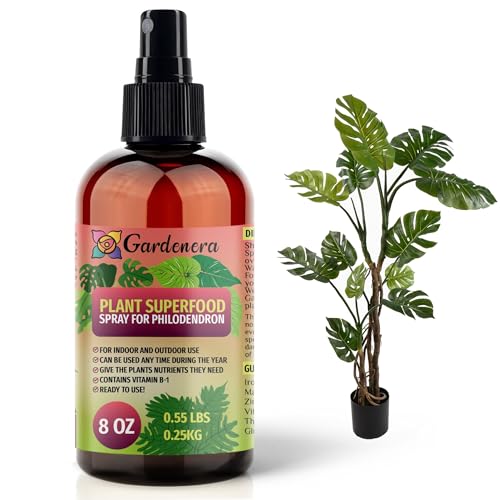
Gardenera takes a different approach with a ready-to-use spray formula that delivers vitamin B1, glucose, iron, manganese, and zinc directly to the leaves and soil. Rather than providing bulk macronutrients like a conventional fertilizer, this “superfood” acts as a metabolic stimulant — the glucose offers an immediate energy source, while B1 promotes root cell division and reduces transplant shock. It’s best used as a supplement alongside a regular feeding schedule or as a rescue treatment for stressed plants.
Owner feedback is notably enthusiastic, with multiple reviews describing it as a “miracle” for struggling plants. One owner revived a dying avocado tree and a lemon Meyer tree that had not bloomed in nine years. Another user with a fiddle leaf fig saw healthy growth through an unusually cold, low-humidity winter. The spray format makes application effortless — just a few pumps at the base and on the leaves every 9–10 days.
The main limitation is that this is not a complete fertilizer — it lacks the balanced N-P-K profile needed for long-term sustained growth. Relying on it exclusively can lead to nutrient deficiencies over time. Some users also found the label text difficult to read due to faded printing. For philodendron owners recovering from repotting, root rot, or shipping stress, this is an excellent targeted booster.
What works
- B1 vitamin reduces transplant shock and stimulates root growth.
- Glucose gives an immediate energy boost to stressed plants.
- Ready-to-use spray bottle — no mixing required.
- Contains iron, manganese, and zinc for trace element support.
What doesn’t
- Not a complete fertilizer; lacks balanced N-P-K.
- Label printing can be faded and hard to read.
- Higher cost per ounce compared to concentrated liquids.
Hardware & Specs Guide
N-P-K Ratio & Leaf Development
Nitrogen (N) drives chlorophyll production and leaf expansion — higher N numbers (5-2-3 or 6-2-4) produce faster foliage growth in active seasons. Phosphorus (P) supports root and rhizome health, while potassium (K) regulates water retention and stress resistance. For philodendrons, the ideal ratio leans heavily on nitrogen relative to P and K.
Dilution Ratio & Concentration
Liquid fertilizers vary from ready-to-use sprays (no mixing) to ultra-concentrated formulas requiring 5 drops per liter. Lower dilution ratios mean a single bottle lasts longer but demands accurate measuring. Self-dissolving tablets eliminate dilution entirely but offer less flexibility for adjusting feed strength based on plant condition.
FAQ
How often should I fertilize my philodendron during active growth?
Can I use a general houseplant fertilizer on philodendrons?
Should I flush the soil between fertilizing sessions?
What causes brown leaf tips after fertilizing?
Final Thoughts: The Verdict
For most gardeners, the fertilizer for philodendron winner is the Growth Technology GT Foliage Focus because its nitrate-nitrogen base and precision mineral profile deliver consistent, balanced growth across soil, hydro, and foliar feeding without burn risk. If you want the most volume for your money, grab the TPS Nutrients Philodendron Fertilizer. And for a no-mess, set-and-forget solution, nothing beats the Instant Biologics Self-Dissolving Tablets.