
Specs are compiled from manufacturer listings and verified buyer reviews and can change over time — please confirm the key details on the product page before buying.
Perennials live for years, but they need the right feeding to come back stronger each season, not just survive. The difference between a few lackluster stalks and a garden that stops neighbors in their tracks often depends on what you put in the ground this spring — and the wrong fertilizer is worse than none at all for plants you expect to return.
I’m Rikta — the founder and writer behind Lawn Gear Lab. This guide is built by comparing the manufacturers’ published specifications and the patterns across verified customer reviews, so you get each pick’s real strengths and trade-offs instead of marketing spin.
The key is matching the nutrient profile to what perennials actually need at bloom time versus root time, and the fertilizer for perennial plants you choose determines whether your flower beds fill in or fizzle out after the first show of color.
Our Picks at a Glance

How To Choose The Best Fertilizer For Perennial Plants
Perennials are not heavy feeders like annual vegetables, but they do need a steady supply of nutrients to build strong root systems that survive winter and push up fresh growth every spring. The trick is picking the right balance so you get flowers, not just leaves.
Read the NPK Ratio for Bloom Power
The three numbers on the bag tell you the percentage of nitrogen (N), phosphorus (P), and potassium (K) — the big three nutrients. For perennials you want flowers from, a formula with higher phosphorus (the middle number) nudges the plant toward bud development. A balanced 10-10-10 works as a general maintenance feed, while a 4-10-7 or similar heavier-phosphorus blend gives bloom production a real spike.
Slow-Release vs. Water-Soluble
Granular slow-release fertilizers break down over weeks or months, so you apply once and the plant feeds gradually through the season. That suits established perennials fine. Water-soluble powders (like a 20-20-20 mix) deliver nutrients instantly, which is great for a quick mid-season pick-me-up, but they require more frequent applications and can wash away faster in rain.
Organic Ingredients Mean Healthier Soil
Organic fertilizers feed the soil microbes that in turn feed your plants. Ingredients like bone meal, blood meal, and kelp release nutrients slowly and improve the soil structure over time. If you want your perennials to return stronger every year rather than just surviving, an organic or natural-based formula is the way to go.
Quick Comparison
| Model | Best For | NPK Ratio | Form | Weight | Amazon |
|---|---|---|---|---|---|
| Nelson ColorStar★ Best Overall | Maximum seasonal blooms | — | Granules | 32 oz | Amazon |
| GreenView 10-10-10Best Value | Large-scale garden feeding | 10-10-10 | Granules | 33 lb | Amazon |
| Jobe’s Organics 4-4-4 | OMRI organic all-purpose | 4-4-4 | Granules | 16 lb | Amazon |
| Dr. Earth Flower Girl | Intensive bloom boost | 4-10-7 | Granules | 4 lb | Amazon |
| Espoma Plant-Tone | Organic spring & fall feed | 5-3-3 | Granules | 8 lb (2-pack) | Amazon |
| GS Plant Foods 20-20-20 | Quick water-soluble feed | 20-20-20 | Water-soluble | 3 lb | Amazon |
| Schultz 15-5-15 | Slow-release rose feeder | 15-5-15 | Granules (slow-release) | 3.5 lb | Amazon |
In‑Depth Reviews
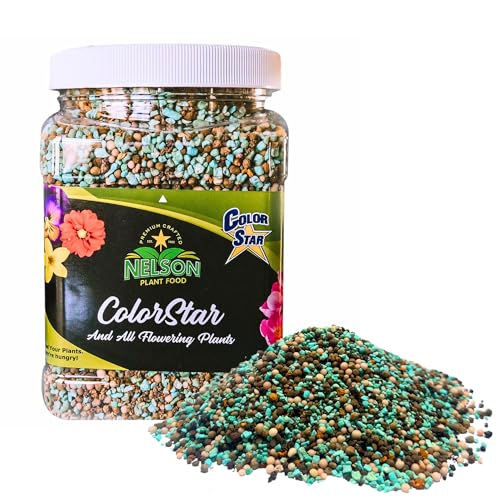
1. Nelson ColorStar Outdoor & Indoor Plant Fertilizer
Our pick — over 4.5★ from 700+ verified ratings; the strongest balance of quality and price.
The bloom-boosting specialist that turns so-so perennials into a neighborhood showpiece.
This is the one that delivers bigger, brighter blooms you can see from the street. The secret is the 25% bone and blood meal content — ingredients naturally rich in phosphorus and nitrogen that directly fuel flower production and root strength. For perennials, that means a longer bloom window and more flower stalks per plant, not just a quick flush of green leaves.
Buyers report that hydrangeas treated with ColorStar in the spring produce “more blooms than usual,” and the effect is visible within weeks. The granules feed for 4 to 5 months per application, so you scatter it once around the drip line of your perennials in early spring and let the rain carry it down. That is about the whole season covered with a single pass.
The only trade-off, as some owners mention, is that the 32-ounce jar looks smaller than expected for the price — but the outstanding results, especially on azaleas and tropicals, win people over. The Espoma Plant-Tone below is a 2-pack totaling 128 ounces, while this is a 32-ounce jar, but the nutrient density and bloom-specific formulation make it the most efficient choice for targeted perennial beds rather than broad garden feeding.
What Wins People Over
- Visible increase in bloom size and quantity on the first application
- One spring feed lasts the whole season (4 to 5 months)
- Bone and blood meal provide natural, slow-feeding nutrients
The Honest Trade-Off
- Smaller jar than many all-purpose bags at a similar price point
- Best value on smaller gardens or targeted perennial beds
Perfect for: The gardener who wants maximum blooms from a single application and is willing to pay for potency over volume.
Not the best fit for: Covering large vegetable gardens or lawns — this is a flower-first formula best reserved for perennials, shrubs, and bulbs.
2. GreenView Multi-Purpose Fertilizer 10-10-10
The workhorse bag that keeps an entire garden fed without draining your wallet.
If you need a single fertilizer for perennials, vegetables, shrubs, trees, and ornamental beds all at once, the 33-pound GreenView bag is the obvious choice. It covers 3,300 square feet, which is a generous suburban garden, and the 10-10-10 balanced formulation (an equal percentage of nitrogen, phosphorus, and potassium) supports steady all-around growth without pushing one thing over another.
Owners running gardens across the Midwest report very good results on hostas, perennials, vegetables, and trees throughout the growing season. The granules are well-formed and non-clogging, which means they spread evenly through a broadcast spreader without jamming the gate — a small detail that saves real frustration when you are covering a large area. The bag is heavy at 33 pounds, but the value for square-foot coverage beats every other option here.
For perennials specifically, a 10-10-10 works best as a maintenance feed applied in early spring and again in midsummer. It will not give the explosive flower display of a bloom-specific formula, but it keeps the entire garden healthy and productive. The convenience of having it delivered by Prime is a genuine bonus for anyone who would rather skip the trip to the home center.
Why It Stands Out
- Enormous 33-pound bag covers 3,300 square feet
- Balanced 10-10-10 works on everything from flowers to vegetables to trees
- Non-clumping granules spread easily through a broadcast spreader
The Catch
- Not formulated specifically for maximum flower bloom — middle phosphorus number is moderate
- Requires a second application mid-season for best perennial performance
Reach for this if: You have a large mixed garden and want one fertilizer that does a solid job on everything without fussing over ratios.
Look elsewhere if: You are only growing flowering perennials and want the densest possible bloom; a higher-phosphorus blend like the Nelson ColorStar above will give you more flowers per plant.
3. Jobe’s Organics All Purpose Fertilizer 4-4-4

The certified organic champion that builds soil health alongside better blooms.
Jobe’s Organics is OMRI-listed, meaning it meets the USDA standards for organic gardening — no synthetic chemicals, no sewage sludge, just natural ingredients. The 4-4-4 NPK (a balanced ratio of nitrogen, phosphorus, and potassium) is a gentle, balanced feed that perennials respond to over the long term, not a shock-and-awe formula that forces a quick green flush at the expense of soil life. Many owners use it as a liquid fertilizer by steeping one cup of granules in a gallon of dechlorinated water for 24 hours, then watering their beds weekly — a trick that produced flowering in 48 hours for one gardener and massive harvests of squash, cucumber, and eggplant.
The 16-pound bag gives you plenty of volume for repeated applications. The manufacturer recommends feeding every 2 to 3 weeks through the growing season, which sounds frequent, but the mild ratio means you will not burn roots if you apply generously. The granular texture breaks down into humus in about a week, so you are feeding the soil as well as the plants.
The honest downside is the smell — it has a strong, farm-like odor for a few days after application, typical of chicken manure-based organics. A few owners mention flies being attracted. That passes once the granules break down, and the results — neighbors asking “how did you do that?” — are the lasting memory.
The Big Wins
- OMRI-listed for certified organic gardening with no synthetic chemicals
- Gentle 4-4-4 ratio safe for frequent feeding without root burn
- Visible plant response within 1 to 2 days of watering in
What to Know
- Strong chicken manure smell lingers for a few days after application
- Needs reapplication every 2 to 3 weeks during the growing season
Best for: Organic gardeners who want to improve soil quality while feeding perennials — and do not mind a farm-yard scent for a day or two.
Think twice if: You need a single annual application or live in a tight urban garden where odor could cause neighbor friction.
4. Dr. Earth Flower Girl Bud & Bloom Booster 4-10-7

The organic bloom bomb that turned a two-tree garden into a 25-bloom dragon fruit show.
When perennials are all leaves and no flowers, the culprit is almost always too much nitrogen and not enough phosphorus. Dr. Earth Flower Girl flips that equation with a 4-10-7 analysis — the high middle number drives bud formation, while the lower nitrogen keeps foliage from going wild. A buyer with dragon fruit trees watched blooms jump from three on two trees to 25 in a single season after switching to this formula.
The blend is 100% organic, certified by the Non-GMO Project, and safe for people and pets — no chicken manure, no sewage sludge, just a handcrafted mix. It is ideal for perennials, flowering shrubs, and even potted plants because the granules feed quickly without harsh chemical salts. The pet-friendly rating is mixed in reviews (a few owners mention it attracts flies), but the overwhelming consensus is that the bloom response is worth every scoop.
At 4 pounds, the bag is small, so this is best used as a targeted bloom booster for specific flower beds rather than a whole-garden spread. Pair it with a balanced maintenance feed for the rest of the yard.
The Bloom Advantage
- High-phosphorus 4-10-7 forces flower production, not leaf growth
- 100% organic and Non-GMO Project Verified
- Safe for people and pets when used as directed
The Limitation
- 4-pound bag covers a limited area — best for targeted perennial beds, not lawns
- Occasional reports of flies attracted to the organic material
Ideal for: The gardener chasing a massive flower show from specific perennials, shrubs, and flowering trees — especially dahlias, dragon fruit, and guava.
Not your pick if: You prefer a single all-purpose feed for the whole property; this is a specialist bloom accelerator, not a general maintenance fertilizer.
5. Espoma Organic Plant-Tone 5-3-3

The century-old organic staple that feeds perennials without guessing.
Espoma has been making natural fertilizers since 1929, and Plant-Tone is their flagship all-purpose formula. The 5-3-3 analysis is deliberately low and balanced, designed to feed soil microbes rather than force-feed the plant. The bag includes Bio-tone, Espoma’s proprietary blend of beneficial microbes that help roots access nutrients already in the soil. That matters for perennials because you are building fertility year over year, not just for one season.
This is a 2-pack, giving you 128 ounces total — a strong value compared to the Nelson ColorStar’s 32 ounces at a similar price. Owners apply it twice a year (spring and fall) on trees and shrubs, or monthly through the growing season on flowers and perennials. The granules are ready to use with no mixing, and they break down slowly, creating a long-lasting nutrient reservoir. The immediate response, as many report, is visibly greener foliage and stronger spring growth.
The catch is the smell — it is made with chicken manure, so it has a farm-yard odor that you will notice during application. Standing upwind is the recommended strategy. A few owners find the scent strong enough to mention it as a negative, but the effectiveness keeps them coming back. For organic gardeners who want a trusted brand with decades of proven results, this is the bag.
The Strengths
- Trusted brand with nearly a century of organic fertilizer experience
- Bio-tone beneficial microbes improve long-term soil health
- 2-pack provides excellent value at 128 ounces total
The Weakness
- Strong chicken-manure odor during and shortly after application
- Lower phosphorus (3) is not ideal for forcing heavy blooms
Choose this for: Year-round organic feeding of ornamentals, trees, and shrubs — especially if you want a gentle, slow-release formula that improves the soil itself.
Pass on it if: You need a bloom-specific booster for flower beds; the 5-3-3 ratio is better for overall plant health than for maximizing flower count.
6. GS Plant Foods All Purpose 20-20-20
The water-soluble rocket fuel that greens up perennials within a week.
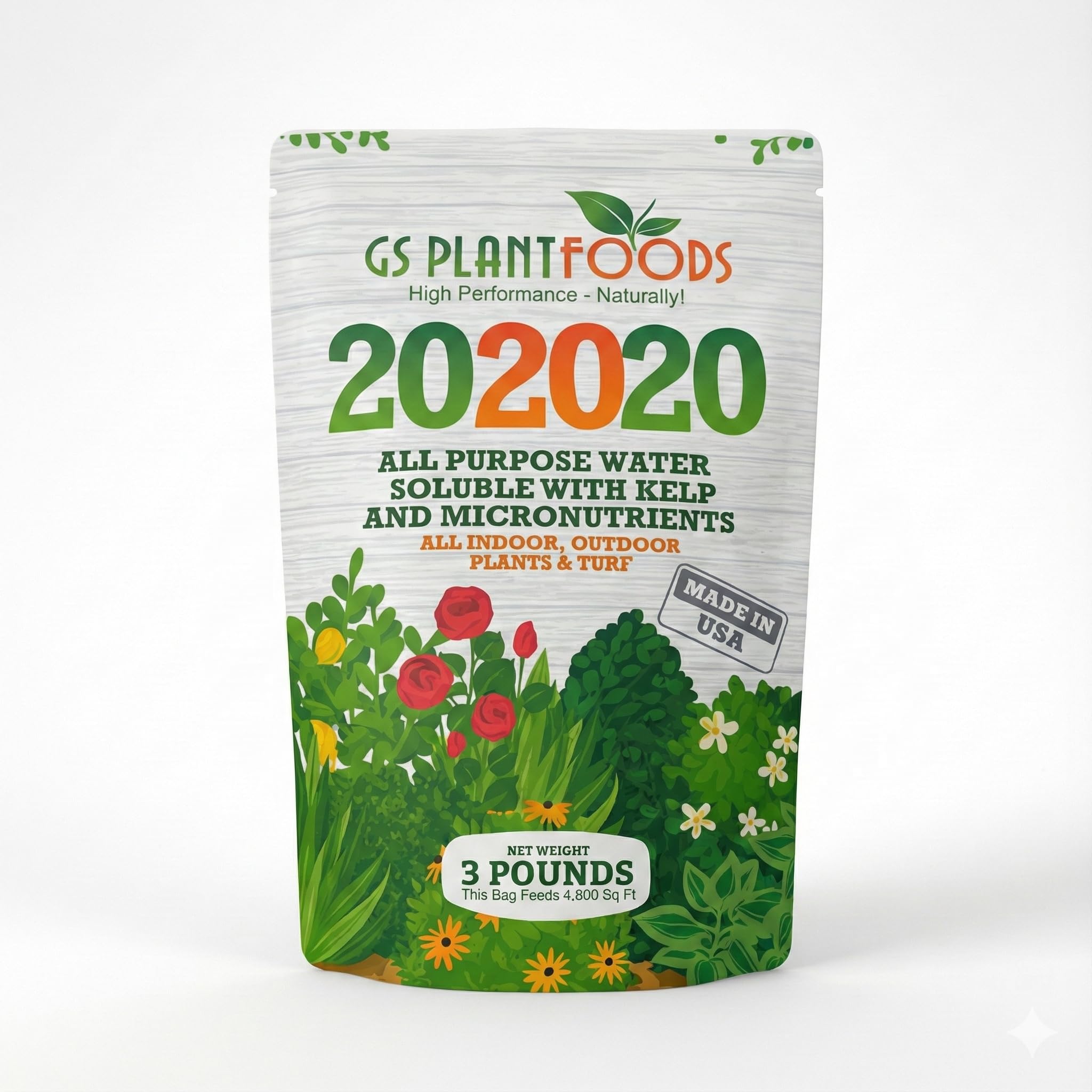
Sometimes your perennials just look tired — leaves are pale, growth has stalled, and a show of blooms feels like a distant hope. That is when a water-soluble formula like GS Plant Foods 20-20-20 shines. It dissolves completely in water and delivers nutrients to the roots immediately, with the kelp extract (Ascophyllum nodosum) providing natural growth stimulants. Buyers watching their Purple Orchid trees saw dark green leaves and new shoots within one week of the first feeding, while untreated trees stayed yellow and stunted.
The balanced NPK of 20-20-20 is high across the board — that means it is potent. You can use it on container plants, houseplants, vegetables, ornamentals, and turf. A single 3-pound bag feeds up to 4,800 square feet of turf when mixed correctly, so it stretches. The formula includes a full micronutrient profile: iron, manganese, copper, zinc, boron, and molybdenum. Those trace elements are often missing in cheap fertilizers and are exactly what perennials need for deep green color and strong stems.
Because it dissolves fast, it also washes out of the soil faster than granules. You will need to feed perennials every 1 to 2 weeks during the growing season to maintain the effect. Also, this is not organic in the pure sense — it is a blend of kelp and conventional fertilizer salts. For a quick mid-season rescue feed, it is unbeatable. For building long-term soil structure, a granular organic is a better foundation.
Why It Works Fast
- Immediate nutrient availability — visible results within one week
- High 20-20-20 concentration with full micronutrient profile
- Versatile across turf, vegetables, ornamentals, and perennials
The Fair Warning
- Requires frequent reapplication (every 1-2 weeks) since it washes out
- Not organic — contains conventional fertilizer salts
Best for: Quick rescue feeding of stressed perennials, or as a weekly boost during peak growing season when you want visible results fast.
Not ideal if: You prefer a low-maintenance organic approach — this is a maintenance-commitment option for the attentive gardener.
7. Schultz Rose & Flower Slow-Release 15-5-15

The slow-release specialist that coaxed a three-year-zero-bloom Gerber daisy into producing 13 buds.
Perennials that refuse to flower — healthy leaves, zero buds — often just need the right ratio at the right time. Schultz 15-5-15 is a slow-release granular that feeds steadily rather than dumping all at once. The high nitrogen (15) supports lush leaf growth, while the moderate phosphorus (5) and high potassium (15) support root strength and flower bud development. The formula includes micronutrients like iron and manganese that are essential for bloom formation.
The real-world story here is the Gerber daisy that sat indoors for three years producing nothing but leaves. After switching to Schultz, it produced its first bloom in months, then a flush of 13 buds. That kind of turnaround from a single fertilizer swap is the best evidence for the formula’s effectiveness. The slow-release mechanism means you apply once and the granules meter out nutrients over weeks, reducing the risk of overfeeding.
The downsides are worth noting: this is a conventional slow-release fertilizer (not organic), and the 15-5-15 ratio is noticeably heavier on the first and last numbers than the middle. It is a great tool for perennials that need a nudge from green to flowering, but it does not replace an organic soil-building program. For rose beds, iris beds, or any perennial that has stalled, this is the precise fix.
The Precision Advantage
- Slow-release coating prevents root burn and extends feeding duration
- 15-5-15 ratio targets both foliage health and bloom production
- Proven to revive stubborn plants that have not bloomed in years
What to Keep in Mind
- Conventional formula, not organic — does not build soil biology
- High nitrogen can push leaf growth if applied too early in spring
Best for: Reviving perennials that grow leaves but refuse to flower — the slow-release and balanced micronutrients are exactly what stubborn plants need.
skip it if: You want an organic, soil-building approach or are feeding a wide variety of plants with different needs.
Understanding the Specs
NPK Ratio — The Three Numbers
The NPK ratio on every bag tells you the percentage of nitrogen (N), phosphorus (P), and potassium (K) in the blend. Nitrogen drives leaf and stem growth — the green stuff. Phosphorus (the middle number) is the bloom and root builder; a higher number here pushes perennials to produce more flowers. Potassium (the last number) supports overall plant health, disease resistance, and fruit development. For perennials grown mostly for their flowers, look for a middle number around 7 to 10, while a balanced 10-10-10 works well for mixed gardens.
Slow-Release vs. Water-Soluble
Slow-release fertilizers are coated granules that break down gradually with moisture and warmth. One application feeds perennials for weeks or months, and the slow pace means roots are never shocked by a sudden nutrient flood. Water-soluble fertilizers dissolve instantly in water and deliver nutrients to the roots immediately, but they wash out of the soil faster. For perennials, slow-release granules are usually the better choice for a low-effort season-long feed, while water-soluble formulas are best for a fast mid-season boost when plants look tired.
Organic vs. Conventional
Organic fertilizers use natural ingredients like bone meal, blood meal, kelp, and composted manure. They feed the soil microbes that then feed the plant, building long-term soil structure. Conventional fertilizers are manufactured from mineral salts that plants absorb directly — they work faster but do not improve soil biology. For perennials that will live in the same spot for years, organic formulas help build a healthy soil ecosystem that supports the plant through all seasons and reduces the need for frequent reapplication.
Bone Meal and Blood Meal
Bone meal is a natural source of phosphorus and calcium, both critical for flower bud formation and strong root growth. Blood meal is high in nitrogen, giving plants a quick green-up. Many bloom-focused organic fertilizers include both because the nitrogen from blood meal fuels leaf growth that supports the flowers, while the phosphorus from bone meal tells the plant it is time to bloom. The Nelson ColorStar, for example, contains 25% bone and blood meal combined — that is why it is so effective at producing bigger, brighter flowers.
FAQ
What is the best NPK ratio for perennial flowers?
Should I use slow-release or water-soluble fertilizer for perennials?
Can I use the same fertilizer on perennials and vegetables?
How often should I fertilize perennial plants?
Is organic fertilizer better for perennials than synthetic?
Will high-nitrogen fertilizer stop my perennials from blooming?
How do I apply granular fertilizer to established perennials?
Does fertilizer for perennials work on new perennial plants?
Final Thoughts: The Verdict
For most people, the fertilizer for perennial plants winner is the Nelson ColorStar because it delivers bigger, more plentiful blooms from a single spring feed, with bone and blood meal providing natural, season-long nutrition that perennials love. If you want to cover a large mixed garden at the best square-foot cost, grab the GreenView 10-10-10. And for gardeners committed to organic soil-building who still want impressive flower shows, the Jobe’s Organics 4-4-4 is the one that builds healthier soil with every feed.
How We Picked
We do not accept paid placement. Every pick is matched to a real buyer and a real use-case; we do not hands-on test units.
Sources & Methodology
Specifications: manufacturer listings and product documentation. Review insights: verified customer reviews, as of July 2026. Pricing: not shown on this page (it changes often); check the current price via the retailer link.
As an Amazon Associate, Lawn Gear Lab earns from qualifying purchases. This does not affect which products we feature.