
Specs are compiled from manufacturer listings and verified buyer reviews and can change over time — please confirm the key details on the product page before buying.
Pachysandra thrives in shady, acidic ground, but the wrong fertilizer leaves it yellow, sparse, or burned. You need a formula that lowers soil pH and delivers steady nutrition without harming the shallow roots. This guide cuts through the options to find the feeds that keep your ground cover dense and vibrant.
I’m Rikta — the founder and writer behind Lawn Gear Lab. This guide is built by comparing the manufacturers’ published specifications and the patterns across verified customer reviews, so you get each pick’s real strengths and trade-offs instead of marketing spin.
We focus on acid-specific blends, slow-release granules, and organic options that match pachysandra’s unique needs. Whether you’re planting a new bed or reviving an established patch, here is the fertilizer for pachysandra that delivers real results.
Our Picks at a Glance
How To Choose The Best Fertilizer For Pachysandra
Pachysandra is a shallow-rooted, acid-loving ground cover. The wrong feed can burn its roots or push weak, leggy growth. Here is what matters most when picking a product.
Look for an Acid-Biased Formula
Pachysandra needs soil with a pH between 5.0 and 6.5. A fertilizer labeled for azaleas, rhododendrons, or evergreens typically contains sulfur or other acidifiers. The data shows formulas like a 4-3-4 with 5% sulfur work well. Without those acidifiers, pachysandra often develops chlorosis — yellow leaves with green veins.
Prioritize Slow-Release Granules
Because pachysandra spreads through shallow runners, a fast-dissolving powder can leach away or burn tender roots. Granular feeds break down slowly, giving a steady supply of nutrients. Products like the 36-pound bag from Espoma rely on natural organics that release over weeks, providing a “long-lasting reservoir,” as the data describes it.
Check the Organic Status
If you have children, pets, or a vegetable garden nearby, an organic feed avoids synthetic chemicals. Several picks in this list are OMRI-listed or approved for organic gardening. They use ingredients like seabird guano, shrimp and crab shell meal, and feather meal instead of ammonium nitrate.
Quick Comparison
| Model | Best For | Weight | Form | N-P-K Ratio | Amazon |
|---|---|---|---|---|---|
| Espoma Holly-Tone 4-3-4★ Best Overall | Best Overall | 36 lbs | Granules | 4-3-4 | Amazon |
| True Organic Azalea, Camellia & Rhododendron FoodNatural Selection | Premium Organic | 12 lbs | Granules | 5-4-3 | Amazon |
| Espoma Evergreen-Tone 4-3-4 | Evergreen Specialist | 18 lbs | Granules | 4-3-4 | Amazon |
| Jack’s Classic 17-6-6 Acid Special | Fast Foliage Boost | 1.5 lbs | Powder | 17-6-6 | Amazon |
| Miracle-Gro Water Soluble Azalea Food | Quick Liquid Feeding | 5 lbs | Powder | — | Amazon |
| GARDENWISE 8-4-8 Acidic Fertilizer | Iron-Rich Feeding | 2.11 lbs | Granules | 8-4-8 | Amazon |
| Dr. Earth Acid Lovers Fertilizer | Budget Organic | 4 lb | Granules | — | Amazon |
In‑Depth Reviews
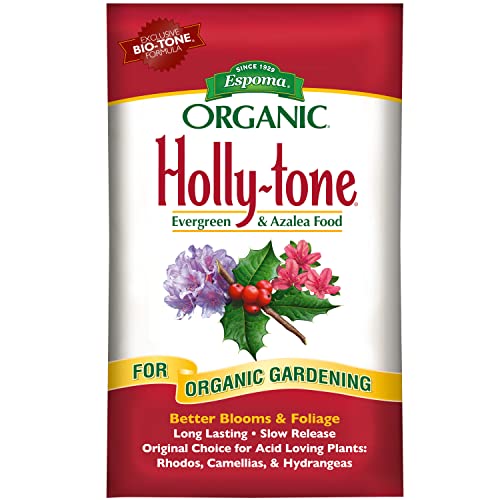
1. Espoma Organic Holly-Tone 4-3-4 Natural & Organic Evergreen & Azalea Plant Food; 36 lb. Bag
Our pick — over 4.5★ from 950+ verified ratings; the strongest balance of quality and price.
The heavy-duty 36-pound bag that feeds a whole pachysandra bed twice a year.
Espoma’s Holly-Tone is the original plant food for acid-loving plants, and its 36-pound weight means you cover a large area without buying refills. The 4-3-4 analysis includes 5% sulfur to lower soil pH (the measure of soil acidity), which is exactly what pachysandra needs to stay dark green. The natural organics break down slowly, creating a long-lasting reservoir of nutrients that won’t burn shallow roots.
Buyers report that one spring and one fall application keeps their ground cover thick for the whole season. Compared to the smaller 5-pound Miracle-Gro bag, Holly-Tone gives you significantly more feed per purchase — at 36 pounds versus 5 pounds — you are not running to the store every few weeks. The granules are ready to use with no mixing required; just scatter around the drip line and water.
It is also approved for organic gardening and registered as an Organic Input Material. The Espoma Company has been making natural organics since 1929, which gives this pick a long track record.
Deep‑bed champion: The sheer 36-pound volume combined with a proven 4-3-4 acid formula makes this the most practical choice for anyone with a medium-to-large pachysandra patch. It lasts longer and costs less per feeding than any other granular on this list.
The one trade-off: At 36 pounds, it is heavy to carry and store. If you only have a small border planting, this much fertilizer may take years to use up.
Ideal for: Homeowners with established pachysandra beds of 100 square feet or more who want a single, organic, acid-specific feed that lasts two seasons.
skip it if: You need a quick-fix liquid feed for a few container plants or have limited storage space.
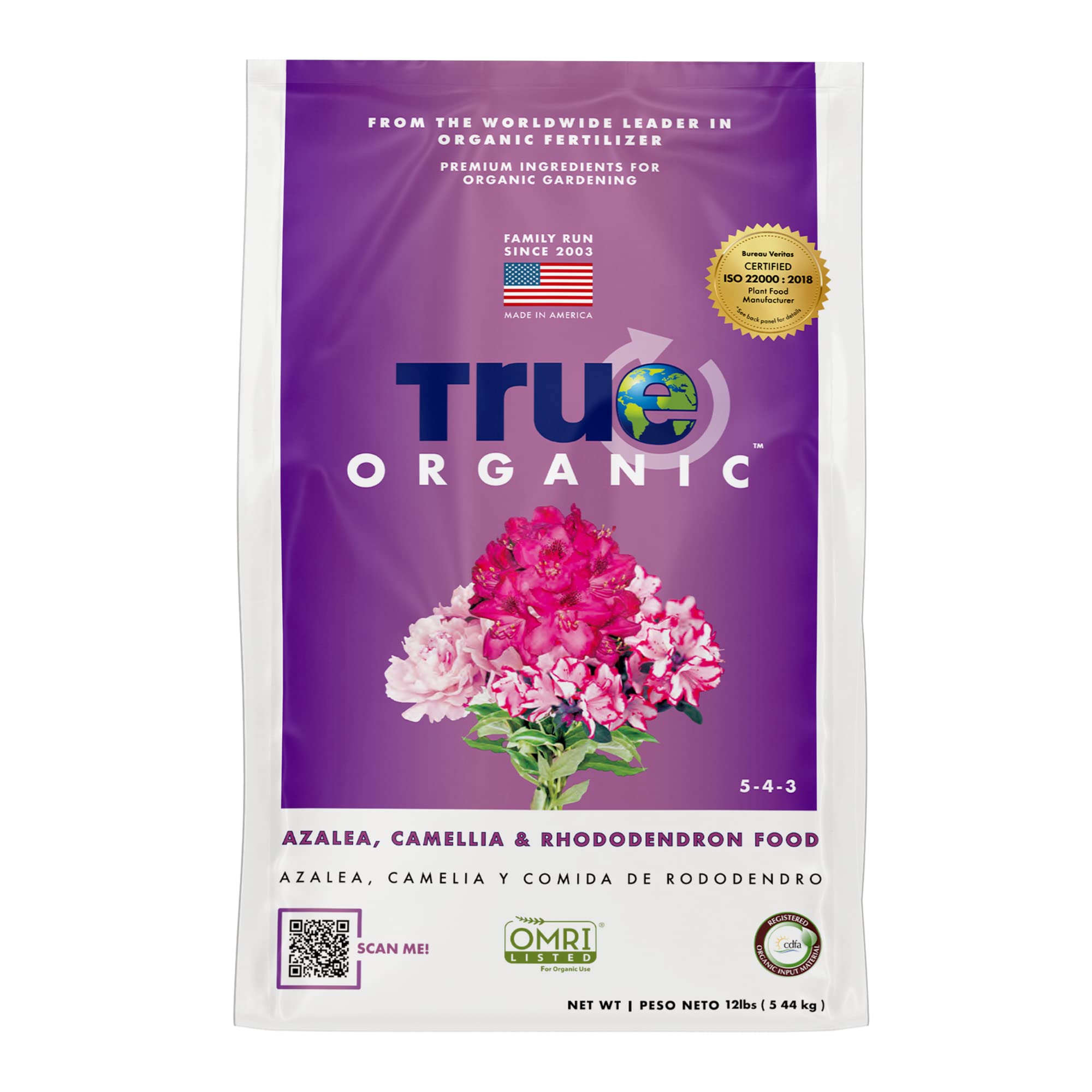
2. True Organic Azalea, Camellia & Rhododendron Food – Organic Fertilizer for Low-pH Plants – 12lb Bag
Organic granules with 5% sulfur that naturally nudge the soil toward the low pH pachysandra loves.
True Organic’s formula uses seabird guano, shrimp and crab shell meal, and other natural ingredients to nourish the soil while gently acidifying it. The 5-4-3 analysis is slightly higher in nitrogen than the Espoma 4-3-4, which helps push out lush, dense foliage in the spring. The 12-pound bag covers up to 261 square feet, according to the data, making it a good fit for medium-sized pachysandra plantings.
The sulfur content (5%) actively lowers soil pH over time, preventing the yellow-leaf chlorosis that plagues pachysandra in neutral soil. Unlike the quick-dissolve Miracle-Gro powder, these granules release nutrients slowly, so you only apply twice a year — in spring and fall. The brand is 100% made in the USA with organic inputs, according to the specifications.
Owners mention that this product noticeably deepens the green color of their ground cover after a single application. It is also safer than the Jack’s Classic 17-6-6 because the nitrogen is organically bound, reducing the risk of burning shallow pachysandra roots.
Gently acidic: The combination of organic ingredients and built-in sulfur makes this a low-risk, high-benefit choice for anyone who wants to avoid synthetic chemicals while still getting a reliable pH drop.
Not for quick fixes: Because it is a slow-release organic, it won’t green up a yellow patch overnight. If you need fast results, a water-soluble powder would work faster.
Best for: Organic gardeners with medium-sized beds who prefer a twice-yearly, no-mix granular feed that also lowers soil pH naturally.
Look elsewhere if: You need an immediate green-up for a struggling, chlorotic patch.
3. Espoma Organic Evergreen-Tone 4-3-4 Natural & Organic Fertilizer and Plant Food for Evergreen Trees & Shrubs. 18 lb. Bag.

An 18-pound evergreen-specific feed that covers pachysandra and its larger shade companions in one go.
Evergreen-Tone from Espoma shares the same 4-3-4 analysis and Bio-tone formula as Holly-Tone, but it is formulated specifically for needle-leaf and broadleaf evergreens — including azaleas, rhododendrons, and camellias. Since pachysandra is a broadleaf evergreen ground cover, this feed matches its needs precisely. The 5% sulfur content again helps keep soil acidic.
At 18 pounds, this bag is half the weight of the Holly-Tone 36-pound option, making it easier to handle while still providing enough for a decent-sized planting. You apply it in early spring and late fall, just like the other Espoma products. It is also approved for organic gardening and made in the USA by the Espoma Company.
Customers note that this feed keeps their evergreens and ground covers a deep, consistent green through the summer. The granules are ready to use with no mixing required, which simplifies the process.
Broadleaf blend: Because it targets all evergreens, this is a versatile choice if your garden mixes pachysandra with taller shrubs like azaleas or junipers.
Not for quick liquid feeding: Like all slow-release granules, it takes weeks to show full results; it is not a rescue feed for a chlorotic patch.
Ideal for: Mixed evergreen beds where pachysandra grows under larger acid-loving shrubs, since one product feeds everything.
pass on it if: You have only a small patch of pachysandra and want a smaller, budget-friendly bag.
4. Jack’s Classic 17-6-6 Acid Special Water-Soluble Fertilizer with Micronutrients, 1.5lbs

A high-nitrogen powder that delivers a rapid green-up for pachysandra when you need fast results.
Jack’s Classic Acid Special is a water-soluble powder with a 17-6-6 analysis — much higher in nitrogen than the granular 4-3-4 options. This makes it ideal for pushing lush, vegetative growth in the spring. Unlike the Miracle-Gro powder, which requires mixing at two different ratios (indoor and outdoor), Jack’s uses a single mixing ratio of 1 teaspoon per gallon of water, according to the data. The included measuring spoon takes the guesswork out of mixing.
The formula is fortified with micronutrients like iron and sulfur, which correct chlorosis quickly. Reviewers point out that it turns yellowing pachysandra dark green within a week of application. It can be used as a foliar spray — spraying directly onto the leaves — or as a root drench, giving you flexibility.
Because this is a synthetic, fast-acting fertilizer, you need to be careful with the dosage around shallow pachysandra roots to avoid burn. Apply it every 7-14 days during the growing season, as the data suggests for water-soluble feeds.
Rapid green: You get dense, dark foliage fast in a struggling patch because the 17-6-6 ratio (17 parts nitrogen for leaf growth, 6 parts phosphorus for roots, 6 parts potassium for overall health) is the highest nitrogen level on this list.
Higher burn risk: Synthetic nitrogen can damage pachysandra’s shallow roots if over-applied; stick to the recommended teaspoon per gallon.
Best for: Reviving yellow, thin pachysandra fast, or for those who prefer a liquid feeding schedule.
Avoid if: You want a low-maintenance, slow-release feed that you apply and forget for months.
5. Miracle-Gro Water Soluble Azalea, Camellia, Rhododendron Plant Food, 5 lb.

A familiar water-soluble powder that feeds acid-lovers on a weekly schedule.
Miracle-Gro’s Azalea, Camellia, Rhododendron Plant Food is a widely available water-soluble powder designed for all acid-loving plants. It works on azaleas, camellias, rhododendrons, gardenias, hibiscus, hollies, hydrangeas, and orchids, according to the data. The 5-pound box contains 80 ounces of powder. You apply it every 7-14 days using a watering can or a Miracle-Gro Garden Feeder, with different mixing ratios for indoor (1:144) and outdoor (1:18) use.
Because it dissolves instantly, the nutrients are available to the plant right away — faster than any granular product on this list. This makes it a good option for a mid-season boost if pachysandra starts to look tired. The product claims it won’t harm other plants or burn foliage when used as directed. However, because pachysandra is shallow-rooted, you still need to follow the outdoor mixing ratio carefully to avoid root burn.
Compared to 36-pound Espoma Holly-Tone, the 5-pound Miracle-Gro box is lighter, so it is easier to carry and store. But it also means you will need to buy refills more often if you have a large bed. It is not an organic product, so it won’t improve soil structure the way the Espoma or True Organic feeds do.
Instant results: The water-soluble formula begins feeding the plant immediately, perfect for giving a struggling patch a fast green boost.
Synthetic schedule: You have to mix and apply every 7-14 days throughout the growing season, which is more work than a twice-yearly granular feed.
Ideal for: Gardeners who already use a Miracle-Gro feeder and want a quick, convenient liquid feed for their acid-loving plants.
Look elsewhere if: You want a set-and-forget organic granular that feeds the soil, not just the leaves.
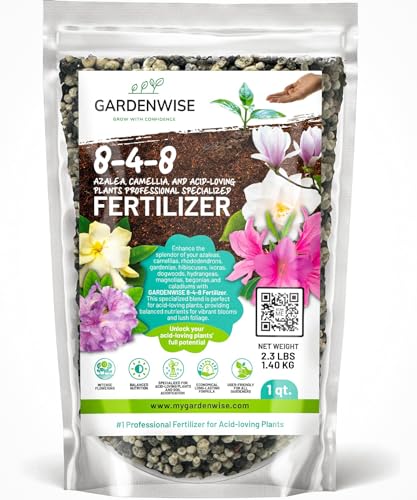
6. GARDENWISE 8-4-8 Acidic Fertilizer for Azaleas, Camellias, Hydrangeas, Blueberries, Gardenias, Magnolia Trees, Evergreens, and Rhododendrons (1 Quart)
An iron-enriched granular that specifically targets the chlorosis pachysandra gets in alkaline soil.
GARDENWISE 8-4-8 is formulated with extra magnesium, iron, and manganese — three micronutrients that prevent the yellow-leaf chlorosis common in acid-loving plants. The 8-4-8 analysis is higher in both nitrogen and potassium than the 4-3-4 Espoma blends, which supports both leaf growth and root development. The data notes that this slow-release granular requires just three feedings per year, making it an economical long-lasting formula for the season.
Each 32-ounce bag is a manageable size for small-to-medium beds. You simply sprinkle the granules around the base of the plant, gently mix into the soil, and water. The iron content is especially useful for pachysandra planted near concrete foundations or sidewalks, where lime leachate can raise the soil pH. It acts as a soil acidifier, creating an optimal growing environment for acid-lovers.
Shoppers say that it restores deep green color to plants that had been looking pale. It is not organic, but the targeted micronutrient blend makes it more effective than a general-purpose feed for correcting iron deficiency.
Chlorosis fixer: The iron, magnesium, and manganese trio directly addresses the nutrient lockout caused by high-pH soil, turning yellow leaves green again.
Limited volume: A 32-ounce bag is fine for small beds but will require multiple purchases for a large pachysandra planting.
Best for: Patches of pachysandra showing yellow leaves, especially those near concrete or in known alkaline soil.
Not ideal if: You need to cover a large area cheaply — you will get more volume for your money from the 18-pound or 36-pound Espoma bags.
7. Dr. Earth Acid Lovers Azalea, Camellia, Rhododendron & Maple Fertilizer 4 lb

The smallest bag with the biggest organic certification — Non-GMO Project Verified.
Dr. Earth’s Acid Lovers Fertilizer is handcrafted from human and feed-grade ingredients, and it is the only Non-GMO Project Verified fertilizer available in the U.S., according to the data. It is enriched with multi-minerals, proteins, carbohydrates, humic acids, and trace elements that promote healthy soil. It is also OMRI-listed and CCOF-certified for organic use, and it is safe for people and pets — no synthetic chemicals or toxic ingredients.
The 4-pound bag is a good option for a small pachysandra border or a few container plants. You simply sprinkle the granules around the base and water. It is formulated by Milo Shammas, the founder of Dr. Earth, and is sustainably made in the U.S. through a collaboration of environmentalists.
Buyers report that the product is gentle enough not to burn sensitive roots, which is important for shallow-rooted pachysandra. However, at only 4 pounds, it will not go far on a large bed. Compared to the 36-pound Espoma Holly-Tone, you are getting significantly less feed per purchase, so the cost-per-square-foot is higher for large areas.
Purest organic: With both Non-GMO and OMRI verification, this is the most rigorously certified organic pick — ideal for gardens near edible plants or high-traffic areas.
Budget is for small spaces: The 16-ounce bag covers a limited area; for a large pachysandra planting, you would need several bags, which drives up cost.
Ideal for: Small pachysandra patches, container plantings, or anyone who requires the strictest organic and non-GMO certification.
Look elsewhere if: You have a large ground cover area to feed — the 36-pound Espoma bag gives much more volume per dollar.
Understanding the Specs
N-P-K Ratio
This stands for nitrogen (N), phosphorus (P), and potassium (K) — the three primary nutrients. For pachysandra, the first number (nitrogen) is the most important because it drives leaf growth. You want a ratio where the first number is at least equal to the other two, like 4-3-4 or 8-4-8. A very high first number, like 17-6-6, gives a fast but temporary boost, while balanced ratios provide steady, long-term nutrition.
Sulfur Content for pH
Pachysandra needs soil with a pH between 5.0 and 6.5. Sulfur is the key ingredient that lowers soil pH over time. Many acid-specific fertilizers include 5% sulfur, which gradually acidifies the root zone. If your pachysandra is growing near a concrete foundation, where lime leachate raises pH, a sulfur-containing fertilizer is especially important to prevent yellow leaves (chlorosis).
Slow-Release Granules vs. Water-Soluble Powder
Granules are solid particles that break down slowly over weeks or months, providing a steady supply of nutrients. This matches pachysandra’s shallow roots, which are easily burned by high-concentration liquid feeds. Water-soluble powders dissolve instantly and give a rapid green-up, but require mixing and more frequent application. For ground covers, slow-release granules are usually the safer, more convenient choice.
Organic Inputs and Soil Health
Organic fertilizers contain plant- or animal-based ingredients (like seabird guano, feather meal, or crab shell) instead of synthetic chemicals. They improve soil structure and microbial activity over time, which helps pachysandra’s roots spread. Products with OMRI or Organic Input Material certifications have been independently verified. Organic is gentler on shallow roots but works more slowly than synthetic options.
FAQ
What is the best N-P-K ratio for pachysandra?
How often should I fertilize pachysandra?
Can I use a general-purpose lawn fertilizer on pachysandra?
Does pachysandra need iron supplements?
Is organic or synthetic fertilizer better for pachysandra?
What is the difference between Espoma Holly-Tone and Evergreen-Tone?
Can I use the Miracle-Gro Azalea food on pachysandra in containers?
How do I apply granular fertilizer to pachysandra without damaging it?
Will sulfur in the fertilizer harm my other plants?
What should I do if my pachysandra is already yellow after fertilizing?
Final Thoughts: The Verdict
For most people, the best fertilizer for pachysandra is the Espoma Organic Holly-Tone because its 36-pound bag size, proven 4-3-4 acid formula (4% nitrogen, 3% phosphorus, 4% potassium — designed for acid-loving plants), and slow-release organic granules give you the most value and convenience for large beds. If you want a premium organic option with a slightly higher nitrogen ratio for denser foliage, choose the True Organic Azalea, Camellia & Rhododendron Food. And for fast green-up of a struggling patch, the Jack’s Classic 17-6-6 Acid Special water-soluble powder works fastest — it dissolves in water and feeds leaves within days, not weeks.
How We Picked
We do not accept paid placement. Every pick is matched to a real buyer and a real use-case; we do not hands-on test units.
Sources & Methodology
Specifications: manufacturer listings and product documentation. Review insights: verified customer reviews, as of July 2026. Pricing: not shown on this page (it changes often); check the current price via the retailer link.
As an Amazon Associate, Lawn Gear Lab earns from qualifying purchases. This does not affect which products we feature.