
Specs are compiled from manufacturer listings and verified buyer reviews and can change over time — please confirm the key details on the product page before buying.
Starting a new lawn from seed or sod depends on one thing mostly — the fertilizer you put down on day one. Get the right one and those tiny grass plants drive roots deep fast. Pick the wrong general-purpose bag and you will watch your new grass stay pale and thin. The best fertilizer for new grass delivers a high dose of phosphorus (the middle NPK number), so roots build before the blades take over.
I’m Rikta — the founder and writer behind Lawn Gear Lab. This guide is built by comparing the manufacturers’ published specifications and the patterns across verified customer reviews, so you get each pick’s real strengths and trade-offs instead of marketing spin.
Choosing the right fertilizer for new grass means matching the NPK numbers to your specific project and soil conditions, and knowing which bag gives you the most established turf for your effort.
Our Picks at a Glance

How To Choose The Best Fertilizer For New Grass
Starter fertilizers differ from standard lawn foods in one key way: they pack more phosphorus (the middle number in the NPK ratio) to drive root development. Here are the three things to check before you buy.
Phosphorus Is Everything
Look for a middle number above 10 — the higher it is, the more energy the seedling can put into root growth. A ratio like 20-27-5 or 12-18-8 tells you the bag is built for establishment, not just a quick top-dress.
Nitrogen Speed Matters
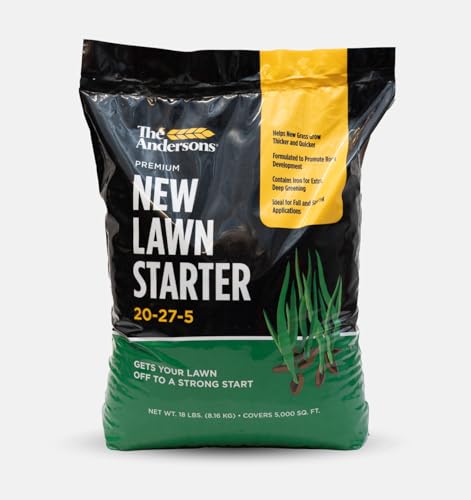
Some nitrogen releases immediately to give seedlings a visible green boost, while slow-release nitrogen feeds them over several weeks. Products that contain both types, like The Andersons 20-27-5, give you instant color and sustained support without a burnout spike.
Coverage Per Pound
Bag sizes and coverage claims vary widely — an 18 lb bag might cover 5,000 sq ft while a 10 lb bag only covers 2,500 sq ft. Compare the square footage, not just the weight, to avoid buying two bags when one would do.
Quick Comparison
| Model | Best For | NPK Ratio | Coverage | Bag Weight | Amazon |
|---|---|---|---|---|---|
| The Andersons Premium 20-27-5★ Best Overall | Best Overall | 20:27:5 | 5,000 sq ft | 18 lb | Amazon |
| Jonathan Green Veri-Green 12-18-8Premium Starter | Premium Starter | 12:18:8 | 5,000 sq ft | 15 lb | Amazon |
| Espoma Starter Plus 4-3-3Organic Pick | Organic Gardens | 4:3:3 | Medium | 4 lb | Amazon |
| Fertilome 9-13-7 | Budget Value | 9:13:7 | 2,500 sq ft | 10 lb | Amazon |
| Covington Naturals 3-18-18 | Liquid Quick Release | 3:18:18 | 3,250 sq ft | 32 oz | Amazon |
| Jonathan Green Green-Up 12-18-8 | Shade & Tough Conditions | 12:18:8 | 5,000 sq ft | 15.2 lb | Amazon |
| GreenView Fairway Formula 1-2-0.5 | Mulch + Fertilizer | 1:2:0.5 | 760 sq ft | 38 lb | Amazon |
| The Andersons 18-24-12 | Big Acreage | 18:24:12 | 12,500 sq ft | 50 lb | Amazon |
In‑Depth Reviews
1. The Andersons Premium New Lawn Starter 20-27-5 Fertilizer – Covers up to 5,000 sq ft (18 lb)
Our pick — over 4.5★ from 550+ verified ratings; the strongest balance of quality and price.
The top-rated starter that pushes grass visible in just over a week.
This is the product owners consistently call “the real deal.” With a 20:27:5 NPK ratio (nitrogen:phosphorus:potassium), it delivers the highest phosphorus number on this list — exactly what a young seedling needs to anchor deep roots before top growth kicks in. The bag contains both quick-release nitrogen (for an almost-instant green boost) and slow-release nitrogen (for steady feeding over weeks), so you get a fast green-up without the burnout that often follows a single blast of synthetic feed. It also includes 1% iron for the deep greening that makes a new lawn look established sooner.
The coverage is generous: an 18 lb bag treats 5,000 sq ft, which is the same footprint as the 15 lb Jonathan Green bags but with a higher nutrient density. Buyers report it outperformed Milorganite alone in side-by-side comparisons, and one owner says they “were able to get grass in just over a week” compared to the slower results with the Jonathan Green 12-18-8. That speed is exactly what you want when you are racing against the season. The only real complaint is that some wish the bag were bigger — at this quality and price, that is a good problem to have.
What wins people over
- Highest phosphorus ratio (27) for class-leading root development
- Dual-release nitrogen feeds immediately and over time
- 1% iron delivers a deep, rich green that looks like an established lawn
The honest trade-off
- No larger bag size available for very big lawns — you may need multiple bags
- Premium formula carries a higher per-bag cost than simpler blends
The stand-out pick: This is the bag to grab if you want the fastest visible results and the highest phosphorus kick available, and you value proven owner satisfaction over a minimal price difference.
Think twice if: Your lawn area exceeds 5,000 sq ft and you would rather buy one giant bag than two smaller ones — the 50 lb 18-24-12 from the same brand may suit you better.
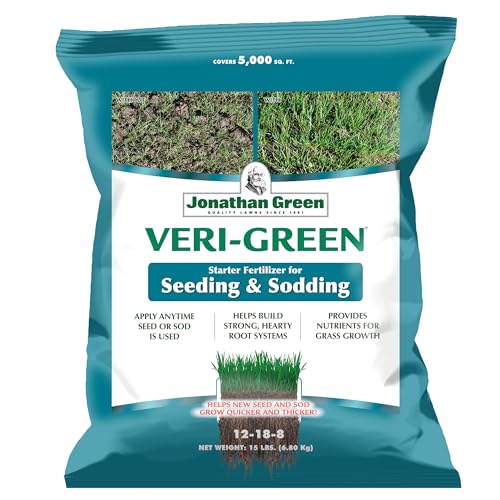
2. Jonathan Green (16007) Veri-Green Starter Fertilizer for Seeding & Sodding – 12-18-8 (5,000 Sq. Ft.)
A trusted name in starter food with added humates for nutrient efficiency.
Jonathan Green’s Veri-Green formula uses a 12-18-8 analysis that is rich in phosphorus (the 18) for root formation, and it keeps feeding for up to two months thanks to the included humates — compounds that help the soil hold and exchange nutrients more effectively. Owners say it “works like a charm,” with one noting their yard looked “10 times better” after a month and another reporting the grass “came up in good time” when used alongside seed. The 15 lb bag covers the same 5,000 sq ft as the top pick but uses fewer total pounds, which tells you the granules are finer and the distribution should be efficient.
What sets this apart from the rest of the field is the inclusion of humates — a feature that the Jonathan Green brand leans on heavily across its line. It means the fertilizer works with the soil biology rather than just dousing it with salts, and owners mention seeing consistent results even in less-than-ideal dirt. The catch is value: it gets mixed reviews there, with some buyers feeling it is a bit pricey for what you get. Still, for a dedicated starter that is designed to be applied the same day as seeding, the performance is hard to argue with.
Root-first approach: The humates give this a soil-conditioning edge that straight N-P-K blends lack, making it a strong choice if you are seeding into poor or compacted soil and want nutrients to stay available longer.
The price note: It costs more per bag than some comparable starters, but the enhanced nutrient exchange means you may not need to reapply as soon.
Reach for this if: You want a dedicated starter that also improves soil nutrient retention, and you value the added humates over a slightly larger bag of straight fertilizer.
Look elsewhere if: Budget is your primary concern — there are equally effective starters at a lower per-square-foot cost.
3. Espoma Starter Plus Plant Food, 4-Lbs. (Pack of 2)
An organic powder that gives transplants a fighting chance without synthetic salts.
This is a very different product from the granular starters above. It is a natural and organic formula with a 4-3-3 guaranteed analysis (4% nitrogen, 3% phosphorus, 3% potassium), meaning the numbers are lower because the nutrients come from natural sources — composted manures, bone meal, and the like. What makes it special is the inclusion of beneficial microbes and mycorrhizae, which are fungi that attach to plant roots and help them pull more water and nutrients from the soil. Owners say “it provokes strong root development” and that they “would not trust my plants to any other product.” It comes ready to use as a powder, with no mixing required.
Customers note using it for everything from vegetable gardens to flower beds, so it is less of a dedicated lawn starter and more of a general transplant booster. The low nitrogen content means you will not see the same dramatic green-up you get from a high-NPK product like The Andersons 20-27-5, but the root-strengthening microbes do real work underground.
What organic buyers love
- Safe for organic gardens and around people and pets
- Beneficial mycorrhizae improve long-term soil structure
- No harsh chemical salts that can burn tender seedlings
The honest trade-off
- Only 4 lb total — not enough for a full lawn seeding project
- Low NPK numbers mean slower visual results compared to synthetic starters
Best for small organic patches: If you are starting a few flower beds or a vegetable garden, or you want a gentle bio-boost for potted plants, this is a solid choice — but for a large lawn, you would need many bags.
Skip for big lawns: The coverage and nutrient density are too low for a full new-seed or sod project.
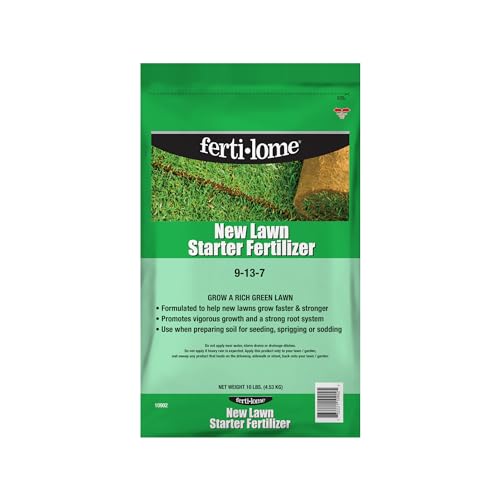
4. Fertilome (10902) New Lawn Starter Fertilizer 9-13-7, 10 lbs
A classic 9-13-7 granular starter that punches above its price tag.
Fertilome is a well-known name in the lawn and garden aisle, and their 9-13-7 starter (9% nitrogen, 13% phosphorus, 7% potassium) has been a go-to for budget-conscious homeowners for years. The 10 lb bag covers 2,500 sq ft when applied at the recommended rate of 4 lbs per 1,000 sq ft, meaning you need four pounds of product for every thousand feet of lawn. Reviewers point out that it turned their weak spots a “dark rich green” and helped establish zoysia sod after just one season. The granules are larger than typical Scott’s-style particles, which some shoppers say leads to less burn risk and longer feeding.
The main trade-off is coverage: at half the square footage of the top pick, you need two bags to cover a 5,000 sq ft lawn, and that pushes the total cost up. Buyers like it for smaller projects — patching dead spots, overseeding a modest yard, or supplementing a new sod installation. It gets the job done without the premium price tag of the 20-27-5 blends.
Solid for small areas: The 9-13-7 ratio is still phosphorus-heavy enough for root development, and the larger granules reduce burn risk — it works well for overseeding and sod.
Coastal trade-off: You will spend more per square foot than with the bigger bags, so plan your yard size before buying.
Best for patching and small lawns: If you are working with 2,500 sq ft or less, this is a cost-effective, proven starter that delivers dark color and strong roots.
Think twice if: You have a large area — the per-square-foot cost climbs quickly when you need multiple bags.
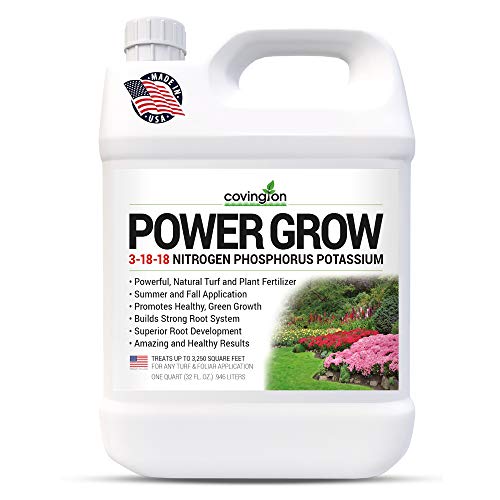
5. Covington Naturals Liquid Lawn Fertilizer, 3-18-18 NPK, 32 OZ
A liquid blast of phosphorus and potassium for rapid root uptake.
This is the only liquid concentrate on the list, and it takes a very different approach from the granular bags. The NPK ratio (nitrogen:phosphorus:potassium) of 3-18-18 is very low in nitrogen but very high in phosphorus and potassium — the two nutrients that drive root growth and overall plant function. You mix 2-4 oz per gallon of water and spray it on, which means the nutrients are absorbed almost immediately through the leaf and root system. Buyers report that seed germinated in just four days and the lawn was “lush green by day 11.” It covers 3,250 sq ft per 32 oz bottle, which puts it between the smaller and larger granular bags in terms of area.
The big advantage of a liquid is speed — there is no need to water it in as heavily as granules, and the uptake is faster. The downside, as some owners mention, is that the low nitrogen content (3%) may leave the grass looking a bit pale if you do not supplement. It is also a single-application concentrate rather than a slow-release feed, so you need to reapply every 2-4 weeks. For a quick boost during the critical first weeks of seedling life, this is an excellent companion to a granular starter.
Fast uptake edge
- Nutrients are absorbed instantly — visible results often within days
- High phosphorus and potassium target root and flower development
- Easy to apply with a hose-end sprayer, no heavy bag to haul
The honest trade-off
- Low nitrogen means grass may stay pale unless you add another source
- Requires repeat applications every 2-4 weeks, adding ongoing cost
Reach for this if: You want a fast-acting root tonic that gets phosphorus to the seedling immediately and you do not mind a simple hose-end application routine.
Look elsewhere if: You prefer a low-maintenance granular feed that needs only one application per season.
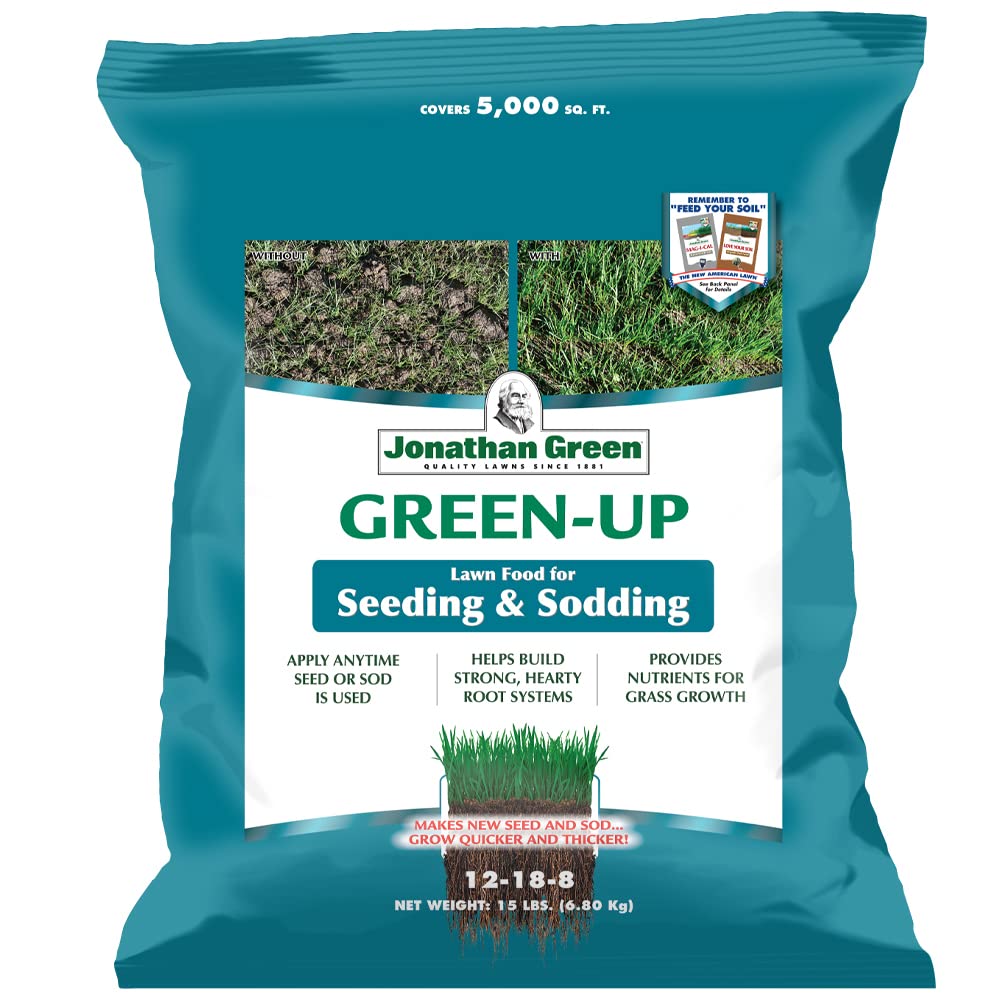
6. Jonathan Green (11541) Green-Up Lawn Food for Seeding & Sodding – 12-18-8 (5,000 Sq. Ft.)
A proven performer for tough conditions and shade-heavy yards.
This is the second Jonathan Green entry on the list, and it shares the same 12-18-8 base ratio (12% nitrogen, 18% phosphorus, 8% potassium) as the Veri-Green product above. The difference is that Green-Up is sold as a general “lawn food” for seeding and sodding rather than a dedicated starter, though the formula is essentially the same. It includes humates for nutrient exchange and iron for deep greening. Buyers in challenging climates — like Kansas where weather swings from rain to drought — say it “really strengthens my grass to handle all conditions.” One owner in Minnesota used it with Black Beauty Original seed on a shaded lawn and hit 90% coverage in four weeks.
The bag is 15.2 lb and covers 5,000 sq ft, matching the quantity of the Veri-Green bag. Owners who switched from Scott’s report “far superior results” within 7 days. The catch, as one honest reviewer put it, is that “nothing special to be so expensive” — the price is higher than some equivalent blends, and the premium does not translate into dramatically different numbers. But for shady spots or variable weather, the consistency is worth the extra dollars.
Weather-tough formula: The humates and iron make this a reliable choice for lawns that face heat, drought, or heavy shade — conditions that often defeat cheaper starters.
The premium cost: It is one of the more expensive options per bag, and the NPK is the same as the company’s own Veri-Green line, so compare pricing closely.
Reach for this if: Your lawn faces tough growing conditions — shade, drought, or poor soil — and you want a starter that helps grass push through stress.
Look elsewhere if: You are on a tight budget and have full-sun, decent soil — there are cheaper options with similar NPK numbers.
7. GreenView Fairway Formula Seeding Success plus Starter Fertilizer – 38 lb. (Covers 760 sq. ft.)

A 2-in-1 paper mulch and starter that holds seeds on slopes.
This is the most unusual product on the list. It is a 38 lb bag of biodegradable paper mulch that has a light starter fertilizer mixed in. The NPK ratio is a very mild 1-2-0.5 (barely any nitrogen, a touch of phosphorus and potassium), so do not expect a powerful nutrient punch — the primary job here is moisture retention and seed protection. The mulch contains a special tackifier (a sticky agent) that helps it cling to slopes and survive rain. Owners say it held seed in place through a five-hour rainstorm and that it “holds 3x water” compared to bare soil. It works with all grass seed types and is weed-free.
The trade-off is significant: at 760 sq ft coverage per 38 lb bag, you need a lot of product for a large lawn. The fertilizer content is minimal — this is more of a seeding aid than a true starter food. Customers note that the pellets do not swell 3x in size as advertised, and some found it did not prevent seed runoff on a steep slope. It decomposes in 6-8 weeks, so you still need a proper starter fertilizer underneath for strong root growth.
What it does uniquely well
- Combines mulch and light fertilizer in one application — saves a step
- Tackifier holds seed on slopes and during rain
- Biodegradable, no cleanup needed after it breaks down
The honest trade-off
- Very low NPK (1-2-0.5) — not enough nutrition for a strong establish
- Coverage is just 760 sq ft per 38 lb bag — expensive for large areas
- Some reviewers point out pellets do not expand as claimed
Best for slopes and bare patches: If you are reseeding a steep bank or a small bare area that needs erosion control, this is a clever all-in-one solution.
Skip for full lawns: The low nutrient content and high cost per square foot make it a poor choice for a full new-seeding project — use a true starter fertilizer underneath.
8. The Andersons 18-24-12 Starter Turf Fertilizer, 50lb Bag
A serious 50 lb bag with a 18-24-12 ratio for serious turf projects.
For anyone seeding or sodding a large property, this is the heavy hitter. The Andersons 18-24-12 starter has a phosphorus (the 24) number of 24 — second only to the 20-27-5 Premium on this list — and comes in a 50 lb bag that covers up to 12,500 sq ft at a medium application rate. That is more than double the coverage of most other products here, making it the clear choice for acreage owners. Owners specifically call it out for Bermuda grass, saying it “is better than what the lawn service was using,” and note that it “made my grass liven up quick” compared to the slower start they got with the GreenView mulch blend. The granules are uniform and spread easily through a broadcast spreader.
One bag of this replaces two-and-a-half bags of the 18 lb 20-27-5, making it a better value for customers with 5,000+ sq ft. A few owners mention using it on fruit trees with visible improvement, which speaks to its versatility beyond just turf.
The efficiency champion: At 12,500 sq ft per bag, this delivers the lowest per-square-foot cost of any starter on the list, and the 18-24-12 ratio is excellent for new seedlings.
The commitment: You are buying a 50 lb bag — make sure you have the storage and the spreader capacity to handle it.
Reach for this if: You have a large lawn (5,000+ sq ft) and want the best per-square-foot value, plus a high-phosphorus formula that performs immediately.
Look elsewhere if: You only need to patch a few bare spots — the bag is too big and heavy for small jobs, and a smaller starter will waste less product.
Understanding the Specs
NPK Ratio — The Three Numbers
The three hyphenated numbers on a fertilizer bag stand for Nitrogen (N), Phosphorus (P), and Potassium (K), in that order. Nitrogen drives leaf and blade growth — it is what makes your lawn green and thick. Phosphorus is the critical one for new grass because it fuels root development and helps seedlings anchor into the soil. Potassium supports overall plant function, helping the grass resist disease and stress. For a new lawn, you want the middle number (phosphorus) to be at least as high as the first, usually 10 or above. A ratio like 20-27-5 is a classic starter blend.
Quick-Release vs. Slow-Release Nitrogen
Quick-release nitrogen dissolves fast in water and gives the grass an immediate green-up. It is great for a visible boost but can burn the lawn if over-applied. Slow-release nitrogen breaks down gradually over several weeks, providing a steady food supply without the risk of a spike. Many starter fertilizers combine both types — like The Andersons Premium 20-27-5 — so the new grass gets an initial burst of color followed by sustained feeding. If a product does not mention slow-release nitrogen, you may need to reapply more frequently.
FAQ
Can I use regular lawn fertilizer instead of a starter for new grass?
When should I apply starter fertilizer to new seed?
How long does starter fertilizer feed new grass?
Do I still need starter fertilizer if I use a mulch mat or erosion blanket?
Will a high-phosphorus fertilizer burn my new grass?
Can I use starter fertilizer on established grass?
What does the “iron” ingredient do in a starter fertilizer?
Do I need to water in starter fertilizer after applying?
Final Thoughts: The Verdict
If you want one dependable pick, the fertilizer for new grass winner is the The Andersons Premium 20-27-5 because it combines the highest phosphorus level on the list with both quick- and slow-release nitrogen for immediate and sustained feeding. If you want the soil-conditioning humates of a premium brand, grab the Jonathan Green Veri-Green 12-18-8. And for large properties where a single bag needs to cover 12,500 sq ft, The Andersons 18-24-12 is the one to reach for — it offers the best per-square-foot value of any starter on this list.
How We Picked
We do not accept paid placement. Every pick is matched to a real buyer and a real use-case; we do not hands-on test units.
Sources & Methodology
Specifications: manufacturer listings and product documentation. Review insights: verified customer reviews, as of July 2026. Pricing: not shown on this page (it changes often); check the current price via the retailer link.
As an Amazon Associate, Lawn Gear Lab earns from qualifying purchases. This does not affect which products we feature.