
A maple tree turning a pale, washed-out yellow instead of a deep, vibrant green or fiery autumn red is the first signal that your soil chemistry is off. Unlike the forgiving vegetable patch, maples are sensitive to pH swings and micronutrient deficiencies — iron chlorosis from alkaline soil is one of the most common reasons a prized maple begins to look sickly year after year. Choosing the wrong fertilizer, or applying a generic lawn food high in fast-release nitrogen, can actually worsen the problem by acidifying the soil unevenly or burning the delicate feeder roots near the surface.
I’m Rikta — the co-founder and writer behind Lawn Gear Lab. I spend my days comparing NPK ratios, studying soil amendment data from university horticulture extensions, and cross-referencing hundreds of verified owner reports to find which formulations actually deliver deeper root systems, richer leaf color, and stronger branch structure for mature and young maples alike.
This guide distills seven top-ranked formulations into a clear, use-case-based ranking to help you find the best fertilizer for maple trees that matches your tree’s age, soil type, and your preferred application method — from set-and-forget spikes to liquid feedings you mix into your watering can every few weeks.
How To Choose The Best Fertilizer For Maple Trees
Maple trees have specific feeding requirements that differ from most shade trees or evergreens. Their shallow root systems, preference for slightly acidic soil, and need for micronutrients like iron and manganese mean that a one-size-fits-all fertilizer can cause more harm than good. Here’s what to prioritize when scanning the label.
Understand the NPK Ratio and What Maples Actually Need
Nitrogen (N) fuels leaf and stem growth, phosphorus (P) supports root and flower development, and potassium (K) aids overall vigor and disease resistance. For a young maple you want to establish quickly, a formula like 16-4-4 (high first number) is effective. For a mature maple where you care most about autumn color and branch strength, a more balanced ratio like 4-3-4 or 6-3-2 is better — too much nitrogen on an older tree produces weak, fast growth that is prone to storm damage and reduces the intensity of fall color.
Check the Soil pH and the Fertilizer’s Acidifying Ability
Maples prefer a soil pH between 5.5 and 6.5. Above 7.0, iron and manganese become less available, and you will see interveinal chlorosis — yellow leaves with dark green veins. Look for fertilizers that contain elemental sulfur or are formulated specifically for acid-loving plants. Products like Espoma Holly-Tone include 5% sulfur to help lower pH over time.
Choose the Right Release Mechanism for Your Routine
Spikes (like Jobe’s) are pre-measured and last an entire season with two applications per year — ideal for busy homeowners who want to set and forget. Water-soluble powders (like Miracle-Gro for acid lovers) give you control over dosage frequency but require mixing every 7-14 days. Granular slow-release formulas (like FoxFarm Happy Frog) are between the two — you sprinkle and water in monthly.
Quick Comparison
On smaller screens, swipe sideways to see the full table.
| Model | Category | Best For | Key Spec | Amazon |
|---|---|---|---|---|
| FoxFarm Happy Frog Japanese Maple | Granular | Root & branch strength | 4-3-4 NPK + mycorrhizae | Amazon |
| Espoma Holly-Tone 36 lb | Granular | Large properties | 36 lb bag, 4-3-4 + 5% S | Amazon |
| TPS Maple Tree Liquid | Liquid | Quick color recovery | 32 oz, 1-0-0 ratio | Amazon |
| Jobe’s Slow Release Spikes | Spike | Mess-free feeding | 16-4-4, 15 spikes | Amazon |
| Espoma Tree-Tone 2-pack | Granular | Organic fruit & shade trees | 6-3-2 + 5% calcium | Amazon |
| Miracle-Gro Acid Loving Water Soluble | Water Soluble | Quick-acting acidic feed | 5 lb powder, 1:18 mix | Amazon |
| FoxFarm Happy Frog Acid Loving | Granular | Low pH gardens | 4 lb bag, 1/16 C/gal | Amazon |
In‑Depth Reviews
1. FoxFarm Happy Frog Japanese Maple Fertilizer

FoxFarm’s Japanese Maple Fertilizer is the rare formulation that gets the NPK ratio exactly right for established maples: a 4-3-4 that delivers low nitrogen to avoid spurring weak, floppy growth while providing enough phosphorus and potassium for strong branch development. The inclusion of mycorrhizal fungi and beneficial soil microbes is a genuine advantage — these organisms colonize the root zone and help the tree extract phosphorus and micronutrients from native soil, which is especially helpful in nutrient-depleted suburban lots.
Owner reports from container-grown red maples and in-ground Japanese varieties both note visible improvements within a single growing season. Reviewers specifically mention deeper leaf coloration and a denser canopy after monthly applications. The application rate of 2 tablespoons per gallon makes it easy to adjust for younger trees versus mature specimens, and the granular form allows top-dressing without disturbing shallow surface roots.
The only downside is that the 4 lb bag covers a limited area — you will need multiple bags for a large landscape with several mature maples. For a single specimen or a small grove of younger trees, this is the most targeted formulation available.
What works
- Specific 4-3-4 ratio matches maple’s needs
- Mycorrhizae improve phosphorus uptake in poor soil
- Easy monthly granular top-dress application
What doesn’t
- Small bag size limits value for large properties
- Requires monthly reapplication during growing season
2. Espoma Organic Holly-Tone 36 lb

Espoma Holly-Tone is the largest-capacity option in this roundup at 36 pounds, making it the clear choice for anyone with a full property of maples, hollies, dogwoods, and other acid-loving trees. The 4-3-4 analysis is supplemented with 5% sulfur — a critical component for maintaining the slightly acidic soil pH (5.5 to 6.5) that maples require to access iron and manganese. The Bio-tone microbial formula further aids nutrient cycling in the root zone.
Seasoned owners report using Holly-Tone twice a year — spring and fall — with consistent results: richer green summer foliage and more intense reds and oranges in autumn. The ready-to-use granules require no mixing; you simply broadcast them around the drip line and water in. The bag is large enough to handle feeding for a dozen mature trees over two seasons, which dramatically lowers the per-application cost.
The trade-off is that Holly-Tone is a general acid-lover fertilizer, not maple-specific. If you have a single small Japanese maple in a pot, the 4 lb bags from FoxFarm give you more precise control over mineral ratios. For multiple in-ground trees, the bulk size and sulfur content make Holly-Tone the superior value.
What works
- 36 lb bag provides exceptional coverage for multiple trees
- 5% sulfur actively lowers soil pH
- Organic Bio-tone microbes support long-term soil health
What doesn’t
- General acid-lover formula, not optimized specifically for maples
- Bag does not reseal well; needs a secondary container for storage
3. TPS Nutrients Maple Tree Liquid Fertilizer
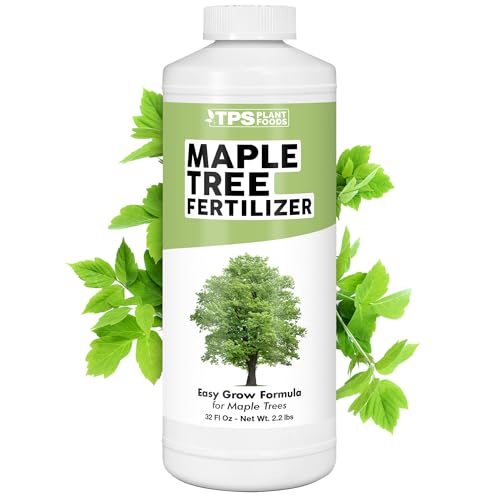
The TPS Liquid Maple Tree Fertilizer fills a specific niche: fast-acting relief for maples showing signs of chlorosis or slow growth. As a liquid concentrate, it is absorbed by the roots within days rather than weeks, making it ideal for correcting a nutrient deficiency mid-season. Owners report noticeable improvements in leaf size and color intensity within two weeks of the first application, with one reviewer noting that their Japanese maple’s spring leaves were “brilliant red” after a season of use.
The 32-ounce bottle mixes easily into a watering can or hose-end sprayer. Because it is a liquid, you can also apply it as a soil drench directly at the root zone, which is useful for container-grown maples where granular top-dress might wash out of the pot. The USA-manufactured formula is suitable for both in-ground and potted trees, and the mixing ratio is straightforward.
The main limitation is that liquid fertilizers require more frequent application — every 2-3 weeks during the growing season — and the small bottle size does not cover large landscapes economically. This is best as a seasonal supplement or for a single prized specimen, not as a primary annual feeding regimen for a row of mature trees.
What works
- Fast absorption corrects chlorosis quickly
- Easy to apply with watering can or hose sprayer
- Ideal for container-grown maples
What doesn’t
- Requires frequent reapplication every 2-3 weeks
- 32 oz bottle is not cost-effective for many trees
4. Jobe’s Slow Release Tree and Shrub Fertilizer Spikes

Jobe’s spikes are the most convenient option on this list. Each pre-measured spike contains a 16-4-4 analysis designed for trees and shrubs, delivering a high-nitrogen boost that is particularly effective for young maples you are trying to establish quickly. The slow-release formula feeds continuously for a full season, and the included plastic cap prevents crumbling when you hammer the spike into the ground around the drip line.
Owner feedback spanning two decades of use backs up the claims: untreated trees on the same street were visibly smaller in both height and trunk circumference than those fed with Jobe’s spikes. The risk of over-fertilizing is eliminated because each spike delivers a fixed dose, and the lack of runoff mess makes this a clean option for properties near patios or driveways. Two applications per year — early spring and late fall — are all that is required.
However, the 16-4-4 ratio is high in nitrogen for mature maples. On an older tree, this can promote soft, fast growth that is more vulnerable to wind damage and may dull autumn color. Use spikes for trees under 5 years old; for mature specimens, a more balanced or low-nitrogen option is preferable.
What works
- Zero-mess, pre-measured spikes simplify feeding
- Slow release lasts an entire season
- Effective for accelerating growth of young trees
What doesn’t
- High nitrogen ratio not ideal for established maples
- Spikes only feed at insertion points, not the entire root zone
5. Espoma Organic Tree-Tone 2-Pack
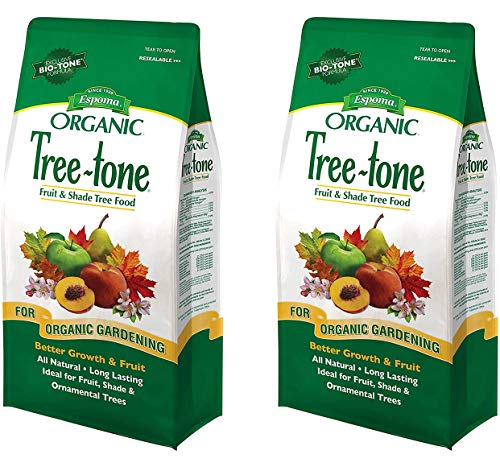
Espoma Tree-Tone is a straightforward, OMRI-listed organic granular fertilizer formulated for all trees — shade, fruit, and ornamental. The 6-3-2 analysis with 5% added calcium provides moderate nitrogen for steady growth without the vigor spike of higher-N formulas, making it appropriate for young and mature maples alike. The calcium content is a bonus for leaf cell structure and disease resistance, an overlooked detail in many tree fertilizers.
Buyers consistently report healthy leaf-out in spring after a single early-season application, with one owner noting a slow-leafing tree fully opened up within a week of feeding. The organic ingredients have no chemical smell and are safe around children and pets, though a handful of reviewers caution that the organic matter is attractive to dogs — you may need to scratch it into the soil surface to prevent foraging. The 4 lb bag size means the 2-pack covers a modest yard with a few trees without waste.
The limitation is the lack of any acidifying agent — Tree-Tone does not contain sulfur or other pH-lowering components. If your soil runs alkaline (above pH 7.0), you will need to supplement with an iron chelate or elemental sulfur to prevent chlorosis in your maples.
What works
- Organic formula approved for organic gardening
- Calcium supports cell wall strength and disease resistance
- No chemical odor or burning risk
What doesn’t
- No sulfur or acidifying ingredients — not ideal for alkaline soil
- Organic matter can attract dogs and wildlife
6. Miracle-Gro Water Soluble Azalea, Camellia, Rhododendron Plant Food

Miracle-Gro’s acid-loving plant food is a water-soluble powder that turns every watering session into a feeding opportunity for your maples. Designed for azaleas, rhododendrons, and gardenias — all plants that share maples’ preference for low pH — this formula delivers nutrients in a form that the roots can absorb immediately. The mixing ratio is simple: 1 tablespoon per gallon of water for outdoor plants.
Owner reports are overwhelmingly positive for quick greening effects, with rhododendron and holly bushes showing visible improvement within a week. For maple owners, this is the fastest way to deliver iron and other micronutrients to a tree showing early signs of chlorosis. The 5 lb bag yields a large volume of mixed solution, making it suitable for a yard with several acid-loving plants beyond just maples.
The main downside is the requirement to mix and apply every 7-14 days throughout the growing season, which is more labor-intensive than spike or granular options. Also, the bag’s closure mechanism is notoriously poor — most users report having to transfer the powder to an airtight container to prevent moisture clumping.
What works
- Instantly available to roots for rapid correction of deficiencies
- Formulated for low pH-loving plants
- Versatile — works on all acid-loving trees and shrubs
What doesn’t
- Requires frequent mixing and application
- Bag does not reseal; must transfer to another container
7. FoxFarm Happy Frog Acid Loving Plants Fertilizer

The FoxFarm Happy Frog Acid Loving Fertilizer is a solid entry-level organic option for gardeners who own a mix of acid-loving plants — azaleas, blueberries, hydrangeas — and want one product to handle them all alongside their maples. The OMRI listing ensures compliance with organic growing standards, and the inclusion of beneficial soil microbes helps break down organic matter in the root zone, aiding nutrient cycling.
Real-world results are encouraging: owners of gardenias and strawberries report heavy flowering and fruit set within weeks of application. The application rate of 1/16 cup per gallon makes it very economical for small gardens. For a single young maple in a mixed border, this is a convenient, low-risk product that won’t burn roots even if applied a bit generously.
However, the NPK ratio is not published on the label in a prominent way — the product is marketed more by its microbial content than by its nutrient analysis. Without specific numbers, you cannot precisely tailor the nitrogen level for a mature maple versus a young one, which makes it less precise than FoxFarm’s own Japanese Maple formulation. For serious maple care, pay the small premium for the maple-specific version.
What works
- Includes beneficial soil microbes for long-term soil health
- OMRI listed for organic production
- Gentle formula unlikely to cause root burn
What doesn’t
- NPK ratio is not prominently displayed
- General acid-lover blend, not optimized for maples
Hardware & Specs Guide
NPK Ratio — The Three Numbers
The ratio of nitrogen (N), phosphorus (P), and potassium (K) is the single most important spec on a fertilizer bag. For maples: 16-4-4 is for fast establishment of young trees; 6-3-2 or 4-3-4 is better for mature trees where you want balanced growth and strong autumn color; 1-0-0 liquid feeds are for quick corrective action but lack long-term nutrient support.
Form Factor — Spike vs. Granular vs. Liquid
Spikes are pre-measured and mess-free, releasing over months — ideal for low-maintenance feeding of young trees. Granular formulas (powder or pellet) let you control dosage but require watering in. Liquid concentrates work fastest for correcting visible deficiencies but need the most frequent reapplication.
Sulfur Content and Soil pH
Maples need a soil pH between 5.5 and 6.5 to absorb iron and manganese. Fertilizers with added sulfur (like Espoma Holly-Tone with 5% sulfur) actively lower pH. If your soil tests above 7.0, look for a sulfur-containing formula or plan to supplement with elemental sulfur separately.
Organic Matter and Microbial Additives
Mycorrhizal fungi and beneficial bacteria — found in FoxFarm Happy Frog and FoxFarm Japanese Maple — colonize the root zone and extend the tree’s ability to access phosphorus and micronutrients. These are especially valuable in compacted suburban soil where native microbial populations are low.
FAQ
Can I use lawn fertilizer on my maple tree?
How often should I fertilize a mature maple tree?
What does it mean when my maple leaves are yellow with green veins?
Should I use spikes or granular fertilizer for a potted maple?
Final Thoughts: The Verdict
For most gardeners, the fertilizer for maple trees winner is the FoxFarm Happy Frog Japanese Maple (4-3-4) because its mycorrhizal-enhanced formula and balanced NPK ratio are precisely tuned to the needs of both young and mature maples. If you want bulk coverage for a whole property of acid-loving trees, grab the Espoma Holly-Tone 36 lb. And for fast corrective feeding of a single container or in-ground maple showing chlorosis, nothing beats the TPS Liquid Maple Fertilizer.