
Clover is a stubborn, fast-spreading weed that chokes out healthy turf and makes a lawn look patchy and unkept. Most general-purpose weed killers only burn the leaves, allowing the deep root system to regenerate within weeks, which forces you into an endless cycle of reapplication. The right fertilizer-based weed killer targets clover at the root while feeding your grass, giving you a long-term solution instead of a temporary cosmetic fix.
I’m Rikta — the co-founder and writer behind Lawn Gear Lab. My process involves cross-referencing hundreds of verified customer reports with the chemical formulation data on each product to find which formulas actually deliver measurable clover suppression without damaging desirable turf.
Whether you’re dealing with white clover patches in the front yard or a full-blown invasion in the back forty, this guide breaks down the top-rated formulas to help you choose the most effective fertilizer for killing clover for your specific lawn type and infestation level.
How To Choose The Best Fertilizer For Killing Clover
Not every weed killer is equal when it comes to clover. Because clover is a legume with a deep taproot and nitrogen-fixing ability, it shrugs off many standard post-emergent herbicides. You need a product that either delivers a high enough concentration of the right actives or pairs them with a slow-release nitrogen feed that starves clover of light and space.
Active Ingredients That Actually Stop Clover
The most effective clover-killing formulas use a three-way herbicide blend: 2,4-D, MCPP, and Dicamba. This trio penetrates the waxy leaf cuticle of clover and translocates to the root nodes. Some premium products also add Carfentrazone or Quinclorac for faster visual burn — you’ll see wilting in 24 to 48 hours rather than a week. Avoid any product that relies on iron alone (like some “natural” sprays); iron only blackens the foliage but rarely kills the root.
Granular vs. Liquid Application
Granular weed-and-feed products (like the Jonathan Green option) release fertilizer over weeks and rely on the granules sticking to weed leaves after watering. This works best for light-to-moderate clover across a whole lawn. Liquid concentrates (like SpeedZone or Trimec) give you precise spot control and faster visual results, ideal for heavy patches or targeted clover spots. For widespread infestations, start with a liquid spray to knock clover down, then follow up with a granular feed to keep your grass thick enough to prevent regrowth.
Grass-Type Safety and Temperature Windows
Clover killers can damage certain turf types. Fine fescues and bentgrass are sensitive to Dicamba-heavy formulas. Products clearly labeled for “cool-season grasses” (fescue, bluegrass, ryegrass) and “warm-season grasses” (Bermuda, Zoysia) differ — don’t use a cool-season-only product on St. Augustine or Centipede. Also check temperature ranges: most liquid herbicides lose effectiveness below 55°F, while some premium formulas work down to 40°F for early spring or late fall applications.
Quick Comparison
On smaller screens, swipe sideways to see the full table.
| Model | Category | Best For | Key Spec | Amazon |
|---|---|---|---|---|
| SpeedZone EW | Liquid Concentrate | Fast visible kill | Carfentrazone + 3-way blend | Amazon |
| Jonathan Green Weed & Feed | Granular | Whole-lawn feeding | 21-0-3 NPK + 250 weed control | Amazon |
| PBI/Gordon Trimec 1 Gal | Liquid Concentrate | Large area coverage | 32,000–64,000 sq ft per gal | Amazon |
| BioAdvanced Weed Killer | Liquid Concentrate | 200+ weed types | Dicamba + MCPP + 2,4-D | Amazon |
| Bonide Captain Jack’s Brew | Iron-Based Concentrate | Eco-conscious users | Iron + disease suppressant | Amazon |
| Ortho WeedClear Wand | RTU Spray | Quick spot treatment | Battery-powered Comfort Wand | Amazon |
| Southern Ag Trimec 32oz | Liquid Concentrate | Entry-level price | 9 turf types approved | Amazon |
In‑Depth Reviews
1. SpeedZone EW Lawn Weed Killer

SpeedZone EW stands apart because of its four-way active ingredient stack — 2,4-D, Dicamba, Mecoprop-p, and Carfentrazone-ethyl. This combination works faster than almost anything on the market, with visible wilting in clover leaves within hours rather than days. The formula is labeled for cool-season grasses (fescue, bluegrass, ryegrass) as well as Bermuda and Zoysia, making it a versatile option for most of the country.
Users consistently report full kill in 48 hours for heavy clover patches using a standard 1-ounce-per-gallon mix. The cool-weather performance is also a standout feature — it remains effective down to around 45°F, which means you can apply an early spring or late fall treatment that most competitors can’t handle. A 20-ounce bottle covers roughly 5,000 to 10,000 square feet depending on infestation density, which puts it in the sweet spot for medium-to-large lawns.
The main trade-off is that overspray can harm desirable grass, especially if applied in windy conditions or heavy-handed on the trigger. A few reviewers noted that spurge may regrow within two months if the root system isn’t fully saturated. The lack of a measuring cup in the package is a minor annoyance, though the cap itself holds roughly 0.2 fluid ounces, which helps for small batch mixing.
What works
- Visible clover wilting in under 24 hours
- Effective at lower temperatures (45°F+)
- Safe for multiple cool and warm season turf types
What doesn’t
- Overspray can burn surrounding grass
- No measuring cup included
- Spurge may require reapplication
2. Jonathan Green (12344) Green-Up Weed & Feed 21-0-3

This granular weed-and-feed is a smart solution if you want to treat the whole lawn at once without dragging a sprayer around. The 21-0-3 NPK ratio provides a strong nitrogen hit that turns the grass a deeper green within a week, while the pre-mixed herbicide targets over 250 broadleaf weeds including clover down to the root. The fine particle size helps the product settle into the turf canopy so more herbicide reaches the weed leaves rather than blowing away.
Customer feedback shows that clover patches start fading within 7–10 days after application when the lawn is moist (light dew or light watering). The slow-release nitrogen continues feeding for up to three months, which gives your grass the density advantage it needs to stop clover from re-establishing. Reviewers with heavy infestations often pair this with a liquid spot spray for the toughest clumps, then use the granular feed as a maintenance layer.
The major complaint is inconsistency against established clover — some users reported that the grass greened up beautifully but the clover barely flinched. This typically happens when the granules don’t stick to the clover leaves because the lawn was too dry at application time. The bag size is also on the smaller side for the coverage claimed, and some units arrive with clumps that are difficult to break apart in the spreader.
What works
- Deep greening from high nitrogen content
- Slow-release feed suppresses clover regrowth for months
- Covers 250+ weed types in one pass
What doesn’t
- Inconsistent results on mature clover if lawn is dry
- Small bag for the claimed coverage area
- Some bags arrive with hardened clumps
3. PBI/Gordon Trimec Lawn Weed Killer (1 Gallon)

The gallon-sized Trimec from PBI/Gordon is the volume play for large properties. With a coverage range of 32,000 to 64,000 square feet, this is the most economical option per square foot among all the concentrates reviewed here. The three-way active ingredient mix (2,4-D, Mecoprop-p, Dicamba) is the industry-standard formula that has been proven effective against clover for decades, and the liquid form gives you flexible mixing ratios depending on infestation severity.
Users report that clover typically shows results within 5 to 7 days, with full die-off by the two-week mark when applied at the standard 2-ounce-per-gallon rate. The product is formulated specifically for cool-season grasses (fescue, bluegrass, ryegrass), so warm-season lawn owners should check compatibility with their specific type. Several long-time customers mention that this is the same formula many professional lawn care companies use, just without the branding premium.
The biggest drawback is that some deliveries arrive with a different label (sometimes Ferti-lome brand) than what was listed in the product page, which understandably frustrates buyers despite the chemicals being identical. The formula also requires a surfactant for maximum leaf adhesion — if you skip the surfactant, clover in the middle of dense turf may not absorb enough chemical to kill the root.
What works
- Massive coverage per gallon saves money on large lawns
- Proven Trimec formula reliable against clover
- Flexible mixing rates for different weed pressures
What doesn’t
- Branding inconsistency on delivered bottles
- Requires separate surfactant purchase for best results
- Only labeled for cool-season grasses
4. BioAdvanced Weed Killer for Lawns Concentrate (32oz)

BioAdvanced delivers a robust Dicamba-plus-MCPP formula that targets over 200 different broadleaf weeds, including all common clover varieties. The 32-ounce concentrate treats a typical suburban lawn size (5,000–10,000 sq ft) and mixes easily with water in a standard hose-end sprayer. The formula translocates to root tissues, which means clover dies from the root up rather than just browning the above-ground leaves.
Several reviewers specifically mention this product as their go-to for dollar weed and white clover, noting that a single application eliminated about 90% of visible clover. The spray formulation sprays evenly without excessive foaming, and the bottle includes clear mixing lines for common dilution ratios. Users also note that it works well when followed up with a general fertilizer to thicken the turf and prevent weed re-establishment.
The main issue reported is that the spray nozzle can be difficult to engage on the first use — the “press tab” mechanism described in the instructions is not intuitive, and several users struggled with it initially. Some Bermuda grass varieties may experience temporary browning after application, though the grass typically recovers within a week. A few reviewers also mention that nutgrass was not fully controlled, which is expected since this formula is optimized for broadleaf weeds rather than sedges.
What works
- Broad-spectrum 200+ weed control including clover
- One application knocks out most clover patches
- Works with standard hose-end sprayers
What doesn’t
- Difficult spray nozzle activation
- May cause temporary Bermuda grass browning
- Ineffective on nutgrass and other sedges
5. Bonide Captain Jack’s Lawnweed Brew (32 oz Concentrate)

Captain Jack’s takes a different approach — instead of synthetic herbicides, it uses iron as the active ingredient to kill moss, algae, and broadleaf weeds including clover. The iron works by dessicating the weed leaves on contact, turning them black within a few hours. This makes it a much friendlier option for households with pets or edible gardens near the lawn, and the added disease-suppression feature targets dollar spot and rust, which are common problems in over-fertilized lawns.
User reports on clover are mixed — the product blackens clover leaves quickly, but the root may survive if the plant is large or deeply rooted. Several reviewers note that for young clover plants (single crowns, not established mats), this iron-based spray delivers complete kill without any risk to surrounding grass. The concentrated formula dilutes with water easily and works best with a backpack or knapsack sprayer for thorough coverage.
The primary limitation is temperature sensitivity: this product performs poorly below 60°F. Users who applied it in cooler spring weather (50s to upper 40s) reported that clover leaves blackened but regrew from the roots within two weeks. The iron content also tends to leave temporary black spots on the grass blades themselves, which look unsightly for a few days before washing off. For heavy clover infestations, this is more of a maintenance tool than a eradication solution.
What works
- Pet-friendly and garden-safe iron chemistry
- Suppresses moss, algae, and lawn diseases
- Fast visual effect — clover blackens in hours
What doesn’t
- Ineffective on mature clover root systems
- Requires temperatures above 60°F to work
- Temporary black staining on grass blades
6. Ortho WeedClear Lawn Weed Killer Ready-to-Use with Comfort Wand (1 Gal)
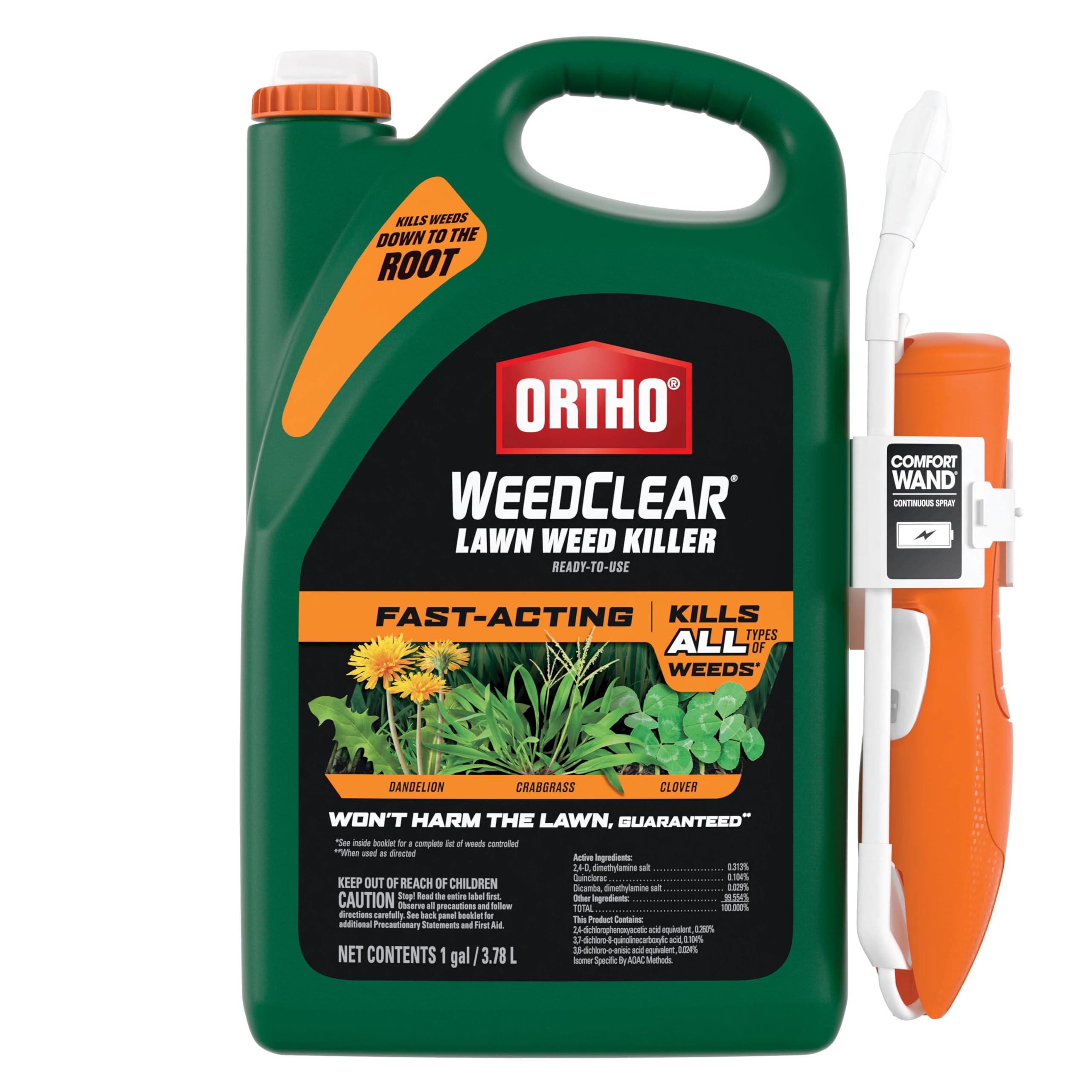
Ortho WeedClear with the Comfort Wand is the most convenient option on this list for homeowners who want a no-mix, no-measure solution. The battery-powered wand dispenses a precise spray pattern that targets individual clover patches without overspray drift, which is a major advantage if your lawn has flower beds or vegetable gardens nearby. The gallon jug is ready to use — just twist on the wand, press the trigger, and spot treat.
Reviews consistently report fast results on dandelions and clover, with visible wilting starting within 24 hours and full die-off in about two weeks. The formula is labeled for Bermuda, fescue, bluegrass, ryegrass, and Zoysia, covering the most common lawn types in the US. Reviewers with heavy weed pressure note that one gallon can tackle a significant infestation — one user cleared 85% of their weed-covered yard in a single application.
The biggest weakness is that it does not touch Bermuda grass weeds at all, which some customers discovered after buying it for that purpose. A minority of users also reported that the liquid seemed weak and required multiple applications on tough clover patches, which is a known trade-off with ready-to-use (RTU) products that typically have lower active ingredient concentrations than concentrates. The wand mechanism can also be finicky with the battery contact points if stored for long periods between uses.
What works
- Battery-powered wand eliminates mixing and measuring
- Precise spot treatment reduces grass damage
- Fast visible results in 24 hours
What doesn’t
- Ineffective on Bermuda grass weeds
- RTU formula lower concentration requires reapplication
- Battery wand may lose contact over time
7. Southern Ag – 13503 – Lawn Weed Killer with Trimec (32 oz)

Southern Ag’s Trimec-based concentrate is the most accessible entry point for clover control, especially if you’re on a tight budget or treating a relatively small lawn. The patented three-way herbicide cocktail (2,4-D, Mecoprop-p, Dicamba) is the same proven formula used in many premium products, but Southern Ag packages it without the bells and whistles at a more accessible price point. The 32-ounce bottle covers up to 5,000 square feet and works with both conventional pump sprayers and hose-end systems.
Reviewers frequently note that this product works particularly well on young clover, spurge, and chickweed when applied at the standard 2-ounce-per-gallon dilution. The formula is labeled for nine different turf types, which is broader than most competitors in this price range. Users recommend pairing it with a non-ionic surfactant to improve leaf adhesion, as some applications on waxy-leaved clover show reduced absorption without it. Several customers also report that mixing in a marking dye helps track treated areas and prevents double-spraying.
The primary compromise is longevity — many reviews mention that weeds return relatively quickly (within 3–4 weeks), requiring reapplication to maintain control. This makes it less ideal for large infestations where you want a lasting solution. Additionally, some users report that it struggled with mature onion grass and heavily established clover mats, needing a second application at double strength. A few reviews also noted a slight chemical odor during application, though it dissipates quickly.
What works
- Proven Trimec formula at a low entry price
- Compatible with 9 different turf types
- Easy mixing with standard spray equipment
What doesn’t
- Weeds return relatively fast, requiring reapplication
- Struggles with heavily established clover
- Works best when paired with a surfactant
Hardware & Specs Guide
Three-Way Herbicide Blends (2,4-D + MCPP + Dicamba)
This is the gold standard for clover control. The combination works by disrupting plant growth hormones at the cellular level: 2,4-D attacks leaf tissue, MCPP targets the stem and root nodes, and Dicamba penetrates the soil to hit any root fragments. Products using all three actives (like Trimec, SpeedZone, and BioAdvanced) consistently outperform single-active or iron-only formulas on mature clover. Check the label for the exact percentage of each — you want at least 10% 2,4-D and 3% Dicamba for reliable clover kill.
Granular vs. Liquid vs. RTU Formulations
Granular weed-and-feed products (21-0-3 NPK type) feed the lawn and control clover simultaneously but require moisture to activate and adhere to weed leaves. Liquid concentrates (32 oz or 1 gal size) give you precision mixing for spot treatment and faster absorption but require a sprayer investment. Ready-to-Use (RTU) products with battery wands offer maximum convenience but have lower active ingredient percentages, often needing reapplication. For clover specifically, liquid concentrates provide the most reliable control per dollar.
FAQ
Why does clover keep coming back after I spray it?
Can I use a granular weed and feed on clover instead of liquid spray?
How long should I wait before reseeding after using a clover killer?
Will clover killers damage my St. Augustine or Centipede grass?
Final Thoughts: The Verdict
For most gardeners, the fertilizer for killing clover winner is the SpeedZone EW because its Carfentrazone-enhanced formula delivers visible clover kill in hours and works in cooler temps when other products stall. If you want a whole-lawn feed-and-weed approach that prevents clover from returning, grab the Jonathan Green Weed & Feed. And for the best value on large properties with persistent clover, nothing beats the coverage-per-dollar of the PBI/Gordon Trimec 1 Gallon.