
Getting a dense, dark emerald stand of Kentucky Bluegrass isn’t about luck—it’s about hitting the right nitrogen window at the right time of year. Bluegrass is a heavy feeder, and throwing a generic all-purpose fertilizer at it will leave you with weak growth, bare patches, and a lawn that folds under summer heat. The difference between a so-so lawn and the thickest turf on the block comes down to one decision: choosing a formula that Bluegrass actually metabolizes without surge growth or leaf burn.
I’m Rikta — the co-founder and writer behind Lawn Gear Lab. I have spent hundreds of hours dissecting soil science, nitrogen release curves, and phosphate restrictions to connect the right chemical profile with the right turf, then cross-referencing that against verified owner feedback to find what really works.
Whether you are overseeding a tired lawn or pushing an established Bluegrass sward to peak density, the best fertilizer for kentucky bluegrass is the one that matches its aggressive spring growth surge with slow-release nitrogen and enough potassium to carry it through a hot, dry summer without surrender.
How To Choose The Best Fertilizer For Kentucky Bluegrass
Kentucky Bluegrass has a unique growth habit: it spreads via rhizomes and thrives on consistent nitrogen through its two main feeding windows—spring green-up and early fall recovery. The right fertilizer for this turf is less about brand and more about matching the NPK ratio, release technology, and iron content to its specific seasonal demands.
Nitrogen Source: Quick vs. Slow Release
Bluegrass loves nitrogen, but it hates a massive quick-release dump. A formula with at least 50-60% slow-release nitrogen (often labeled as controlled-release polymer-coated sulfur-coated urea) gives you steady greening over 6-12 weeks. Pure fast-release urea burns the leaf tip and forces a growth spurt that requires mowing twice a week—exactly what the Yard Mastery 24-0-6 critics found. Look for the words “slow release” or “extended feeding” on the bag.
Potassium for Stress Tolerance
Summer heat is the #1 enemy of a pure Bluegrass stand. Potassium (the third number in the NPK) governs root strength, drought resistance, and disease defense. A ratio like 24-0-12 or 28-0-3 with a decent K number is far better than a zero-K quick-green product. If you overseed in fall, a starter with high phosphorus (the middle number) like The Andersons 20-27-5 is critical for seedling root development.
Iron for Deep Color Without Growth
Bluegrass naturally has a blue-green tone, but iron (chelated or sulfate) intensifies that color without pushing leaf growth. A fertilizer with 1-3% iron content delivers the dark emerald look without forcing you to mow every three days. The Yard Mastery Flagship and The Andersons starter both include iron for that exact reason—color without the growth spike.
Quick Comparison
On smaller screens, swipe sideways to see the full table.
| Model | Category | Best For | Key Spec | Amazon |
|---|---|---|---|---|
| Yard Mastery 24-0-6 | Slow-Release Granular | Full-season maintenance | 24% N / 3% Iron | Amazon |
| Petramax 28-0-0 Liquid | Liquid Nitrogen | Quick green-up correction | 28-0-0 / 70% quick release | Amazon |
| The Andersons 20-27-5 | Starter Granular | New seeding / Overseeding | 20-27-5 / 1% Iron | Amazon |
| GreenView Fairway 27-0-5 | Slow-Release Granular | Large lawns / Spring feed | 27-0-5 / 63% slow release | Amazon |
| Safer Brand Lawn Restore 9-0-2 | Natural Granular | Eco-sensitive yards | 9-0-2 / Non-burning | Amazon |
| Purely Organic 10-0-2 | Plant-Based Granular | Pet-safe / Phosphate bans | 10-0-2 / No manure | Amazon |
| Scotts Turf Builder Sun & Shade | Seed + Fertilizer Combo | Patch repair / Overseeding | Seed + N-P-K / 5.6 lb bag | Amazon |
In‑Depth Reviews
1. Yard Mastery 24-0-6 Flagship Granular Lawn Fertilizer

This premium granular fertilizer packs a 24-0-6 NPK profile with 3% chelated iron and Bio-Nite technology, making it a perfect high-nitrogen feed for aggressive Bluegrass. The slow-release mechanism (24% is coated) delivers steady nutrition for roughly 8 weeks, reducing the risk of a sudden green flush followed by a crash. Owners of Bermuda and fescue alike report rapid greening, but several Bluegrass users noted the growth response is strong enough that you will be mowing every 5 days during peak spring growth.
The 45-pound bag covers 15,000 square feet, which is exceptional value per square foot for a premium formula. The potassium content (6% K) helps Bluegrass tolerate summer drought stress, and the iron provides that deep blue-green color without pushing excessive top growth. One reviewer reported their lawn choked out weeds entirely after a single application—a testament to how dense a well-fed Bluegrass stand becomes.
Be aware that the growth stimulation is real. A few reviewers had to mow twice a week, which is the trade-off for maximum density. If you prefer a slower, lower-maintenance approach, this may require dialing back the application rate. Overall, it is the most complete single-bag solution for a full-season Bluegrass program.
What works
- High slow-release nitrogen percentage feeds consistently.
- 3% iron delivers deep color without extra mowing.
- Covers 15K sq ft per bag—excellent coverage.
What doesn’t
- Strong growth stimulation may require twice-weekly mowing.
- Premium price point per bag.
2. Petramax Liquid Nitrogen Fertilizer 28-0-0

When a Kentucky Bluegrass lawn turns pale yellow after a rainy spell or heavy traffic, a liquid nitrogen fix works faster than any granular. Petramax delivers 28-0-0 with a dual-release system: 70% quick-release for a visible green-up in 2-3 days and 30% slow-release to sustain color for another couple of weeks. The liquid form allows for precise spot-treating or uniform coverage with a sprayer—ideal for targeting nitrogen-deficient patches without broadcasting a full bag.
The one-gallon container treats up to 25,600 square feet at maintenance rates, which is massive coverage for a liquid product. Owners report that the liquid soaks in immediately without burning, even on stressed Bluegrass. One reviewer converted from granular and saw results within 48 hours. The formula contains no phosphorus, which is compliant with phosphate-restricted areas, but it also lacks potassium, so you must pair it with a K-source for summer heat tolerance.
Because this is a liquid, it works best on actively growing grass in spring or early fall. Avoid applying during a drought or extreme heat, as the quick-release nitrogen can stress the roots. It is not a standalone fertilizer for the entire season—use it as a mid-season correction or a spring kick-starter before a slow-release granular application.
What works
- Visible green-up within 2-3 days on deficient turf.
- Huge coverage per gallon at maintenance rates.
- Compliant with phosphate-restricted areas.
What doesn’t
- Contains zero potassium—needs a K supplement for summer.
- Quick-release portion can burn if over-applied.
3. The Andersons Premium New Lawn Starter 20-27-5
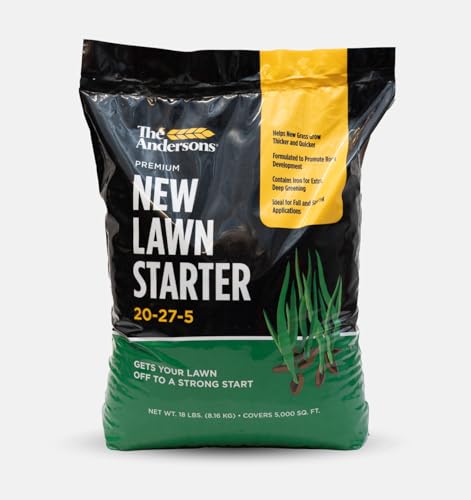
Establishing Kentucky Bluegrass from seed demands phosphorus—and lots of it. The middle number in 20-27-5 is the highest phosphorus count on this list, designed to fuel vigorous root development in young seedlings. The Andersons also includes 1% iron for early greening, which helps Bluegrass seedlings develop that characteristic blue tint before the first mow. The bag contains both quick- and slow-release nitrogen, giving new turf immediate energy for leaf growth while sustaining feeding for weeks.
Coverage is 5,000 square feet per 18-pound bag, which is right-sized for overseeding a medium lawn or starting a new patch. Reviewers consistently report germination in just over a week, with dense, healthy growth that outperforms standard starter blends. One user specifically credited this starter as the difference-maker in a full renovation that included dethatching and overseeding, noting that the Milorganite alone had never produced similar results.
Because of the high phosphorus content, verify local regulations before buying—some municipalities restrict phosphorus on established lawns. This is not a maintenance fertilizer; it is designed for seeding or sodding only. Apply it at the time of seeding and follow up with a nitrogen-maintenance product 4-6 weeks later.
What works
- High phosphorus (27%) drives strong root development in seedlings.
- 1% iron adds early color to new grass.
- Dual-release nitrogen feeds immediately and over time.
What doesn’t
- High phosphorus may be restricted in some municipalities.
- Not a maintenance formula—use only when seeding.
4. GreenView Fairway Formula Lawn Fertilizer 27-0-5

GreenView Fairway Formula packs a high 27-0-5 NPK with 63% slow-release nitrogen—one of the highest percentages on this list. For Kentucky Bluegrass, this means you get rapid greening from the quick-release portion, followed by consistent feeding for up to 12 weeks without the boom-and-bust cycle. The 33-pound bag covers 10,000 square feet, giving it a solid cost-per-square-foot for medium-to-large lawns.
Owner feedback highlights visible darkening within days of application, with one reviewer noting their lawn turned “healthy dark green” after a single treatment. The lack of phosphorus makes it compliant with most local restrictions, and the zero-phosphate formula means you can use it as a spring or fall maintenance feed without worrying about runoff. The potassium content (5% K) supports root strength and helps Bluegrass handle summer stress.
The granules apply cleanly through a standard broadcast spreader without clumping. Because this is a spring/summer formula, avoid using it during the fall seeding window—the high nitrogen could burn tender new seedlings. Pair it with a starter fertilizer like The Andersons for fall renovation.
What works
- 63% slow-release nitrogen feeds for 12 weeks.
- Zero phosphate—compliant with most regulations.
- Great coverage for large lawns at 10K sq ft per bag.
What doesn’t
- Too strong for use on new seedlings or overseeding.
- Brand is less well-known than Scotts or Andersons.
5. Safer Brand Lawn Restore Natural Lawn Fertilizer 9-0-2
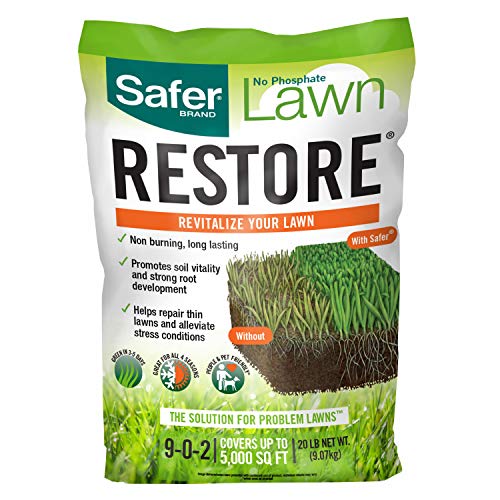
For homeowners keeping a pet-friendly lawn, Safer Brand Lawn Restore offers a naturally derived 9-0-2 formula that greens up Bluegrass without burning or requiring re-entry restrictions. The nitrogen is derived from corn gluten meal and other plant-based sources, which provides a gentler feeding curve than synthetic urea. Multiple reviewers reported seeing results within 3-5 days, with one reviving a neighbor’s dead lawn in under a week.
The 22-pound bag covers 5,000 square feet, making it best for small to medium lawns. Because this is a low-nitrogen natural product, Bluegrass will green up more gradually than with a synthetic high-N formula—but the trade-off is zero risk of fertilizer burn and immediate safety for kids and pets. The corn gluten also acts as a pre-emergent weed suppressant, which is a bonus for spring applications.
Note that corn gluten can inhibit seed germination, so do not apply this within 2-3 weeks of overseeding. One reviewer specifically warned about this interaction. For a purely organic Bluegrass program, pair this with a late-fall synthetic nitrogen boost or a top-dressing of compost.
What works
- Non-burning and safe for pets and children immediately after application.
- Greens up within 3-5 days despite being natural.
- Corn gluten provides pre-emergent weed control.
What doesn’t
- Low nitrogen content requires more frequent application for heavy feeders.
- Cannot be used near seeding or overseeding due to corn gluten.
6. Purely Organic Products Lawn Food 10-0-2

Purely Organic Lawn Food uses a plant-based formula derived from distillers grains and soy—no manure, no biosolids, and no lingering smell. The 10-0-2 NPK is low but steady, designed to feed Bluegrass gradually without surge growth or burn risk. Many owners of pets and horses reported using this product without any restriction on re-entry, and one reviewer noted that it turned yellow grass green in just 4 days.
The 15-pound bag covers 3,000 square feet, which is less coverage than other options. However, you can apply it more frequently without worry because the 10-0-2 formula is gentle on the soil biome. The zero-phosphorus composition meets most municipal phosphate bans, making it a safe choice for lakefront or well-water-sensitive properties.
For a full-season Bluegrass program, Purely Organic works best as a supplement between synthetic granular applications. It lacks the nitrogen punch to carry Bluegrass through its heavy spring growth period alone. Use it in early summer after your spring synthetic feed has worn off, or as a late-summer maintenance feed before fall overseeding.
What works
- Plant-based formula—no manure smell or biosolids.
- Zero risk of burn; safe for pets and children immediately.
- Compliant with phosphate-restricted areas.
What doesn’t
- Low nitrogen content not sufficient alone for spring flush.
- Small coverage area (3,000 sq ft per bag).
7. Scotts Turf Builder Grass Seed Sun and Shade Mix (Seed + Fertilizer)

This Scotts product bundles grass seed, a small dose of starter fertilizer, and a soil improver in one bag. It is not a standalone fertilizer—it is a patch-repair or overseeding kit. The NPK within the bag is low but sufficient to kick-start germination. Designed for sun and moderate shade, the seed blend includes Kentucky Bluegrass, fescue, and perennial ryegrass, making it a blended solution rather than a pure Bluegrass product.
Coverage is limited: 745 sq ft for a new lawn or 2,240 sq ft for overseeding. Buyer feedback reveals that the seed germinates well in ideal conditions (daily watering, 60-80°F soil temp), but some users reported patchy results on reused soil and slower growth compared to pure seed plus separate starter fertilizer. One reviewer also noted a quality control issue with a recent batch producing more crabgrass than expected.
For a quick fix on small bare patches or for overseeding a thin lawn on a budget, this is a convenient all-in-one. However, for serious Bluegrass renovation, you will get denser, more reliable results by buying pure Bluegrass seed and a dedicated starter fertilizer separately. The fertilizer component in this bag is too weak to support aggressive Bluegrass growth.
What works
- Convenient all-in-one seed and starter fertilizer.
- Good for small patch repair and overseeding thin areas.
- Designed for both sun and moderate shade.
What doesn’t
- Fertilizer component too weak for dedicated Bluegrass feeding.
- Mixed reviews on seed quality and weed content.
Hardware & Specs Guide
Nitrogen Release Rate
The release mechanism defines how fast your Bluegrass gets its nitrogen. Quick-release (water-soluble nitrogen) greens up the lawn in 2-3 days but fades in 2-4 weeks. Slow-release (polymer-coated or sulfur-coated urea) feeds evenly over 6-12 weeks, which matches Bluegrass’s natural growth curve. A 60-70% slow-release ratio is ideal for spring and summer feeding to avoid a growth spike.
NPK Ratio for Every Stage
Kentucky Bluegrass needs different ratios depending on the season. A spring-maintenance fertilizer should have high nitrogen (24-28% N) with a decent potassium percentage (5-12% K) for root endurance. A fall starter fertilizer for overseeding needs high phosphorus (20-27% P) to drive root growth. Summer blends can drop nitrogen to 10-15% and lean on iron for color without pushing leaf growth.
FAQ
How often should I fertilize Kentucky Bluegrass in a year?
Can I use a high-nitrogen liquid fertilizer like Petramax 28-0-0 exclusively?
Final Thoughts: The Verdict
For most gardeners, the fertilizer for kentucky bluegrass winner is the Yard Mastery 24-0-6 Flagship because it delivers the perfect balance of slow-release nitrogen, high potassium, and color-enhancing iron. If you are starting a new lawn from seed, grab the The Andersons 20-27-5 Starter for its unmatched phosphorus content. And for a pet-safe, non-burning maintenance feed, nothing beats the Purely Organic 10-0-2.