
Specs are compiled from manufacturer listings and verified buyer reviews and can change over time — please confirm the key details on the product page before buying.
Your Japanese maple’s red leaves and delicate shape live or die by the soil acidity. Use the wrong fertilizer and you risk burnt roots, washed-out color, or stalled growth.
I’m Rikta — the founder and writer behind Lawn Gear Lab. This guide is built by comparing the manufacturers’ published specifications and the patterns across verified customer reviews, so you get each pick’s real strengths and trade-offs instead of marketing spin.
Your goal is simple: find the fertilizer for japanese maple that delivers dense foliage, strong branch structure, and long-term health without guessing.
Quick Picks
- TreeHelp Premium Fertilizer for Japanese Maple — Best Overall
- FoxFarm Happy Frog Japanese Maple Fertilizer 4 — Top Performer
- Japanese Maple Fertilizer — Most Versatile
- Jobe’s Slow Release Tree and Shrub Fertilizer — Easiest Feed
- Dr. Earth Acid Lovers Azalea — Premium Organic
- FoxFarm Happy Frog Acid Loving Plants — Budget Champion
- Jack’s Classic 17-6-6 Acid Special — Fast Green-Up
How To Choose The Best Fertilizer For Japanese Maple
Feeding a Japanese maple is different from feeding a lawn or a tomato plant. These trees need a low pH (acidic soil), a slow-release formula, and an acidifying ingredient. Miss any one of those three and you will see weak color, leaf burn, or stalled growth.
Look for a Low pH (Acid-Loving) Formula
A Japanese maple needs soil on the acidic side — around a pH (a measure of acidity or alkalinity) of 5.0 to 6.5. Any fertilizer marked “acid-loving” or “for azaleas/camellias/rhododendrons” is on the right track. A general 10-10-10 lawn food will raise the pH and starve your tree of the iron (a nutrient needed for red leaf color) it needs for those deep red leaves.
Slow-Release Beats Quick-Fix
Japanese maples have fine, sensitive roots that burn easily. A slow-release granular or a spike that meters out nitrogen over months is safer than a water-soluble blast. Slow-release also means you feed less often — typically once in early spring and once in late fall is enough.
Match the NPK to Your Goal
The three numbers on the bag stand for Nitrogen (N), Phosphorus (P), and Potassium (K) — the main nutrients plants need. A higher first number (e.g., 16-4-4) pushes leafy growth and branch extension. A lower first number (e.g., 4-3-4) is gentler for a mature or container tree. For a Japanese maple, avoid anything over a 20 in the first number unless you want leggy, weak growth.
Quick Comparison
| Model | Best For | NPK Ratio | Item Weight | Form | Amazon |
|---|---|---|---|---|---|
| TreeHelp Premium Fertilizer for Japanese Maple | Targeted root development for maples | — | 1.5 kg | Granules | Amazon |
| Dr. Earth Acid Lovers Azalea, Camellia, Rhododendron & Maple Fertilizer 1 lb | Non-GMO organic with zero synthetics | — | 1 lb | Granules | Amazon |
| Jobe’s Slow Release Tree and Shrub Fertilizer Spikes | No-mess, no-measure feeding | 16-4-4 | 12 oz | Spikes | Amazon |
| FoxFarm Happy Frog Japanese Maple Fertilizer 4 lb | Low-pH specialists with soil microbes | 4-3-4 | 4 lb | Powder | Amazon |
| FoxFarm Happy Frog Acid Loving Plants Fertilizer 4 lb | Budget-friendly slow-release for acid-lovers | — | 4 lb | Powder | Amazon |
| Jack’s Classic 17-6-6 Acid Special Water-Soluble Fertilizer 1.5lb | Fast green-up with a water-soluble boost | 17-6-6 | 1 lb | Powder | Amazon |
| Japanese Maple Fertilizer – Liquid Plant Food 1 Gallon | Immediate liquid feed for stressed trees | — | 128 fl oz | Liquid | Amazon |
In‑Depth Reviews
1. TreeHelp Premium Fertilizer for Japanese Maple
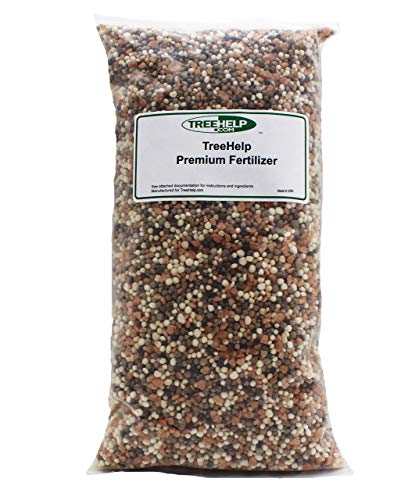
A targeted granular feed that builds deep roots and thick foliage all season long.
TreeHelp formulated this specifically for Japanese maples — not as an afterthought, but as the main design brief. The slow-release nitrogen feeds your tree gently across the entire growing season, so you get steady leaf color instead of a quick flush followed by a slump. The 1.5 kg bag can treat one large tree or two to three younger or newly planted ones.
Buyers report a notable difference: one verified owner says the product “worked wonders for my tree” on a five-year-old Japanese maple, with more foliage than any year since they had owned it. Another says a visible improvement showed in two weeks. The catch is the application method — the instructions call for drilling holes into the ground to place the fertilizer, which may require an auger bit you do not already own.
This pick weighs 1.5 kg compared to the Dr. Earth bag at just 1 lb, so you get far more product per bag for the same price tier.
Where It Shines
- Specially formulated for Japanese maples, not a generic acid-lover blend
- Slow-release nitrogen provides gentle feeding for months
- One bag covers one large tree or 2-3 smaller trees
The Fine Print
- Not available for sale in Washington state
- Requires drilling holes into the ground for application — may need an auger tool
Best for: The Japanese maple owner who wants a purpose-built, long-lasting granular feed and is willing to do a bit of hole-drilling upfront for deep root delivery.
Watch out: If you dislike digging or your tree is in a very tight root zone with utility lines, the drill-in method could be impractical.
2. FoxFarm Happy Frog Japanese Maple Fertilizer 4 lb

The gentle 4-3-4 powder with beneficial fungi that resurrects struggling trees.
FoxFarm calls this one out specifically for Japanese maples, hydrangeas, and other low-pH feeders. The 4-3-4 NPK ratio is intentionally low on nitrogen — it supports dense foliage and strong branch development without pushing weak, fast growth that flops over. The powder includes mycorrhizal fungi (a type of beneficial root fungus that helps roots absorb water and nutrients) and soil microbes that help your tree extract more from the soil.
Buyers consistently share dramatic turnarounds: one verified owner says “I’ve bought this multiple times and my Japanese Maples are looking great!” and another says their tree “has never looked better,” calling the result “almost unrecognizable.” One reviewer even brought a struggling plant back to life. This product uses a 2 tablespoons per 1 gallon mixing ratio and is designed for monthly feeding through the growing season.
Unlike the water-soluble Jack’s Classic below, this is a powder that you mix into soil or top-dress — so it works as a slow-release amendment rather than a quick foliar spray (sprayed on leaves).
On the Plus Side
- Low 4-3-4 NPK is ideal for mature and container Japanese maples
- Contains mycorrhizal fungi to boost root efficiency
- Thousands of verified 5-star reviews for revitalizing weak trees
One Thing
- Requires monthly application and measuring each time — less convenient than a single spike
- Powder form means you need to water it in thoroughly after each feed
Reach for this if: You want a proven, organic-friendly, low-pH formula that has a track record of reviving struggling Japanese maples.
Look elsewhere if: You prefer a low-maintenance spike or a single annual application with no measuring.
3. Japanese Maple Fertilizer – Liquid Plant Food 1 Gallon
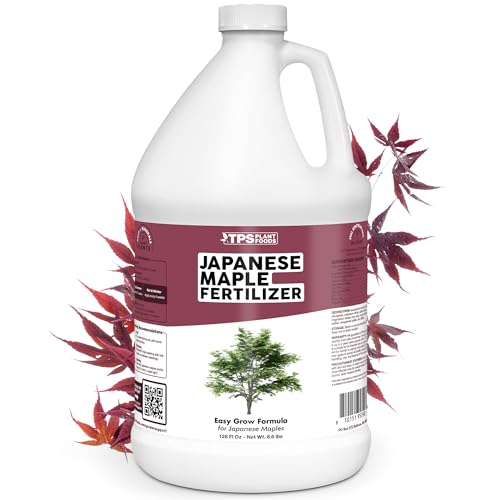
A full gallon of ready-to-apply liquid that brings weak trees back from the brink.
TPS Nutrients formulated this liquid specifically for Japanese maples, targeting foliage color, root strength, and new growth. The 128-ounce (one gallon) container is huge compared to the small powder bags above — you get many applications from one purchase. The liquid form means zero mixing or measuring for the first feed; just pour the directed amount around the root zone and you are done.
One buyer says “I used this and in 2 weeks the difference was night and day” on a tree that had barely any red leaves. Another says it “has done wonders” for a Japanese maple that had started to die after 30 years. A third uses it on a dwarf Japanese maple over 20 years old and says it is “doing wonderful.” One shipping complaint noted the lid arrived loose, so check the seal on delivery.
This is a liquid feed, so unlike the granular picks above, it delivers nutrients immediately — great for a stressed or underperforming tree, but you will need to reapply more frequently than a slow-release granule or spike.
What Works
- One-gallon container is a huge volume for the money — many feedings per bottle
- Liquid form delivers nutrients instantly to stressed or dying trees
- Designed specifically for Japanese maples, not a generic acid-lover mix
What to Know
- Liquid requires more frequent reapplication than slow-release granules or spikes
- Some owners mention shipping issues with missing or loose caps — inspect on arrival
Pick this if: You have a Japanese maple that looks weak, has poor color, or is recovering from transplant shock — the liquid delivers an immediate nutrient boost.
skip it if: You prefer a low-maintenance “feed twice a year” approach and do not want to mix and apply liquid every few weeks.
4. Jobe’s Slow Release Tree and Shrub Fertilizer Spikes 15 Count

Pre-measured spikes that eliminate measuring, mixing, and messy runoff.
Jobe’s makes feeding as simple as hammering a spike into the soil. The 15-count box covers multiple trees or several seasons for a single tree. The 16-4-4 NPK ratio pushes strong leafy growth — the higher nitrogen is best for younger trees you want to bulk up, not for stressed or mature trees that need a gentler hand. The spikes are designed to release nutrients slowly right at the active root zone, avoiding the runoff and smell of granular fertilizers.
The instructions recommend application twice a year (early spring and late fall), so one box could last you several seasons for a single tree. At 12 ounces total box weight, these are far lighter than the 4-pound FoxFarm bags — but the 16-4-4 formula is significantly higher in nitrogen than the 4-3-4 blend of the FoxFarm Japanese Maple pick above, so use caution on sensitive or container trees.
Jobe’s markets these for oaks, maples (including Japanese maples), dogwoods, and boxwoods, but the high first number means you should not use them on a very small or newly planted Japanese maple.
The Upside
- No measuring, mixing, or mess — hammer in and walk away
- Slow-release design feeds roots directly for months
- Pre-measured so you cannot over-fertilize
The Downside
- 16-4-4 ratio is high in nitrogen for a mature Japanese maple
- Spikes may not distribute nutrients evenly in a container tree
Best for: The gardener who wants the absolute simplest feeding routine and has a young or sturdy Japanese maple that can handle the higher nitrogen ratio.
Not for: A mature, container-bound, or stressed Japanese maple that needs a low-nitrogen, gentle formula like the FoxFarm 4-3-4.
5. Dr. Earth Acid Lovers Azalea, Camellia, Rhododendron & Maple Fertilizer 1 lb

The only Non-GMO Project Verified fertilizer on this list — with zero synthetic chemicals.
Dr. Earth takes purity seriously: this fertilizer is OMRI-listed (approved for organic use), Non-GMO Project Verified, and handcrafted from human-grade and feed-grade ingredients. It includes multi-minerals, proteins, carbohydrates, humic acids, and trace elements — all designed to build healthy soil rather than pushing a quick green flush. The bag coverage is marked “Medium” and the weight is 1 lb, making it a more compact option than the 4-pound FoxFarm bags.
The “No Synthetic Chemicals” claim stands out in a category where many organic-ish products still use processed chicken manure. Dr. Earth says its formula is safe for people and pets once applied and watered in. It is formulated by Milo Shammas, the founder, and is sustainably made in the U.S.A.
At 1 lb, this is significantly smaller than the FoxFarm Happy Frog Acid Loving Plants fertilizer which weighs 4 lb — if you have multiple trees, you will run through the Dr. Earth bag much faster. You are paying more per pound for that organic certification and purity guarantee.
Good For
- Non-GMO Project Verified and OMRI-listed — highest organic purity standards
- Enriched with humic acids and trace minerals for soil health
- People and pet safe with no toxic ingredients
Limitation
- Only 1 lb per bag — you get less product for the same price as the 4 lb FoxFarm bags
- Granular form requires watering in and repeat application through the season
Choose this if: You are an organic-only gardener who wants the cleanest possible ingredients, with Non-GMO and OMRI stamps to back it up, for a single small tree or container.
Think twice if: You have multiple large trees or want more volume per dollar — the 4 lb FoxFarm bags are a much better value for bigger gardens.
6. FoxFarm Happy Frog Acid Loving Plants Fertilizer 4 lb

The budget-friendly 4-pound bag that delivers visible results in as little as 10 days.
This is the more affordable cousin of the FoxFarm Happy Frog Japanese Maple fertilizer above. It is formulated for all acid-loving plants — azaleas, rhododendrons, blueberries, hydrangeas, camellias, evergreens, and strawberries — making it a generalist option that still works for Japanese maples at the recommended rate. The mixing ratio is 1/16 cup per gallon of water, and it uses slow-release feedings so you do not overwhelm sensitive roots.
Customers note fast results: one verified owner says within 10 days their baby gardenia sprouted two buds and their strawberry plant “exploded with flowers, fruit forming.” Another buyer credits this fertilizer with saving their Katsura bushes after a late frost. The formula contains beneficial soil microbes (tiny organisms that help roots absorb nutrients) similar to the pricier FoxFarm specialty bag, but at a lower cost per pound.
This is a budget-friendly entry point for a Japanese maple, but the formula is not as targeted to low-pH feeders as the FoxFarm Japanese Maple-specific version above — you are getting a general acid-lover feed rather than one tuned to maples’ exact NPK needs.
What It Does Well
- 4 lb bag gives you lots of product for the price
- Contains beneficial soil microbes for root health
- Reviews report visible results within 10 days
What It Is Not
- Not specifically formulated for Japanese maples — it is a general acid-lover feed
- Powder form requires measuring 1/16 cup per gallon and watering in
Grab this if: You have multiple acid-loving plants and want one bag that feeds everything — from your Japanese maple to your blueberries — without overspending.
Pick the specialty version if: You only feed your Japanese maple and want the exact 4-3-4 NPK ratio and mycorrhizal fungi of the FoxFarm Japanese Maple-specific formula.
7. Jack’s Classic 17-6-6 Acid Special Water-Soluble Fertilizer 1.5lb

A high-nitrogen water-soluble powder that gives acid-lovers a quick, strong growth push.
Jack’s Classic Acid Special has a 17-6-6 NPK analysis — that 17 in the first slot means it is heavy on nitrogen, which drives lush vegetative growth and deep green leaves. For a Japanese maple that looks pale or thin, this can provide a rapid green-up. The powder is water-soluble and can be applied as a foliar spray (sprayed directly on leaves) or as a root feeding (poured into soil). It comes with a measuring spoon and mixes at 1 teaspoon per gallon of water.
The improve levels of iron and sulfur in this formula are designed to promote better blooms and leaf color in acid-loving plants. The 1.5 lb bag is lightweight and small, but each teaspoon makes a full gallon of liquid feed, so the bag goes further than you would expect. Unlike the slow-release pick above, this is a fast-acting water-soluble formula — great for a mid-season boost, but not a substitute for a slow-release base feed.
For a Japanese maple, the 17-6-6 ratio is on the high side — use it at half-strength or less frequently than the label says to avoid nitrogen burn on a mature or sensitive tree. This is better suited for young, fast-growing Japanese maples or trees in the ground with large root systems.
Where It Excels
- Water-soluble powder goes a long way — 1 tsp makes 1 gallon of feed
- Can be used as a foliar spray for quick leaf greening
- Added iron and sulfur support deeper color in red-leaved varieties
Where It Falls Short
- 17% nitrogen is high for mature or container Japanese maples — risk of burn
- Water-soluble means it washes out fast and requires frequent reapplication
Best for: A young, in-ground Japanese maple that you want to push for fast growth, or for a mid-season foliar green-up on a tree that looks pale.
Skip if: You have a mature container tree or want a low-maintenance slow-release approach — the high N is risky and the frequent mixing is work.
Understanding the Specs
NPK Ratio — The Three Numbers
The three hyphenated numbers on every fertilizer bag (e.g., 4-3-4 or 17-6-6) stand for Nitrogen (N), Phosphorus (P), and Potassium (K). Nitrogen pushes leaf and stem growth. Phosphorus supports root development and flower set. Potassium strengthens overall plant health and disease resistance. For a Japanese maple, you want a low first number (under 10) for mature trees to avoid weak, leggy growth, and a balanced middle number to support that delicate root system.
Slow-Release vs. Water-Soluble
Slow-release fertilizers (like the FoxFarm Happy Frog powder or Jobe’s spikes) meter out nutrients over weeks or months so the tree gets a steady, gentle supply. Water-soluble fertilizers (like Jack’s Classic) deliver nutrients instantly but wash out of the soil quickly, requiring more frequent applications. For a Japanese maple, a slow-release formula is the safer, lower-maintenance choice — especially for container trees where water-soluble salts can build up and burn roots.
Mycorrhizal Fungi and Soil Microbes
Mycorrhizal fungi are beneficial microorganisms that form a symbiotic relationship with tree roots, helping the plant absorb water and nutrients far more efficiently than roots alone. Products like the FoxFarm Happy Frog Japanese Maple Fertilizer include these microbes. If your soil is poor or your tree is stressed, a fertilizer with added microbes can make a big difference in how well your tree uses the feed.
Acid-Loving vs. General Purpose
Japanese maples thrive in acidic soil, typically in the pH 5.0–6.5 range. A fertilizer labeled “acid-loving” or “for azaleas and rhododendrons” contains acidifying ingredients like sulfur or iron that keep soil pH in the right zone. A general-purpose 10-10-10 fertilizer will raise the pH over time, locking up the iron your tree needs for those signature red leaves. Never use a lawn fertilizer on a Japanese maple.
FAQ
When should I fertilize my Japanese maple?
Can I use a general-purpose fertilizer on a Japanese maple?
How often should I feed a Japanese maple in a container?
What NPK ratio is best for a mature Japanese maple?
Can I fertilize a newly planted Japanese maple?
Do I need to water after applying granular fertilizer?
How do I know if I am over-fertilizing my Japanese maple?
Can I use Jobe’s spikes on a Japanese maple in a container?
Is liquid or granular fertilizer better for Japanese maples?
How deep should I apply granular fertilizer for a Japanese maple?
Final Thoughts: The Verdict
For most people, the fertilizer for japanese maple winner is the TreeHelp Premium Fertilizer for Japanese Maple because it is purpose-built for the species, uses slow-release nitrogen for steady feeding all season, and a single 1.5 kg bag treats one large tree or multiple smaller ones. If you want a gentler formula with added mycorrhizal fungi to boost root health, grab the FoxFarm Happy Frog Japanese Maple Fertilizer. For the easiest no-mix, no-measure feeding routine, the Jobe’s Slow Release Tree and Shrub Fertilizer Spikes deliver the simplest application.
How We Picked
We do not accept paid placement. Every pick is matched to a real buyer and a real use-case; we do not hands-on test units.
Sources & Methodology
Specifications: manufacturer listings and product documentation. Review insights: verified customer reviews, as of July 2026. Pricing: not shown on this page (it changes often); check the current price via the retailer link.
As an Amazon Associate, Lawn Gear Lab earns from qualifying purchases. This does not affect which products we feature.