
Specs are compiled from manufacturer listings and verified buyer reviews and can change over time — please confirm the key details on the product page before buying.
Your jalapeño plants are hungry — they need the right mix of nutrients to grow thick, spicy peppers. Pick the wrong feed, and you get pale leaves and a mild harvest. The best fertilizer for jalapeno peppers delivers a fast green-up for the money: the Miracle-Gro Water Soluble All Purpose with its 24-8-16 NPK ratio (24% Nitrogen, 8% Phosphorus, 16% Potassium). That ratio puts most of the energy into leaves at first, but you switch to a bloom booster once flowers appear.
I’m Rikta — the founder and writer behind Lawn Gear Lab. This guide is built by comparing the manufacturers’ published specifications and the patterns across verified customer reviews, so you get each pick’s real strengths and trade-offs instead of marketing spin.
In-ground or in containers, the NPK ratio (Nitrogen, Phosphorus, and Potassium) is the number that decides between a few sad peppers and a heavy, spicy harvest.
Our Picks at a Glance


How To Choose The Best Fertilizer For Jalapeno Peppers
Jalapeños are heavy feeders, meaning they pull a lot of nutrients from the soil throughout their growing cycle. To get a serious harvest, you need to understand three core choices: the NPK ratio, how the fertilizer releases its nutrients, and if you want a synthetic or organic source. Here is what each one means for your pepper plants.
NPK Ratio: The Three Numbers That Matter
The three large numbers on a fertilizer bag — Nitrogen (N), Phosphorus (P), and Potassium (K) — tell you the percentage of each major nutrient by weight. Nitrogen fuels green leafy growth early on. Phosphorus drives flower and fruit production. Potassium strengthens roots and overall plant health. For jalapeños, you want a lower first number (Nitrogen) and higher middle number (Phosphorus) once the plants start setting fruit. Otherwise, all that energy goes into leaves, not peppers.
Water-Soluble vs. Granular: How Fast You Want Results
A water-soluble powder or liquid mixes into your watering can and feeds the plant immediately — great for a quick green-up boost. Granular fertilizers are sprinkled onto the soil and break down slowly over weeks or months, giving a steady supply without needing to mix a new batch every time you water. Your choice depends on whether you prefer a hands-on weekly routine or a set-it-and-forget approach.
Synthetic vs. Organic: Speed Versus Soil Health
Synthetic fertilizers (like those with a high NPK like 24-8-16) are highly concentrated and deliver nutrients fast — you often see visible results within days. Organic options (like 3-4-4 or 4-6-2) release nutrients more slowly as soil microbes break them down. They improve your soil structure over time but usually require more product for the same feeding power. Jalapeños thrive with either approach, but the choice affects how often you need to apply.
Quick Comparison
| Model | Best For | NPK Ratio | Item Weight | Release Type | Amazon |
|---|---|---|---|---|---|
| Miracle-Gro Water Soluble All Purpose★ Best Overall | Fast, visible greening | 24-8-16 | 3 lb | Water-soluble (instant) | Amazon |
| FoxFarm Happy Frog Tomato & VegetablePremium Pick | Preventing blossom end rot | 5-7-3 | 4 lb | Granular (plus mycorrhizae) | Amazon |
| Lilly Miller Morcrop 5-10-10 | Great-tasting vegetables | 5-10-10 | 4 lb | Granular (slow-release) | Amazon |
| Purely Organic 8-8-8 Triple Play | Balanced protein & plant formula | 8-8-8 | 2.25 lb | Granular (feeds 6-8 weeks) | Amazon |
| MasterBlend 4-18-38 | Hydroponic & precision feeding | 4-18-38 | 16 oz | Powder (water-soluble) | Amazon |
| Espoma Organic Garden-tone 3-4-4 | Organic gardening & urban yields | 3-4-4 | 4 lb | Granular (monthly feed) | Amazon |
| Down To Earth 4-6-2 All Purpose | Gentle organic feeding | 4-6-2 | 5 lb | Granular (steady supply) | Amazon |
In‑Depth Reviews
1. Miracle-Gro Water Soluble All Purpose Plant Food, 3 lb.
Our pick — over 4.5★ from 30,500+ verified ratings; the strongest balance of quality and price.
You get the fastest green-up of any formula here — one buyer says it “doubled plant size, greener leaves in 1 week.”
This synthetic-speed champion uses a 24-8-16 NPK ratio (24% Nitrogen, 8% Phosphorus, 16% Potassium) to drive leaf growth fast. You mix ½ teaspoon per gallon for indoor plants or 1½ tablespoons per 1½ gallons for outdoor feeding. The blue powder dissolves instantly, so microbes do not need to break it down. The 3 lb container covers roughly 1,200 sq ft of garden area, which is a huge spread for a single container.
The strong nitrogen content means at 24-8-16 versus the Espoma Garden-Tone’s 3-4-4, so you see results fast. One buyer reports it “doubled plant size, greener leaves in 1 week.” The trade-off is that the fine blue powder can blow in the wind and stain your hands and clothes. Avoid using it on orchids or Venus flytraps. For a quick, dramatic green-up on your jalapeños, this is the most cost-effective trigger.
Best for rapid results: If your plants look pale and you want to see improvement within a week, this is the easiest, most concentrated option for the money.
Watch out for staining: The blue powder can stain clothes and surfaces — wear gloves when mixing and avoid applying on windy days.
Grab this if: you need a fast-acting rescue feed for struggling plants or want to boost early-season vegetative growth before fruiting kicks in.
skip it if: you prefer organic methods or want to avoid frequent mixing — you will need to apply every 1-2 weeks.
2. FoxFarm Happy Frog Tomato & Vegetable Fertilizer, 4 lb
A calcium-rich granular feed that stops blossom end rot before it starts — a common jalapeño failure mode.
The 5-7-3 formula is tuned for the flowering and fruiting stage. Higher Phosphorus than Nitrogen directs energy into setting fruit, not just leaves. It also includes added calcium, the key mineral that prevents the dark, sunken spots of blossom end rot. Mycorrhizal fungi (beneficial root fungi) in the mix help your plant’s roots absorb water and nutrients more efficiently, acting like a natural root extender.
Buyers report the results are impressive — one buyer calls it “one of the best dry fertilizers around” and reports “bumper crop results” with no chemical or fish smell. The 4 lb bag is easy to sprinkle into containers or rows and you use it throughout the season. The downside is the price point sits above most entry-level granular fertilizers, but you are paying for the organic base and the added calcium protection that can save an entire harvest. Compared to the Miracle-Gro, this takes more time to show results but provides better fruit quality and fewer rot issues.
What stands out
- Calcium content directly blocks blossom end rot — a common jalapeño failure mode
- Mycorrhizal fungi improve root system efficiency for better water and nutrient uptake
What to consider
- Premium price point versus simpler granular fertilizers
- Only 4 lb; larger gardens may need multiple bags
Your pepper’s insurance policy: Choose this if you have ever lost peppers to blossom end rot or want to boost fruit quality with a top-tier organic granular.
Consider something else if: you are on a tight budget or need to cover a very large in-ground garden area.
3. Purely Organic Products LLC 8-8-8 Triple Play Tomato & Vegetable Plant Food, 2.25 lb

A balanced 8-8-8 ratio that feeds for 6-8 weeks per application — perfect for set-it-and-forget gardeners.
The 8-8-8 ratio is a true all-rounder. It gives 8% Nitrogen for leaves, 8% Phosphorus for fruit, and 8% Potassium for roots, so you do not have to switch formulas mid-season. It uses a protein and plant-derived base, meaning it feeds the soil biology as it breaks down. A single 2.25 lb bag covers up to 250 square feet. The pouch is resealable, which keeps the granules fresh and dry between uses.
Comparing directly with the heavier options, Purely Organic, at 2.25 lb versus the Down To Earth mix’s 5 lb, delivers a higher NPK concentration per pound so you use less product. One buyer says their “tomato plants 5x bigger than friend’s using different brand.” The main catch is that the bag size is small, so large raised beds will need multiple purchases per season.
Smart formulation: The protein base is unique — it feeds plants without the salt burn risk of some synthetics, making it a safe middle-ground option.
Bag size reality: At 2.25 pounds, it covers 250 sq ft; if your garden is larger, expect to buy 2-3 pouches to get through the season.
Reach for this if: you want an easy, balanced granular that requires no mixing and lasts 6-8 weeks between applications.
Look elsewhere if: you have a very small container or prefer a water-soluble formula for more control over feeding frequency.
4. MasterBlend 4-18-38 Tomato & Vegetable Fertilizer, 1 lb
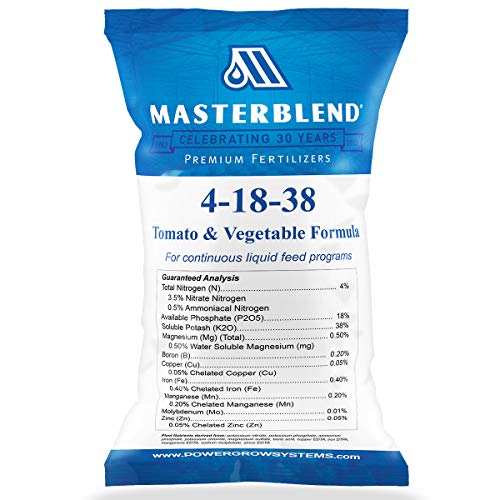
A super-concentrated 4-18-38 powder built for hydroponics that works just as well in soil.
The 4-18-38 ratio looks strange next to a balanced fertilizer — very low Nitrogen and very high Potassium — but that is exactly what fruiting plants need once they start flowering. It is 100% water-soluble (dissolves fully in water) and contains trace minerals (tiny amounts of elements like iron and zinc), so it feeds the plants directly without any soil microbes required. You choose between 1, 5, or 25 pound quantities, and the 1 lb bag is a super-concentrated starter that lasts a long time.
Reviewers love it in hydroponic systems: “It’s easy to mix and the peppers love it!” works for Kratky-method growers who set up a 5-gallon bucket and let the plants drink for weeks. In soil, you mix a small amount per gallon of water and use it as a weekly feed. The catch is that you need to also add calcium nitrate and Epsom salts separately to get a complete nutrient profile for your plants.
Pros of this formula
- Extremely concentrated — a 1 lb bag lasts over a year for a small garden
- Contains all trace minerals needed for healthy pepper development
What you should know
- Requires mixing with calcium nitrate and Epsom salts for a complete feed
- Not a stand-alone product — you need to measure and combine components
Best for controlled feeding: Ideal if you grow hydroponically or want to precisely control your plants’ nutrient intake by mixing your own solutions.
Avoid if: you want a simple pour-and-go granular that needs no measuring or secondary additives.
5. Espoma Organic Garden-Tone 3-4-4, 4 lb (Pack of 2)

A proven organic granular that, according to one urban gardener, delivered 400 lbs of tomatoes and 100 lbs of carrots.
Espoma Garden-Tone uses a 3-4-4 NPK analysis (3% Nitrogen, 4% Phosphorus, 4% Potassium) plus 5% calcium. It is enhanced with the company’s exclusive Bio-tone formula — a blend of beneficial microbes that help roots access nutrients already in the soil. The pack comes with two 4 lb bags, so you have 8 total pounds to work with. You apply it monthly by sprinkling around the drip line of your plants and watering in.
The numbers stack up: one reviewer achieved “yielded 400 lbs tomatoes and 100 lbs carrots in an urban setting, a personal best” — proof of how effective a low-NPK organic can be when used consistently. It is also OMRI-listed (Organic Materials Review Institute), which means it meets the requirements for certified organic production. The smell is noticeable — one buyer describes it as having “a smell but overall good” — but that dissipates after a few days. It is gentler than synthetic feeds, so you cannot easily burn your plants by over-applying.
Urban proven: This fertilizer has real-world proof from an urban gardener who set a personal best, making it a reliable organic choice even in limited space.
Slight odor: The natural ingredients produce a smell after application — it fades within days but you may notice it initially.
Choose this if: you want an OMRI-listed organic feed that improves soil over time and still produces heavy harvests.
pass on it if: you cannot tolerate any smell around your garden or you prefer a higher NPK ratio for more immediate visual results.
6. Down To Earth All Natural Fertilizers 4-6-2, 5 lb

A gentle, all-natural 5-pound box that, according to one reviewer, “revived pale, flimsy tomato plants in two weeks.”
The 4-6-2 formula is deliberately mild. It provides a steady supply of nutrients through organic ingredients like fish bone meal, blood meal, feather meal, rock phosphate, langbeinite, greensand, humates, and kelp meal. Because it is a non-burning granular (it will not chemically burn plant roots if you apply a generous amount), you can be less precise with application. The 5 lb box offers the largest volume among similar organic options, giving you plenty of feeding power for a full season of jalapeños.
It is OMRI-listed for organic production. One reviewer noticed it “revived pale, flimsy tomato plants in two weeks after application,” showing it has enough strength to rescue struggling plants despite the gentle formulation. The biggest downside is the smell — the natural ingredient blend has an unpleasant odor when first applied, but it dissipates within days. It weighs 5 lb compared to the 2.25 lb Purely Organic bag, for roughly similar coverage per pound.
Why it works
- 5 lbs of product — the largest bag by weight among the organic picks here
- Gentle non-burning formula safe for even delicate transplants and container plants
Real trade-offs
- Low NPK means you need more product per square foot than synthetic alternatives
- Noticeable smell from fish meal and bone meal for several days after application
Grab it for: large in-ground gardens where you want an organic feed in bulk, and you do not mind a temporary soil smell.
Consider another if: you have a small container garden and want a more concentrated feed to avoid storing a 5 lb box.
7. Lilly Miller Morcrop Tomato & Vegetable Food 5-10-10, 4 lb

A classic 5-10-10 bloom-booster that focuses plant energy on fruit quality — one reviewer says “this works best” compared to other tomato foods.
The 5-10-10 ratio is a traditional bloom-booster formula. It is lower in Nitrogen to discourage leafy overgrowth and higher in Phosphorus and Potassium to push the plant into heavy fruit production. It is fortified with essential plant minerals and comes as simple granules you work into the soil. The 4 lb bag is a straightforward, no-hassle option for gardeners who know exactly what they want: more peppers, not more leaves.
Buyers consistently praise it for producing great-tasting vegetables. One review says it is “perfect for making sure I’ll realize a good crop of tomatoes in my greenhouse” and calls it a “trusted product” they use every year. A separate reviewer who tried other tomato and pepper foods says “this works best.” The smell is a recurring note — one buyer says it “smells horrible” when applied, similar to many organic-based granular fertilizers. It is a simple, affordable entry point for anyone wanting a fruit-focused feed without mixing powders.
Straightforward approach: This is a simple granular feed with a proven 5-10-10 ratio that keeps the focus on fruit set rather than foliage.
Odor is real: Multiple reviewers mention the strong smell after application — it is normal for this type of fertilizer but worth knowing before you apply near a patio.
Best for: gardeners who already understand NPK and want a simple, fruit-focused granular without any extra mixing or additives.
Not ideal if: you need an all-in-one feed that also provides micronutrients or calcium — this is a basic NPK blend.
Understanding the Specs
NPK Ratio
The three numbers on a fertilizer bag — like 4-18-38 or 5-10-10 — stand for Nitrogen (N), Phosphorus (P), and Potassium (K). Nitrogen drives green leaf and stem growth, Phosphorus supports flower and fruit development, and Potassium strengthens the overall root system and disease resistance. For jalapeños, you want a higher middle number (P) once the plants are flowering, and a lower first number (N) so the plant puts energy into producing fruit, not just leaves.
Water-Soluble vs. Granular
A water-soluble fertilizer, like a powder you mix into water, is absorbed by the plant within hours — perfect for a quick rescue feed or for hydroponic systems. A granular fertilizer sits on top of the soil and breaks down over weeks or months, releasing nutrients slowly. Granular is easier for busy gardeners because you apply it less often, but it takes longer to show results.
FAQ
What NPK ratio is best for jalapeno peppers?
Should I use water-soluble or granular fertilizer for jalapenos?
Can I use the same fertilizer for jalapenos in containers and in-ground gardens?
How often should I fertilize jalapeno pepper plants?
What causes blossom end rot on jalapenos and how do I prevent it?
Is organic fertilizer better than synthetic for jalapeno peppers?
Can I use tomato fertilizer on jalapeno peppers?
How do I know if my jalapeno plant is over-fertilized?
What are trace minerals and do jalapenos need them?
Will a high-nitrogen fertilizer stop my jalapenos from producing fruit?
Final Thoughts: The Verdict
If you want one dependable pick, the best fertilizer for jalapeno peppers winner is the Miracle-Gro Water Soluble All Purpose because its 24-8-16 NPK ratio delivers the fastest visible green-up and the most concentrated feeding power per dollar. If you want an organic granular that also protects against blossom end rot, grab the FoxFarm Happy Frog Tomato & Vegetable. And for hydroponic or precision-controlled feeding, the standout is the MasterBlend 4-18-38 with its super-concentrated, mineral-rich formula.
How We Picked
We do not accept paid placement. Every pick is matched to a real buyer and a real use-case; we do not hands-on test units.
Sources & Methodology
Specifications: manufacturer listings and product documentation. Review insights: verified customer reviews, as of July 2026. Pricing: not shown on this page (it changes often); check the current price via the retailer link.
As an Amazon Associate, Lawn Gear Lab earns from qualifying purchases. This does not affect which products we feature.