
Specs are compiled from manufacturer listings and verified buyer reviews and can change over time — please confirm the key details on the product page before buying.
When you remove soil from the equation, your plants rely entirely on what you put in the water. That is why picking the wrong mix can stall growth, cause nutrient burn, or leave you with weak stems and pale leaves. The difference between a thriving hydro garden and a frustrating one often depends on a single click on the right bottle or bag.
I’m Rikta — the founder and writer behind Lawn Gear Lab. This guide is built by comparing the manufacturers’ published specifications and the patterns across verified customer reviews, so you get each pick’s real strengths and trade-offs instead of marketing spin.
Below, you will find a focused breakdown of four proven options that belong on your shortlist, each chosen because it matches a specific stage or style of growing. Read on for the clearest route to your best fertilizer for hydroponics.
Quick Picks
- General Hydroponics FloraSeries Hydroponic Nutrient Fertilizer System Trial Pack — Best Overall
- Athena Blended Grow A&B | 2-Part Vegetative Liquid Fertilizer — Vegetative Power
- Athena Blended Bloom A&B | 2-Part Flowering Liquid Fertilizer — Flower Focus
- General Hydroponics GLCMBX0008 Maxigro, Maxibloom, Koolbloom Combo — Budget Champion
How To Choose The Best Fertilizer For Hydroponics
Hydroponic plants get every nutrient from the water, so the fertilizer you choose must be fully soluble and balanced for the growth stage you are in. Unlike soil, there is no buffer to correct mistakes — your mix is the only source of food.
Liquid vs. Powder Form
Liquid fertilizers are easy to measure and mix instantly, which makes them beginner-friendly and ideal for small reservoirs. Powders generally cost less per feed and have a longer shelf life, but they require a scale and a little more effort to dissolve completely.
Complete System vs. Stage-Specific Nutrients
A complete system such as a three-part base set covers every growth phase from seedling to harvest, while stage-specific blends (vegetative or bloom) focus on one phase for more targeted feeding. Your choice depends on if you want simplicity or maximum precision during each transition.
Mixing Ratio and Solubility
Every hydroponic fertilizer lists its mixing ratio, usually expressed in parts like 1:1:1 or 1:1. This tells you how to combine the bottles for a balanced solution. A fertilizer that dissolves fully — leaving no sediment in the reservoir — prevents clogged lines and uneven feeding.
Quick Comparison
| Model | Best For | Form | Number of Items | Item Weight | Amazon |
|---|---|---|---|---|---|
| General Hydroponics FloraSeries System | Full-cycle controlled feeding | Liquid | 3 | 8.06 Pounds | Amazon |
| Athena Blended Grow A&B | Early vegetative vigor | Liquid | 2 | — | Amazon |
| Athena Blended Bloom A&B | High-density flowering | Liquid | 2 | — | Amazon |
| General Hydroponics Maxigro/Maxibloom/Koolbloom Combo | Budget-friendly dry storage | Powder | 1 | 6.7 Pounds | Amazon |
In‑Depth Reviews
1. General Hydroponics FloraSeries Hydroponic Nutrient Fertilizer System Trial Pack

Three bottles that guide your plants from seedling to harvest with a simple 1:1:1 recipe.
This set covers the full life cycle without separate purchases. You get FloraMicro (loaded with nitrogen and calcium for structural support), FloraGro (blended with nitrogen, phosphorus, and potassium for leaf growth), and FloraBloom (packed with phosphorus and potassium to boost flowers and fruit). The mixing ratio is 1:1:1, so you measure each bottle equally — no complicated math. At 8.06 pounds for three 1-quart bottles (32 fluid ounces each), this is a mid-weight liquid set that carries you from veg through bloom. Unlike the powder-based General Hydroponics Maxi Combo, these are liquid, so you pour and stir without dissolving granules. One reviewer noted that a “Leca conversion saved dying pothos (heirloom) in 2 days; new leaves, root growth on pink princess, rubber tree leaf,” showing how fast the right base nutrients revive a struggling plant.
The FloraSeries requires keeping three bottles on hand and mixing each time, while the Athena two-part systems below simplify your lineup to just a grow or bloom pair. For flexible feeding across every growth stage without buying separate formulas later, this set covers the ground.
Three-bottle flexibility: The 1:1:1 mixing ratio takes the guesswork out of feeding at every stage.
Liquid shelf awareness: You will want to use these within a reasonable timeline; unlike the Maxi powder, liquids do not store indefinitely.
Reach for this if: You want a proven three-part system that handles the full growth cycle in one purchase.
Look elsewhere if: You prefer a smaller number of bottles or only need a stage-specific formula.
2. Athena Blended Grow A&B | 2-Part Vegetative Liquid Fertilizer
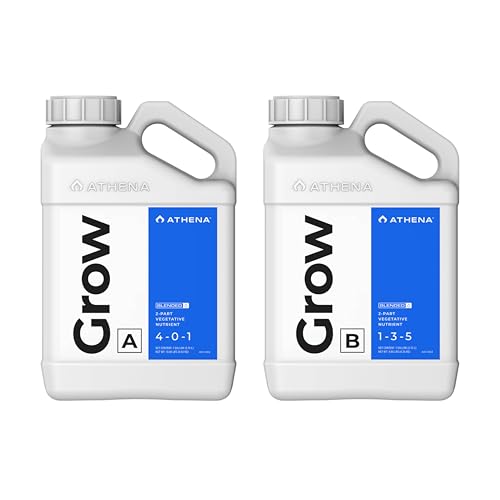
A two-bottle vegetative duo that triggers near-instant growth in young plants and transplants.
If leafy green growth and strong roots are your current goal, this Athena Grow formula delivers a professional NPK profile—A is 4-0-1 and B is 1-3-5—in a 1:1 mixing ratio. The NPK stands for nitrogen (N), phosphorus (P), and potassium (K), the primary macronutrients. The higher nitrogen in part A drives leaf growth, while the phosphorus and potassium in part B support root strength. It works across hydroponics, coco coir, rockwool, and soil, making it versatile for mixed setups. The adjustable dosing ranges from 2 to 15 mL per gallon, so you can start seedlings on a light feed and ramp up as they mature.
One buyer mentioned, “I use this for my hydroponic table top setups” and noted an “almost instant growth spurt” after switching to Athena. That quick response is exactly what you want during the veg phase when vigorous growth builds a stronger framework for flowers. The formula is 100% soluble with no sediment, which keeps your pump and drip lines clean — a clear advantage over powders that might leave residue if not mixed thoroughly.
The catch? This is a stage-specific bottle set. You will need the Athena Bloom A&B for the flowering phase, which means a separate purchase later. For growers who want to push vegetative growth hard without juggling three bottles, the Athena Grow is a streamlined step up from the FloraSeries general approach.
Veg-Phase Edge
- Two-part liquid is easy to dose and mixes cleanly at 1:1
- Soluble formula prevents clogging in pumps and drip lines
- Buyers report near-instant growth spurt after switching
Bloom-Bound Limitation
- Only covers vegetative stage — requires a separate bloom purchase
- Premium tier cost adds up when combined with the Bloom A&B
Best for: Home growers who want a fast-acting vegetative boost and prefer a two-bottle system over three.
skip it if: You only want a single all-in-one fertilizer that handles every growth stage.
3. Athena Blended Bloom A&B | 2-Part Flowering Liquid Fertilizer
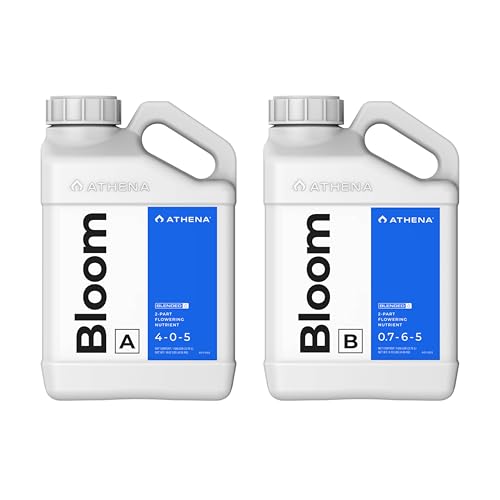
A two-bottle bloom booster built to push dense flowers and heavy fruit in the final growth stage.
When your plants shift from leaf-making to flower-making, the nutrient profile needs to flip. This Athena Bloom A&B delivers that with an NPK of A 4-0-5 and B 0.7-6-5, giving you a higher phosphorus and potassium punch that supports explosive flower development, rich coloration, and dense fruit clusters. The 1:1 mixing ratio is simple — equal parts A and B — and the formula is 100% soluble, so it will not gum up your reservoir or drip emitters.
A reviewer noted they were “3/4 of the way through flower. Needed refills went with the gallons,” which tells you that serious users trust this line for the bloom phase. The Athena system pairs with the Grow A&B for veg, then transitions here for flowering, plus optional PK booster and CalMag supplements as needed. Compared to the FloraSeries, which handles bloom with one of its three bottles, the Athena Bloom gives a more concentrated, bloom-specific profile that commercial growers rely on.
Since it is a two-bottle liquid system, you get precision without a heavy shelf footprint. Just be ready to buy the Grow A&B separately if you are raising plants from seed or clone.
Bloom-specific power: The higher phosphorus and potassium (0.7-6-5 in part B) target dense flower sites and heavy fruit set.
Not a standalone system: For a full cycle you need the Athena Grow A&B, so this works best as part of a planned two-phase feed schedule.
Your pick if: You are entering the bloom stage and want a commercial-grade, two-part liquid that maximizes yield.
Better to skip if: You need a single fertilizer that covers both veg and flowering in one bottle.
4. General Hydroponics GLCMBX0008 Maxigro, Maxibloom, Koolbloom Combo

A dry powder bundle that keeps your shelf life infinite and your cost per feed low.
Stock up without worrying about expiration dates. This Maxi Combo is the most economical route. The set includes Maxigro (for seedlings and vegetative growth), Maxibloom (for flowering and fruiting), and Koolbloom (used only at the very end of the plant’s life to build larger, heavier fruits and flowers). The total weight is 6.7 pounds across all three bags, versus the 8.06-pound FloraSeries liquid set.
One experienced buyer noted, “General Hydroponics dry nutrients have infinite shelf life if kept dry,” so you can buy in bulk and use what you need over many seasons without any degradation. Another reviewer recommends using a TDS meter (a device that measures total dissolved solids in water) and never exceeding 1500, mixing with Schultz or Miracle-Gro to extend coverage. This powder approach demands a scale and thorough stirring, but dry nutrients are typically chosen for lower per-feed cost than liquid systems.
Compared to the FloraSeries liquid trio, the Maxi Combo trades convenience for value and longevity. It holds 35.2 ounces of total powder, while the FloraSeries includes 96 fluid ounces (three quarts) of liquid concentrate. The trade-off is mixing each powder individually, and Koolbloom is only for the final stage — you cannot skip it in your routine.
What You Save
- Infinite shelf life when kept dry — no worrying about bottle expiration
- Lighter to store and ship at 6.7 pounds vs. 8.06 pounds for the liquid set
- Complete seed-to-harvest coverage with three targeted powders
The Extra Work
- Requires a scale and thorough stirring for each feed
- Koolbloom is only for the final stage — easy to forget that step
Grab this for: Long-term storage at a low cost per feed, especially if you grow seasonally or in batches.
Pass if: You prefer the pour-and-stir simplicity of liquid concentrates.
Understanding the Specs
NPK Ratio
Every fertilizer label shows three numbers separated by dashes (for example, 4-0-5). They stand for nitrogen, phosphorus, and potassium — the three primary macronutrients (nutrients plants need in the largest amounts). Nitrogen drives leafy green growth, phosphorus supports root and flower development, and potassium strengthens stems and overall plant health. A higher first number (nitrogen) is ideal during the vegetative stage, while a higher middle and last number (phosphorus and potassium) is better during flowering and fruiting.
Soluble vs. Concentrate
Some fertilizers are sold as dry powders that you mix into water (soluble), while others are liquid concentrates you simply measure and pour. Soluble powders generally offer a lower cost per feed and longer shelf life, but they require a scale and more thorough mixing to ensure full dissolution. Liquid concentrates are more convenient for small reservoirs and beginners — just measure and stir — but they weigh more and have a shorter shelf life once opened.
Mixing Ratio
This is the proportion of each part (A, B, or C) you need to combine to make a complete nutrient solution. A 1:1:1 ratio means you mix equal volumes of each bottle, while a 1:1 ratio means equal parts of two bottles. Following the correct mixing ratio is critical in hydroponics because an imbalance can lock out certain nutrients or cause deficiency symptoms in your plants.
Stage-Specific vs. Complete System
A complete system like the FloraSeries covers every growth phase from seedling to harvest with one set of bottles. Stage-specific formulas such as Athena Grow or Athena Bloom focus on a single phase (vegetative or flowering) and require a separate purchase for the other phase. Stage-specific formulas often provide more targeted nutrition for that exact phase, while a complete system offers simplicity and fewer buying decisions.
FAQ
Can I use a soil fertilizer in my hydroponic system?
What does NPK mean for hydroponic fertilizers?
How often should I change my nutrient solution in a hydroponic reservoir?
Is liquid or powder fertilizer better for hydroponics?
What does a mixing ratio like 1:1:1 mean?
Do I need separate grow and bloom fertilizers?
How long does liquid hydroponic fertilizer last once opened?
Can I mix different brands of hydroponic nutrients together?
What is the difference between a two-part and a three-part hydroponic fertilizer?
Do I need to adjust pH after adding fertilizer to my hydroponic reservoir?
Final Thoughts: The Verdict
For most buyers, the fertilizer for hydroponics winner is the General Hydroponics FloraSeries System because its simple 1:1:1 mixing ratio covers every growth stage with one purchase. If you want a targeted vegetative boost, grab the Athena Blended Grow A&B. And for the flowering phase with dense blooms and heavy fruit, the standout is the Athena Blended Bloom A&B.
How We Picked
We do not accept paid placement. Every pick is matched to a real buyer and a real use-case; we do not hands-on test units.
Sources & Methodology
Specifications: manufacturer listings and product documentation. Review insights: verified customer reviews, as of July 2026. Pricing: not shown on this page (it changes often); check the current price via the retailer link.
As an Amazon Associate, Lawn Gear Lab earns from qualifying purchases. This does not affect which products we feature.