
Specs are compiled from manufacturer listings and verified buyer reviews and can change over time — please confirm the key details on the product page before buying.
You watch your hanging baskets go from lush to leggy by mid-summer because the soil dries fast and nutrients leach away with every watering. The right fertilizer keeps those baskets pouring with color from June through September — but picking a formula that actually delivers trips up most gardeners.
I’m Rikta, the founder of Lawn Gear Lab. This guide compares published specs and patterns in verified customer reviews, so you get each pick’s real strengths and trade-offs — not marketing spin.
A high-nitrogen lawn food gives you leaves but few flowers. A bloom-specific formula puts energy into the petals you actually want. That is the core difference when shopping for a fertilizer for hanging baskets, and this guide walks through seven effective options on the market right now.
Quick Picks
- Jobes Biozome Fertilizer Formula for Potted Plants & Hanging Baskets (72 Spikes) — Best Overall
- Fertilome (11722) All Purpose Water Soluble Plant Food 20-20-20 (3 lb.) — Fast-Acting Star
- Jobe’s Fertilizer Spikes for Flowering Plants 8-9-12 (36 Count, 2 Pack) — Smart Value
- Jobe’s Fertilizer Spikes for Flowering Plants (54 Spikes) — Large Collection Pick
- Fertilome Geranium Hanging Basket and Pansy Plant Food (1.5 lb) — Bloom Booster
- Fertilome (12140) Garden Cote Fertilizer 12-12-12 (1 lb.) — Long-Feeding Champ
- Espoma Organic Bloom! 16-Ounce Concentrated Plant Food (1-3-1) — Organic Choice
How To Choose The Best Fertilizer For Hanging Baskets
Hanging baskets have a small soil volume, fast drainage, and plants that are heavy feeders. Picking the right product depends on three main factors.
NPK Ratio: What Those Numbers Actually Mean
The three numbers on every fertilizer label stand for Nitrogen (N), Phosphorus (P), and Potassium (K). Nitrogen drives leaf growth — too much and your basket looks green but has few flowers. Phosphorus supports root development and bloom production, which is exactly what you want in a hanging basket. A fertilizer formula like 8-9-12 or 10-10-4 gives you a balanced push for both foliage and flowers without going leaf-heavy.
Slow-Release vs. Water-Soluble: Which Fits Your Routine?
A slow-release fertilizer, usually in spike or granular form, meters out nutrients over weeks — great if you want to “low-maintenance.” A water-soluble powder delivers an immediate boost but requires mixing and more frequent application. If you water your baskets daily, a water-soluble formula gives you control. If you want fewer steps in your weekly routine, a slow-release spike is the smarter choice.
Organic vs. Synthetic: What Changes for Your Plants
Organic fertilizers, like those made from kelp or humic acids, feed the soil microbes first and release nutrients more slowly. Synthetic formulas are faster-acting and often have a more precise NPK ratio. For a hanging basket that needs quick color before a party, a synthetic water-soluble product is tough to top. For long-term soil health in a basket you plan to keep all season, an organic liquid concentrate can be a strong choice.
Quick Comparison
| Model | Best For | NPK Ratio | Form | Unit Count | Amazon |
|---|---|---|---|---|---|
| Jobes Biozome 72 Spikes | Bloom explosion in heat | 8:9:12 | Spikes | 72 Count | Amazon |
| Fertilome All Purpose 20-20-20 | Fast-acting, versatile feeding | 20:20:20 | Granules | 3 lb | Amazon |
| Jobe’s Spikes 8-9-12 (36 Count) | No-mess convenience | 8:9:12 | Spikes | 36 Count | Amazon |
| Jobe’s Spikes (54 Count) | Large basket collections | 10:10:4 | Spikes | 54 Count | Amazon |
| Fertilome Geranium & Pansy Food | Dramatic petunia growth | 20:20:20 | Powder | 1.5 lb | Amazon |
| Fertilome Garden Cote 12-12-12 | Long-lasting granular feeding | 12:12:12 | Granules | 16 oz | Amazon |
| Espoma Organic Bloom! | Organic bloom boosting | 1:3:1 | Liquid | 16 fl oz | Amazon |
In‑Depth Reviews
1. Jobes Biozome Fertilizer Formula for Potted Plants & Hanging Baskets (72 Spikes)

The spike that kept flowers going even through a blistering 95-degree heat wave, according to buyers.
With an 8:9:12 NPK ratio (where the middle number, phosphorus, tells plants to put energy into blooms rather than just leaves), this formula is specifically designed for potted plants and hanging baskets. The spikes release nutrients slowly over eight weeks, so you push a few into the soil and the basket feeds itself for nearly two months. Buyers report flower production literally doubled in extreme heat, with one owner noting full baskets even during 95-degree weather.
The 72-count pack gives you 72 spikes total — enough to handle a whole porch full of baskets for the season. Compared to the Jobe’s Flowering Plant Spikes 8-9-12 (36 Count), this gives you 72 spikes versus 36 spikes. Each spike goes right into the soil near the root zone with no mixing, no measuring, and no runoff cleanup. The spikes weigh only 0.3 pounds total, so even a large box is light to store and handle.
Why It Earns the Top Spot
- 72 spikes per order means a full season of feeding without repurchasing
- Doubled flower production even in 95-degree heat, per buyer reports
- Spikes last approximately two months compared to weekly liquid fertilizer
One Thing to Know
- Not ideal for quick-fix situations — slow-release means it needs a week to show results
Grab this if: you want maximum blooms with minimum effort across many baskets.
Look elsewhere if: you need an emergency feed for a basket that is already fading fast.
2. Fertilome (11722) All Purpose Water Soluble Plant Food 20-20-20 (3 lb.)

The powder that revived drooping hosta leaves within two hours of a single feeding, per one buyer.
A 20-20-20 balanced fertilizer gives you equal parts nitrogen, phosphate, and soluble potash — making it a versatile choice for hanging baskets, geraniums, petunias, impatiens, and even indoor plants. Because it is water-soluble, the nutrients enter the root system immediately. One buyer described how drooping hosta leaves perked up within 2 hours after feeding via sprinkler, and an indoor philodendron produced leaves 5 times larger. The mixing ratio is straightforward: 1 to 2 teaspoons per gallon of water for soil drench, or 1/4 to 1 teaspoon per gallon for foliar spray (sprayed directly on leaves).
That 3-pound weight reflects the sheer volume of feedings you get — owners mention a 3-pound bag takes care of outdoor plants and trees for months. Unlike the liquid Espoma Bloom! (16 ounces), this powder format stores indefinitely without going bad, and you mix only what you need. The catch is that you have to mix it each time, so it is one extra step compared to inserting a spike.
Standout Strengths
- Revived drooping leaves within hours, per verified buyer reports
- 3-pound bag provides months of feedings for multiple baskets
- Balanced 20-20-20 works for both flowers and foliage plants
Trade-Off
- Requires mixing and measuring — not as grab-and-go as spikes
Choose this for: gardeners who want precise control over feeding strength and speed.
Not ideal for: anyone who wants a zero-effort, no-mix solution for a busy season.
3. Jobe’s Fertilizer Spikes for Flowering Plants 8-9-12 (36 Count, 2 Pack)
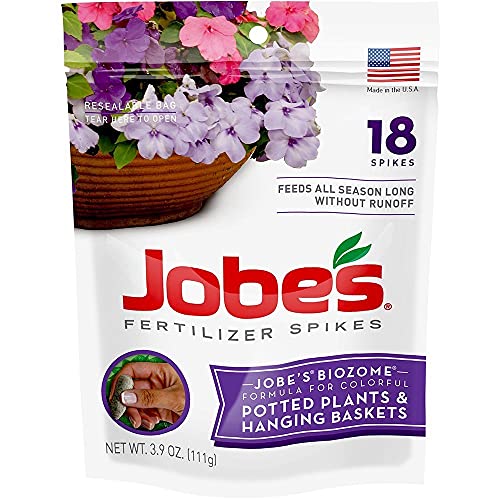
The set-and-forget spike that kept one gardener’s plants looking beautiful into mid-August.
With an 8:9:12 NPK ratio, this slow-release spike formula delivers slightly more potassium than nitrogen — an edge for flower production in potted and hanging basket plants. You simply push a spike into the soil at the pot edge, away from the main stalk, and the nutrients release over eight weeks. One reviewer noted using one tab per pot (two for pots over 20 inches) each month, and 90% of their outdoor potted plants looked beautiful into the middle of August. The 36-count pack is enough for a solid season on a modest collection.
Compared to the Jobe’s 10:10:4 Spikes (54 Count), this formula is 8:9:12 versus 10:10:4, making it more targeted for bloom-heavy baskets like petunias and fuchsias. Reviewers specifically note that spikes last approximately two months versus weekly liquid fertilizer, and several call out the no-mess, easy storage as a major convenience. It is 36 spikes versus 72 spikes in the Jobes Biozome pack, so if you have a large number of baskets, you will repurchase sooner.
Why It Works
- No mixing, no measuring, no runoff mess
- Spikes last approximately two months per application
- Customers note 90% of potted plants stayed beautiful through August
Consider This
- Some petunias may need a mid-season trim despite the feeding
Best for: gardeners with a medium-sized basket collection who want a simple, reliable routine.
Skip if: you have a very large number of baskets and want to avoid repurchasing mid-season.
4. Jobe’s Fertilizer Spikes for Flowering Plants (54 Spikes)
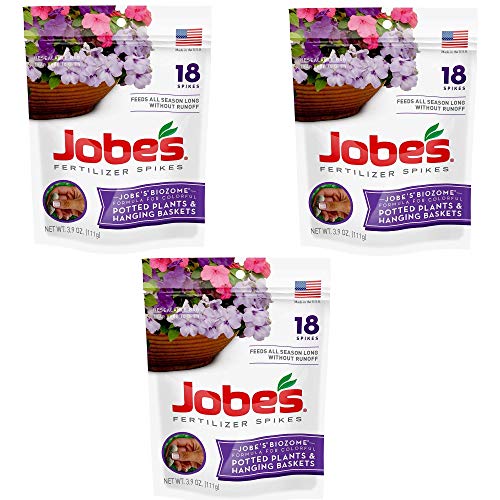
The spike that one buyer says “makes a difference in your potted flower displays by bringing on the blooms and keeping them coming.”
With a 10:10:4 NPK ratio, this spike formulation trades some potassium for more nitrogen and phosphorus compared to the 8:9:12 formula above. The higher phosphorus (the middle number) pushes root and bloom development, while the 10% nitrogen keeps foliage a rich green. It targets specific basket favorites: begonias, fuchsia, lobelia, petunia, and creeping jenny. One buyer specifically called out that only two applications all summer were needed for excellent results.
At 54 spikes weighing 12.42 ounces, this is a larger quantity than the 36-count 8:9:12 pack but has fewer spikes than the Jobes Biozome 72-pack. The spikes are easy to insert around the plant’s dripline with no mixing or runoff. One buyer mentioned it worked great on a non-blooming Bougainvillea, while another said they used them on indoor plants and are just waiting for spring in Colorado. The only real difference from the other Jobe’s spike option is the ratio — this one leans equally on nitrogen and phosphorus, making it a touch more balanced for all-around growth versus bloom-specific feeding.
Strong Points
- 54 spikes cover a large basket collection with just two applications all summer
- Reviewers point out it works on non-blooming plants like Bougainvillea
- No waste, no runoff, no hazard around pets or kids
One Detail
- The 10:10:4 ratio is slightly less bloom-focused than 8:9:12 formulas
Reach for this: if you have many different types of flowering plants and want a single spike that handles them all.
Not for: gardeners who prefer a higher-potassium ratio for intense bloom production.
5. Fertilome Geranium Hanging Basket and Pansy Plant Food (1.5 lb)

The highly concentrated powder that buyers claim produced the neighborhood’s most blooms.
This fertilizer uses a balanced 20-20-20 formula — the same ratio as the Fertilome All Purpose above — but is branded specifically for geraniums, pansies, and hanging baskets. The difference is in the concentration and the recommended use as a soil drench. One buyer posted photos showing dramatic petunia growth in just 3 days, and specifically noted that the balanced 20-20-20 outperformed Miracle-Gro for leaves, flowers, and roots. Another said the small container lasts a surprisingly long time at 2 tablespoons per gallon.
At 1.5 pounds, this is half the size of the 3-pound all-purpose bag, but the same essential formula. The key difference is that this product targets basket-specific plants, whereas the larger bag is labeled more broadly. Reviewers also mention using it alongside other products from the same brand to alternate between bloom and root fertilizers. The powder form is water-soluble, so it works fast — but you do need to collect the drain-off if you want to use the runoff on other plants, which one buyer recommends as a smart practice.
What Makes It Special
- Buyer photos show dramatic petunia growth in just 3 days
- Highly concentrated — 2 tbsp per gallon goes a long way
- Outperformed Miracle-Gro for leaves, flowers, and roots per one review
Limitation
- 1.5-pound bag is smaller than the 3-pound all-purpose version of the same formula
Buy this: if you want a fast-acting, proven formula for petunias and pansies that shows results in days.
Consider the larger bag: if you plan to feed many baskets all season long.
6. Fertilome (12140) Garden Cote Fertilizer 12-12-12 (1 lb.)
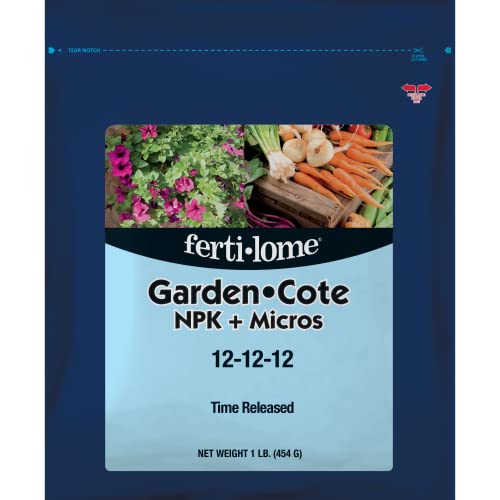
The granular feed that buyers call “amazing” — as soon as it hit the soil, grapes and roses started producing buds within a week.
With an equal 12:12:12 NPK ratio, this granular formula provides a balanced diet for flowers, vegetables, and hanging baskets. The key difference from the other Fertilome products is that Garden Cote releases micronutrients through moisture and soil temperature — so it does not dump everything at once. You mix it into the top 1 to 3 inches of soil, then water it in. One very satisfied buyer reported that as soon as they put it on their grapes and roses, both started producing buds and fruits within a week, calling it “exactly what my plants needed.”
Weighing 16 ounces, this bag is exactly the same weight as the Espoma liquid (16 ounces) but in granular form. Compared to the Jobe’s 10:10:4 spikes, the ratio is 12:12:12 versus 10:10:4, which is an advantage for flower production. The trade-off is that granules require mixing into the soil rather than a simple push-in. Several buyers mention buying this product dozens of times, which speaks to its consistency for lazy gardeners who just fertilize when they water.
What Shines
- Moisture and temperature-activated release for gradual feeding
- Shoppers say bud and fruit production within one week of application
- 12:12:12 ratio gives you 12 phosphorus versus 9 in the 8:9:12 Jobe’s formula
Watch Out For
- Requires mixing into topsoil — more effort than spikes
Perfect for: gardeners who want a balanced, slow-release granular feed that works for both flowers and vegetables.
Not for: anyone who wants a no-mix, push-and-forget spike system.
7. Espoma Organic Bloom! 16-Ounce Concentrated Plant Food (1-3-1)

The organic liquid that made one buyer’s zinnias, gardenias, and hydrangeas significantly more vibrant.
With a 1-3-1 fertilizer analysis, this liquid concentrate is very low in nitrogen and high in phosphorus — a classic bloom-booster formula that pushes flowers rather than foliage. It is approved for organic gardening, made from natural proteins enhanced with kelp extracts and humic acids. The mixing instructions are simple: one capful per gallon of water for a soil drench, and the manufacturer recommends feeding every 2 to 4 weeks throughout the growing season. Buyers report that it significantly improved flower vibrancy and beauty across zinnias, gardenias, geraniums, azaleas, and hydrangeas.
At 16 fluid ounces, this bottle is small — and several owners mention that it does not last very long if you have a large garden. One owner with a 15,000-square-foot lot using it twice monthly wishes larger sizes were available. It also has a pungent odor, which multiple buyers mention, so you will want to wear gloves when mixing. Unlike the slow-release spikes above, this requires regular reapplication, but it is the only 100% organic option in this lineup and the only liquid concentrate that targets blooming specifically with a 1-3-1 ratio.
Key Advantages
- Approved for organic gardening — no synthetic ingredients
- High-phosphorus 1-3-1 formula targets bloom production
- Customers note significantly improved vibrancy in flowers
Downsides
- Small bottle does not last long for large gardens
- Pungent smell when mixing, per multiple buyer reports
Go with this: if organic certification matters to you and you have a modest number of baskets to feed.
Choose something else: if you need a large volume of fertilizer or prefer an unscented product.
Understanding the Specs
NPK Ratio
The three numbers on the label represent the percentage of Nitrogen (N), Phosphorus (P), and Potassium (K) in the fertilizer. For hanging baskets, look for a phosphorus number (the middle digit) that is close to or higher than the nitrogen number — this tells the plant to put energy into flowers and roots rather than just leaves. A balanced formula like 20-20-20 works for general feeding, but a bloom-specific ratio like 8:9:12 or the 1-3-1 in the Espoma Organic Bloom! is more targeted for maximum blooms in baskets.
Slow-Release vs. Water-Soluble
Slow-release fertilizers, which include spikes and coated granules, meter out nutrients over several weeks or months. This is ideal for hanging baskets that are watered frequently, because the nutrients resist leaching. Water-soluble powders or liquids provide an immediate dose and are great for a quick revival or a pre-event bloom push, but they need to be applied every 7 to 14 days. Your choice between the two depends on how often you want to be mixing and measuring versus inserting a spike and walking away.
FAQ
How often should I fertilize my hanging baskets?
What does the NPK ratio mean for my hanging basket flowers?
Can I use lawn fertilizer on my hanging baskets?
Are fertilizer spikes better than liquid for hanging baskets?
How do I use water-soluble fertilizer for hanging baskets?
Will slow-release fertilizer work in hot weather?
Is organic fertilizer better for hanging baskets?
How many fertilizer spikes do I need per hanging basket?
Can I mix different fertilizers together?
Why are my flowers not blooming even with fertilizer?
Final Thoughts: The Verdict
For most people, the fertilizer for hanging baskets winner is the Jobes Biozome 72 Spikes because reviewers point out it doubles flower production even in 95-degree heat, it lasts eight weeks per application, and you get 72 spikes for a full season of coverage. If you want fast-acting, water-soluble feeding that can revive tired plants within hours, grab the Fertilome All Purpose 20-20-20 (3 lb.). And for organic gardeners looking for a pure bloom booster, the Espoma Organic Bloom! 1-3-1 is the best way to get vibrant flowers without synthetic chemicals.
How We Picked
We do not accept paid placement. Every pick is matched to a real buyer and a real use-case; we do not hands-on test units.
Sources & Methodology
Specifications: manufacturer listings and product documentation. Review insights: verified customer reviews, as of July 2026. Pricing: not shown on this page (it changes often); check the current price via the retailer link.
As an Amazon Associate, Lawn Gear Lab earns from qualifying purchases. This does not affect which products we feature.