
Picking the wrong plant food can mean the difference between a bumper crop of juicy tomatoes and a patch of pale, underperforming leaves. The right fertilizer delivers a precise balance of nitrogen, phosphorus, and potassium to fuel strong roots, lush foliage, and, most importantly, prolific fruiting. This guide breaks down the top organic blends and liquid concentrates that actually deliver measurable results.
I’m Rikta — the co-founder and writer behind Lawn Gear Lab. I spend my days dissecting fertilizer NPK ratios, studying soil science data, and cross-referencing hundreds of verified owner reports to find the formulations that produce real, repeatable harvests for home gardeners.
After comparing granular blends, liquid emulsions, and specialty fruit-tree mixes, this analysis of the best fertilizer for fruits and vegetables focuses on the formulations that deliver steady growth without the risk of burning your plants.
How To Choose The Best Fertilizer For Fruits And Vegetables
Selecting the wrong fertilizer can stall growth, burn roots, or produce all leaves and no fruit — so understanding what each formula actually does is essential before you buy.
Decoding the NPK Ratio for Edible Crops
The three numbers on the bag represent nitrogen (N), phosphorus (P), and potassium (K). For fruiting vegetables and fruit trees, a higher middle number (phosphorus) encourages bloom and fruit set, while a balanced or slightly lower first number (nitrogen) prevents excessive leafy growth at the expense of fruit. A formula like 5-7-3 or 4-6-2 is generally ideal for tomatoes, peppers, and squash.
Granular vs. Liquid: Feeding Frequency and Soil Impact
Granular organic fertilizers like those from Down To Earth and Espoma release nutrients slowly over weeks, feeding soil microbes and building long-term fertility with a single monthly application. Liquid fish emulsions, by contrast, deliver a quick nitrogen boost that is absorbed immediately through roots and leaves, but they require reapplication every two to three weeks during the growing season.
The Role of Calcium and Mycorrhizae
Blossom end rot — that black, sunken spot on the bottom of tomatoes — is caused by a calcium deficiency during rapid fruit development. A fertilizer that includes calcium, such as the FoxFarm Happy Frog Tomato & Vegetable formula, directly addresses this problem. Mycorrhizal fungi, also found in many premium blends, form a symbiotic relationship with plant roots to dramatically improve water and nutrient uptake.
Quick Comparison
On smaller screens, swipe sideways to see the full table.
| Model | Category | Best For | Key Spec | Amazon |
|---|---|---|---|---|
| FoxFarm Happy Frog Tomato & Vegetable | Granular Organic | Tomatoes & heavy feeders | 5-7-3 NPK with Mycorrhizae | Amazon |
| Down To Earth All Purpose Mix | Granular Organic | All-around garden fertility | 4-6-2 NPK, OMRI Listed | Amazon |
| FoxFarm Happy Frog Fruit & Flower | Granular Organic | Fruit trees & flowering crops | 4-9-3 NPK for bloom support | Amazon |
| Espoma Garden-tone | Granular Organic | Cool & warm season veggies | 3-4-4 NPK with Bio-tone | Amazon |
| Down To Earth Fruit Tree Mix | Granular Organic | Backyard orchard trees | 6-2-4 NPK with Calcium | Amazon |
| Alaska Fish Fertilizer | Liquid Organic | Quick nitrogen boost | 5-1-1 NPK, OMRI Listed | Amazon |
| The Grow Co Fish Emulsion | Liquid Organic | General garden & foliar feeding | 2-3-1 NPK, 1 Gallon | Amazon |
In‑Depth Reviews
1. FoxFarm Happy Frog Tomato & Vegetable Fertilizer

This 4-pound granular formula delivers a 5-7-3 NPK ratio specifically calibrated for vigorous feeders like tomatoes, peppers, and berries. The elevated phosphorus content directly supports bloom initiation and fruit set, while the added calcium targets the root cause of blossom end rot — a common frustration for tomato growers.
The inclusion of mycorrhizal fungi sets it apart from cheaper blends. These beneficial organisms colonize root systems to increase the surface area for water and nutrient absorption, effectively helping plants extract more from the surrounding soil. Users consistently report rapid results, with tomato plants producing baby fruit just days after application.
It carries no strong chemical or fishy odor, making it a practical choice for container gardens on patios or near the house. The granules are easy to work into the top layer of soil, and the blend is safe enough that it won’t burn plants when applied according to the label rates.
What works
- High phosphorus ratio drives exceptional fruit production
- Added calcium prevents blossom end rot effectively
- Mycorrhizae improve root efficiency and nutrient uptake
What doesn’t
- Priced at a premium compared to basic vegetable foods
- 4-pound bag may require multiple purchases for large gardens
2. Down To Earth All Natural Organic All Purpose Mix

This 5-pound box of granular organic fertilizer uses a 4-6-2 formula built from fish bone meal, blood meal, feather meal, rock phosphate, langbeinite, greensand, humates, and kelp meal. It is essentially a pantry of soil amendments in a single box, simplifying organic gardening by replacing the need for fifteen separate products.
OMRI listing confirms it is suitable for certified organic production. The gentle, non-burning nature of the formula makes it safe for transplants and container plants, where synthetic fertilizers can easily cause root damage. A five-pound bag reportedly lasts roughly two years for an average home gardener, making it an exceptional long-term value.
The one notable trade-off is the natural odor — a result of the fish and feather meal content. Multiple users note the smell is unpleasant for a few days after application but dissipates completely once watered into the soil. For outdoor vegetable beds, this is a minor inconvenience for the soil-building payoff.
What works
- Replaces a shelf of amendments with one box
- Slow-release formula lasts an entire season without burning
- OMRI listed and rich in microbial food sources
What doesn’t
- Strong organic smell for the first few days after application
- Coverage per box may be limited for large row-crop gardens
3. FoxFarm Happy Frog Fruit & Flower Fertilizer

Where the standard Happy Frog tomato blend focuses on balanced feeding, this 4-9-3 variant is optimized specifically for heavy flowering and fruit development. The significantly higher phosphorus content (the middle number) provides the energy plants need to produce abundant buds, making it a strategic choice for fruit trees, berry bushes, and flowering crops.
The granular form requires no mixing — just sprinkle it around the drip line of fruit trees or onto the soil around vegetable plants. It also contains mycorrhizal fungi to support root efficiency, which is especially valuable for perennial fruit trees that need sustained nutrient access throughout a long growing season.
Users report visible improvements in bloom density on flowering plants and faster recovery for cold-stressed tropical trees like banana plants. The absence of a strong odor is a practical advantage over fish-based formulas when working near outdoor living spaces.
What works
- High phosphorus ratio drives heavy flowering and fruit set
- Low odor and easy dry application with no mixing required
- Effective on fruit trees, tropical plants, and flowering crops
What doesn’t
- Lower nitrogen may not support leafy greens well
- Pricier than general-purpose all-purpose mixes
4. Espoma Organic Garden-tone 3-4-4

Espoma Garden-tone delivers a 3-4-4 NPK analysis enhanced with Bio-tone, a proprietary blend of beneficial microbes and mycorrhizae. The pack includes two 4-pound bags, effectively doubling the coverage at a competitive per-pound rate. It is approved for certified organic production and contains no sludges or synthetic ingredients.
The formula works across both cool-season crops like lettuce and kale and warm-season staples like tomatoes, peppers, squash, and melons. Calcium content at 5% provides an additional buffer against blossom end rot. Application is straightforward — sprinkle around the drip line monthly and water in — with no mixing required.
Long-term users often describe Espoma as their go-to brand, noting that the formula is forgiving enough that accidental over-application does not burn plants. The only complaint is a mild smell typical of organic fertilizers, though it is far less offensive than fish-based alternatives.
What works
- Two-bag pack offers excellent value for the coverage
- Forgiving formula that won’t burn if over-applied
- Bio-tone microbes improve soil health over time
What doesn’t
- Mild organic smell may be noticeable indoors
- 3-4-4 ratio is lower in phosphorus than dedicated bloom foods
5. Down To Earth Organic Fruit Tree Mix 6-2-4

This 5-pound powder formulation is specifically designed for fruiting trees — apples, pears, plums, mangos, pomegranates, and figs — but also works on fruiting canes and shrubs. The 6-2-4 NPK ratio provides higher nitrogen to support canopy growth while maintaining enough potassium for fruit quality and disease resistance.
The addition of calcium carbonate supports proper fruit development and cell wall structure, a critical factor for tree fruits that develop over months. Ingredients include feather meal, fish bone meal, langbeinite, potassium sulfate, alfalfa meal, and kelp meal — all OMRI listed for organic use. The manufacturer notes the fertilizer does not expire if stored in a cool, dry place.
User reports highlight its ability to revitalize trees stressed by cold weather or poor soil. One gardener documented a struggling crabapple that produced healthy leaves and abundant berries after two years of annual applications. The powder form does create some dust during application compared to prilled granules.
What works
- 6-2-4 ratio matches the needs of established fruit trees
- Calcium content supports proper fruit development
- Long shelf life and OMRI listed for organic orchards
What doesn’t
- Powder form can be dusty during handling
- Not ideal as a standalone feed for container vegetables
6. Alaska Fish Fertilizer 5-1-1
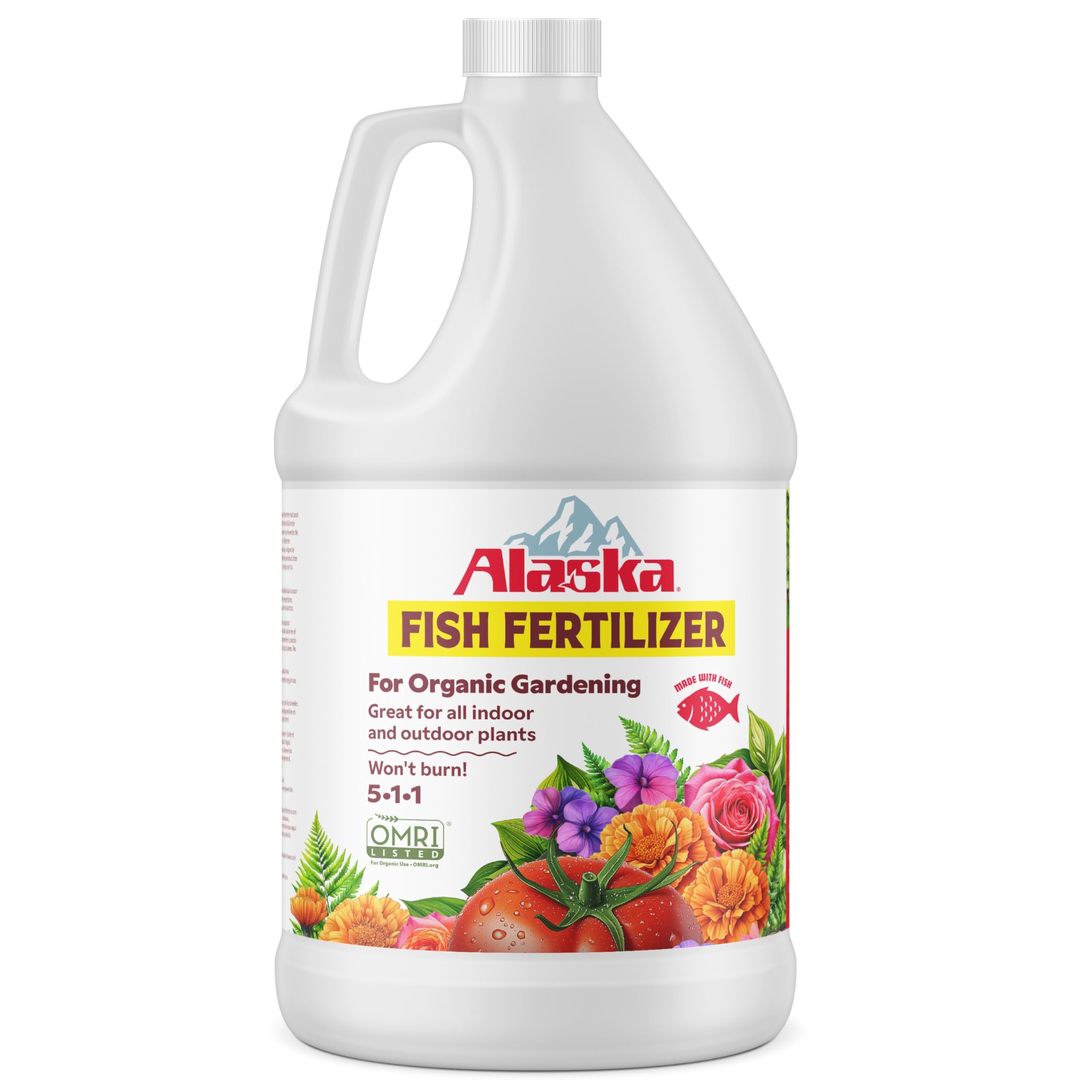
Alaska Fish Fertilizer is a liquid concentrate with a 5-1-1 NPK ratio that delivers a rapid dose of organic nitrogen sourced from cold-pressed fish. The high nitrogen content makes it ideal for the vegetative growth phase of leafy greens, herbs, and early-season vegetables where lush foliage is the goal.
OMRI listing confirms organic compliance, and the formula is gentle enough not to burn plants when diluted according to the label. Users with over a decade of experience report it as a garden staple for promoting strong stems and deep green foliage across vegetables, fruits, trees, and container plants. The recommended schedule is every three weeks during the growing season.
The primary drawback is the fishy smell that accompanies mixing and application. While the odor typically dissipates within a day after watering, it is strong enough to be off-putting for indoor or enclosed-space use. Some users note that for flowering and fruiting stages, a phosphorus supplement may be needed due to the low 1% phosphorus content.
What works
- Fast-acting organic nitrogen for leafy growth
- OMRI listed and safe for organic gardening
- Large container provides good coverage per bottle
What doesn’t
- Strong fish odor during mixing and application
- Low phosphorus limits bloom and fruit production alone
7. The Grow Co Organic Fish Emulsion 2-3-1

This hydrolyzed fish emulsion from The Grow Co uses a 2-3-1 NPK ratio that tilts slightly toward phosphorus, making it a better match for flowering and fruiting than standard high-nitrogen fish formulas. The gallon-sized bottle provides a large volume of concentrate that dilutes significantly — a little goes a long way across a medium-sized garden.
The manufacturing process uses sustainably sourced whole fish, cold-pressed to retain amino acids and micronutrients. It works both as a soil drench and a foliar spray, offering flexibility for gardeners who want to feed through leaves during active growth. Experienced users with decades of organic gardening experience confirm the formula produces strong, vigorous plants when applied weekly and watered in afterward.
The trade-off is the pungent fish aroma. The manufacturer makes no apology for this — they state plainly that if it doesn’t smell like fish, it isn’t real. The smell does fade after the soil dries, but it is a factor for anyone gardening near open windows or entertaining spaces. The thinner consistency means it does not cling to containers the way some thicker emulsions do.
What works
- 2-3-1 ratio is better for fruiting than standard fish formulas
- Large gallon bottle offers excellent volume per purchase
- Versatile as soil drench and foliar spray
What doesn’t
- Strong fish smell during and after application
- Thin consistency may require more frequent application for best results
Hardware & Specs Guide
NPK Ratio Explained
The three-number ratio on any fertilizer bag represents the percentage by weight of nitrogen, phosphorus, and potassium. For fruit and vegetable production, a ratio with a middle number equal to or higher than the first (e.g., 4-6-2 or 5-7-3) encourages bloom initiation and fruit set rather than just leaf growth. Granular organics typically have lower numbers but release more slowly over weeks, while liquid concentrates have higher numbers that are immediately available.
Granular vs. Liquid Formulation
Granular fertilizers (like Down To Earth and Espoma) are applied dry to the soil surface and require water to activate. They feed soil microbes and build long-term fertility with monthly applications. Liquid fertilizers (like Alaska and The Grow Co) are mixed with water and applied as a soil drench or foliar spray. They provide an immediate nutrient boost but require reapplication every 2-3 weeks.
The Role of Mycorrhizae and Calcium
Premium organic blends often include mycorrhizal fungi, which form a symbiotic network with plant roots to dramatically increase the surface area for water and mineral absorption. Calcium, listed as a percentage on the label, is essential for cell wall development and directly prevents blossom end rot in tomatoes and peppers. Look for at least 5% calcium in any formula meant for fruiting vegetables.
OMRI and Organic Certification
OMRI (Organic Materials Review Institute) listing means the product has been reviewed and approved for use in certified organic production. This is important for gardeners who want assurance that no synthetic pesticides, GMOs, or prohibited additives are present in the formula. All products reviewed in this guide carry OMRI listing, confirming their suitability for organic gardening.
FAQ
What does the NPK ratio mean for my tomato plants?
Is it better to use granular or liquid fertilizer for vegetables?
How do I prevent blossom end rot on my tomatoes?
Final Thoughts: The Verdict
For most gardeners, the fertilizer for fruits and vegetables winner is the FoxFarm Happy Frog Tomato & Vegetable because its balanced 5-7-3 NPK ratio with added calcium and mycorrhizae directly addresses the two biggest problems in home vegetable gardening: low fruit yield and blossom end rot. If you want a budget-friendly, long-lasting granular option, grab the Espoma Garden-tone 2-Pack. And for an organic liquid boost that perks up plants within days, nothing beats the Alaska Fish Fertilizer.