
Specs are compiled from manufacturer listings and verified buyer reviews and can change over time — please confirm the key details on the product page before buying.
If your fruit plants look leafy but give you almost no fruit, or if your tomatoes get that sunken black spot on the bottom, the problem is almost always the fertilizer you are using. The wrong ratio can give you a bushy plant with nothing to harvest, while the right one turns a single sprig into what one buyer described as a “tomato-producing tree.”
I’m Rikta — the founder and writer behind Lawn Gear Lab. This guide is built by comparing the manufacturers’ published specifications and the patterns across verified customer reviews, so you get each pick’s real strengths and trade-offs instead of marketing spin.
Whether you are nursing a potted Meyer lemon on the patio or feeding a row of blueberries, this guide to the best fertilizer for fruit plants breaks down the formulas, the real buyer feedback, and the exact situation each product handles best.
Our Picks at a Glance


How To Choose The Best Fertilizer For Fruit Plants
Picking the right fertilizer for your fruit plants depends on matching the NPK numbers (nitrogen, phosphorus, potassium — the three big nutrients plants need) to what your plant needs right now. The three numbers on the bag — nitrogen (N), phosphorus (P), and potassium (K) — each do a different job. Too much nitrogen gives you a giant leafy bush with barely any fruit. Too little potassium and the fruit stays small and bland.
Match the NPK to the plant stage
For leafy growth before flowering, a higher first number (like a 12-10-10) works well. Once your plant starts forming buds and fruit, you want a higher middle number (like 5-7-3) to support blooming and fruit set. For long-term tree health and fruit quality, a balanced or potassium-heavy formula (like 3-5-5 or 6-2-4) helps the fruit ripen properly and strengthens the plant’s resistance to stress.
Granules vs spikes vs powders
Granular fertilizers like most of these picks are the easiest to use — you sprinkle them on the soil and water them in. Spikes (like the Jobe’s option) are pre-measured and release nutrients slowly over weeks, which means you cannot mess up the amount. Powders need mixing but are often the most concentrated option per pound.
Organic vs synthetic
Organic fertilizers (most picks here) feed the soil microbes along with the plant, which leads to healthier root systems over time. They release nutrients more slowly, so they are harder to overdo. Synthetic fertilizers give a faster green-up but can burn roots if you apply too much and do not improve soil structure long-term.
Quick Comparison
| Model | Best For | NPK Ratio | Form | Weight | Amazon |
|---|---|---|---|---|---|
| FoxFarm Happy Frog Tomato & Vegetable★ Best Overall | Blossom end rot prevention | 5-7-3 | Granules | 4 lb | Amazon |
| Down To Earth Fruit TreeBest Value | Long-term orchard health | 6-2-4 | Powder | 5 lb | Amazon |
| Espoma Organic Citrus-Tone | Citrus trees | 5-2-6 | Granules | 4 lb | Amazon |
| Jobe’s Organics Fruit & Citrus Spikes | Container trees | 3-5-5 | Spikes | 6 spikes | Amazon |
| FoxFarm Happy Frog Fruit & Flower | Tropical fruit plants | — | Granules | 4 lb | Amazon |
| Espoma Berry Tone | Blueberries and raspberries | 4-3-4 | Granules | 4 lb | Amazon |
| Nelson NutriStar Citrus & Avocado | Quick green-up | 12-10-10 | Granules | 4 lb | Amazon |
In‑Depth Reviews
1. FoxFarm Happy Frog Tomato & Vegetable Fertilizer
Our pick — over 4.5★ from 600+ verified ratings; the strongest balance of quality and price.
The one that stops blossom end rot cold while turning cherry tomato plants into fruit factories.
This is the fertilizer that solves the most common heartbreak of tomato and pepper growers — blossom end rot (a black, sunken spot on the bottom of the fruit caused by a calcium shortage). The 5-7-3 mix includes calcium, and its phosphorus ratio (7) is 67% higher than the 3-5-5 Jobe’s spikes, so it strongly supports flower and fruit development. According to buyers, this stuff turned a “tiny cherry tomato sprig into a tomato-producing tree.”
The granules also contain mycorrhizal fungi (a beneficial root fungus that helps roots pull more water and nutrients from the soil). You sprinkle it on the soil, water it in, and it works for all vigorous feeders including tomatoes, peppers, berries, and leafy greens. At 4 lb per bag, one application covers a solid patch of garden. At 4.8 out of 5 stars from 625 reviews, it is the top-rated pick here.
What puts it ahead
- Calcium in the formula prevents blossom end rot before it starts
- Mycorrhizal fungi improves root efficiency and water uptake
- Top-rated at 4.8 out of 5 from 625 reviews
What to keep in mind
- Formulated specifically for vigorous feeders — lighter feeders get too much nitrogen
- Not ideal for citrus trees that need a lower first number
Grab this if: you grow tomatoes, peppers, or berries and want to stop blossom end rot before you ever see it.
Look elsewhere if: you are feeding container citrus or established fruit trees that need a lower-nitrogen formula.
2. Down To Earth Fruit Tree Fertilizer 6-2-4
The 5-pound box that revitalizes cold-damaged trees and feeds everything from apples to figs.
You get a full 5 pounds here — a pound more than most other granular options — making it the best value in terms of raw material per bag. The 6-2-4 mix has added calcium (calcium carbonate is listed in the ingredients) for proper fruit development, plus langbeinite (a natural mineral that supplies potassium and magnesium) and kelp meal for trace minerals. Buyers report that even trees hit by a cold frost “are coming back to life” after using this.
This is a powder, not granules, so it blends into the soil quickly with no harsh synthetic smell. It is OMRI listed (approved for certified organic production by the Organic Materials Review Institute). The ingredients list is all natural — feather meal, fish bone meal, alfalfa meal — and the maker claims it does not expire if stored in a cool, dry place.
Why it stands out
- Largest volume at 5 lb for the price tier
- Added calcium for fruit development prevents common issues
- OMRI listed for certified organic gardens
Its trade-off
- Powder form can be dusty during application compared to granules
- Lower phosphorus number (2) means less bloom support for heavy-fruiting plants
Reach for this if: you have multiple fruit trees (apples, pears, plums) and want a single bag that covers all of them organically.
Pass if: you need a bloom-booster for container plants that need high phosphorus right now.
3. Espoma Organic Citrus-Tone 5-2-6

The 5-2-6 formula that feeds Meyer lemons, limes, and avocado trees without any mixing.
Citrus trees need a lower nitrogen, higher potassium mix to produce juicy fruit with good flavor, and that is exactly what the 5-2-6 ratio delivers. The potassium (the last number) is higher than the nitrogen, which helps fruit ripen evenly and improves cold tolerance in the tree. One reviewer noted “the best I’ve found for citrus,” while another noted it works on strawberries and raspberries too — “good results.”
This is a ready-to-use granular formula — no mixing required — that you apply around the drip line of the tree and water in. It also contains 5% calcium, which supports trunk and limb strength. The one real catch: owners mention it has a strong odor. One review mentioned it is “very smelly… definitely use outdoors only” and that dogs are attracted to the smell. The odor fades after about a week.
Where it excels
- Potassium-heavy 5-2-6 ratio is perfect for citrus fruit quality
- Approved for organic gardening with no mixing needed
- Calcium added for stronger tree structure
The honest catch
- Strong smell for the first week — use outdoors only
- Not ideal for in-ground apple or pear trees that need more phosphorus
Best for: dedicated citrus growers who want a bagged granular that targets the exact NPK citrus trees need.
Skip if: you are sensitive to fertilizer odors or feeding indoor trees where the smell could linger.
4. Jobe’s Organics Fruit & Citrus Spikes 3-5-5

The pre-measured spikes that release 3-5-5 nutrients right at the roots — no scooping, no guessing.
If you have ever over-fertilized and burned a plant’s roots, these spikes are your solution. Each spike is pre-measured with a 3-5-5 time-release formula, so you just push them into the soil around your tree and they break down slowly over the season. Customers note getting “an abundance of juicy, sweet lemons every year” from their potted Meyer lemon trees using these.
The formula includes Jobe’s Biozome, a proprietary archaea microorganism (a type of ancient microbe) that helps break down the fertilizer faster in the soil. This also improves drought resistance and disease resistance in the tree. The spikes are OMRI listed for organic gardening. One buyer did note that spacing matters — place them too close to the trunk and you get less effect, but follow the package directions and they work well.
Why these work
- Zero mess — no scooping, no dust, no measuring
- Time-release prevents root burn from over-application
- Organic with Biozome for faster soil breakdown
The limitation
- Only 6 spikes per package — you may need multiple boxes for a grove
- Cannot adjust the dose per plant like loose granules
Choose this if: you have a few potted fruit trees and want the simplest, most simple to use feeding method available.
Pass if: you have many in-ground trees and need a bulk granular option that covers more ground per dollar.
5. FoxFarm Happy Frog Fruit & Flower Fertilizer

The bloom-boosting granular that revived struggling banana trees and keeps flowering plants vibrant.
This FoxFarm blend focuses on supporting abundant flowering and fruit set rather than general leafy growth. Its rich phosphorus content (the middle number) is what drives bloom formation, making it a strong choice for plants that are already established but not producing fruit. One buyer shared that their “banana trees were really struggling after a cold winter at the gulf” and that this product “worked perfectly” to jump-start new growth.
It contains mycorrhizal fungi for root health and has no strong odor, which buyers appreciated even when applying near the house. Like the other FoxFarm product, it is OMRI listed for organic gardening. Use it on fruit trees, flowering bushes, and tropical plants once a month and let irrigation handle the rest. The target species listed are flowering plants and fruit trees, so it is more general than a citrus-specific product but less targeted than a tomato fertilizer.
What makes it useful
- High phosphorus supports bloom and fruit set in established plants
- No strong smell — comfortable to use even near patios
- Mycorrhizal fungi boosts root nutrient absorption
Where it falls short
- Exact NPK ratio is not published on the product data — hard to compare precisely
- Not ideal for plants still in the vegetative growth stage
Reach for this if: you have tropical fruit plants (bananas, mangos) or flowering shrubs that need a bloom-phase boost.
Pick something else if: you need a specific NPK number you can verify and compare against other options.
6. Espoma Berry Tone 4-3-4
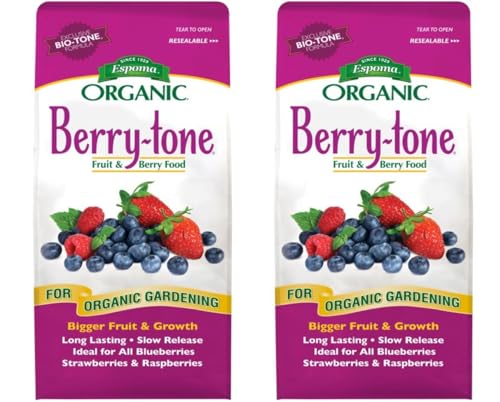
The sulfur-enriched 4-3-4 that turned one blackberry bush into a syrup-making operation.
Berries, especially blueberries and raspberries, need a different balance than other fruit plants — they prefer a slightly acidic soil environment with sulfur. This 4-3-4 formula includes 5% sulfur to help maintain that acidity, and reviewers point out dramatic results. One buyer mentioned they were “drowning in blackberries, making syrups and desserts for most of the season” after using this, and when they skipped a year, their bush barely flowered.
The granules are ready to use with no mixing. Apply twice a year — early spring and late spring — for established berry bushes. It is approved for organic gardening and made by Espoma, the same company behind Citrus-Tone. For blueberries specifically, one owner reported “I have the most incredible amount of berries on each of the blueberry bushes. I swear by this.”
Why berry growers love it
- 5% sulfur maintains the acidic soil blueberries need
- 4-3-4 ratio is specifically formulated for berry plants
- Organic and ready to use with no mixing
The honest catch
- Not suitable for citrus or regular fruit trees — the sulfur content is too specific
- Only 4 lb per bag and you apply twice a year, so it goes fast with multiple bushes
Best for: anyone with blueberry, raspberry, strawberry, or blackberry bushes who wants an organic formula that targets their specific soil needs.
Skip if: your garden is mostly fruit trees or citrus that would not benefit from the added sulfur.
7. Nelson NutriStar Citrus & Avocado 12-10-10
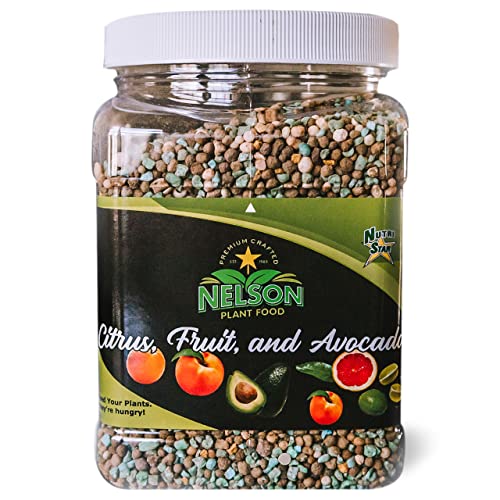
The 12-10-10 high-nitrogen formula that gave an orange tree a full set of new leaves in two months.
This is the highest-nitrogen option on this list at 12-10-10, which makes it the go-to for trees that are looking pale, struggling after transplant, or recovering from winter damage. The high potassium content (10) also helps trees survive colder weather by strengthening cell walls. One customer observed their “orange tree has taken off and grown a full batch of new leaves” after just two months of use.
Nelson’s NutriStar formula includes calcium for trunk and limb strength, and it works for a very wide range of fruit trees: oranges, lemons, avocados, limes, kumquats, grapefruits, persimmons, figs, peaches, plums, pears, apples, and even grapes and kiwis. Apply every 30 days during the growing season. It is not organic, so if you need OMRI certification, look at the Down To Earth or Jobe’s options instead.
Where it shines
- 12-10-10 gives a fast visible green-up for struggling trees
- High potassium helps fruit trees survive cold snaps
- Works on a huge range of fruit and nut trees
What holds it back
- Not organic — synthetic formula may not suit organic gardeners
- High nitrogen can reduce fruit set if used late in the season
Grab this if: your fruit trees look pale or are recovering from cold damage and you want fast, visible results.
Pass if: you practice organic gardening and need an OMRI-listed option for your orchard.
Understanding the Specs
NPK Ratio
These three numbers tell you the percentage of nitrogen (N), phosphorus (P), and potassium (K) in the bag by weight. Nitrogen drives leafy green growth, phosphorus supports flowering and fruit set, and potassium helps fruit ripen and strengthens the plant’s overall health. For fruit plants, you generally want the middle and last numbers to be close to or higher than the first number once the plant is established — too much nitrogen and you get leaves instead of fruit.
Mycorrhizal Fungi
This is a beneficial fungus that lives in the soil and attaches to plant roots. It acts like an extension of the root system, helping the plant pull more water and nutrients (especially phosphorus) from the soil. Not all fertilizers include it, but when present (like in both FoxFarm Happy Frog products), it can reduce how much fertilizer you need to apply over time.
FAQ
What NPK ratio is best for fruit plants?
Can I use tomato fertilizer on fruit trees?
How often should I fertilize fruit plants?
What is the difference between spikes and granular fertilizer?
Do I need organic fertilizer for fruit plants?
Will these fertilizers work on potted fruit trees?
How long do granular fruit fertilizers last in the bag?
What is blossom end rot and how do I prevent it?
Can I use berry fertilizer on citrus trees?
Is the Nelson 12-10-10 organic?
Final Thoughts: The Verdict
For most buyers, the fertilizer for fruit plants winner is the FoxFarm Happy Frog Tomato & Vegetable Fertilizer because its 5-7-3 ratio with added calcium prevents the most common fruit-growing problems while mycorrhizal fungi improve root health over the long run. If you want a no-mess solution for container trees, grab the Jobe’s Organics Fruit & Citrus Spikes. And for dedicated berry growers, the standout is the Espoma Berry Tone 4-3-4 for the bushels of fruit it produces.
How We Picked
We do not accept paid placement. Every pick is matched to a real buyer and a real use-case; we do not hands-on test units.
Sources & Methodology
Specifications: manufacturer listings and product documentation. Review insights: verified customer reviews, as of July 2026. Pricing: not shown on this page (it changes often); check the current price via the retailer link.
As an Amazon Associate, Lawn Gear Lab earns from qualifying purchases. This does not affect which products we feature.