
Specs are compiled from manufacturer listings and verified buyer reviews and can change over time — please confirm the key details on the product page before buying.
Yellowing leaves or leaf drop often signal a fertilizer deficiency. You need the right nutrients in the right balance — and this guide picks the formulas that actually produce bigger leaves, stronger roots, and deep green color.
This guide compares manufacturers’ published specs and verified customer reviews to highlight each pick’s real strengths and trade-offs.
Every ficus — tall Ficus lyrata (fiddle leaf fig) or classic Ficus benjamina (weeping fig) — needs a dedicated fertilizer for ficus trees that matches their 3-1-2 NPK hunger (3% nitrogen, 1% phosphorus, 2% potassium) without burning roots. Here are the products that earn their spot in your watering routine.
Our Picks at a Glance


How To Choose The Best Fertilizer For Ficus Trees
Choosing the right plant food starts with understanding the NPK ratio, fertilizer form, and micronutrients your ficus needs. Here is what matters most.
Start with the 3-1-2 NPK Ratio
Ficus trees need high nitrogen to fuel leaf production and maintain deep green color. A 3-1-2 NPK ratio is the established ideal for ficus trees. Products that stray from this balance risk leggy growth, weak stems, or nutrient lockout. Always check the label — generic all-purpose plant food rarely hits this target.
Liquid vs. Powder: Which Form Fits Your Routine?
Liquid fertilizers are the easiest option for ficus feeding. You dilute them in your watering can and feed as you water. They act fast and are less likely to burn roots if you follow the directions, but they run out faster and you have to remember to buy more. Powder concentrates store longer and often make many more gallons of solution per container. They take one extra step — mixing — but tend to be more economical per feeding. Your choice depends on whether you value speed or long-term cost efficiency.
Don’t Overlook Micronutrients
Beyond the NPK numbers, look for a formula that includes calcium, magnesium, and trace minerals like iron, zinc, and manganese. Calcium prevents leaf tip burn and supports cell wall strength, while magnesium keeps chlorophyll production high. A fertilizer that only lists nitrogen, phosphorus, and potassium is incomplete — those secondary nutrients separate a surviving plant from a thriving one.
Quick Comparison
| Model | Best For | NPK Ratio | Form | Bottle Size | Amazon |
|---|---|---|---|---|---|
| Aquatic Arts Ficus Fertilizer★ Best Overall | All-around Ficus food | 3-1-2 | Liquid | 8 fl oz | Amazon |
| Bless Your Soil Fiddle Leaf TreatsAlso Great | High-strength feeding | 12-4-8 | Powder | 8 oz | Amazon |
| TPS Nutrients Ficus Fertilizer | Large bottle value | — | Liquid | 32 fl oz | Amazon |
| FOLLOWIN Ficus Fertilizer | Calcium-rich formula | 3-1-2 | Liquid | 21 fl oz | Amazon |
| Perfect Plants Fiddle Leaf Fig Fertilizer | Beginner-friendly feeding | — | Liquid | 8 fl oz | Amazon |
| GARDENWISE 3-1-2 Concentrate | Budget-friendly concentrate | 3-1-2 | Liquid | 8 fl oz | Amazon |
| TPS Nutrients Tropical Fertilizer | Multi-plant versatility | — | Liquid | 32 fl oz | Amazon |
In‑Depth Reviews
1. Fiddle Leaf Fig Tree Fertilizer by Aquatic Arts
Our pick — 4.6★ from 4,770 verified ratings; the strongest balance of quality and price.
The liquid that turned a five-year struggle into two-week growth.
With over 4,700 ratings and a 4.6-star average, this bottle from Aquatic Arts is among the most trusted options for ficus owners. Its 3-1-2 NPK ratio (3% nitrogen, 1% phosphorus, 2% potassium) is the ideal balance for healthy leaf and root development, and the formula includes calcium and magnesium to help prevent the brown spots and drooping leaves that plague indoor fiddle leaf figs. You dilute just one teaspoon with two cups of water — the manufacturer says an 8 oz bottle can last 6 months to 1 year per tree, making it a very efficient choice for the price tier.
It works across the entire ficus family: Ficus Lyrata, Ficus Audrey, Ficus Elastica (rubber trees), Ficus Benjamina (weeping fig), and more. One buyer reports their ficus had “5 years of slow growth” and after using “2 capfuls diluted in water” saw a new bud sprout within two weeks — the plant produced three sequential inner buds in a layering effect. That kind of recovery story is rare. Another reviewer noted their “bambino fiddle-leaf fig tree” went from sad to thriving after combining this fertilizer with a brighter location.
This includes built-in calcium and magnesium support. The only real caution is not to overdo it — too much can cause nutrient burn, so stick to the weekly or monthly schedule on the label.
Why Owners Keep Buying It
- Proven 3-1-2 ratio with added micronutrients for leaf health
- Safe to use every watering with no burn risk (when diluted correctly)
- Lasts 6-12 months per tree — one teaspoon per feeding
- Works for multiple ficus varieties, not just Lyrata
The One Mistake to Avoid
- Overuse can cause nutrient burn — follow the dilution chart exactly
- Small 8 oz bottle; you will need to reorder sooner than with a concentrate
Best for daily feeders: The most reviewed and most reliable liquid 3-1-2 option for any ficus owner who wants a simple, proven solution with real success stories.
Not for you if: You want a no-mix powder that lasts years, or you need a formula with an ultra-low waste pouch.
2. Fiddle Leaf Fig Plant Food by Fiddle Leaf Treats (Bless Your Soil)
A concentrated powder for strong feeding.
This is not your standard 3-1-2 blend — at a 12-4-8 NPK ratio (12% nitrogen, 4% phosphorus, 8% potassium), Fiddle Leaf Treats delivers the same balanced proportions but in a far more concentrated form. You get a highly concentrated formula, so a little goes a long way. The dry powder (no water weight) comes in a stay-fresh pouch that the maker claims can feed your ficus for up to 2 years, and it reduces plastic waste, so you are saving space and waste at the same time.
The formula is urea-free (uses alternative nitrogen sources that won’t release ammonia and burn roots), so it will not burn roots even when used as directed — one to two teaspoons per gallon is all it takes. It also includes organic sea kelp for naturally occurring phytohormones and amino acids, plus organically bonded minerals for better uptake. Buyers report their fiddle leaf figs produce constant new growth and that guests often compliment how nice the plants look — a clear sign this food is doing its job at a level most competitors struggle to match.
The only trade-off is that you have to mix it yourself, but one scoop makes a full gallon and the formula supports soil, semi-hydroponic, and fully hydroponic setups alike. It is the clear winner if you want maximum strength and longevity.
Peak performance: The most concentrated formula here — a 12-4-8 NPK ratio that is urea-free, kelp-rich, and covers 22 gallons from one 8 oz pouch. Ideal for experienced owners who want the best long-term value.
The adjustment: Not drop-in ready — you mix powder with water yourself. If you prefer grab-and-go liquid, one of the options below fits better.
Reach for this if: You want the strongest, most economical feeding solution for one or multiple ficus trees and do not mind mixing a powder.
Look elsewhere if: You only want a liquid you can pour straight into your watering can with zero prep.
3. TPS Nutrients Ficus Tree Fertilizer (32 oz)
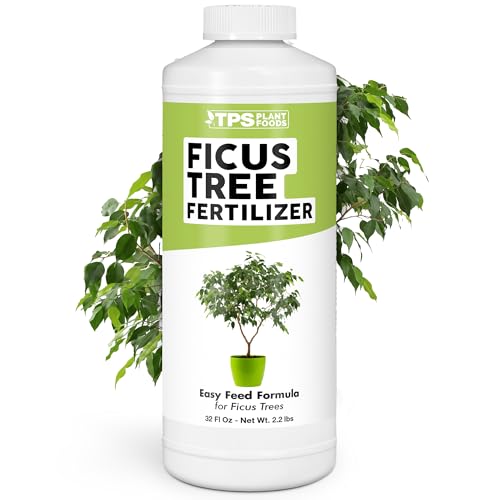
A full quart that revives even a 30-year-old ficus to lush new growth.
At 32 fluid ounces, this is a large liquid bottle — and it is formulated specifically for ficus and indoor fig plants. The mixing instructions are straightforward: two tablespoons per gallon or one teaspoon per quart, giving you a lot of flexibility depending on how many plants you feed. One buyer with a 30+ year old indoor/outdoor ficus tree that stands about 8 feet tall noted that after two months of use, the tree produced “abundant new leaf growth” — a solid sign that this formula supports even the oldest, largest specimens.
Owners mention that their indoor ficus trees grow well and experience no leaf loss when using this as directed. Another owner of a 32-year-old ficus who was worried after repotting and pruning said “no leaf loss over winter, leaves are supple and deep green.” That kind of resilience is exactly what you want in a maintenance fertilizer. It is made in the USA and designed for container-grown, indoor trees, so it fits naturally into homes, offices, and any decorative pot.
This product does not publish a specific NPK ratio on its label, so you are trusting the brand’s ficus-specific formulation rather than a standardized breakdown. For the volume and the price tier, it is a great value if you have multiple ficus plants or a very large specimen that eats through food quickly.
Value-led feeding: The largest liquid volume in the list at 32 oz — great for owners of big, mature ficus trees or multiple pots. Buyers with decades-old plants report deep green leaves and no winter leaf loss.
The unknown: No NPK ratio is listed on the label, which may matter to experienced growers who want a precise 3-1-2 guarantee.
Reach for this if: You have a large or multiple ficus trees and want a cost-effective liquid that shows clear results for older plants.
Look elsewhere if: You need a guaranteed 3-1-2 NPK ratio or prefer a concentrated powder that stores longer.
4. FOLLOWIN Fiddle Leaf Fig Fertilizer (21 fl oz)

The formula that targets yellow leaves with a calcium boost and 21 oz for many months.
FOLLOWIN’s fertilizer stands out by combining the standard 3-1-2 NPK ratio with a notably high calcium content of 1.8% and magnesium at 0.6%, plus seven chelated micronutrients including iron, zinc, copper, and manganese. Chelation is a process that binds these minerals to organic molecules so the plant roots can absorb them directly without the soil chemistry getting in the way. This is especially useful if your ficus shows signs of yellowing leaves or crispy tip burn, which often trace back to a calcium or magnesium shortage.
The concentrated formula makes 98 gallons of plant food from a single 21 fl oz bottle, and the built-in graduated measuring cap eliminates guesswork — you dilute between 0.8 and 1.6 gallons of water per feeding, depending on the schedule. One buyer called it “excellent results, regular new growth” on their 4-year-old fiddle leaf fig, while another noted “HUGE difference” and that their ficus “took out new big beautiful leaves” when used roughly once a week. The product is also EPA-registered for indoor use and urea-free, so it is safe around pets when used as directed.
This formula includes a graduated cap and a full micronutrient profile, which makes it a stronger choice if you are dealing with specific leaf discoloration. On the downside, the foil seal under the cap is a minor nuisance to remove, but the precision it offers for mixing makes up for it.
what separates it
- High calcium (1.8%) and magnesium (0.6%) for yellow leaf correction
- Makes 98 gallons from one bottle — very efficient
- Built-in measuring cap with 5 mL increments for accuracy
- Urea-free and safe for indoor use with pets
Minor Annoyances
- Foil seal under the cap needs careful removal
- Some users note that light and water issues matter more than fertilizer alone
Best for fixing yellow leaves: The calcium-enriched 3-1-2 formula is the most targeted option if your ficus has leaf discoloration, but it still requires proper light and watering habits to work fully.
Not ideal if: You prefer a powder that lasts years, or you already have healthy leaves and just need basic maintenance.
5. Perfect Plants Liquid Fiddle Leaf Fig Fertilizer (8 oz)
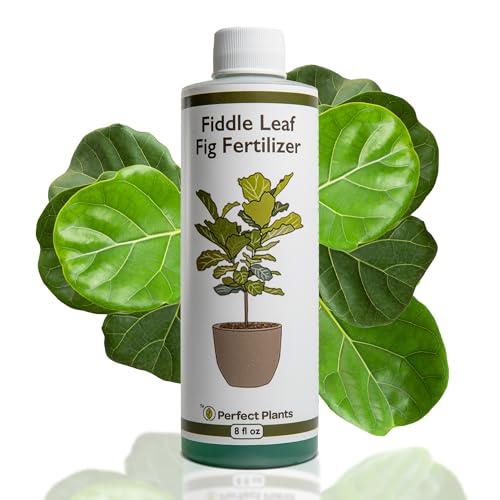
A straightforward concentrated mix that revived a dying fiddle leaf fig.
Perfect Plants offers a no-frills approach — you get an 8 oz bottle of concentrated liquid food with a 1:128 mixing ratio (just a small amount per watering). It is specifically formulated for the Ficus family of houseplants, and the resealable bottle keeps the food effective for months after opening. One buyer wrote, “I’ve only used for two months but it appears to be doing what it needs to keep my beautiful fig tree nourished & healthy,” which captures the steady, predictable performance this product delivers.
Another verified review notes that the fertilizer “revived a dying fiddle leaf fig, stopped leaf drop, stimulated new growth” — a serious claim that aligns with the product’s straightforward formulation. If you are new to ficus care and want something simple that does not require measuring complex ratios or mixing powders, this is a solid entry point. The 8 oz bottle will run out sooner, meaning the 8 oz bottle will run out sooner, but the instructions are clear and the risk of over-fertilizing is low.
Simple and effective: A concentrated liquid with a clear 1:128 mixing ratio and proven results for stopping leaf drop. Great for first-time ficus owners who want a gentle, step-by-step feeding routine.
The catch: The 8 oz bottle is smaller than the FOLLOWIN or TPS offerings, so you will need to reorder more frequently if you feed weekly.
Reach for this if: You are new to fertilizing ficus trees and want a straightforward liquid that helps with leaf drop recovery.
Look elsewhere if: You want a calcium-rich treatment for yellow leaves or a large bottle that lasts many months.
6. GARDENWISE 3-1-2 Liquid Fertilizer Concentrate (8 oz)

The affordable concentrate that perked up a nearly-given-up fiddle plant.
GARDENWISE delivers a solid 3-1-2 NPK liquid concentrate with a 1:128 dilution ratio, meaning two tablespoons of the stuff make a full gallon of ready-to-use fertilizer. That makes an 8 oz bottle very efficient in the same price tier. The formula is enriched with micronutrients aimed at promoting large, glossy leaf development and root vigor. One buyer reports the product “arrived very quickly and is very easy to use,” adding that it “was amazing how quickly my plants responded and started perking up and producing new foliage.” They had nearly given up on one fiddle plant, but after using GARDENWISE, they noticed new leaves budding.
It is designed specifically for Ficus Lyrata and fig trees, but some buyers have used it on chili peppers and vegetables with good results, which hints at a versatile formula. The clear mixing instructions (2 tbsp per gallon) make it beginner-friendly, and the bottle is compact enough to store easily. The drawback is the small 8 oz bottle size — if you have many plants, you will go through it faster than a larger bottle like the TPS 32 oz, but the price point reflects that.
Why It Works for Budget Shoppers
- True 3-1-2 NPK ratio at an accessible price point
- 1:128 dilution makes the small bottle go further than you expect
- Buyers confirm fast response — new foliage visibly budding
The Limitation
- Small 8 oz bottle means regular reordering for heavy users
- Fewer total ratings (34) compared to more established brands
Best for budget-feeding: A true 3-1-2 concentrate that customers note works quickly, even on struggling plants. Perfect if you want the right NPK ratio without paying a premium.
skip it if: You want a large bottle or a formula with added calcium and magnesium for leaf discoloration.
7. TPS Nutrients Tropical Plant Fertilizer (32 oz)
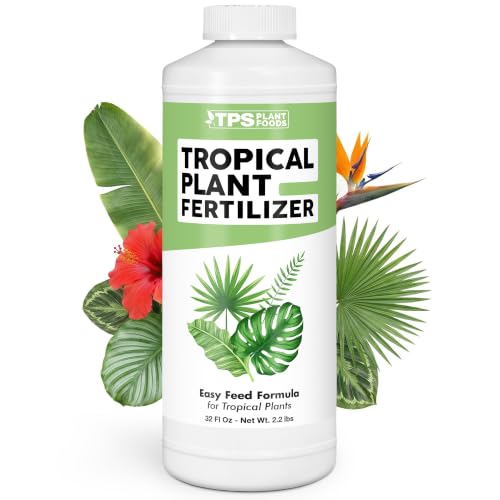
A tropical food that revived a neglected fiddle fig with seven new leaves in a week.
If your collection includes tropical plants beyond just ficus — like Bird of Paradise, Monstera, or palms — this 32 oz liquid from TPS Nutrients covers all of them with one bottle. The recommended mixing ratio provides flexibility depending on the plant’s needs. One buyer who used it on a neglected fiddle leaf fig reported amazing results: “7 new leaves in a week after one feeding.” That is a fast turnaround that suggests the formula is immediately bioavailable.
Another reviewer noted their plants are “thriving” on this food and even bought a second bottle, while a third described it as “my plants favorite food” — mentioning it promotes instant new growth and that the large bottle lasts a long time when using just 1 tablespoon per gallon. It is made in the USA and formulated to boost leaf size, lush growth, and root strength. The downside for strict ficus purists is that, like the other TPS product, this is a general tropical formula rather than a ficus-specific 3-1-2 blend, but the results from buyers speak for themselves.
Versatile powerhouse: A 32 oz liquid that works across tropical species. One reviewer noted 7 new leaves on a neglected fiddle fig in one week. Ideal if you have a mixed collection and want one bottle for all your indoor plants.
The trade-off: Not ficus-specific — the NPK ratio is not published as a tailored 3-1-2 blend, which may matter to growers who want exact numbers.
Reach for this if: You have a variety of tropical houseplants and want one effective food that keeps them all thriving without buying separate bottles.
Look elsewhere if: You insist on a ficus-labeled 3-1-2 ratio with guaranteed micronutrients for leaf discoloration.
Understanding the Specs
NPK Ratio — the Three Numbers on the Label
NPK stands for nitrogen, phosphorus, and potassium — the three macronutrients every plant needs, but in different proportions. For ficus trees, a 3-1-2 ratio (3% nitrogen, 1% phosphorus, 2% potassium) is the ideal balance. Nitrogen drives leaf growth and gives leaves that rich green color. Phosphorus supports root development and flower production (though ficus trees rarely flower indoors). Potassium strengthens the plant’s overall resilience and helps prevent leaf tip burn.
Chelated Micronutrients — What Are They?
Chelation is a natural chemical process that wraps minerals like iron, zinc, and copper in protective organic molecules so plant roots can absorb them directly. Without chelation, many micronutrients get locked up by the soil chemistry and never reach the plant. If you see “chelated” on a fertilizer label, it means the trace elements are ready for immediate uptake — especially helpful if your ficus shows signs of nutrient deficiency like yellowing between the veins of new leaves.
FAQ
What NPK ratio is best for ficus trees?
How often should I fertilize my ficus tree?
Can I use a general all-purpose fertilizer on my ficus?
What does urea-free mean and why does it matter?
How do I know if my ficus needs fertilizer?
Can I use liquid fertilizer on my ficus in water or hydroponics?
What is the difference between liquid and powder fertilizer for ficus?
Why are the leaves on my ficus turning brown at the tips?
Can I use ficus fertilizer on other houseplants?
How long does an 8 oz bottle of liquid fertilizer last for one ficus?
Final Thoughts: The Verdict
Across the board, the fertilizer for ficus trees winner is the Bless Your Soil Fiddle Leaf Treats because its concentrated 12-4-8 powder formula delivers the strongest feeding, lasts the longest, and generates far less plastic waste than liquid bottles. If you want a drop-in liquid that requires no mixing, grab the Aquatic Arts Ficus Fertilizer — its 3-1-2 NPK ratio with added calcium and magnesium has thousands of verified reviews backing its effectiveness. And for owners with a multi-species indoor jungle, the TPS Nutrients Tropical Fertilizer offers a full quart of versatile liquid that reviewers point out revives even neglected plants with impressive speed.
How We Picked
We do not accept paid placement. Every pick is matched to a real buyer and a real use-case; we do not hands-on test units.
Sources & Methodology
Specifications: manufacturer listings and product documentation. Review insights: verified customer reviews, as of July 2026. Pricing: not shown on this page (it changes often); check the current price via the retailer link.
As an Amazon Associate, Lawn Gear Lab earns from qualifying purchases. This does not affect which products we feature.