
Evergreen shrubs hold their foliage year-round, which means they need a steady, targeted supply of nutrients to maintain color, density, and disease resistance through every season. A generic all-purpose fertilizer often delivers the wrong nutrient balance, leading to weak growth or yellowing needles—problems that take months to reverse.
I’m Rikta — the co-founder and writer behind Lawn Gear Lab. I’ve spent countless hours cross-referencing NPK ratios, micronutrient profiles, and soil acidification data alongside thousands of verified owner accounts to pinpoint the formulations that actually deliver measurable results for acid-loving evergreens.
Whether you are tending arborvitae, spruce, juniper, or broadleaf evergreens like rhododendron, this guide breaks down the top contenders to help you find the best fertilizer for evergreen shrubs that fits your specific soil conditions and growth goals.
How To Choose The Best Fertilizer For Evergreen Shrubs
Evergreen shrubs have unique nutritional demands compared to deciduous plants. Their active root systems continue drawing nutrients during dormancy, and they are particularly sensitive to pH imbalances that lock out iron and manganese—resulting in chlorotic yellow needles. Selecting a fertilizer requires matching the NPK profile to the shrub’s growth stage and soil acidity.
NPK Ratio — What Evergreens Actually Need
Evergreens rarely need the high phosphorus (middle number) found in bloom-boosting formulas. A balanced or slightly nitrogen-heavy ratio—such as 4-3-4, 8-4-8, or 19-8-10—supports steady foliage density without pushing soft, pest-prone growth. Ratios exceeding 30-10-10 risk nutrient burn on established shrubs and should be reserved for severe deficiency corrections with careful application.
Soil Acidification — The pH Factor
Most evergreens, including spruce, fir, juniper, and rhododendron, thrive in acidic soil with a pH between 4.5 and 6.0. When the soil turns alkaline, iron and manganese become unavailable regardless of how much fertilizer you apply. Look for formulas with sulfur or ammonium-based nitrogen, as these actively lower pH and prevent chlorosis without requiring a separate soil acidifier.
Release Mechanism — Granules, Spikes, or Soluble Powder
Slow-release granules (pelleted or prilled) feed over several months and are ideal for a single spring application. Spikes deliver nutrients at the root zone with zero drift, making them useful for established shrubs in tight planting beds. Water-soluble powders provide the fastest uptake and are best for correcting visible deficiencies or for container-grown evergreens that require frequent light feeding.
Quick Comparison
On smaller screens, swipe sideways to see the full table.
| Model | Category | Best For | Key Spec | Amazon |
|---|---|---|---|---|
| Espoma Organic Evergreen-Tone 4-3-4 | Organic Granules | Year-round maintenance of all evergreens | 18 lb bag; 5% sulfur | Amazon |
| Jobe’s Tree Fertilizer Spikes 16-4-4 | Spikes | Mess-free root-zone feeding | 30 spikes; feeds all season | Amazon |
| GARDENWISE 8-4-8 Acidic Fertilizer | Acidifying Granules | Correcting chlorosis in acid-lovers | 1 quart; 8-4-8 + iron | Amazon |
| Jack’s Classic 17-6-6 Acid Special | Water-Soluble | Fast green-up on container shrubs | 1.5 lb powder; spoon included | Amazon |
| Espoma Organic Holly-Tone 4-3-4 | Organic Granules | Acid-loving broadleaf evergreens | 2 pack of 4 lb; Bio-tone | Amazon |
| Miracle-Gro Water Soluble Azalea Food | Water-Soluble | Quick feeding for flowering evergreens | 5 lb powder; instant feed | Amazon |
| Fertilome 10864 Tree and Shrub Food 19-8-10 | Granules | Targeted feeding for struggling trees | 4 lb; penetrating action | Amazon |
In-Depth Reviews
1. Espoma Organic Evergreen-Tone 4-3-4

Espoma’s Evergreen-Tone is formulated specifically for needle-leaf and broadleaf evergreens including pine, spruce, fir, juniper, rhododendron, and camellia. The 4-3-4 ratio delivers a steady nitrogen supply without forcing excessive soft growth, while the added 5% sulfur actively acidifies the root zone to prevent iron chlorosis—the most common cause of yellowing in evergreens.
The granular form is ready to apply directly around the drip line with no mixing required, making two annual feedings (early spring and late fall) a straightforward task. The Bio-tone blend of beneficial microbes improves nutrient cycling in compacted or tired soils, and the OMRI-listed organic certification means no synthetic salts that could accumulate and damage root systems over time.
At 18 pounds, this bag covers a substantial number of mature shrubs, and owner reports consistently describe visible greening within two weeks of spring application. A mild barnyard odor from the poultry manure base is a minor consideration but fades quickly after watering.
What works
- Designed exclusively for evergreens with built-in soil acidifier
- Large bag provides multiple seasons of feeding
- Organic certification eliminates burn risk when used as directed
What doesn’t
- Odor from natural ingredients may linger briefly
- Slow-release means slower visible response on severely deficient shrubs
2. Jobe’s Tree Fertilizer Spikes 16-4-4

For gardeners who prefer a set-and-forget approach, Jobe’s spikes deliver a 16-4-4 analysis directly into the root zone with zero runoff or measuring. The time-release design supplies nutrients continuously for an entire growing season, which means a single spring installation covers the shrub’s needs through fall without reapplying.
The spikes are ideal for established evergreens planted in mulched beds where broadcasting granules might drift or get washed away. Installation requires pounding the spike into damp soil or pre-drilling a hole in rocky ground—a minor effort that eliminates the risk of surface fertilizer being consumed by turf grass or weeds.
Owner feedback highlights recovery in drought-stressed trees and consistent blooming in flowering shrubs like rhododendron. The 30-count package treats multiple mature shrubs, making it an economical choice for a medium-sized landscape.
What works
- No mixing, measuring, or cleanup required
- Continuous feeding without risk of over-fertilization
- Keeps nutrients at active root depth
What doesn’t
- Hard to install in dry or rocky soil without pre-drilling
- Higher nitrogen ratio may not suit all dwarf evergreen varieties
3. GARDENWISE 8-4-8 Acidic Fertilizer
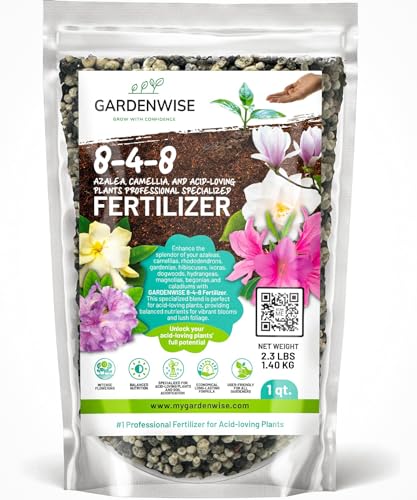
GARDENWISE 8-4-8 is engineered for acid-loving shrubs that show early signs of chlorosis—pale needles with darker veins. The inclusion of chelated iron, magnesium, and manganese targets the exact micronutrient deficiencies that high-pH soils cause, while the slow-release 8-4-8 granular base provides balanced macronutrient support for foliage density and root development.
The formula requires just three feedings per year, which aligns well with the growth cycle of most evergreens. The granules are easy to sprinkle around the drip line and incorporate lightly into the soil surface. Owner reports note dramatic greening in magnolia trees and rhododendrons within one to two weeks of application, particularly when used as a corrective treatment for plants that had stalled after transplanting.
One quart covers a modest number of medium shrubs, so larger landscapes may need multiple units for a single application. The iron-rich formulation is effective but should not be used on plants already growing in full-acid soil without verifying leaf color first.
What works
- Fast visual improvement on chlorotic evergreens
- Slow-release design reduces application frequency
- Contains targeted micronutrients for acid-soil plants
What doesn’t
- Smaller bag size limits coverage on large properties
- Primarily for acid-lovers; not suited for alkaline-tolerant conifers
4. Jack’s Classic 17-6-6 Acid Special

Jack’s Classic Acid Special is a water-soluble powder that dissolves instantly for foliar or root feeding. The 17-6-6 ratio is nitrogen-dense, which makes it particularly effective for promoting lush green growth on evergreen shrubs that need a rapid recovery from deficiency or transplant shock. The elevated iron and sulfur content also helps maintain acidic soil conditions over repeated applications.
Each bag includes a measuring spoon calibrated to mix one teaspoon per gallon of water, eliminating guesswork. This formulation is popular among blueberry growers for the same acid-loving benefits, but it works equally well on container-grown spruce, fir, and camellias that need frequent light feeding. The concentrated powder goes further than pre-mixed liquids, producing multiple gallons of fertilizer from a single 1.5-pound bag.
Because it is fast-acting, users should follow the recommended 7-14 day schedule to avoid salt buildup in potting mix. A few owners note that the bag’s resealability could be improved, but transferring the powder to an airtight container solves that.
What works
- Quick nutrient availability for visible green-up in days
- Concentrated formula yields many gallons of feed
- Works as both root drench and foliar spray
What doesn’t
- Requires regular mixing and application schedule
- Not a slow-release; less suited for one-time seasonal feeding
5. Espoma Organic Holly-Tone 4-3-4 (2-Pack)

Holly-Tone is the original organic acid-lover’s fertilizer, trusted for decades on azalea, rhododendron, holly, and broadleaf evergreens. The 4-3-4 analysis combined with 5% sulfur provides gentle but effective feeding that builds soil biology rather than forcing a temporary flush. The Bio-tone microbes improve nutrient availability in cooler soils when evergreens are still actively root-feeding.
This two-pack provides 8 pounds total, which is ideal for properties with a mix of acid-loving shrubs and needled evergreens. The granular formula is sprinkled around the drip line twice per year—spring and fall—and watered in. It is OMRI-listed for organic production, which means no synthetic chemicals or sludge by-products.
Long-time users report consistent performance across Leyland cypress, arborvitae, and hemlock, noting that it helps struggling trees regain color without the rapid growth surge that can attract pests. The small bag size in individual packs is convenient for spot treatment but less economical for large-scale landscape maintenance.
What works
- Proven organic formula with decades of positive feedback
- Built-in sulfur content supports soil acidification
- Two-pack offers convenience for split applications
What doesn’t
- Individual 4 lb bags are small for extensive planting areas
- Slow-release may not satisfy severe nitrogen deficiency quickly
6. Miracle-Gro Water Soluble Azalea, Camellia, Rhododendron Food

Miracle-Gro’s water-soluble acid-lover formula is designed for instant feeding through a watering can or hose-end feeder. It delivers nutrients immediately to the root zone, making it a strong option for correcting visible yellowing or supporting newly planted evergreens during their establishment period. The formula is safe for all acid-loving species including rhododendron, gardenia, holly, and hydrangea.
The 5-pound bag produces a large volume of liquid feed, and the mixing ratio changes between indoor (1:144) and outdoor (1:18) use, giving the user control over concentration. Shrubs that receive biweekly applications during the growing season often show deeper green foliage and denser branching compared to unfertilized controls.
A common complaint is that the bag’s closure seal fails to grip, making storage messy. Transferring the powder to a sealed container eliminates this issue. The formula is synthetic, so organic gardeners may prefer an alternative like Espoma’s lineup.
What works
- Fast nutrient delivery for rapid visual results
- Large bag yields many gallons of finished feed
- Versatile across multiple acid-loving species
What doesn’t
- Bag reseal mechanism is unreliable
- Synthetic formula not compatible with organic gardening practices
7. Fertilome 10864 Tree and Shrub Food 19-8-10

Fertilome’s 19-8-10 formula is a high-nitrogen granular that uses a penetrating agent to move nutrients directly to feeder roots without requiring hole-digging. This is particularly useful for established trees and large shrubs where surface-applied fertilizer may not reach the deeper root system. The target species include both deciduous trees and evergreens, making it a flexible option for mixed landscapes.
Owner reports consistently describe it as bringing borderline-dying trees back to health when applied twice per year in early spring and fall. The 4-pound bag is compact and easy to store, and the granules scatter easily by hand or with a small spreader. The high nitrogen content (19-8-10) is effective for green-up but should be used carefully on dwarf or slow-growing evergreens to avoid excessive leggy growth.
A few users note that the bag weight has decreased over time while the price stayed the same, but the efficacy of the formulation itself remains well regarded. For a targeted, concentrated feed on struggling specimens, this is a reliable rescue option.
What works
- Penetrating technology eliminates need for digging
- High nitrogen ratio delivers strong green-up response
- Trusted brand with consistent long-term results
What doesn’t
- Bag size feels small relative to price point
- High nitrogen can stimulate excessive growth on dwarf varieties
Hardware & Specs Guide
NPK Ratio & Analysis
The three-number ratio (Nitrogen-Phosphorus-Potassium) defines a fertilizer’s primary nutrient contribution. For evergreen shrubs, nitrogen is the most critical macronutrient because it drives chlorophyll production and needle density. Phosphorus promotes root development, while potassium supports overall disease resistance and stress tolerance. A ratio like 4-3-4 or 8-4-8 provides balanced maintenance, while higher first numbers like 17-6-6 or 19-8-10 are reserved for fast green-up in deficient plants.
Soil Acidification — Sulfur Content
Evergreens depend on acidic soil to access iron and manganese. A fertilizer that contains 5% sulfur (as seen in Espoma’s Evergreen-Tone and Holly-Tone) actively lowers soil pH over time. Without this acidifying component, shrubs planted in neutral or alkaline soils will show interveinal chlorosis regardless of how much fertilizer is applied. The sulfur works slowly and should be combined with annual soil pH testing to avoid over-acidification.
Release Rate: Granules vs. Spikes vs. Soluble
Slow-release granules rely on soil moisture and temperature to break down over 2-3 months, making them ideal for a single spring application. Spikes concentrate nutrients at a specific depth and are best for established shrubs with developed root zones. Water-soluble powders provide immediate nutrient availability and are suited for container-grown evergreens or corrective feeding. Choosing the wrong release rate can lead to nutrient leaching (fast-release in sandy soil) or insufficient feeding (slow-release on potted plants).
Micronutrients — Iron, Manganese, Magnesium
Beyond the NPK profile, evergreen fertilizers often include chelated iron, manganese sulfate, and magnesium oxide to prevent specific deficiency symptoms. Iron is the most common limiting micronutrient in alkaline soils, causing new growth to emerge yellow while older needles remain green. Fertilizers like GARDENWISE 8-4-8 highlight iron content because it directly addresses this chlorosis problem. Without these micronutrients, even a perfect NPK ratio can fail to green up a struggling shrub.
FAQ
How often should I fertilize evergreen shrubs?
Can I use a general all-purpose fertilizer on evergreens?
What does chlorosis look like on evergreen shrubs?
Should I fertilize newly planted evergreen shrubs?
Are fertilizer spikes better than granules for evergreens?
Final Thoughts: The Verdict
For most gardeners, the fertilizer for evergreen shrubs winner is the Espoma Organic Evergreen-Tone 4-3-4 because it provides a complete organic feeding package with built-in soil acidification, targeted micronutrients, and a bag size that covers large landscapes. If you want zero-mess, season-long feeding, grab the Jobe’s Tree Fertilizer Spikes 16-4-4. And for correcting chlorosis fast on a struggling shrub, nothing beats the GARDENWISE 8-4-8 Acidic Fertilizer.