
Specs are compiled from manufacturer listings and verified buyer reviews and can change over time — please confirm the key details on the product page before buying.
Getting a heavy harvest of sweet, firm cherry tomatoes depends on one thing: giving them the right nutrients at the right time. Whether you are growing a few plants on a balcony or a full row in the backyard, the difference between a so-so crop and a bushel of bite-sized gems is choosing a fertilizer that feeds without burning and balances leaf growth with fruit production.
I’m Rikta — the founder and writer behind Lawn Gear Lab. This guide is built by comparing the manufacturers’ published specifications and the patterns across verified customer reviews, so you get each pick’s real strengths and trade-offs instead of marketing spin.
After digging through the numbers and what buyers actually report, these are the seven most effective products that make up the real fertilizer for cherry tomatoes options worth your time and money today.
Quick Picks
- FoxFarm Happy Frog Tomato & Vegetable Fertilizer — Top Performer
- MaterAid Tomato Fertilizer (GS Plant Foods) — Best Liquid Feed
- Espoma Organic Tomato-Tone — Best Organic Prevention
- Down To Earth All Natural Fertilizers All Purpose Mix — Organic Soil Builder
- Jobe’s Tomato Fertilizer Spikes — Easiest Application
- Purely Organic Products Triple Play — Balanced Fast Results
- Lilly Miller Morcrop Tomato & Vegetable Food — Budget Champion
How To Choose The Best Fertilizer For Cherry Tomatoes
Cherry tomatoes are vigorous feeders, but they need a different balance than what a general all-purpose lawn food provides. The key is picking an N-P-K ratio (the three numbers on every bag representing Nitrogen, Phosphorus, and Potassium) that supports flowering and fruit set without pushing the plant into producing huge leaves at the expense of the fruit you actually want to eat.
The N-P-K Ratio That Does the Job
Aim for a formula where the middle number (phosphorus) is higher than the first number (nitrogen). Phosphorus fuels bloom and fruit development, which is exactly what your cherry tomato plants need. Numbers like 5-10-10 or 6-18-6 are common examples; the lower nitrogen keeps the plant from getting overly tall and bushy, directing energy into the fruit instead.
Granule, Spike, or Liquid: Which One Fits Your Routine
Granules and spikes release nutrients slowly over weeks, which is ideal if you want a set-it-and-forget approach. Liquids work faster and let you adjust the feeding schedule as the plant grows, but require mixing and more frequent applications. Cherry tomatoes in containers often respond well to a liquid feed, while in-ground plants thrive on a slow-release granular or spike that you apply once or twice a season.
Calcium for Blossom End Rot Prevention
Cherry tomatoes are prone to blossom end rot — that dark, sunken spot on the bottom of the fruit. That happens when the plant cannot move enough calcium to the developing fruit fast enough during a growth spurt. A fertilizer that includes a significant calcium boost (like 8% calcium) helps prevent that problem before it starts, giving you firm, blemish-free fruit.
Quick Comparison
| Model | Best For | N-P-K Ratio | Item Form | Weight / Volume | Amazon |
|---|---|---|---|---|---|
| FoxFarm Happy Frog Tomato & Vegetable | Vigorous fruit production | 5-7-3 | Granules | 4 lb | Amazon |
| MaterAid Tomato Fertilizer (GS Plant Foods) | Fast-acting liquid feed | — | Liquid | 32 Fluid Ounces | Amazon |
| Espoma Organic Tomato-Tone | Blossom end rot prevention | 3-4-6 with 8% Calcium | Powder | 4 lb (Pack of 3) | Amazon |
| Down To Earth All Natural Fertilizers All Purpose Mix | Organic soil health | 4-6-2 | Granules | 5 lb | Amazon |
| Jobe’s Tomato Fertilizer Spikes | No-mess time release | 6-18-6 | Sticks | 0.55 lb (18 spikes per pouch) | Amazon |
| Purely Organic Products Triple Play | Fast results indoors or out | 8-8-8 | Granules | 2.3 lb (36 oz) | Amazon |
| Lilly Miller Morcrop Tomato & Vegetable Food | Budget-friendly granule | 5-10-10 | Granules | 4 lb (64 oz) | Amazon |
Please note: This list uses flexible, human-like matching for fertilizers formulated for tomatoes or vegetables, so not every pick is the exact same size or format; the nearest same-type product serves the same purpose.
In‑Depth Reviews
1. FoxFarm Happy Frog Tomato & Vegetable Fertilizer

The granular powerhouse that turns a cherry tomato sprig into a fruit-producing tree.
This 4 lb bag of dry granules puts extra phosphorus (middle number 7) behind the flowers and fruit. It also includes calcium specifically formulated to help prevent blossom end rot (the dark, sunken bottom that can ruin cherry tomatoes right before they ripen) — a problem that tends to hit fast-growing cherry varieties hardest. Unlike the Jobe’s spikes, which are a set-and-forget stick, the Happy Frog granules require you to work them into the soil.
Buyers report that their “tiny cherry tomato sprig” turned into a “tomato-producing tree” after using this product. It also contains mycorrhizal fungi (beneficial microscopic fungi that attach to the roots and help the plant pull more water and nutrients from the soil), a feature you do not see in most standard vegetable fertilizers. Owners mention there is no chemical or fish smell.
Best all-around pick: If you are growing cherry tomatoes in containers or in a raised bed and want one product that covers root health, fruit production, and blossom-end-rot prevention in a single application, this is the one.
The trade-off: At 4 lb it is heavier than the Jobe’s spikes (0.55 lb) and needs to be mixed into the soil rather than just pushed in.
Reach for this if: you want a proven, organic-friendly granular that gives you bumper crops — one reviewer called it “bumper crop” results.
Look elsewhere if: you need a purely organic OMRI-listed product (this one is not listed as such) or prefer a no-measurement liquid.
2. MaterAid Tomato Fertilizer (GS Plant Foods)
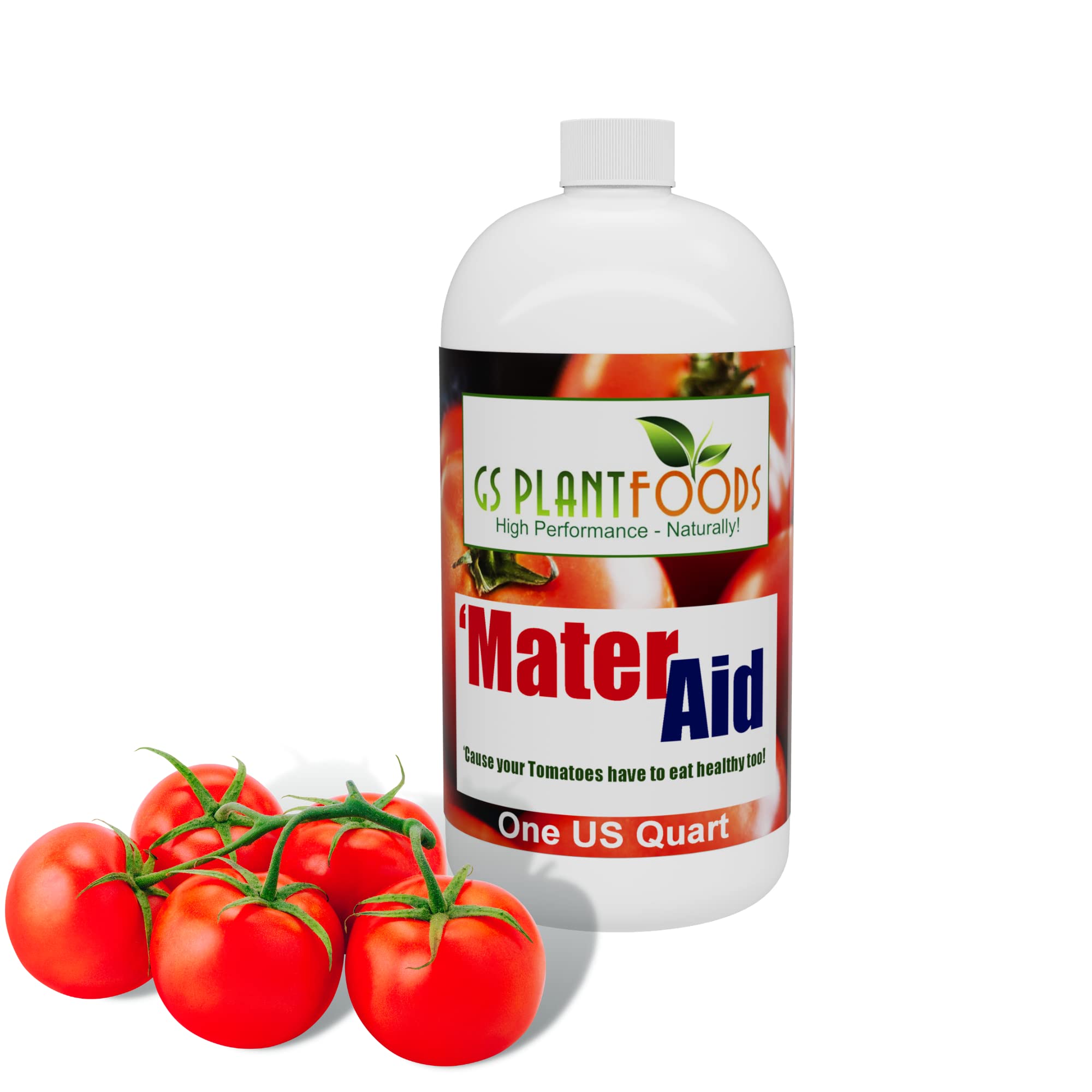
The concentrated organic liquid that makes cherry tomato plants shoot up and out overnight.
This is a liquid feed rather than a dry granule, which means you mix 1-2 ounces with 1 gallon of water and pour it around the plant roots every other week, then weekly after the fruit starts setting. The advantage over the FoxFarm granules is speed — the nutrients are already in water-soluble form and can be absorbed immediately by the plant instead of needing to be broken down in the soil, so you see results faster.
Customers note their plants “shot up and out overnight” and that they saw “loads of blossoms” after use. The formula includes magnesium for improved flowering and fruit quality, calcium for stronger roots and firmer tomatoes, and sulfur for protein and increased chlorophyll. Unlike the FoxFarm Happy Frog granules you mix in, this liquid works especially well for container cherry tomatoes where the roots need quick access to nutrients. A reviewer also noted they bought a second bottle and that it “really helps the tomatoes and strawberries.”
What makes it effective
- Fast-acting liquid absorbs immediately into the roots
- Contains magnesium, calcium, and sulfur for strong fruit
- Safe around pets and families with no harsh chemicals
What to consider
- Requires mixing every 1-2 weeks
- Not a slow-release option
Perfect for: cherry tomato growers who want quick, visible results and like being hands-on with their feeding schedule.
Not for you if: you want a one-time application that lasts the season without any mixing or measuring.
3. Espoma Organic Tomato-Tone
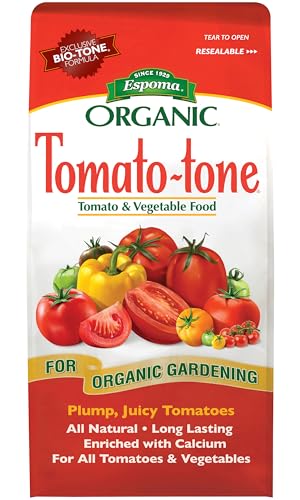
The calcium-rich organic powder that keeps blossom end rot off your cherry tomatoes.
This pack gives you three 4 lb bags (total of 192 ounces) of a 3-4-6 formula enhanced with 8% calcium, which is the highest calcium content among the picks here. That calcium is the key reason you would choose this over the Lilly Miller 5-10-10 or the FoxFarm 5-7-3 — it directly addresses blossom end rot, a common problem with cherry tomatoes during sudden growth spurts when the plant cannot move calcium to the fruit fast enough.
Reviewers point out Tomato-Tone “makes tomato plants become tomato trees” when applied at planting and side-dressed (scattered around the base) every 3 weeks. The formula is listed by the maker as approved for organic gardening and contains Espoma’s proprietary Bio-tone formula (a mix of beneficial microbes). Unlike the Jobe’s spikes which you simply push into the soil, Tomato-Tone requires you to scatter it around the plant’s drip line and water it in, but buyers find that straightforward. A longtime user notes they have used it for 6 years.
Best for organic prevention: If blossom end rot has ruined past harvests, the 8% calcium in this formula is your best defense.
The catch: It needs reapplication every two weeks through the growing season rather than a single spike application.
Reach for this if: you grow heirloom or hybrid cherry tomatoes and want a reliable organic fertilizer that delivers “beautiful, bountiful tomatoes” as one reviewer put it.
Look elsewhere if: you want a liquid feed for quick absorption in containers.
4. Down To Earth All Natural Fertilizers All Purpose Mix

The OMRI-listed organic granule that revives pale tomato plants within two weeks.
If organic certification matters to you, this 5 lb box of 4-6-2 granules is listed by the Organic Materials Review Institute (OMRI) for use in certified organic production. That means it meets strict standards for organic farming — unlike the FoxFarm Happy Frog which is not OMRI-listed. The ingredients include fish bone meal, blood meal, feather meal, rock phosphate, langbeinite, greensand, humates, and kelp meal, which feed the soil microbes along with the plant itself.
Shoppers say that despite its “unpleasant smell” (which they say dissipates in a couple of days), it “revived pale, flimsy tomato plants within two weeks after application.” A 15 lb bag lasts nearly a year for an avid gardener. The 4-6-2 ratio is gentler than the 6-18-6 of the Jobe’s spikes and the 8-8-8 of the Purely Organic — it is designed as a non-burning formula safe for transplants. One reviewer noted they were “petty and won’t tell mother-in-law” about the source of the recommendation.
Reasons to choose this
- OMRI-listed for organic production
- 5 lb box provides steady supply
- Non-burning formula safe for young transplants
Things to note
- Strong smell for the first couple of days after application
- Lower phosphorus than the Jobe’s 6-18-6 spikes
Best for organic growers: if you need an OMRI-listed fertilizer that builds long-term soil health rather than just feeding the plant.
skip it if: you cannot tolerate the initial smell or want a higher-phosphorus formula for a quick fruit push.
5. Jobe’s Tomato Fertilizer Spikes

The push-and-forget spike that feeds cherry tomatoes for eight weeks straight.
If you do not want to measure, mix, or scatter anything, these pre-measured spikes deliver a 6-18-6 ratio right at the root zone. Push a spike into the soil near each plant and it releases nutrients over 8 weeks with no runoff, no mess, and no smell. The phosphorus number (18) is the highest in this list, which makes this the most targeted formula for pushing flowers and fruit development — a sharper fruit-focused punch than the FoxFarm Happy Frog’s gentler 5-7-3.
Buyers call Jobe’s spikes “my fertilizer of choice when growing tomatoes” and report “bumper crops” with peppers as well. These spikes are much lighter than the Down To Earth 5 lb box — at 0.55 lb for the pouch versus the Down To Earth’s 5 lb box, they are a lighter alternative for small-space gardening, though you need to use 18 spikes across multiple plants. A long-time user says they have used them for years and their “tomatoes love them.” The magnesium content mentioned in the MaterAid liquid is not in these spikes — the focus here is purely the N-P-K punch.
Best for convenience: If you hate mixing fertilizers or measuring amounts, this is the no-brainer pick.
The trade-off: The spikes are single-use per spike — you cannot adjust the dose once they are in the ground, unlike a liquid feed where you can dilute or increase concentration.
Reach for this if: you want a mess-free, time-release solution — just push it in and come back for big tomatoes.
Look elsewhere if: you are growing in very small containers where a spike might be too concentrated.
6. Purely Organic Products Triple Play

The protein-based balanced granule that made one gardener’s tomatoes five times bigger.
This 2.3 lb bag (36 oz) of 8-8-8 formula covers up to 250 square feet and uses a protein and plant-based formula for fast-acting results while continuing to feed for 6-8 weeks. The balanced N-P-K ratio (8-8-8) is flatter than the Jobe’s 6-18-6 and the Lilly Miller 5-10-10 — it provides equal support to leaves, flowers, and roots rather than pushing heavily on fruit. That makes it a good choice if you are growing a mix of tomatoes, herbs, and berries in the same bed.
One buyer reports their “tomato plants alone were five times bigger than my friends tomatoes” when using this product versus a different brand. Another reviewer used it on fig and pomegranate trees and says “it brought it back with new leaves.” The resealable pouch is convenient for storage, and unlike the Down To Earth mix, there is no strong smell reported. It comes in a 36 oz bag versus the Lilly Miller’s 64 oz bag.
Reasons to buy
- Fast-acting protein-based formula
- Balanced 8-8-8 works for multiple plants
- Resealable pouch for storage
Things to know
- Not organic (not OMRI-listed)
- Lower phosphorus than Jobe’s spikes for fruit-specific feeding
Best for mixed gardens: if you feed a variety of vegetables and herbs alongside your cherry tomatoes, the 8-8-8 balance works across the board.
Not ideal if: you want a high-phosphorus formula to boost fruit on a small number of cherry tomato plants.
7. Lilly Miller Morcrop Tomato & Vegetable Food

The affordable 5-10-10 granule that has been a greenhouse staple for years.
If you are looking for the most straightforward, low-cost way to feed cherry tomatoes without any organic certification or fancy additives, this 4 lb bag of 5-10-10 granules (64 oz unit count) gets the job done. The ratio is higher in phosphorus (10) than nitrogen (5), which pushes energy into fruit development — similar in concept to the Jobe’s spikes but in a loose granule form that you can apply to the soil and water in.
Buyers call it a “trusted product” that works “every year” and note it is “virtually the same” as a more expensive iris fertilizer from the same brand. One greenhouse grower says it is “perfect for making sure I’ll realize a good crop of tomatoes in my greenhouse.” The granules have an unpleasant smell when first applied (buyers report it “smells horrible”), but that fades. It is made in the United States and fortified with essential plant minerals. The 64 oz bag (64 ounces) is larger than the 36 oz Purely Organic bag (36 ounces), making this the entry-level choice for covering more ground.
Best value pick: If you are feeding multiple tomato plants and just need a reliable, high-phosphorus fertilizer without any organic labels or special features, this is the budget-friendly workhorse.
The catch: The smell when applying is strong — buyers warn it “smells horrible” for a short time.
Reach for this if: you want a proven, affordable fertilizer for a greenhouse or backyard patch where the initial smell is not an issue.
Look elsewhere if: you need an organic, OMRI-listed product or a completely odor-free application.
Understanding the Specs
N-P-K Ratio: The Three Numbers That Matter
The three numbers on every fertilizer bag — like 5-10-10 — stand for Nitrogen (N), Phosphorus (P), and Potassium (K). Nitrogen drives leaf and stem growth. Phosphorus fuels flower and fruit development — the higher this middle number, the more energy goes into your cherry tomatoes. Potassium supports overall plant health and root strength. For cherry tomatoes, you generally want the middle number to be the highest or at least equal to the first, so the plant does not waste energy growing huge leaves instead of fruit.
Calcium and Blossom End Rot
Blossom end rot is that dark, sunken spot on the bottom of cherry tomatoes. It is not a disease — it is a calcium deficiency that happens when the plant is growing so fast that the roots cannot deliver calcium to the developing fruit quickly enough. A fertilizer with added calcium (like 8% calcium in some formulas) helps prevent this problem. If you have had blossom end rot in past seasons, look for a fertilizer that explicitly lists a calcium percentage on the label.
Time Release vs. Liquid vs. Granules
Time-release spikes and slow-release granules feed steadily over 6-8 weeks — you apply once and forget it. Liquids give immediate results because the plant absorbs them right away, but you must reapply every 1-2 weeks. Loose granules fall in the middle: they break down with watering over a few weeks. Your choice depends on how hands-on you want to be. Container plants often do well with liquids because watering frequency is higher and nutrients drain out faster.
OMRI Listing for Organic Gardening
If you are growing organically, look for the OMRI (Organic Materials Review Institute) seal on the label. That means an independent third party has verified the product meets organic production standards. Not all natural-sounding fertilizers have this certification. A product can contain natural ingredients but still not be OMRI-listed if it includes synthetic additives. The Down To Earth All Natural Mix in this list is OMRI-listed; the FoxFarm Happy Frog is not, even though it contains natural ingredients.
FAQ
What N-P-K ratio is best for cherry tomatoes?
Can I use a general vegetable fertilizer on cherry tomatoes?
How often should I fertilize cherry tomatoes in containers?
Does calcium prevent blossom end rot on cherry tomatoes?
Are Jobe’s spikes safe to use with cherry tomato seedlings?
What is the difference between OMRI-listed and natural fertilizers?
Can liquid fertilizer replace slow-release granules?
Why does my cherry tomato plant have lots of leaves but no fruit?
How do I apply granular fertilizer to cherry tomatoes?
Is the FoxFarm Happy Frog fertilizer safe for organic gardening?
Final Thoughts: The Verdict
For most home growers, the top pick among fertilizer for cherry tomatoes is the FoxFarm Happy Frog Tomato & Vegetable Fertilizer because it combines a balanced 5-7-3 ratio with added calcium and mycorrhizal fungi to support fruit production and prevent blossom end rot. If you prefer a fast-acting liquid you can adjust week to week, grab the MaterAid Tomato Fertilizer. And for the easiest no-mess application with the highest phosphorus kick, the Jobe’s Tomato Fertilizer Spikes deliver time release with zero measuring.
How We Picked
We do not accept paid placement. Every pick is matched to a real buyer and a real use-case; we do not hands-on test units.
Sources & Methodology
Specifications: manufacturer listings and product documentation. Review insights: verified customer reviews, as of July 2026. Pricing: not shown on this page (it changes often); check the current price via the retailer link.
As an Amazon Associate, Lawn Gear Lab earns from qualifying purchases. This does not affect which products we feature.