
Specs are compiled from manufacturer listings and verified buyer reviews and can change over time — please confirm the key details on the product page before buying.
Your cherry blossom tree can put on a stunning show of pink flowers each spring, but the feeder you pick months earlier is what makes or breaks the display. Pick the wrong one and you get lots of leaves and very few blooms. This guide compares three fertilizers built for acid-loving trees and shrubs (plants that need low-pH soil to thrive), so you can grab the one that turns your tree into a showpiece.
Rikta here — founder and writer at Lawn Gear Lab. This guide uses each manufacturer’s published specs and the patterns across verified customer reviews, so you see real strengths and trade-offs instead of marketing spin.
Every product below is designed to support acid-loving plants like cherry blossoms. The best fertilizer for cherry blossom trees depends on if you want a slow-release powder that feeds over weeks or a liquid boost that works fast in the current season. Use this to narrow your choice.
Quick Picks
- FoxFarm Happy Frog Acid Loving Plants Fertilizer — Best Overall
- Cherry Tree Fertilizer – Liquid Plant Food (TPS Nutrients) — Best Value
- Bloom City Acid-Loving Plant Fertilizer – Liquid Soil Acidifier — Revival Pro
How To Choose The Best Fertilizer For Cherry Blossom Trees
Cherry blossom trees need a soil pH (a measure of how acidic or alkaline your soil is) between 5.5 and 6.5 to absorb the nutrients that drive flower production. If your tree looks leafy but has few buds, the issue is usually the fertilizer’s pH and nutrient balance.
Slow-Release vs. Liquid
A slow-release powder or granule feeds your tree gradually over several weeks and works best when applied in early spring or fall. A liquid fertilizer delivers nutrients immediately to the roots and works better during the growing season when you need a quick boost. Decide based on how soon you need results.
Beneficial Microbes
Some fertilizers include mycorrhizal fungi (a type of root-friendly fungus) or other soil microbes that help roots absorb water and nutrients more efficiently. For a tree that has been in the ground for years, these added microbes can make a bigger difference than the fertilizer itself.
Quick Comparison
| Model | Best For | Form | Size | Target Plants | Amazon |
|---|---|---|---|---|---|
| FoxFarm Happy Frog | Steady, long-term feeding | Powder (Slow-Release) | 4 lbs | Acid-loving plants | Amazon |
| Cherry Tree Fertilizer (TPS Nutrients) | Targeted cherry tree nutrition | Liquid | 32 oz | Cherry trees | Amazon |
| Bloom City Acid-Loving | Reviving older, struggling plants | Liquid | 32 oz (1 Quart) | Blueberries, azaleas, rhododendrons | Amazon |
In‑Depth Reviews
1. FoxFarm Happy Frog Acid Loving Plants Fertilizer

You get slow-release feeding for weeks plus soil biology that helps roots work harder.
This 4-pound bag is a slow-release formula (a powder that breaks down slowly in the soil, feeding the tree over weeks). You mix 1/16 cup (one tablespoon) per gallon of water or sprinkle it around the base, and it provides gentle feedings that won’t overwhelm your tree. It is specifically made for low-pH loving plants like azaleas, rhododendrons, and cherry blossom trees. Unlike the liquid options below, this works best in early spring or fall to build up the soil over time.
A unique advantage here is the inclusion of beneficial soil microbes and mycorrhizal fungi (a fungus that attaches to roots and helps them absorb water and nutrients). These help your tree’s roots pull in more, especially if your soil is compacted. Buyers report visible results fast: one reviewer noted that within 10 days, a gardenia grew 2 new buds and a strawberry plant produced flowers and fruit. That response suggests the nutrient profile works quickly even as a slow-release product.
It is OMRI listed (certified by the Organic Materials Review Institute for organic gardening), confirming it meets organic standards. The main trade-off compared to the TPS Cherry Tree Fertilizer: you need to plan ahead — this is not a quick liquid fix mid-summer if your tree looks pale.
What Makes It Worth It
- Slow-release feeding that won’t burn roots
- Contains mycorrhizal fungi for better root health
- OMRI listed for organic gardening
- Buyers saw visible results in 10 days on other plants
One Thing to Know
- Best applied before the growing season, not for an immediate mid-summer fix
Choose this over the TPS liquid if you want steady, season-long feeding with added soil biology and don’t mind applying it early.
Pick the TPS Cherry Tree Fertilizer instead if you need to fix a nutrient shortage mid-summer.
2. Cherry Tree Fertilizer – Liquid Plant Food (TPS Nutrients)
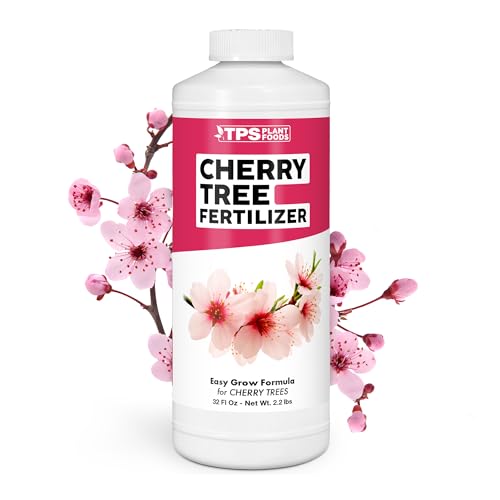
A liquid boost made only for cherry trees, so the nutrient ratio matches your tree exactly.
If you want a fertilizer designed for the exact species you are growing, this 32-ounce liquid from TPS Nutrients is it. It provides balanced nutrition to feed cherry trees without over-fertilizing or stressing the roots — a real concern with established trees. Unlike the FoxFarm bag that works for a wide range of acid-loving plants, this one targets cherry trees only, so the nutrient ratio is matched to what your tree needs for blossoms and fruit production (the process of developing fruit after flowers).
Owners mention it gives young cherry trees a strong start: one buyer mentioned that after a month, their trees “really took off growing with big leaves.” Another reviewer, who had three cherry trees they had never fertilized before, picked this product to start a feeding routine. The liquid form means you can apply it through a hose attachment or mix it into a watering can, getting nutrients to roots fast — a major advantage over the slow-release FoxFarm powder when you need a quick response.
Why It Works
- Formulated exclusively for cherry trees (unlike multi-purpose options)
- Liquid form works fast on young or stressed trees
- Made in the USA
- Buyers reported strong leaf growth within a month
The Catch
- One owner reported the lid can leak — check it is tight before storage
This is your pick for a species-specific formula that goes straight into the roots for a quick response, especially on young trees.
Grab the FoxFarm Happy Frog instead if you want a slow-release powder you apply once and forget about for weeks.
3. Bloom City Acid-Loving Plant Fertilizer – Liquid Soil Acidifier

Revives older acid-loving trees and shrubs that have slowed down over the years.
Bloom City’s 32-ounce liquid formula targets acid-loving plants that look tired or have reduced output. It works for blueberries, hydrangeas, azaleas, rhododendrons, and cherry blossom trees. Its biggest strength is correcting soil chemistry (adjusting the pH level) in older plants. One customer observed it revived 8-year-old stressed blueberry bushes with low production after applying from mid-summer to late fall. The result was healthier, fuller plants with improved leaf growth and significantly rebounded fruit production.
This is a smart pick if your cherry blossom tree is mature and has been putting out fewer flowers each year — a situation where the FoxFarm or TPS options may not be enough. The trade-off is that the mixing ratio is not on the Amazon listing, so you need to check the product packaging when it arrives. It is made in the USA and works for garden or container growing.
Strong Suit
- Proven to revive old, underperforming plants (buyers saw results on 8-year-old bushes)
- Liquid form allows quick absorption for a mid-season fix
- Formulated for a wide range of acid-loving plants
Drawback
- Mixing ratio is not printed on the Amazon listing — double-check the label on arrival
Best for mature cherry blossom trees that have stopped flowering well and need a soil pH correction, not just a nutrient boost.
For a slow-release, low-maintenance option that lasts a whole season, stick with FoxFarm.
Understanding the Specs
Slow-Release vs. Liquid
A slow-release fertilizer (like the FoxFarm powder) feeds the tree gradually over weeks or months as soil moisture breaks down the granules. This gives you a long feeding season with fewer applications. A liquid fertilizer (like the TPS Cherry Tree or Bloom City options) enters the soil and roots almost immediately, making it better for a mid-season rescue or a quick growth push.
pH and Acid-Loving Plants
Cherry blossom trees prefer slightly acidic soil, typically with a pH between 5.5 and 6.5. Fertilizers labeled for “acid-loving plants” or containing sulfur or ammonium-based nitrogen lower the soil pH. This helps the tree absorb iron and other essential nutrients that trigger flower production. If your tree looks green but lacks blooms, the soil pH is often the first thing to check.
FAQ
Can I use any general-purpose fertilizer on my cherry blossom tree?
When is the best time to fertilize cherry blossom trees?
How often should I apply a slow-release fertilizer like FoxFarm Happy Frog?
Can I use a liquid fertilizer on a newly planted cherry blossom tree?
What does “OMRI Listed” mean on the FoxFarm bag?
Will these fertilizers change the color of my hydrangeas or other nearby plants?
How do I measure 1/16 cup for the FoxFarm mixing ratio?
Can I use the Bloom City fertilizer on potted cherry trees?
What happens if I over-fertilize my cherry blossom tree?
Which fertilizer works fastest for a tree that looks sick mid-season?
Final Thoughts: The Verdict
For most people, the FoxFarm Happy Frog is the best fertilizer for cherry blossom trees because it combines slow-release feeding with beneficial soil microbes and organic certification — season-long support with little effort. If you want a species-specific liquid that works fast on young or established trees, grab the Cherry Tree Fertilizer from TPS Nutrients. And for reviving an older cherry blossom tree that has stopped flowering well, the Bloom City Acid-Loving Plant Fertilizer has proven buyer-reported results on stressed plants.
How We Picked
We do not accept paid placement. Every pick is matched to a real buyer and a real use-case; we do not hands-on test units.
Sources & Methodology
Specifications: manufacturer listings and product documentation. Review insights: verified customer reviews, as of July 2026. Pricing: not shown on this page (it changes often); check the current price via the retailer link.
As an Amazon Associate, Lawn Gear Lab earns from qualifying purchases. This does not affect which products we feature.