
Specs are compiled from manufacturer listings and verified buyer reviews and can change over time — please confirm the key details on the product page before buying.
Cannas are hungry plants, but feeding them the wrong food is worse than not feeding them at all. If you dump a generic all-purpose fertilizer on your cannas, you will get towering leaves and almost no flowers. The real fix is a bloom-focused formula that pushes phosphorus and potassium, not nitrogen. The three fertilizers here are the ones gardeners actually reach for when they want those fiery red and orange spikes to show off.
I’m Rikta — the founder and writer behind Lawn Gear Lab. This guide is built by comparing the manufacturers’ published specifications and the patterns across verified customer reviews, so you get each pick’s real strengths and trade-offs instead of marketing spin.
Your cannas deserve a feeding plan that delivers color, not just growth, so here is the definitive breakdown of the best fertilizer for cannas.
Our Picks at a Glance

How To Choose The Best Fertilizer For Cannas
Cannas grow fast and bloom even faster, which means they pull a lot of nutrients out of the soil. The right fertilizer keeps those broad leaves green while forcing energy into the flower stalks. The wrong one gives you a jungle of foliage and zero color, which is the most common complaint from first-time canna growers.
Decode the N-P-K ratio first
Every fertilizer label shows three numbers, like 10-4-12. The first is nitrogen, which drives leaf growth. The second is phosphorus, which fuels flower and root development. The third is potassium, which strengthens the whole plant. For cannas you want a middle number that is noticeably higher than the first, because that pushes blooms instead of leaves. A balanced 10-10-10 mix will leave you with a leafy monster and few flowers.
Choose your feeding style: liquid or granular
Water-soluble powders dissolve in a bucket and feed the plant immediately through the roots or leaves. They give you precise control and fast results, but you need to mix and apply them regularly. Granular fertilizers are sprinkled on the soil and release nutrients slowly over weeks. They are easier for busy gardeners, but they take longer to show visible change. Decide how much effort you want to put in before you pick a form.
Quick Comparison
| Model | Best For | NPK Ratio | Item Form | Weight | Amazon |
|---|---|---|---|---|---|
| Jack’s Classic Blossom Booster★ Best Overall | Maximum bloom color and quantity | 10-30-20 | Powder | 16 oz | Amazon |
| BloomBiscus Hibiscus Food | Tropicals and container cannas | 10-4-12 | Granules | 4 lb | Amazon |
| Espoma Bulb-Tone | Organic planting and feeding | 3-5-3 | Granules | 18 lb | Amazon |
In-Depth Reviews
1. Jack’s Classic 10-30-20 Blossom Booster Water-Soluble Fertilizer
Our pick — over 4.5★ from 5,500+ verified ratings; the strongest balance of quality and price.
The bloom-forcing powder that turns canna stalks into flower factories.
This is the single most effective bloom booster you can buy for cannas, and the numbers explain why. The 10-30-20 analysis puts the phosphorus at triple the nitrogen, which is exactly the signal a canna needs to stop growing leaves and start pushing flower spikes. You mix the powder with water and feed it as a liquid, so the nutrients reach the roots within hours, not weeks. It also works as a foliar spray, meaning you can mist it directly onto the leaves for an even faster uptake.
The results are not subtle. Buyers report visible improvement in 7 to 10 days, with abundant blooms and healthier growth across flowering plants. One gardener revived two dying hanging baskets that had no blossoms, and after just the first watering the blooms returned. The included measuring spoon removes all guesswork, so you are not left hunting for a teaspoon in the garden shed.
The crowd has spoken loudly here — this one holds a 4.8-star score across more than 5,500 ratings, far more feedback than the other two picks combined. A landscape designer recommends it to clients, and gardeners who compared it to other bloom inducers say it wins every time. The only honest caution is that it is not organic, and the label warns it is toxic to ruminants like goats and cows, so keep it away from pasture areas.
Why It Wins
- Triple-phosphorus 10-30-20 formula forces flowers over foliage
- Works as both a root drench and a foliar spray
- Included measuring spoon makes mixing simple to use
Before You Buy
- Synthetic formula, not suited for organic gardens
- Label warns it is toxic to grazing animals
- Requires regular mixing rather than a one-time sprinkle
Reach for this if: you want maximum flower production from your cannas and are happy to mix a quick liquid feed every week or two.
Look elsewhere if: you need an organic-certified product or you have livestock that graze near your flower beds.
2. BloomBiscus Hibiscus 4LB Plant Food with 2% Iron
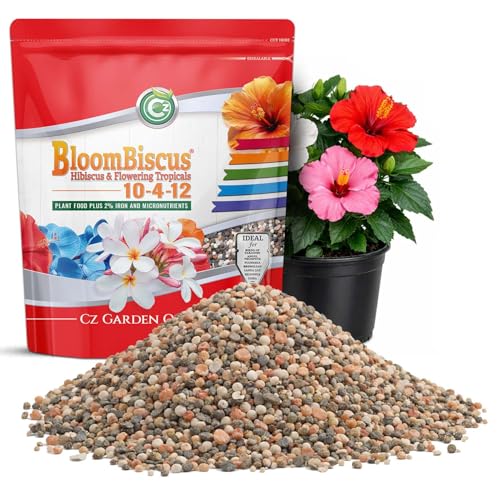
The tropical specialist that names canna lily right on the label.
This is the only pick here that lists “Canna Lily” by name among the plants it was built for, which tells you exactly who this is for. The 10-4-12 NPK ratio is high in nitrogen and potassium with a modest phosphorus level, so it fuels strong, healthy growth while the 2% iron keeps those broad canna leaves deep green instead of yellowing. It is a granular feed, so you sprinkle it on the soil, water it in, and let it release over time.
The bloom response is startlingly fast. Owners mention buds appearing the next day, and potted hibiscus blooms jumped from 1-2 flowers a day to 4-8 within a week. One gardener in Nebraska whose braided hibiscus barely survived a basement winter saw buds appear overnight after feeding, and birds of paradise that had never bloomed started flowering after a single round. The same gardeners confirmed it also helped their canna lily and bird of paradise in the same feeding.
There is one honest catch: the Amazon page instructions say it is for water application, but it is actually a granular product, so do not try to dissolve it in a watering can. It is made in the USA and comes in a resealable 4-pound pouch, which is a 4.5x smaller bag than the 18-pound Espoma option, so it suits smaller gardens and container growers. A few buyers also note that no scoop is included, so you will need to measure by hand using the pot-size guidance. Its N-P-K of 10-4-12 is a 3.3x higher total concentration than the Espoma’s gentle 3-5-3, making it a stronger feed for hungry tropicals.
Standout strength: the 2% iron plus quick granular release makes this the best choice for container cannas and tropical beds where foliage health matters as much as flowers.
Honest limit: the label and page instructions disagree on form, and there is no scoop in the pouch, so expect a little measuring math on your first feed.
3. Espoma Organic Bulb-Tone 3-5-3 Fertilizer

The organic workhorse that feeds canna rhizomes for an entire season.
If you grow organically or you plant cannas from rhizomes in the spring, this is the fertilizer to bury in the planting hole. The 3-5-3 analysis is gentle but perfectly tilted toward phosphorus, which is exactly what newly planted canna rhizomes need to establish strong roots and set buds. It is a granular, ready-to-use formula that needs no mixing — you toss it in the planting hole or sprinkle it on the soil surface and water it in.
The value here is extraordinary because of the sheer volume. This is an 18-pound bag, which is 4.5x heavier than the BloomBiscus 4-pound pouch, and one buyer specifically mentions using it every year for irises and cannas. It is approved for organic gardening and registered as an Organic Input Material, so it meets the requirements for organic production. The blend is enhanced with Espoma’s Bio-tone formula and carries 6% calcium for extra structural strength.
The honest trade-off is the smell. Multiple customers note the organic odor is noticeable, though they accept it as the price of natural ingredients. The N-P-K concentration is also much gentler than the others — a 3-5-3 versus the Jack’s 10-30-20 — so it works best as a planting-season base feed rather than a heavy mid-summer bloom push. It produces great tulips and promotes year-to-year survival of bulbs, and a canna grower calls it the best stuff for bulbs, so this is a buy-once-for-the-season choice rather than a weekly mixing routine.
The big win: one 18-pound bag covers a whole bed of cannas and spring bulbs, making it the most economical organic feed per square foot of garden.
The catch: the organic scent is strong, and the low concentration means you might still want a bloom booster later in the season for maximum flowers.
Understanding the Specs
N-P-K Ratio
The three numbers on any fertilizer bag stand for nitrogen, phosphorus, and potassium. Nitrogen grows leaves, phosphorus drives flowers and roots, and potassium builds overall plant strength. For cannas you want the middle number to be equal to or higher than the first, so the plant puts its energy into blooming rather than producing a mountain of foliage. A ratio like 10-30-20 is a heavy bloom pusher, while 3-5-3 is a gentle organic feed for planting time.
Water-Soluble vs. Granular
Water-soluble fertilizers come as a powder you mix with water, and they feed the plant immediately through the roots or a foliar spray. Granular fertilizers are sprinkled on the soil and break down slowly over weeks. Water-soluble gives you fast, dramatic results but requires regular mixing, while granular is a low-maintenance option that releases nutrients gradually. Choose based on how often you want to be out in the garden with a watering can.
FAQ
How often should I fertilize my cannas?
What N-P-K ratio is best for canna flowers?
Can I use a hibiscus fertilizer on cannas?
Is organic fertilizer better for cannas?
Should I fertilize cannas when I first plant the rhizomes?
Why are my canna leaves turning yellow?
Can I use a bloom booster on cannas in containers?
How long does a bag of canna fertilizer last?
Final Thoughts: The Verdict
To get the most vivid blooms from your cannas, the fertilizer for cannas to pick is the Jack’s Classic Blossom Booster—its 10-30-20 ratio (10% nitrogen, 30% phosphorus, 20% potassium) is designed to push out more flowers with deeper color, and buyers rate it 4.8 stars out of 5 across thousands of reviews. If you’d rather set a slow-release granular feed and forget it, choose the BloomBiscus, which includes 2% iron to keep leaves green. For organic gardeners planting rhizomes (the underground stems) in spring, the Espoma Bulb-Tone 18-pound bag is the one to grab.
How We Picked
We do not accept paid placement. Every pick is matched to a real buyer and a real use-case; we do not hands-on test units.
Sources & Methodology
Specifications: manufacturer listings and product documentation. Review insights: verified customer reviews, as of August 2026. Pricing: not shown on this page (it changes often); check the current price via the retailer link.
As an Amazon Associate, Lawn Gear Lab earns from qualifying purchases. This does not affect which products we feature.