
Specs are compiled from manufacturer listings and verified buyer reviews and can change over time — please confirm the key details on the product page before buying.
You did everything right — planted broccoli transplants in rich soil, watered faithfully, kept the pests at bay. But when it came time to harvest, you got a bundle of yellowing leaves and a few tiny, loose buds instead of the dense, deep-green heads you were counting on. That is almost always a feeding problem: too much nitrogen pushes leaves, not nearly enough of the right phosphorus and potassium starves the head formation. A fertilizer for broccoli needs a lower first number (N) and a higher second and third number (P and K) to tell the plant “stop sprouting leaves and start building a head.”
I’m Rikta — the founder and writer behind Lawn Gear Lab. This guide is built by comparing the manufacturers’ published specifications and the patterns across verified customer reviews, so you get each pick’s real strengths and trade-offs instead of marketing spin.
If you are ready to stop growing salad for the rabbits and start growing real broccoli heads, the best place to begin is the right fertilizer for broccoli — and that means picking a product that knows how to balance the NPK numbers for a brassica, not just a generic “all-purpose” mix.
Quick Picks
- Dr. Earth Organic 5 Tomato — Best Overall
- 5-10-10 Tomato & Vegetable Fertilizer — Premium Pick
- Schultz 018062 Spf48100 Slow-Release Vegetable Fertilizer — Budget Champion
- Jobe’s Organics Granular Blood Meal Fertilizer — Nitrogen Fix
- Dr. Earth Home Grown Tomato — Fast Boost
How To Choose The Best Fertilizer For Broccoli
Broccoli is a heavy feeder, but it is also picky about what it eats. Here are the three things you need to check before you pick a bag or a bottle.
Read the NPK numbers — the second one matters most
The three numbers on a fertilizer bag stand for Nitrogen (N), Phosphorus (P), and Potassium (K). For broccoli, you want a formula where the middle number (phosphorus) is higher than the first (nitrogen). Something like a 5-10-10 is ideal. High nitrogen pushes leaves, which is what you do not want when the plant is working on a head. Phosphorus drives root and flower development — and a broccoli head is really just a cluster of unopened flower buds.
Slow-release vs. liquid — timing is everything
Granular slow-release fertilizers feed the plant gradually over weeks. They are the easier, “low-maintenance” option. A liquid concentrate, on the other hand, gives the plant an immediate shot of nutrients. Liquid works well if you can stick to a schedule (every other week, for example), but slow-release granules are more forgiving for the gardener who wants to top-dress once and let the soil do the rest.
Organic matter and microbes matter for broccoli
An organic fertilizer that also adds beneficial soil microbes and mycorrhizae can make a noticeable difference. Those microbes help the plant access nutrients already in the soil and improve drought tolerance. Look for products that list specific strains, like “seven champion strains of beneficial soil microbes” or “ecto and endo mycorrhizae.” This is especially important if you are growing in containers or raised beds where the soil biology is often poor.
Quick Comparison
| Model | Best For | NPK Ratio | Item Form | Item Weight | Amazon |
|---|---|---|---|---|---|
| Dr. Earth Organic 5 Tomato, Vegetable & Herb | Best Overall | Not specified (Organic) | Granules | 4 Pounds | Amazon |
| Cz Garden 5-10-10 Tomato & Vegetable | Premium Pick | 5-10-10 | Granules | 4 Pounds | Amazon |
| Schultz SPF48100 Slow-Release Vegetable | Budget Champion | 10:12:12 | Granules | 1 Pounds | Amazon |
| Jobe’s Organics Granular Blood Meal | Nitrogen Fix | 12-0-0 | Granules | 3 Pounds | Amazon |
| Dr. Earth Home Grown Tomato, Vegetable & Herb Liquid | Fast Boost | 3-2-2 | Liquid | 24 ounces | Amazon |
In‑Depth Reviews
1. Dr. Earth Organic 5 Tomato, Vegetable & Herb Fertilizer Poly Bag

This is the bag that turned 3-inch starters into 9-foot towers of fruit.
Dr. Earth’s formula is built for the grower who wants a plug-and-play organic approach without worrying about burning delicate broccoli roots. It comes as granular particles that you mix into the soil at planting time, and the release is slow enough that you only need to reapply after a few months. The ingredients list reads more like a biology lab than a chemical plant: it includes seven champion strains of beneficial soil microbes plus ecto and endo mycorrhizae, which make the nutrients in your native soil more available to the broccoli plant. This is especially useful if you are fighting poor soil biology in a raised bed or container.
The results from real buyers are hard to ignore. One reviewer noted that just 50 days after planting 3-inch seedlings, the plants had grown to 6 feet tall and were covered in blossoms and fruit, with cherry tomatoes already ripe. That kind of explosive growth is tied directly to the microbial boost and the balanced release of nutrients. Another reviewer mentioned they used 1/4 cup per 5 gallons of soil for indoor veggies and watched zucchini, squash, and bush tomatoes get larger and produce more flowers — with zero blossom rot.
The trade-off is that this is a general “vegetable and herb” mix, not a custom broccoli-specific blend. If you want an NPK ratio explicitly printed for brassica head development, you will need to look at the 5-10-10 product below. But for sheer reliability and plant health improvement across a whole garden, this bag is the safest bet.
Why it wins the garden
- Contains 7 strains of beneficial soil microbes and mycorrhizae for better nutrient uptake
- Slow-release granular form means you apply once and it feeds for several months
- 100% organic ingredients with no GMOs, chicken manure, or sewage sludge
- Buyers report massive growth: 3-inch seedlings to 6-9 foot plants in 50-85 days
The honest limitation
- Does not have a specific NPK ratio printed as a “broccoli formula” — it is a general purpose organic blend
- The compost tea derived from it is described as “extremely smelly” by one reviewer
Reach for this if: you want a single organic bag that can power your entire vegetable garden — including broccoli — with minimal effort and maximum soil biology benefits.
Look elsewhere if: you need a precise, high-phosphorus NPK number (like a 5-10-10) explicitly for maximizing broccoli head size.
2. 5-10-10 Tomato & Vegetable Fertilizer – Made in USA – 2% Iron + Micronutrients Plant Food

The exact NPK ratio your broccoli head needs to bulk up.
If you care about the numbers, this is the one that delivers. The 5-10-10 ratio (low nitrogen, high phosphorus and potassium) is the textbook formula for a fruiting and flowering plant — and a broccoli head is just a large flower cluster. The extra 2% iron helps prevent the yellowing that happens when a brassica is starved of micronutrients. It comes as a solid granular product in a resealable, heavy-duty pouch, so you can pour out what you need and store the rest without the bag leaking smell or moisture.
Unlike the Dr. Earth organic option, this is a conventional fertilizer with a precise and measurable ratio. It is manufactured in the USA and has a mixing ratio of 1-2 tablespoons per plant, which owners mention makes the bag last an entire season. One reviewer described it as an “effective late-season veggie fertilizer for fruiting” and noted that the bag contains colored beads that indicate the fertilizer is actively present. Another reviewer mentioned they have used it for years and it has “never burned my plants” — a sign of a balanced formula that does not shock the roots.
The catch is that this is not an organic product, and the NPK is targeted toward the fruiting stage, not the early leaf-building phase. You would want to switch to this once your broccoli seedling has established its first few sets of true leaves and is ready to start building a head. It is also a 4-pound bag, which is significantly larger than the Schultz option (which is 1 pound), so you get more total fertilizer for your money upfront.
What stands out
- Perfect 5-10-10 NPK ratio for broccoli head development — low N, high P and K
- 2% iron added to prevent leaf yellowing and boost overall plant health
- Heavy-duty resealable pouch keeps fertilizer dry and easy to store
- Buyer review says “just use once in 2 weeks during fruiting” — clear and simple to follow
What to keep in mind
- Not an OMRI listed organic product — it is a conventional chemical fertilizer
- Best used only after the plant is established and moving into head formation, not during early seedling stage
Grab this if: you are growing specifically for large, dense heads and want the precise low-N, high-P ratio that broccoli needs during the fruiting stage.
skip it if: you need a single organic fertilizer that can safely transition your plant from seedling all the way to harvest.
3. Schultz 018062 Spf48100 Slow-Release Vegetable Fertilizer 1 Lb
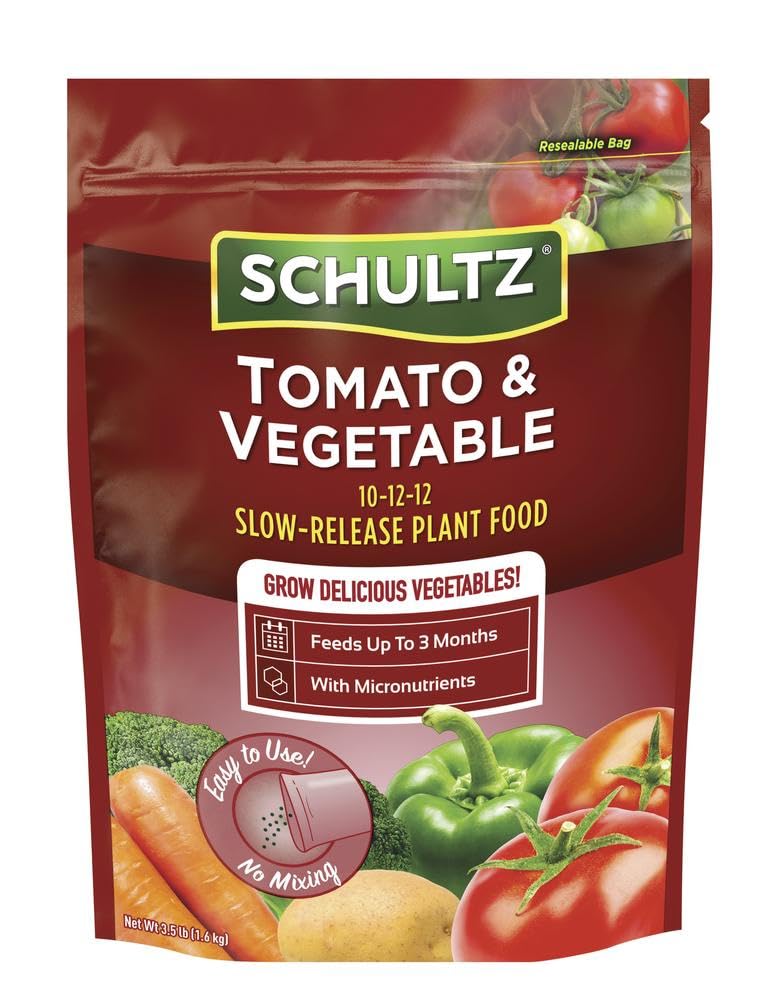
A tiny bag that punches above its weight with slow-release efficiency.
Do not be fooled by the 1-pound weight — this small pouch from Schultz packs a 10:12:12 NPK ratio that is actually well-suited for broccoli once it is into its fruiting phase. The slow-release mechanism is the main selling point here: you apply the granules once at planting time, then once more at first bloom, and you are done for the season. Customers note that this “slow-release fertilizer” is “easy to use (no mixing/hauling)” and that it “improved tomato taste” when used from the start.
However, the bag size is very small compared to the other options here. The Dr. Earth and Cz Garden bags are each 4 pounds — while the Schultz bag is 1 pound — so you get significantly more product for a similar price point. One reviewer did note that the bag is “smaller than my last osmocote delivery,” so it is worth checking your garden size before buying. For a small raised bed or a container garden with three or four broccoli plants, this is a tidy, no-mess option.
The NPK ratio of 10:12:12 is decent, but note that the first number (nitrogen) is still relatively high. You need to be careful not to over-apply nitrogen when broccoli is forming its head, as it can push leaf growth instead of head development.
The good part
- True slow-release formula: apply at planting and at first bloom, then you are set
- Comes as dry granules — no mixing, no hauling, no mess
- Reviewers point out it “kick started my garden plants” and improved vegetable flavor
The hassle
- Very small bag at 1 pound — does not go far for a mid-sized garden
- NPK of 10:12:12 still has relatively high nitrogen, so it is not tune solely for broccoli head formation
Best for: the small-space gardener with just a few broccoli plants who wants a simple, two-step slow-release program and minimal product waste.
Consider something else if: you are feeding a full vegetable bed of 12+ plants — the bag is too small.
4. Jobe’s Organics Granular Blood Meal Fertilizer, Excellent Source of Nitrogen for Spinach, Broccoli, and Leafy Greens, 3 lbs Bag

This is the nitrogen jolt that turns yellow, struggling plants green in two weeks.
Blood meal is a specific tool, not a general-purpose cure. It is a 12-0-0 nitrogen-only fertilizer, meaning it supplies a massive dose of the first number and nothing else. You would use this in a very specific scenario: when your broccoli is in its early vegetative stage and looks pale, stunted, or yellow. That is a classic sign of nitrogen deficiency, and Jobe’s organic blood meal will correct it quickly. One reviewer confirmed it was “really effective in returning vibrancy to non flowering plants” and added that ferns “look green and healthy after about 2 weeks.”
The product is OMRI listed for organic gardening by the USDA, which matters if you are running a certified organic garden. It comes as granules that you sprinkle onto the soil surface and water in. One important behavioral note from reviewers: blood meal has a “distinct strong smell upon application” that some gardeners find unpleasant — but that same smell also repels deer and rabbits, which is a bonus protection for your broccoli patch. Mixing it with peat or soil helps cut the odor somewhat.
The risk here is over-application. If you apply a high-nitrogen blood meal when your broccoli is already forming a head, you will get huge leaves and a tiny, loose head. Use this only in the first few weeks after transplanting, then switch to a lower-N, higher-P product like the 5-10-10 formula above. The product label itself recommends application “monthly or as needed during the growing season,” which gives you some flexibility, but you must stay mindful of the plant’s growth stage.
When it shines
- 12-0-0 NPK is a pure nitrogen source that rapidly corrects yellowing and stunted growth
- OMRI listed for organic gardening by the USDA — certified organic input
- Naturally repels deer and rabbits due to the strong blood meal smell
- Buyer says it “has kept the animals away” from plants
How to use it safely
- Only use during the early leafy growth phase — high nitrogen during head formation will ruin your broccoli
- The smell is noticeable; mix with soil to reduce odor
Reach for this if: your broccoli seedlings are pale and struggling in the first few weeks and you want a fast-acting organic fix that also keeps deer away.
Stop and think if: your broccoli is already forming a head — the nitrogen will kill the yield.
5. Dr. Earth Home Grown Tomato, Vegetable & Herb Liquid Fertilizer 24 oz Concentrate

The liquid shot that gives broccoli an immediate, consistent boost every two weeks.
If you prefer to work with a measuring spoon and a watering can rather than a trowel, this Dr. Earth liquid concentrate is your match. It has a 3-2-2 NPK, which is a very gentle, balanced formula that is safe to use on young broccoli plants and during the head-forming stage without the risk of burning roots. It works as a feed you apply every other week. One buyer mentioned that it “worked great for my seedlings and kept my garden looking great all season long,” and another specifically mentioned it “produced dense broccoli.” The bottle is 24 fluid ounces and is a concentrate, so you mix it at a 1:200 ratio (very dilute) — meaning one bottle goes a long way.
The big difference from the granular products is speed. A liquid feed goes straight into the root zone and is available immediately. That makes it ideal for a quick correction if your broccoli looks a little pale or if you are experiencing a cool, wet stretch when soil biology slows down. It is also OMRI Listed for organic use. The formula is made from recycled grocery produce, fish, and meat — a fully sustainable process that is safe around family and pets. One reviewer did caution that it is “too strong for flower pots,” so stick to the dilution instructions and use it on your garden beds.
The trade-off is labor: you have to mix and apply every 14 days. A granular slow-release product like the Schultz or the Dr. Earth dry bag only needs a top-dress every few months. If you are a “low-maintenance” gardener, the liquid routine might feel like a chore. But if you enjoy the precision and the immediate feedback, this is the most responsive option.
The liquid advantage
- Immediate nutrient availability — corrects deficiencies fast
- OMRI Listed organic — safe for pets, family, and the environment
- Gentle 3-2-2 NPK ratio is safe for all growth stages, even for broccoli seedlings
- Buyer reports it “produced dense broccoli” — directly verified for this crop
What it asks of you
- Must be applied every two weeks — not a “set and forget” option
- Requires shaking the bottle thoroughly before each use to ensure proper nutrient mix
- Liquid is more expensive per ounce than granular concentrates
Choose this if: you are a hands-on gardener who enjoys weekly mixing and wants a fast-acting, organic liquid that you can dial in precisely per plant.
Pass on it if: you want a one-time spring application that feeds your broccoli all season without fuss.
Understanding the Specs
NPK Ratio
These three numbers (e.g. 5-10-10) tell you the percentage of Nitrogen, Phosphorus, and Potassium by weight. For broccoli, you want phosphorus (the middle number) to be higher than nitrogen (the first number). This nudges the plant to put energy into building a dense head of flower buds rather than growing more leaves. A 5-10-10 or a 4-12-12 ratio is ideal.
Slow-Release vs. Liquid
Slow-release granules, like the Schultz SPF48100, break down gradually and only need application once or twice per season. They are forgiving. Liquid concentrates, like the Dr. Earth Home Grown, work immediately and give you control, but require a strict bi-weekly schedule. Your choice depends on whether you prefer a low-maintenance top-dress or the precision of a watering-can routine.
FAQ
What is the best NPK ratio for broccoli?
Can I use a tomato fertilizer for broccoli?
When should I stop fertilizing broccoli with nitrogen?
How often should I fertilize broccoli with a liquid feed?
Does organic blood meal really repel deer from broccoli?
Can I use a slow-release granular fertilizer on container-grown broccoli?
How much Dr. Earth Home Grown liquid do I use per plant?
Will the 5-10-10 fertilizer burn my plants if I use too much?
Does the Dr. Earth Organic granular fertilizer need to be mixed into the soil?
Is it safe to use a 12-0-0 blood meal on broccoli seedlings?
Final Thoughts: The Verdict
For most gardeners, the fertilizer for broccoli winner is the Dr. Earth Organic 5 Tomato, Vegetable & Herb because it combines slow-release organic ingredients with beneficial soil microbes that make your whole garden stronger — not just your broccoli. If you want a precise, high-phosphorus ratio for maximum head weight, grab the Cz Garden 5-10-10. And for a small-space setup where simplicity matters most, the Schultz SPF48100 gets the job done with a single spring application.
How We Picked
We do not accept paid placement. Every pick is matched to a real buyer and a real use-case; we do not hands-on test units.
Sources & Methodology
Specifications: manufacturer listings and product documentation. Review insights: verified customer reviews, as of July 2026. Pricing: not shown on this page (it changes often); check the current price via the retailer link.
As an Amazon Associate, Lawn Gear Lab earns from qualifying purchases. This does not affect which products we feature.