
Specs are compiled from manufacturer listings and verified buyer reviews and can change over time — please confirm the key details on the product page before buying.
Azaleas need a specific kind of food — a fertilizer that keeps the soil acidic and delivers the right nutrients for those showy spring blooms. Get it wrong, and you’ll get yellow leaves and sad, sparse flowers. The right fertilizer for azaleas supplies iron and sulfur to prevent that yellowing, and it balances nitrogen, phosphorus, and potassium for lush foliage and sturdy flowering.
I’m Rikta — the founder and writer behind Lawn Gear Lab. This guide is built by comparing the manufacturers’ published specifications and the patterns across verified customer reviews, so you get each pick’s real strengths and trade-offs instead of marketing spin.
Whether you are tending a single potted azalea or a whole acid-loving border, knowing which product actually works is the difference between an average display and a spectacular one — that is exactly what this guide to the best fertilizer for azaleas is designed to deliver.
Our Picks at a Glance

How To Choose The Best Fertilizer For Azaleas
Picking the right azalea food depends on a few key specs that match your soil type and your preferred routine. Here is what to look for.
The N-P-K Ratio
The three numbers on the bag (for example, 4-3-4) stand for nitrogen, phosphorus, and potassium. Nitrogen pushes green leaf growth, phosphorus helps roots and flowers, and potassium supports overall health. Azaleas in established soil often do fine with a balanced or slightly higher middle number, but a ratio like 4-3-4 or 8-4-8 is a safe starting point.
Acidifying Ingredients (Sulfur & Iron)
Azaleas need acidic soil (pH around 4.5-6.0) to take up nutrients properly. A good fertilizer for azaleas includes sulfur to lower pH and iron to prevent leaf yellowing, a condition called chlorosis. Products with 5% sulfur or added iron are a strong indicator the formula is designed for acid lovers.
Organic vs. Water-Soluble
Organic granules (like Espoma Holly-Tone or Dr. Earth) release nutrients slowly as soil microbes break them down — you apply them once or twice a year. Water-soluble powders (like Miracle-Gro or Jack’s Classic) give plants an immediate boost, but you need to mix and apply them every 7-14 days during the growing season. Your choice depends on how much hands-on time you want.
Quick Comparison
| Model | Best For | N-P-K Ratio | Form | Unit Size | Amazon |
|---|---|---|---|---|---|
| Espoma Organic Holly-Tone 4-3-4★ Best Overall | Long-lasting organic feeding | 4-3-4 | Granules | 128 oz (2 x 4 lb) | Amazon |
| Miracle-Gro Water Soluble Azalea FoodTop Performer | Quick, easy liquid feeding | Not listed | Powder | 80 oz (5 lb) | Amazon |
| Dr. Earth Acid Lovers Fertilizer | Non-GMO verified organic care | Not listed | Granules | 4 lb | Amazon |
| GARDENWISE 8-4-8 Fertilizer | Iron-rich formula for chlorosis | 8-4-8 | Granules | 32 oz (1 qt) | Amazon |
| Jack’s Classic 17-6-6 Acid Special | Precise water-soluble control | 17-6-6 | Powder | 24 oz | Amazon |
| True Organic Azalea, Camellia & Rhododendron Food | Large-scale organic feeding | 5-4-3 | Granules | 12 lb | Amazon |
| Fertilome Azalea, Camellia, Rhododendron Food 9-15-13 | High-phosphorus bloom booster | 9-15-13 | Granules | 160 oz (10 lb) | Amazon |
In‑Depth Reviews
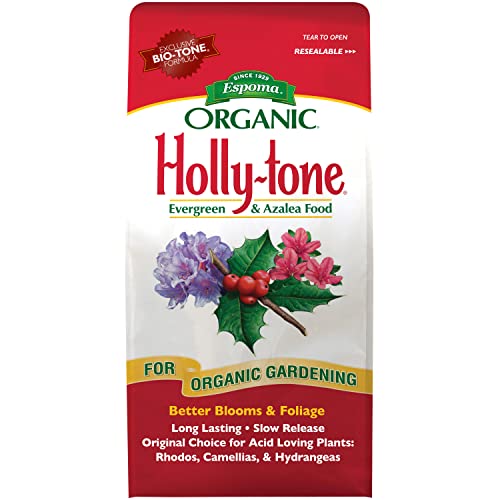
1. Espoma Organic Holly-Tone 4-3-4 Evergreen & Azalea Plant Food; 4 lb. Bag (Pack of 2)
Our pick — over 4.5★ from 700+ verified ratings; the strongest balance of quality and price.
The original organic formula trusted for decades to feed acid-loving plants with zero guesswork.
You get a rich blend of natural ingredients — the 4-3-4 analysis includes 5% sulfur to keep soil acidic, plus the exclusive Bio-tone formula. Unlike many organic fertilizers that require a lot of fuss, this one is ready to use right out of the bag: just sprinkle it around the base and water it in. Holly-tone is approved for organic gardening and is a registered Organic Input Material, so it meets production standards if that matters to you.
One unique advantage here is the pack of two 4-pound bags, which gives you a total of 128 ounces of product compared to the 32 oz GARDENWISE bag below. Buyers report that while it hasn’t turned their hydrangeas blue quickly, their blueberry bushes “definitely like this stuff” and their azalea “seems much happier.” The strong smell for the first few days is a common note, but it does fade after a few waterings.
This is the pick to reach for when you want a proven, no-mix organic feed that covers a broad range of acid-loving plants — azaleas, rhododendrons, blueberries, camellias, and even evergreens. It’s a 2-item pack, doubling the quantity of the single-bag Miracle-Gro option above.
Why Gardeners Choose It
- Approved for organic gardening — meets organic production requirements
- No mixing required; just sprinkle and water
- Bio-tone formula with 5% sulfur for soil acidification
The Trade-Offs
- Not water-soluble — results take a few weeks to appear
- Noticeable earthy smell for the first few days after application
The original that delivers: Perfect for organic gardeners who want a single, reliable granular feed for all their acid-loving plants — azaleas, hydrangeas, blueberries, and evergreens included.
Not the fastest fix: If you need quick greening or immediate results, a water-soluble option like Miracle-Gro will act faster; this is a slow-release, long-term investment.
2. Miracle-Gro Water Soluble Azalea, Camellia, Rhododendron Plant Food, 5 lb
The instantly dissolving powder that delivers a rapid nutrient boost to all acid-loving plants.
If you prefer watching your plants respond within days rather than weeks, this water-soluble powder is the approach. Just mix it with water — the mixing ratio is 1:144 for indoor plants and 1:18 for outdoor plants — and apply it with a watering can or a Miracle-Gro Garden Feeder. It’s formulated for azaleas, camellias, rhododendrons, gardenias, hibiscus, hollies, hydrangeas, and even orchids, so it covers a very wide range.
A buyer with 30 years of experience noted that it “outperformed a pricier, highly-publicized alternative,” calling it the best fertilizer they’ve used for all plants. One reviewer described it as an “acidic water soluble fertilizer, dissolves completely and easily,” used on their azaleas, rhododendrons, and blueberries. The resealable Velcro closure on the bag works well when kept clean, though a few buyers found it loses grip over time.
What Stands Out
- Dissolves instantly and completely in water
- Won’t burn foliage when used as directed
- Works for both indoor and outdoor acid-loving plants
What to Watch
- Bag seal can weaken over time; consider a separate container
- Requires mixing every 7-14 days — more hands-on than granular
For the hands-on gardener: Choose this if you enjoy regularly mixing a quick liquid feed and want to see results fast — it’s ideal for container plants and small gardens where you can water each one individually.
Not a set-and-forget: If you want to apply once in spring and walk away, the granular Espoma or True Organic options are a better match.
3. Dr. Earth Acid Lovers Azalea, Camellia, Rhododendron & Maple Fertilizer 4 lb

The only Non-GMO Project Verified fertilizer in the U.S., handcrafted from human-grade ingredients.
Dr. Earth positions itself as the premium organic choice — it is handcrafted from human and feed grade ingredients, enriched with multi-minerals, proteins, carbohydrates, humic acids, and trace elements. The bag weighs 4 pounds, making it a compact option for smaller gardens or targeted spot treatments. It carries certifications from OMRI, OIM, CCOF, and the Non-GMO Project, so the organic transparency is well-documented.
One gardener shared that they “applied it to my rhododendron (with hadn’t bloomed for two years) and bam! It sprang to life and was covered with huge pink flowers in no time.” Another reviewer noted that it “revived sad camellias” quickly, producing new leaves and even causing nearby agapanthus to flower a month early. The item form is granules, so you simply toss it around the base and water — no digging or pre-mixing needed. It is sustainably made in the U.S.A. and formulated by founder Milo Shammas.
The Certifications
- Non-GMO Project Verified fertilizer in the U.S.
- OMRI, OIM, CCOF, and NOP certified
- Contains no synthetic chemicals or chicken manure
Considerations
- Higher price per pound than some alternatives
- Small 4 lb bag may not cover a large garden
For purity-focused gardeners: This is your pick if you want the highest level of organic certification — down to Non-GMO — and you value pet and people safety above cost per plant.
Not for big budgets: If you have a large border of rhododendrons or many azaleas, the 4 lb bag runs out quickly; consider the larger True Organic bag below for extended coverage.
4. GARDENWISE 8-4-8 Acidic Fertilizer for Azaleas, Camellias, Hydrangeas, Blueberries & More (1 Quart)
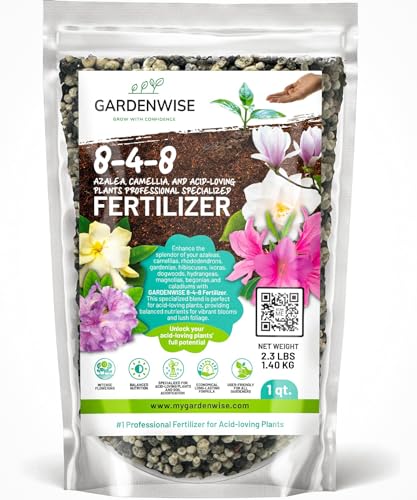
An economical, iron-enriched formula that requires just three feedings a year for sustained results.
This product brings a higher middle number (8-4-8) compared to the 4-3-4 of the Espoma, meaning a stronger phosphorus boost for root and bloom development. The 32-ounce bag is one-quarter the size of the Espoma’s 128-ounce total, but the concentration is higher. It is enriched with magnesium, iron, and manganese specifically to prevent chlorosis — the yellowing you see when an azalea cannot take up enough iron. The formula acts as a soil acidifier, which is crucial for plants that struggle in neutral or alkaline soil.
One reviewer noted, “I bought this for my newly planted rhododendron and it has doubled in size,” and another noted their magnolia tree in a pot is “helping it grow” — a memorial plant they are keeping in a container. The slow-release granules provide three feedings per year, which is quite convenient. The product is also described as eco-conscious, made from bio-solid waste treated to strip toxins and heavy metals while retaining live bacterial microbes.
Why It Works
- High 8-4-8 NPK with added iron and manganese for chlorosis prevention
- Slow-release formula requires only 3 feedings per year
- Includes live bacterial microbes for soil health
Things to Note
- Smaller 32 oz bag compared to the 128 oz Espoma pack
- Not organic — derived from bio-solid treatment process
Best for iron-deficient soils: Reach for this if your azaleas show yellow leaves despite getting enough water — the 8-4-8 ratio and added iron directly target chlorosis.
Skip it for organic gardens: If organic certification is a priority, the Dr. Earth or Espoma options are better aligned with your standards.
5. Jack’s Classic 17-6-6 Acid Special Water-Soluble Fertilizer, 1.5lbs

Concentrated 17-6-6 powder with added micronutrients for controlled, high-performance feeding.
This is a more concentrated option than the others in this list — the 17-6-6 analysis means you use less powder per gallon of water. The mixing ratio is 1 teaspoon per gallon of water. It is designed for both foliar (spraying on leaves) and root feeding, so you can apply it directly to the soil or onto the foliage for quick absorption. The powder comes with a measuring spoon, and each bag makes multiple gallons of liquid fertilizer.
A reviewer noted they prefer Jack’s over the Miracle-Gro Acid mix because the lower NPK (17-6-6 vs 30-10-10) reduces the risk of over-fertilization, and the sulfur content effectively lowers soil pH. The 24-ounce bag is smaller than the 80-ounce Miracle-Gro bag, but the concentration is much higher, so it goes further. Another buyer said their “berry plants love this stuff” and they have seen new growth after using it. It is great for azaleas, camellias, rhododendrons, hydrangeas, blueberries, and citrus.
Why It Stands Out
- Concentrated formula means more gallons per bag
- 1 teaspoon per gallon mixing ratio is easy to measure
- Works for both foliar spray and root drench feeding
Consider This
- Smaller bag size — 24 oz total
- Requires mixing and regular application every 1-2 weeks
For precise fertilizer users: This is your pick if you want a concentrated powder that gives you control over exactly how much each plant gets, with a built-in measuring spoon to avoid mistakes.
Not for beginners: If you prefer a sprinkle-and-forget granular approach, the True Organic or Fertilome options below require less active management.
6. True Organic Azalea, Camellia & Rhododendron Food – 12lb Bag
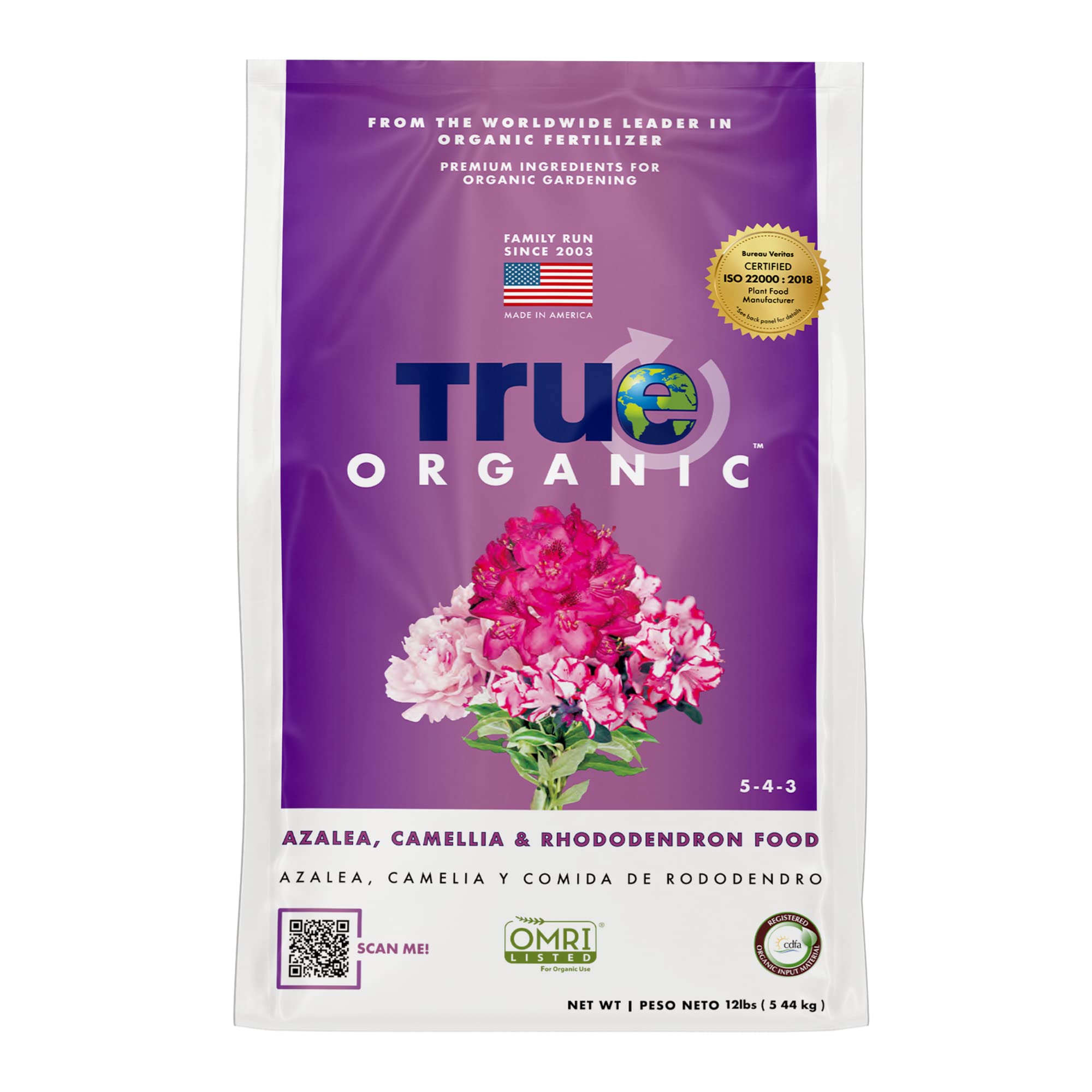
A 12-pound organic bag that covers up to 261 square feet with just two applications a year.
If you have a large hedge of azaleas or a big acid-loving border, this is the most economical organic option in terms of coverage. The 12-pound bag is formulated with 5% soil sulfur to lower pH naturally, and the 5-4-3 analysis is designed to promote lush blooms without pushing excessive leaf growth. The ingredients include seabird guano, shrimp and crab shell meal, and other natural sources — so it is a serious organic feed, not a chemical blend. The maker recommends application in spring and fall, so just two feedings per year.
One gardener shared that their zinnias were struggling, but after applying this, “the following 2 weeks, these flowers are pushing 4 feet tall, with the biggest blossoms ever.” Another reviewer noted that their roses are “beautiful” after using it. The bag is 100% made in the USA with organic inputs, and it covers up to 261 square feet — a full coverage product. You get one 12-pound bag in this order.
The Big Advantage
- Covers up to 261 sq ft per 12 lb bag — excellent value for large gardens
- Contains 5% sulfur for natural soil acidification
- Made from seabird guano and shellfish meal
Things to Know
- Strong earthy/seafood smell for a few days after application
- Requires watering in to activate the granules
Best for large organic gardens: Choose this if you need to cover a lot of ground organically — the 12-pound bag and twice-yearly application make it the easiest option for a big azalea or camellia hedge.
Not for small spaces: If you only have a few potted azaleas, the 12 lb bag is more than you need; the 4 lb Espoma or Dr. Earth bag would be a better fit.
7. Fertilome (13695) Azalea, Camellia, Rhododendron Food 9-15-13 (10 lbs.)
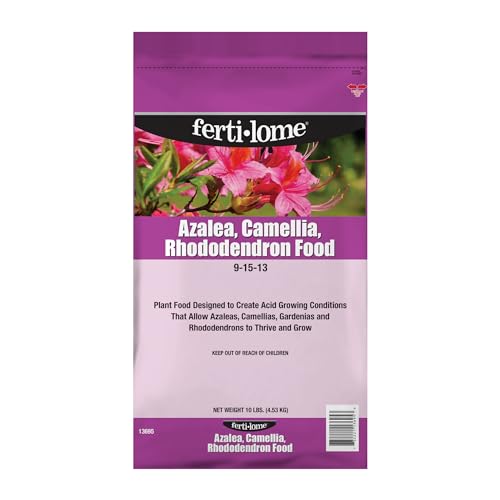
A high-phosphorus granular feed that creates ideal acidic conditions for maximum blooming.
This product has the highest middle number on this list — 9-15-13 — which means a strong phosphorus dose for root development and flower production. It is designed to create and maintain an acidic growing condition for azaleas, camellias, and rhododendrons. The 10-pound bag contains 160 ounces of granules, giving you plenty of product for the season. The maker recommends feeding existing plants in very early spring, again after blooming, and once more in the fall.
One buyer mentioned their rhododendron “hadn’t bloomed in almost 3 years until i used this!” — a strong testimonial for a plant that had been stubborn. Another buyer noted it revived stressed rhododendrons, with leaves becoming “greener, brighter” and new growth appearing. The application rate is simple: 1/4 to 1/2 cup for plants 1 to 5 feet tall, and 3/4 to 1 1/4 cups for plants 6 to 12 feet tall. It also contains micronutrients, which are the key benefit beyond just the N-P-K ratio, as one owner reported.
Why It Works Well
- Highest phosphorus number (15) for bloom stimulation
- 10-pound bag lasts a long time — up to 300 feedings
- Micronutrients included for overall plant health
Notes
- Not organic — chemical-based granular fertilizer
- Higher phosphorus may not be needed if your soil is already rich
For bloom-focused gardeners: Pick this if your azaleas or rhododendrons are well-established but not flowering — the high phosphorus (15) targets exactly that problem.
Skip if organic matters: If you need a certified organic input, the Espoma, Dr. Earth, or True Organic products are better suited for your growing philosophy.
Understanding the Specs
N-P-K Ratio
The three numbers on a fertilizer bag (e.g. 4-3-4, 8-4-8, or 17-6-6) tell you the percentage by weight of nitrogen (N), phosphorus (P), and potassium (K). For azaleas, a balanced or phosphorus-heavy ratio is usually best. Nitrogen promotes green leaf growth, phosphorus helps roots and flowers, and potassium boosts overall plant health. Avoid high-nitrogen lawn fertilizers — they push leaves at the expense of blooms.
Water-Soluble vs. Granular
Water-soluble powders (like Miracle-Gro and Jack’s Classic) dissolve in water and are taken up by roots immediately — you see results in days. Granular products (Espoma, Dr. Earth, GARDENWISE, True Organic, Fertilome) release nutrients slowly over weeks or months, requiring fewer applications. Granular is better for pre-planting, top-dressing, and long-term feeding; water-soluble is better for regular maintenance and container plants.
FAQ
When is the best time to fertilize azaleas?
Can I use regular garden fertilizer on azaleas?
How often should I water after applying granular fertilizer?
Is organic azalea fertilizer more effective than synthetic?
How much azalea fertilizer should I use per plant?
What causes yellow leaves on azaleas even when I fertilize?
Can I use azalea fertilizer on other acid-loving plants?
How do I switch from water-soluble to granular fertilizer?
What is the difference between 4-3-4 and 8-4-8 fertilizer for azaleas?
How long does granular azalea fertilizer last in the soil?
Final Thoughts: The Verdict
For most buyers, the best fertilizer for azaleas winner is the Espoma Organic Holly-Tone 4-3-4 because it combines proven organic ingredients, a balanced 4-3-4 ratio with 5% sulfur, and the simplicity of a sprinkle-and-water application that covers azaleas, hydrangeas, and blueberries. If you want the speed and flexibility of a water-soluble feed, grab the Miracle-Gro Water Soluble Azalea Food. And for large organic gardens that need broad coverage with minimal effort, the standout is the True Organic Azalea, Camellia & Rhododendron Food with its 12-pound bag covering up to 261 square feet.
How We Picked
We do not accept paid placement. Every pick is matched to a real buyer and a real use-case; we do not hands-on test units.
Sources & Methodology
Specifications: manufacturer listings and product documentation. Review insights: verified customer reviews, as of July 2026. Pricing: not shown on this page (it changes often); check the current price via the retailer link.
As an Amazon Associate, Lawn Gear Lab earns from qualifying purchases. This does not affect which products we feature.