
Asparagus is a perennial workhorse in the garden — one well-fed patch can produce for 15 to 20 years. But getting those thick, tender spears every spring comes down to one thing: giving the roots the right nutrition at the right time. This guide walks you through seven proven fertilizers, from slow-release granules to organic liquids, so you can pick the one that turns your asparagus bed into a long-term producer.
I’m Rikta — the co-founder and writer behind Lawn Gear Lab. This guide is built by comparing the manufacturers’ published specifications and the patterns across verified customer reviews, so you get each pick’s real strengths and trade-offs instead of marketing spin.
If you want thick, tender spears year after year, the right fertilizer for asparagus needs a balanced nutrient profile that supports deep root growth and steady top growth without burning the delicate crowns.
How To Choose The Best Fertilizer For Asparagus
Asparagus roots go deep, and they need a steady supply of nutrients over many weeks to build energy for next year’s spears. The wrong fertilizer can cause weak, spindly growth or even damage the crown. Here is what matters most.
N-P-K Ratio — Balanced or Phosphorus-Heavy
Asparagus thrives on a balanced fertilizer where the three numbers (nitrogen, phosphorus, potassium) are roughly equal or slightly heavier on phosphorus and potassium. Phosphorus (the middle number) fuels root and crown development, while potassium (the last number) boosts disease resistance. A 10-10-10 or 5-10-10 formula is ideal for most beds.
Slow-Release vs Fast-Release
Slow-release granules feed the soil over weeks or months, which matches the asparagus’s long growing season and reduces the risk of nutrient spikes that burn roots. Fast-release formulas give a quick green-up but require more frequent application and careful measuring.
Organic vs Synthetic
Organic fertilizers (like fish emulsion or compost-based granules) improve soil structure and microbial activity over time, which is critical for a perennial crop that stays in the ground for years. Synthetic options deliver nutrients faster but do little for long-term soil health.
Quick Comparison
On smaller screens, swipe sideways to see the full table.
| Model | Category | Best For | Key Spec | Amazon |
|---|---|---|---|---|
| Jobe’s Organics 4-4-4 | Organic Granular | Long-term soil health | 16 lbs, 4-4-4 NPK | Amazon |
| FoxFarm Happy Frog 5-7-3 | Premium Granular | Fruit & root development | 4 lbs, 5-7-3 NPK + calcium | Amazon |
| 10-10-10 Slow-Release | Balanced Granules | Steady 8-week feeding | 1 quart, 32 oz | Amazon |
| 10-10-10 Fast Release (Gardenera) | Fast-Release Granules | Quick green-up after winter | 2 quarts, 64 oz | Amazon |
| Cz Garden 5-10-10 | Phosphorus-Heavy | Spear size & fruiting | 4 lbs, 5-10-10 + iron | Amazon |
| Hi-Yield 8-10-8 | Vegetable Granules | Versatile garden feeding | 3.25 lbs, 8-10-8 NPK | Amazon |
| The Grow Co Fish Emulsion | Organic Liquid | Quick organic boost | 1 gallon, 2-3-1 NPK | Amazon |
In‑Depth Reviews
1. Jobe’s Organics Granular All Purpose Fertilizer, 4-4-4

The 16-pound bag and its 4-4-4 NPK ratio make Jobe’s Organics the top pick for anyone managing an established asparagus bed that needs steady, gentle nutrition across the whole growing season — exactly what a perennial that lives 15+ years needs. This isn’t a quick-fix fertilizer; it is a long-term soil builder that feeds the crowns slowly so you get thicker spears each spring.
The balanced 4-4-4 ratio (each nutrient equally at 4%) means you do not need to worry about burning young shoots, and the OMRI-listed organic ingredients (verified by the USDA for organic gardening) mean no synthetic chemicals lingering in the bed. One reviewer noted that mixing 1 cup of granules with 1 gallon of dechlorinated water and steeping it for 24 hours created a liquid that caused “rapid budding and flowers within 48 hours” on squash — a sign of how bioavailable the nutrients are.
At 16 pounds, this bag holds 4x the weight of the FoxFarm Happy Frog (4 lbs), so it is the clear value king for large beds. The only real trade-off is the pungent organic smell when first applied, though buyers report it fades faster than raw manure. For a long-lived perennial like asparagus, this is the one steady, season-long feed you can count on.
Why it’s great
- Massive 16-pound bag covers a large asparagus bed for the whole season
- OMRI-listed organic formula builds long-term soil health
- Balanced 4-4-4 NPK is gentle on crowns and safe for repeated use
Good to know
- Pungent organic smell when first applied (fades within a few days)
- Granules are small and friable, so a hand spreader works best
2. FoxFarm Happy Frog Tomato & Vegetable Fertilizer, 5-7-3

The FoxFarm Happy Frog 5-7-3 beats Jobe’s on phosphorus (7% vs 4%) and calcium inclusion, making it the better choice if your asparagus bed has shown signs of weak root growth or you want to push spear size during the harvest window. Its 5-7-3 ratio leans into phosphorus (the middle number) and potassium (the last number) — both critical for crown development and disease resistance — while keeping nitrogen moderate so you don’t get all leaf and no spear.
This granular formula also contains mycorrhizal fungi, which attach to roots and improve water and nutrient uptake — a real benefit for asparagus whose deep roots need to access subsoil moisture. Owners mention that “Fox Farm products produce bumper tomato crops when blended with Ocean Forest soil, perlite, and coco coir,” and the same performance carries over to asparagus when worked into the top few inches of soil.
At 4 pounds, the bag holds 2.7x less weight than Jobe’s 16-pound bag, so you will need to reorder sooner for a large bed. But if you want concentrated root nutrition and are willing to pay a premium per pound, the Happy Frog is the better pick.
Where it shines
- Added calcium helps prevent common crown issues like root rot
- Mycorrhizal fungi boost root efficiency and water absorption
- Organic formula with no chemical or fishy smell
Worth noting
- Only 4 pounds — a 2.7x smaller bag than Jobe’s for the same price tier
- Higher phosphorus means careful measuring to avoid over-applying
3. 10-10-10 Slow-Release Premium Fertilizer
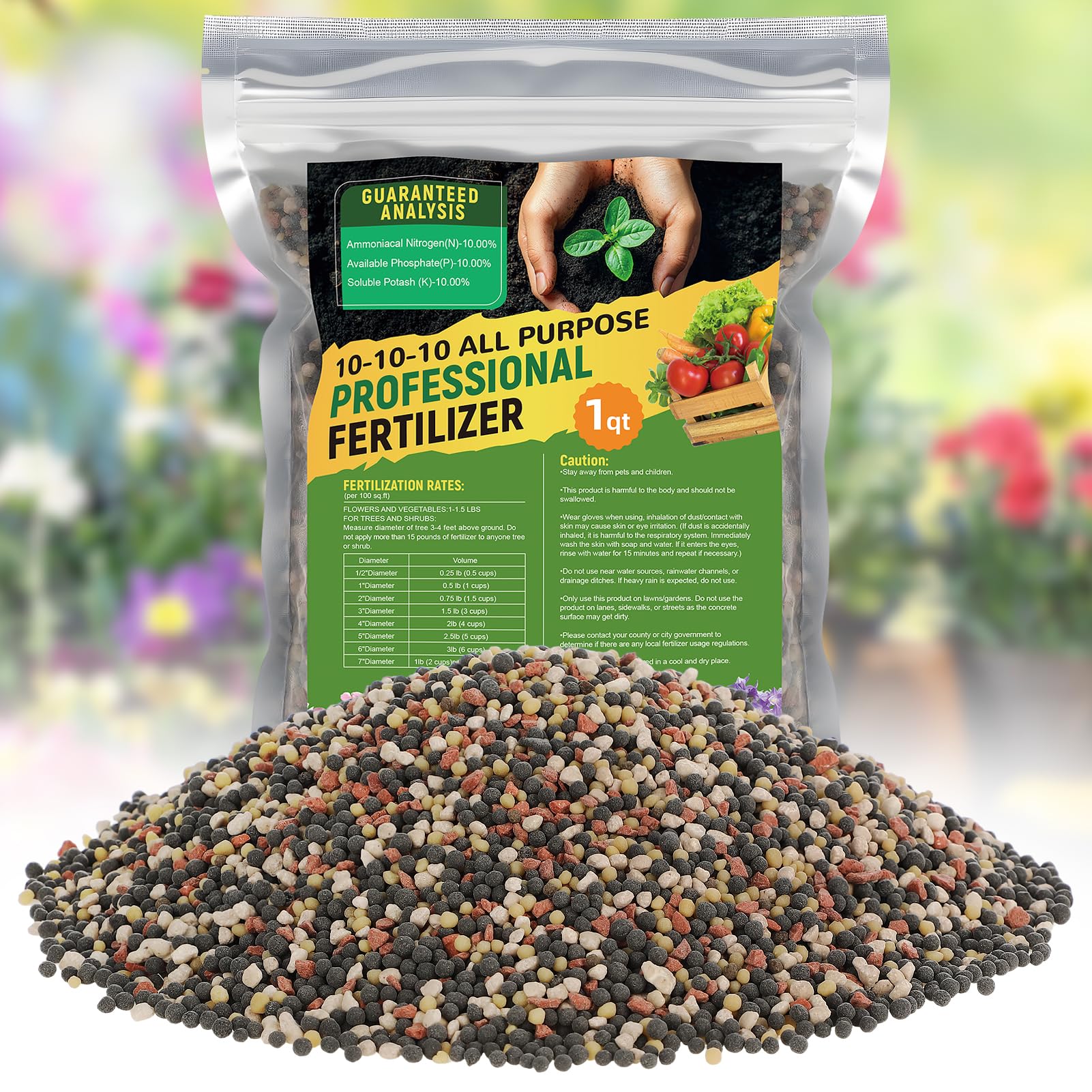
If you need a set-it-and-forget-it option for a new asparagus bed, the 10-10-10 slow-release formula feeds for up to 8 weeks with a single application — no weekly mixing or hauling bags. The balanced 1:1:1 NPK ratio (10% each of nitrogen, phosphorus, and potassium) covers all three growth stages: leaf production, root development, and disease resistance.
One buyer mentioned it “worked well on the small tree we were afraid was going to die,” which speaks to how gentle the slow-release mechanism is on stressed plants. The granules are packed in a resealable container (1 quart, 32 ounces), so you can apply exactly what each crown needs without waste.
At 32 ounces, this is half the volume of the Gardenera 10-10-10 fast-release (64 ounces), but the slow-release technology means you apply less often. For a mid-sized bed of 10 to 20 crowns, one container handles two full feedings per season.
What stands out
- 8-week slow-release window means less frequent application
- Resealable container keeps granules dry between uses
- Balanced 10-10-10 is gentle on new and established crowns
The trade-offs
- 32-ounce pack is half the volume of the Gardenera fast-release (64 oz)
- Not OMRI-listed, so not suitable for certified organic gardens
4. Gardenera 10-10-10 Fast Release Plant Fertilizer
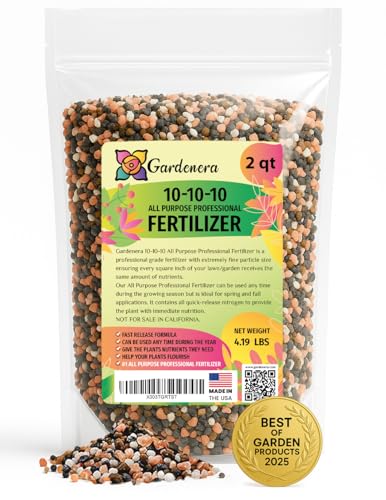
The single number that matters most in this category is the N-P-K ratio, and the Gardenera 10-10-10 scores a balanced 10-10-10 fast-release formula that delivers nutrients immediately — no waiting for slow-release coatings to dissolve. At 64 ounces per container, this is a 2.0x larger volume than the slow-release 10-10-10 (32 ounces), giving you more feedings per purchase.
One owner reported “just need a few pellets around plants and they grow healthy with lots of new growth and blooms,” which is exactly the scenario for early-spring asparagus: a small dose around each crown to wake up the roots. The fast-release nature means you apply every 2 to 3 weeks during the growing season, not once every 8 weeks.
Buyers caution that the bag can arrive with loose seals — one reported “bag arrived open in transit due to poor packaging” — so store it immediately in a sealed container. But for the sheer volume (64 ounces at a budget-friendly tier) and immediate nutrient availability, this is the best option for gardeners who like to control timing, offering strong price-to-value for frequent feeding.
The upsides
- 64-ounce container — 2.0x the volume of the slow-release competitor (32 oz)
- Fast-release formula provides visible results within days
- Balanced 10-10-10 works for all garden plants, not just asparagus
Keep in mind
- Requires every-2-3-week reapplication during the growing season
- Bag seal may be weak; transfer to an airtight container on arrival
5. Cz Garden 5-10-10 Tomato & Vegetable Fertilizer

At this lower price, you get a 4-pound resealable pouch of 5-10-10 granules with 2% iron and colored beads that show where you have spread them — a targeted phosphorus and iron supplement rather than a balanced all-purpose feed.
One buyer described it as “effective late-season veggie fertilizer for fruiting” and noted you apply just one spoonful around the dripline after watering — a simple routine that works for asparagus too. The 4-pound bag comes in a resealable pouch, and the granules include colored beads that help you see where you have spread them.
This is not a balanced all-purpose feed; it is a targeted phosphorus and iron supplement. Use it in late spring or early summer after the main spear harvest to give the crowns the nutrients they need to build energy for next year. The catch is low nitrogen (5%), so you will need a balanced feed early in the season — it is perfect for the budget buyer who already has a balanced spring fertilizer and just wants a low-cost phosphorus and iron boost for mid-season asparagus care.
Why we’d pick it
- 10% phosphorus directly supports crown energy storage for next year’s spears
- 2% iron keeps fern foliage dark green and productive
- Resealable pouch with colored beads for easy application tracking
A few caveats
- Low nitrogen means you need a separate balanced feed in early spring
- Best used as a mid-season side-dress, not a sole fertilizer
6. Hi-Yield Garden Fertilizer, 8-10-8
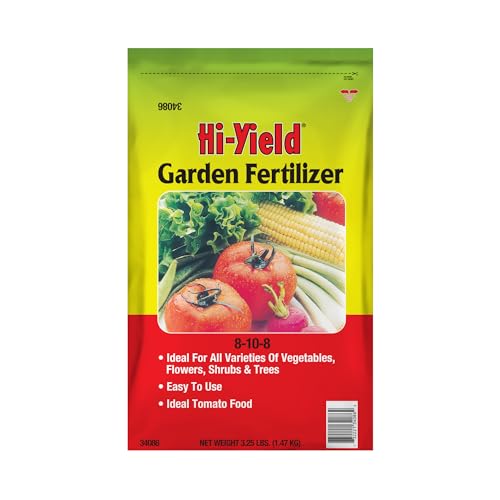
If you have a mixed vegetable garden and want one granular fertilizer that handles asparagus, tomatoes, and flowers without buying separate bags, the Hi-Yield 8-10-8 hits a useful middle ground. Its 8% nitrogen keeps the leaves green, 10% phosphorus feeds roots and crowns, and 8% potassium supports overall plant health.
One buyer confirmed “granular 8-10-8 fertilizer for banana plants” and noted that “granules slowly dissolve with watering” — the same slow-release behavior works well for asparagus, where you want nutrients to sink down to the deep roots. The 1.5-pound bag is lightweight compared to Jobe’s 16-pound behemoth (a 10.7x weight difference), so it is easier to handle and store in small sheds.
At 1.5 pounds, this bag covers about 50 square feet per application (at 1.75 lbs per 50 sq ft for new plants), making it ideal for a small bed of 5 to 10 crowns. It is not organic, but the 8-10-8 ratio is one of the best non-organic options for balancing growth and storage — just keep in mind that the small bag size means you will need to reorder more frequently than with larger bulk options.
Strong points
- 8-10-8 ratio is perfectly balanced for asparagus and other vegetables
- Granules dissolve slowly with watering for sustained feeding
- Light 1.5-pound bag is easy to store and handle
Before you buy
- Not OMRI-listed — not suitable for certified organic gardens
- Small bag means more frequent reorders for large beds
7. The Grow Co Organic Fish Emulsion Fertilizer, 2-3-1

At roughly $25 per gallon, the Grow Co fish emulsion sits near the middle of the price range among these seven picks — cheaper than the premium liquid kelp blends but more expensive than basic granular organics — and its concentrated 1:100 dilution ratio makes it one of the best values per gallon of finished feed on this list. One gallon of concentrate yields over 160 gallons of ready-to-use liquid, and its 2-3-1 NPK ratio is phosphorus-heavy, which is exactly what asparagus needs for strong crown development.
Buyers confirm “it stinks! this is good because it’s supposed to stink, my plants love this stuff,” and note the odor is a sign of real hydrolyzed fish protein — not a synthetic substitute. The liquid form is perfect for foliar feeding (spraying directly on the ferny tops) or as a soil drench around the crown area, and the 1-gallon bottle covers an entire season for a medium asparagus bed.
The honest trade-off: the fish smell is strong and can linger for hours after application. One 50-year gardener recommended watering it in immediately and using rainwater that has been allowed to sit to dechlorinate. If you can handle the smell, the one clear reason to choose it is that it is the best organic liquid for pushing spear production without synthetic inputs.
What we like
- 1 gallon makes over 160 gallons of diluted feed — incredible value
- 2-3-1 NPK is phosphorus-heavy for strong asparagus crowns
- Sustainably sourced fish emulsion with no synthetic additives
The downsides
- Strong fish odor that some gardeners find unpleasant
- Must be diluted at 1:100 ratio — easy to over-apply if not careful
Understanding the Specs
N-P-K Ratio — The Three Numbers
Every fertilizer label shows three numbers, like 10-10-10 or 5-10-8. The first is nitrogen (N), which drives green leaf and stem growth. The second is phosphorus (P), which fuels root development, crown storage, and flower/fruit production. The third is potassium (K), which boosts disease resistance and overall plant hardiness. For asparagus, you want the phosphorus number (the middle one) to be the same or slightly higher than the nitrogen number — a 10-10-10 or 8-10-8 is ideal.
Slow-Release vs Fast-Release
Slow-release fertilizers have a coating or organic base that breaks down over weeks (often 6 to 8 weeks) so the nutrients are released gradually. This matches the asparagus’s long growing season and reduces the risk of root burn. Fast-release formulas dissolve immediately and give a quick green-up, but they require more frequent application — every 2 to 3 weeks — and you must measure carefully to avoid a nutrient spike that damages the crown.
FAQ
When should I fertilize my asparagus bed each year?
Why is phosphorus important for asparagus specifically?
Can I use a tomato fertilizer on my asparagus?
Final Thoughts: The Verdict
For most asparagus growers, the fertilizer for asparagus winner is the Jobe’s Organics 4-4-4 because its giant 16-pound bag, organic certification, and gentle balanced ratio make it the easiest way to feed a perennial bed for years without guesswork. If you want premium root nutrition with calcium and mycorrhizae, grab the FoxFarm Happy Frog. And for a quick organic liquid boost that covers the whole garden, the standout is the Grow Co Fish Emulsion.