
Specs are compiled from manufacturer listings and verified buyer reviews and can change over time — please confirm the key details on the product page before buying.
You laid that pretty fence, edged the beds perfectly, and within a month — weeds. A fence line is a weed superhighway: sunlight hits the bare soil right at the base where the mower cannot reach, and you are back on your knees. A good weed barrier does not just slow them down; it cuts the line between sunlight and soil so thoroughly that the only thing growing is what you planted. The trick is picking a fabric that blocks light, drains rain, and does not disintegrate after one season of sun and snow.
I’m Rikta — the founder and writer behind Lawn Gear Lab. This guide is built by comparing the manufacturers’ published specifications and the patterns across verified customer reviews, so you get each pick’s real strengths and trade-offs instead of marketing spin.
You want a fence weed barrier that stops weeds for years without constant maintenance — these eight picks do exactly that, each earning its spot with real specs and real results.
Our Picks at a Glance

How To Choose The Best Fence Weed Barrier
A fence line is one of the hardest spots in your yard to keep clean. A mower cannot trim tight against the posts, and a string trimmer flings soil everywhere. A landscape fabric is your best first move, but the wrong one tears, sheds plastic fibers, or lets weeds punch through in a single growing season. Here is what separates the keepers from the one-season wonders.
Fabric Weight and Density
The number that matters most is ounces per square yard — you will see 3.2 oz and 5 oz on the labels here. A 3.2 oz fabric is the standard for most home gardens and fence lines; it blocks enough light to suppress weeds while staying flexible and easy to cut. A 5 oz fabric is nearly twice as thick, takes more abuse from foot traffic and tools, and generally lasts longer — but it is noticeably heavier to carry and harder to cut cleanly.
Woven vs Non-Woven Construction
Woven fabric looks and feels like a sturdy cloth bag — it is what most people picture as “landscape fabric.” The weave creates tiny gaps that let water and air pass through while blocking light. Non-woven fabric (sometimes called needle-punched) feels like felt and acts a bit like a filter; it lets water drain fast but can hold more moisture on the surface. For a fence line where you want good drainage under gravel or mulch, a high-quality woven fabric with a tight weave is usually the better bet.
Permeability and Drainage
A barrier that traps water turns your garden bed into a swamp. Look for fabric that is described as permeable or breathable — the best ones use the weave itself to draw water downward through “molecular attraction” (essentially, the fibers act like a wick). That keeps the soil underneath moist without puddling on top, which means healthier plant roots and less runoff onto your path or driveway.
UV Resistance and Longevity
Any fabric left exposed to direct sun will eventually break down. Some manufacturers add anti-aging compounds or use polypropylene that resists UV degradation. If your fence line gets full afternoon sun, you want a fabric that specifically mentions UV resistance or includes stabilizers. The general rule: a 3.2 oz quality fabric with UV stabilizers should hold up for several growing seasons before it starts to weaken.
Ease of Cutting and Fraying
This is the practical pain point that frustrates almost every DIY installer. Cheaper fabrics and some woven polypropylenes unravel along the cut edge — the loose strands then catch on your rake, your boots, and the wind, tangling into a mess. Better fabrics use a construction that minimizes fraying (special woven edges or a dense needle-punched layer). If you plan to cut the fabric into strips for a fence row, a fabric that holds its edge cleanly will save you a lot of cleanup.
Quick Comparison
| Model | Best For | Weight / Thickness | Width x Length | Water Permeability | Amazon |
|---|---|---|---|---|---|
| VIVOSUN Premium Weed Barrier★ Best Overall | Heavy-duty garden beds & fence lines | 5 oz, double-layered | 3 ft x 50 ft | 6x more than traditional woven | Amazon |
| VEVOR 4x100FT 3.2ozBest Value | Large area coverage on a budget | 3.2 oz (90.7g) | 4 ft x 100 ft | Uniform micro gaps | Amazon |
| Winisok 4FT x 100FTRunner Up | Long-term weed control with high durability | 3.2 oz | 4 ft x 100 ft (2×50 ft) | High permeability & breathability | Amazon |
| Winisok 3FT x 100FT | Narrow fence rows & standard beds | 3.2 oz | 3 ft x 100 ft (2×50 ft) | Superior permeability | Amazon |
| FEED GARDEN 4FT x 100FT | All-in-one starter kit with stakes | 3.2 oz | 4 ft x 100 ft (2×50 ft) | Good permeability | Amazon |
| 3x300FT Weed Barrier | Massive landscaping projects | 3.2 oz | 3 ft x 300 ft | Shading properties, air/water penetrate | Amazon |
| Pattiumo Weed Barrier Fabric 3x300FT | Heavy foot traffic & driveways | 3.2 oz, dual-layer needle-punched | 3 ft x 300 ft | Permeable & breathable | Amazon |
| Vanver 3ftx300ft | Versatile garden & path coverage | 3.2 oz | 3 ft x 300 ft | High permeability, slow air/water exchange | Amazon |
In‑Depth Reviews
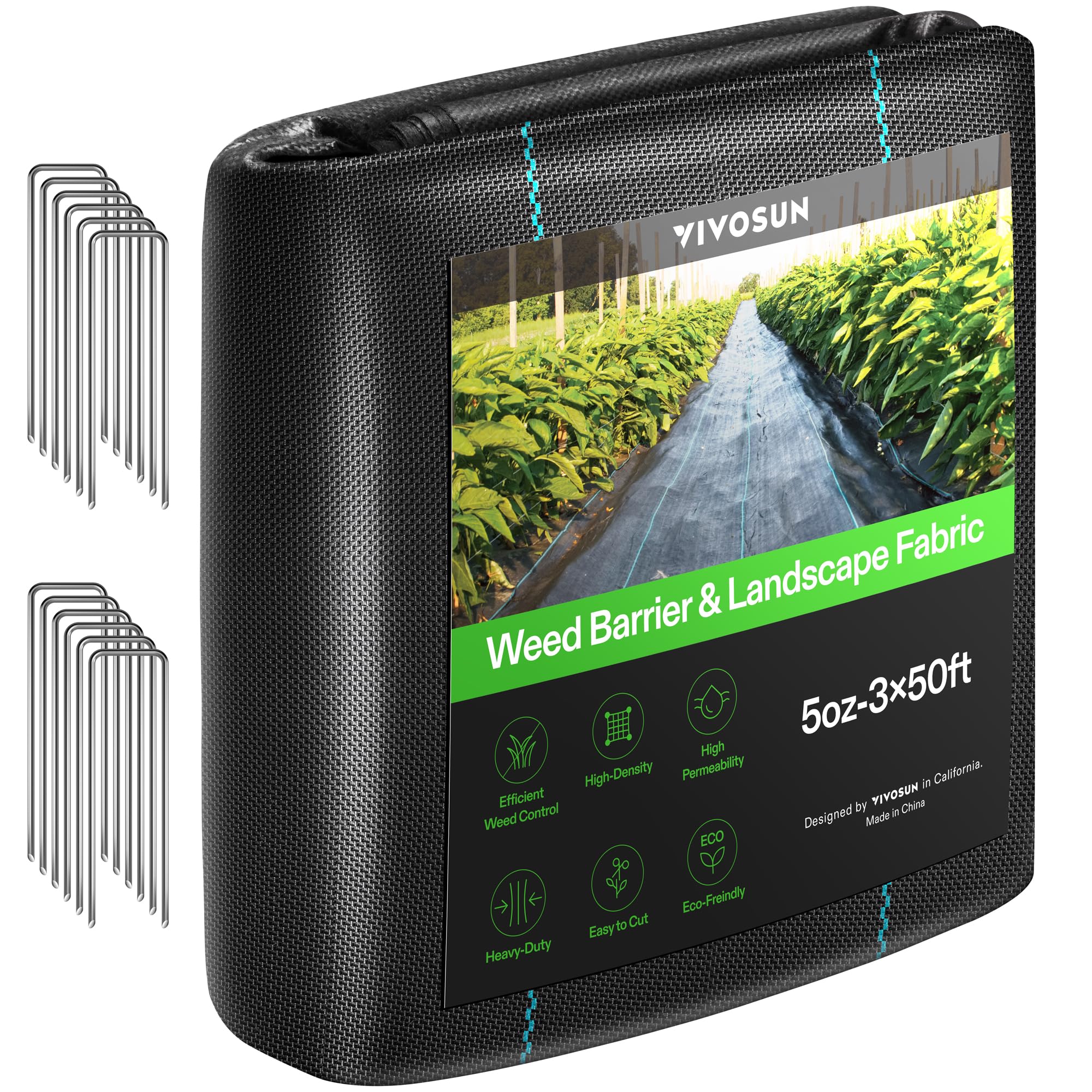
1. VIVOSUN Premium Weed Barrier Landscape Fabric 3ftx50ft
Our pick — over 4.5★ from 900+ verified ratings; the strongest balance of quality and price.
The thickest fabric on this list, built to shrug off foot traffic and keep weeds out for seasons.
At 5 oz with a dual-layer construction that bonds a non-woven layer to a woven one, this is the heavy hitter. The woven base has small holes, while the non-woven fibers on top use molecular attraction to pull water downward — so you get six times the water permeability of a standard woven ground cover. That means your garden beds drain fast while the fabric stays opaque enough to block all sunlight. Owners say they “walk on it everyday” and it holds up great, which matches the tough feel right out of the package. The green guide lines every foot help you space plants evenly without reaching for a tape measure.
The trade-off is fraying at the cut edge — a few buyers report it unravels more than they would like when trimmed. That is the price of that dense construction. At 3 ft wide and 50 ft long, it is best suited for medium runs along a fence line or standard raised beds rather than a sprawling yard. The crowd favorite rating backs it up: this one earns the top spot for anyone who wants low-maintenance defense against weeds.
The fabric that drains fast: The dual-layer design gives you 6x the water pass-through of traditional woven fabrics, so even after a heavy rain your soil is not waterlogged.
Reach for this for: A fence line or garden bed you want to install once and not touch again for years, especially if you walk on it regularly.
Look elsewhere if: You need to cut it into narrow strips — the fraying at cut edges is a genuine nuisance that requires a sharp blade and patience.
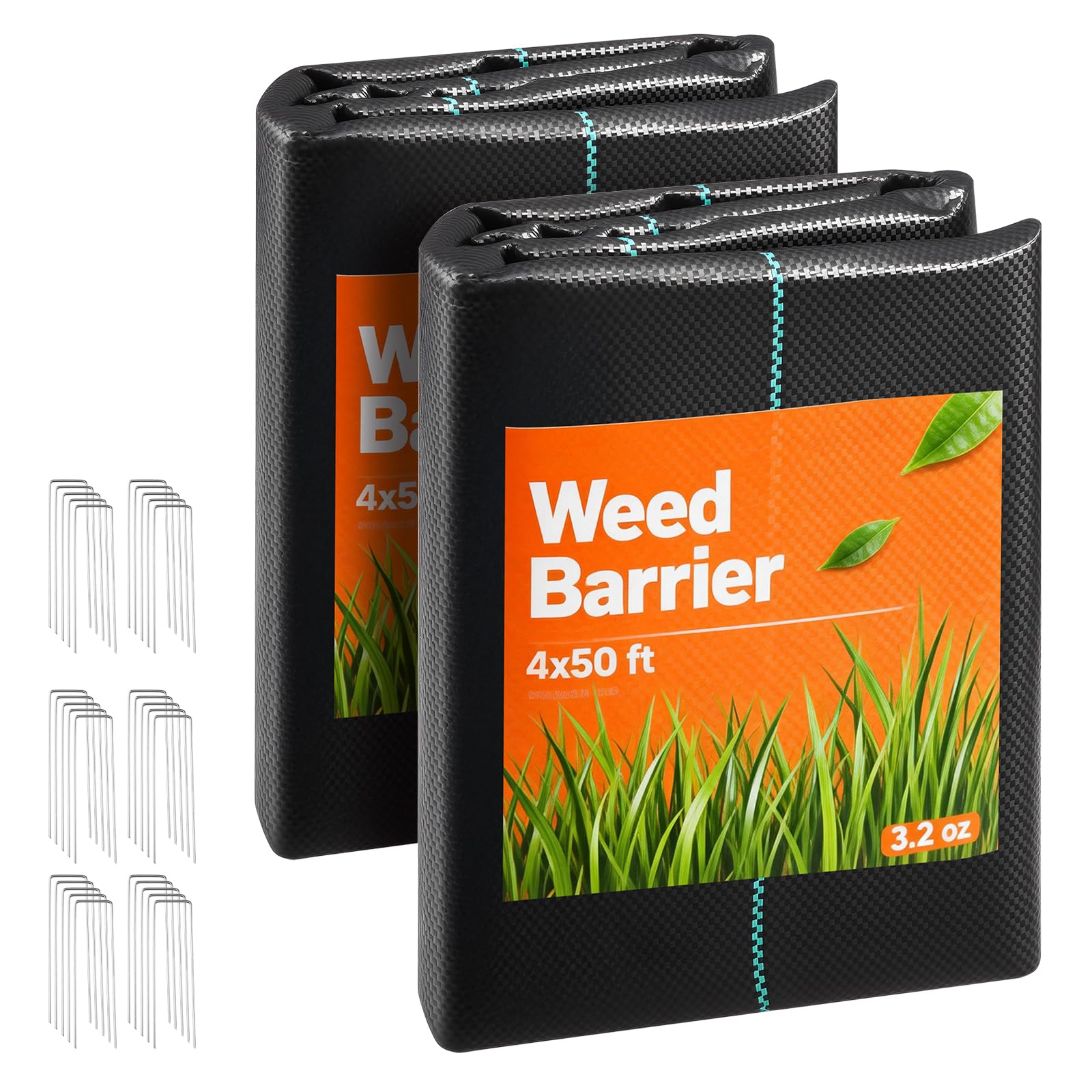
2. VEVOR 4x100FT 3.2oz Weed Barrier Fabric
A 100-foot roll that covers twice as much ground as the top pick for a similar outlay.
The VEVOR covers more ground per dollar than most picks here — its 3.2 oz high-density PP woven material (the standard weight for residential landscape fabric) comes in a 4 ft wide by 100 ft long roll, covering about 200 sq ft at full width. The woven structure creates uniform micro gaps that let water, air, and nutrients through while staying dense enough to block weed root penetration. Owners mention: “No weeds coming through. The item is well worth it. It’s thick durable and well made.” Several mention it costs half what a home improvement store charges for similar quality.
It is not without quirks. Like several woven fabrics here, it can unravel into long streamers when cut into strips — especially if you are using it for row covers. A few owners flagged that the included stakes are flimsy, so you will want to budget for heavy-duty ground staples if you are covering a windy area. But for the price per square foot, this is the strongest budget-friendly contender for big fence-line projects.
Massive coverage, modest cost: At 8.16 pounds for the full roll, it is noticeably heavier than a 50-ft option, but that weight comes from 100 feet of fabric — great for large gardens or long property lines.
Grab this for: Large areas where you need to suppress weeds across a long stretch — think a 100-ft fence row or a big vegetable patch.
Think twice if: You plan to cut it into narrow strips for individual plant rows; the unraveling is a real headache that requires melting the cut edges.
3. Winisok 4FT x 100FT Weed Barrier Landscape Fabric
A 5-year weed-control claim backed by tightly woven polypropylene that stands up to abuse.
Winisok stakes a strong claim: more than 5 years of effective weed control from a 3.2 oz fabric. The tightly woven polypropylene is tear-resistant, and the fabric is sold as two 4 ft x 50 ft sheets (not a single roll), which makes it easier to handle and stretch across a bed without a helper. Owners say it is “really tuff stuff” — strong enough to require a sharp blade for cutting — and that water passes through freely while weeds stay out. The green stripes for planting alignment are a simple but welcome touch when you are laying out a long fence row.
The honest downside: the fabric shreds some. A few customers note it leaves plastic strands in the soil when cut, and if you plan to remove and reuse it seasonally, those fibers become a nuisance. It is better suited as a permanent installation where you lay it down, cover it with mulch, and forget it. That durability is exactly what a fence weed barrier needs, but the fraying at cut edges is something to plan for.
Built for permanence: The 5-year durability claim is not just marketing — the tight weave genuinely resists tearing under gravel and stone, making it a strong choice for paths as well as beds.
Ideal for: Permanent garden beds and fence lines where you will lay fabric once and cover it with mulch, bark, or stone.
Not ideal for: A seasonal garden where you lift and replant every year — the shredding when cut makes removal messy.
4. Winisok 3FT x 100FT Weed Barrier Landscape Fabric
The 3-ft width is perfect for standard fence rows, giving you a clean strip without excess overhang.
This is the same Winisok 3.2 oz fabric as the 4-ft version above, but in a narrower 3-ft width that many fence-line installers will find more practical. A 3-ft strip covers the ground right along the fence base without leaving a wide flap that catches mower clippings. Owners mention that the green guide lines are genuinely helpful for keeping plants in a straight row, and the fabric has been in place for many months with no weeds pushing through. One buyer called it “great value” and said the delivered price beats big-box store options. The roll is lighter too — 5.35 pounds versus the 4-ft version’s 7.59 pounds.
The catch is the same as the 4-ft version: significant fraying at cut edges. One owner specifically warns against cutting with scissors (they recommend a utility knife on a hard surface), and the fabric is not really reusable year to year if you change your layout. For a permanent fence-line install where you cut a few slits for plants and then cover with mulch, it works beautifully.
Width that fits fence work: At 3 ft wide, you get a clean barrier that sits under the fence line without wasteful overhang — exactly what a property-border application needs.
Best for: Straight fence rows where you need a 3-ft barrier and want to avoid trimming a wider roll down to size.
skip it if: You anticipate lifting and repositioning the fabric yearly — the edge fraying grows worse with each handling.
5. FEED GARDEN 4FT x 100FT Landscape Fabric with 30 U-Shaped Stakes

Comes with 30 ground staples, so you can start installing the minute the box arrives.
FEED GARDEN bundles the fabric with 30 U-shaped stakes — a practical bonus that means you do not need a separate trip to the hardware store. The fabric itself is a standard 3.2 oz woven polypropylene with clear green guide lines. Owners find it sturdy enough to stop chipmunks from digging under a fence line, and several praise the price compared to big-box stores. One reviewer noted it is “strong enough to keep the Chipmunks from Digging” and that the fraying after cutting was not too bad — a better experience than some other woven fabrics here.
The fabric runs slightly thinner than some expect, and the included stakes are not heavy-duty — they work fine for holding the fabric flat during installation, but for long-term wind resistance you may want to upgrade to longer staples. The edge still frays when cut, as most woven polypropylenes do, but the included stakes and the straightforward installation make this a solid all-in-one kit for a weekend project along a fence. pass on it if you need a fabric that won’t fray at all when cut — that is not this material.
Everything in one box: The 30 U-shaped stakes eliminate the biggest “I forgot to buy” frustration, so you can lay and pin the fabric in one go.
Reach for this if: You want a ready-to-install kit for a medium-size project and appreciate not having to buy stakes separately.
Pass if: You need extremely thick fabric for heavy foot traffic or vehicle loads — the 3.2 oz is standard, not “commercial grade.”
6. 3x300FT Weed Barrier Landscape Fabric

A 300-foot roll that turns a weekend of measuring into one afternoon of continuous laying.
If you are covering a long fence line, a 300-ft roll means fewer seams, fewer overlaps, and fewer places for weeds to sneak through. This is a 3.2 oz heavy-duty woven polypropylene that comes with 20 U-shaped fixing staples. The fabric includes clear green guide lines for accurate trimming, and owners find it easy to cut with scissors. One buyer with a large garden called it “great weed suppression” and noted the 3-ft width covers big areas efficiently. The 300 ft length is not folded but rolled, so it unfurls smoothly — less wrestling than a folded sheet.
The included staples are lightweight and bend under pressure — several owners note they are cheap and recommend replacing them with stronger ones. And like most woven fabrics, weeds can still push through if you get a thin spot or a tear during installation. For the sheer coverage, it is impossible to beat on cost-per-foot, but you will want good ground prep and strong staples to make it last.
One roll, one day: A continuous 300-ft length means you lay it once without stopping to re-position, saving hours on a large fence-line project.
Ideal for: Big properties, long fence runs, or any project where seam-to-seam coverage is a priority.
it’s not for you if: You only need 50 ft — the roll is heavy (18.16 pounds) and oversized for small gardens.
7. Pattiumo Weed Barrier Fabric 3x300FT

A needle-punched dual layer that handles foot traffic and even vehicle weight without tearing.
Pattiumo uses a cross-woven, needle-punched dual-layer construction in a 3.2 oz fabric. That needle-punching step fuses the fibers together rather than just weaving them, which gives it better resistance to fraying and punctures than standard woven fabrics. The fabric is opaque to light — it blocks sunlight completely — and stays breathable so air and water reach plant roots. Owners who use it under river stone or wood mulch report effective weed control for three years or more. The roll is 3 ft wide and 300 ft long, giving you continuous coverage for large projects.
It is not a magic shield. A few owners note that weeds still grow through if there is any dirt sitting on top of the fabric — so you need a clean layer of mulch or stone over it. The water runoff can also be an issue if you are not using drip irrigation; watering slowly is the fix. But for a heavy-use area like a driveway border or a path that gets foot traffic, this fabric holds up better than the basic woven options.
Built for traffic: The needle-punched dual-layer construction makes it noticeably tougher against wear from feet, tools, and even light vehicle rolling.
Choose this for: Driveway edges, gravel paths, or any fence line that sees regular foot traffic and needs a fabric that does not rip.
Not for: pure planting beds where water pooling on the surface could be an issue — you may need drip irrigation or slower watering.
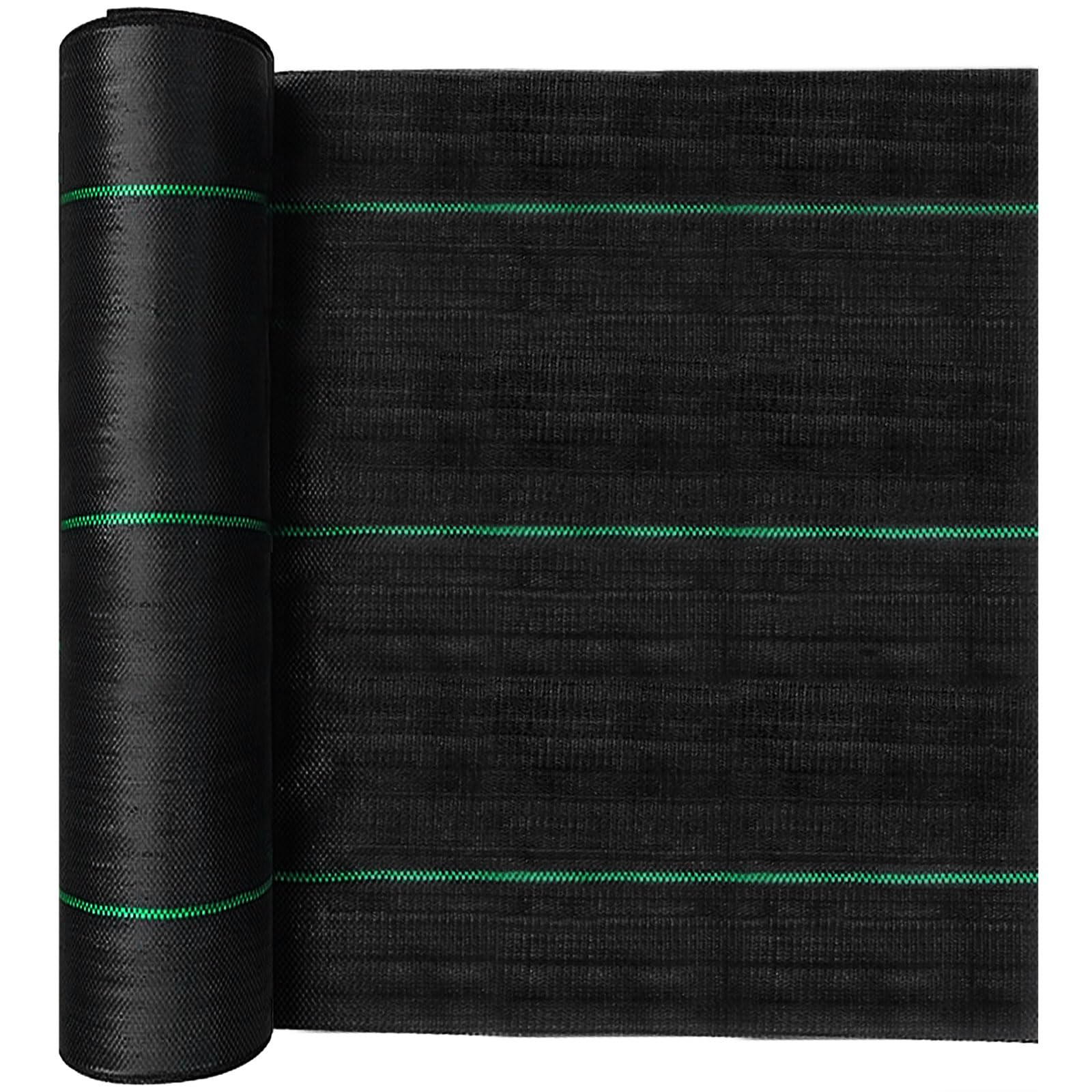
8. Vanver 3ftx300ft Garden Landscape Fabric
A budget-friendly 300-ft roll with anti-aging material to stretch its life under the sun.
Vanver’s 3.2 oz woven polypropylene fabric includes an anti-aging additive that helps it resist UV breakdown longer than basic polyethylene alternatives. The woven construction allows slow exchange of air, water, and nutrients while blocking light. The fabric cuts cleanly enough with scissors, and the 3-ft width is a natural fit for fence-line strips.
The durability is a mixed bag. Some buyers find it thick enough to block weeds effectively; others say it is thinner than they expected and that some weeds still push through after a month. Fraying at cut edges is a common note. The anti-aging treatment is a real plus for a sun-exposed fence line, but you still need a solid layer of mulch or stone on top to ensure nothing grows through the weave itself.
Sun-fighting additive: The anti-aging material is a genuine advantage for a fence row that gets full afternoon sun — it slows the fabric’s breakdown compared to untreated polypropylene.
Great for: Sunny fence lines and walkways where you want a full 300-ft run without spending premium money.
Keep looking if: You expect the fabric alone to stop every weed — you will still need a clean layer of mulch or stone on top.
Understanding the Specs
Fabric Weight (oz/sq yd)
This is the number you see as “3.2 oz” or “5 oz” on every label. It tells you how dense the fabric is. A 3.2 oz fabric is standard for most home gardens — it flexes easily, cuts with scissors, and blocks enough light to suppress most weeds. A 5 oz fabric is noticeably thicker and heavier, which makes it more resistant to tearing and foot traffic, but harder to cut and heavier to carry. For a fence line that you will cover with mulch, 3.2 oz is usually plenty. If you are laying gravel or stone on top, the heavier 5 oz option gives you more puncture resistance.
Water Permeability
Water permeability tells you how fast rain and irrigation flow through the fabric into the soil below. A fabric that drains well prevents puddling and keeps plant roots healthy. Some high-end fabrics use a needle-punched or dual-layer design that creates tiny channels for water to travel down by “molecular attraction” — essentially the fibers wick the water through. Others rely on the simple weave pattern. For a fence-line barrier, you want permeability so water does not run off onto your path, but it does not need to be as fast-draining as a fabric in a vegetable bed that gets daily watering.
FAQ
Will a fence weed barrier stop all weeds from growing?
How do I prevent the fabric from fraying when I cut it?
Can I install a fence weed barrier directly over existing weeds?
How many ground staples do I need for a fence line?
What width fabric do I need along a fence?
Will water pool on top of the fabric after rain?
How long does landscape fabric last under gravel?
Can I use a fence weed barrier under artificial turf?
Is a 3.2 oz fabric thick enough for a driveway edge?
What is the difference between woven and non-woven landscape fabric?
Final Thoughts: The Verdict
For most buyers, the fence weed barrier winner is the VIVOSUN Premium Weed Barrier because its 5 oz dual-layer construction blocks weeds completely while draining six times faster than standard fabrics — a rare combination of density and breathability that works beautifully under mulch. If you are covering a long stretch and want the best coverage per dollar, grab the VEVOR 4x100FT — at 100 feet, it covers twice as much ground as most competitors for a similar budget. And for a big project like an entire property line where you want continuous fabric with no seams, the 3x300FT Weed Barrier is the one to reach for: one roll, one afternoon, done.
How We Picked
We do not accept paid placement. Every pick is matched to a real buyer and a real use-case; we do not hands-on test units.
Sources & Methodology
Specifications: manufacturer listings and product documentation. Review insights: verified customer reviews, as of July 2026. Pricing: not shown on this page (it changes often); check the current price via the retailer link.
As an Amazon Associate, Lawn Gear Lab earns from qualifying purchases. This does not affect which products we feature.