
Autumn is the season when your trees retreat into dormancy, but the window before the ground freezes is the most critical time to deliver nutrients directly to the root zone for next spring’s vigor. A targeted slow-release granular or spike formula applied in late fall fuels root development through winter and primes the canopy for a dense, vibrant flush when temperatures rise again.
I’m Rikta — the co-founder and writer behind Lawn Gear Lab. I’ve spent hundreds of hours cross-referencing soil science data, analyzing NPK ratios, and synthesizing long-term owner feedback to identify the formulations that actually deliver measurable trunk and canopy improvements year after year.
This guide breaks down the specific nitrogen, phosphorus, and potassium profiles, application methods, and organic certifications that define a truly effective fall fertilizer for trees.
How To Choose The Best Fall Fertilizer For Trees
Selecting a fall fertilizer for trees requires understanding the specific nutritional demands of dormant-season root storage. Spring blends prioritize high phosphorus for blooms, but autumn formulas should emphasize nitrogen with a gradual release curve to avoid spurring tender growth that winter frost can kill.
The NPK Ratio for Dormancy
Look for a first-number nitrogen value between 6 and 15 percent in granular or spike form. The phosphorus and potassium numbers should be lower — a 13-3-3 or 6-3-2 profile is ideal. The nitrogen fuels root storage energy while the reduced phosphorus prevents wasteful top-growth stimulation during the shortening daylight hours.
Organic vs. Synthetic Carriers
Organic base ingredients such as feather meal, bone meal, and molasses break down slowly with soil microbial activity, which aligns perfectly with autumn’s cooling temperatures. Synthetic high-nitrate sources may release too quickly and leach away before roots can absorb them. For trees, a registered organic input material like those from the Espoma line offers predictable slow-release behavior without risking chemical burn.
Application Format: Granules versus Spikes
Both formats work well when applied correctly. Granules spread evenly beneath the drip line and require watering in, making them ideal for large shade trees with extensive root zones. Spikes concentrate nutrients at specific insertion points, which works better for smaller ornamental trees and shrubs where you want to avoid runoff. For mature trees with a canopy radius exceeding eight feet, granular distribution across the entire feeder-root zone yields more uniform uptake.
Quick Comparison
On smaller screens, swipe sideways to see the full table.
| Model | Category | Best For | Key Spec | Amazon |
|---|---|---|---|---|
| Espoma Organic Tree-Tone 6-3-2 | Organic Granules | Lush shade & fruit trees | 6-3-2 with 5% calcium | Amazon |
| Nelson NutriStar 21-6-8 | Synthetic Granules | Fast green-up on evergreens | 5 nitrogen sources | Amazon |
| Fertilome 19-8-10 | Synthetic Granules | Mature oaks & large shade trees | 19-8-0 analysis | Amazon |
| Jobe’s 16-4-4 Spikes | Spikes | No-mess small ornamental trees | 16-4-4 time release | Amazon |
| Old Farmer’s Almanac 13-3-3 Spikes | Spikes | Deep root feeding clay soils | 13-3-3 TruSpike | Amazon |
| Espoma Evergreen-Tone 4-3-4 | Organic Granules | Acid-loving spruce & fir | 4-3-4 with 5% sulfur | Amazon |
| Winchester Gardens 15-10-9 Spikes | Spikes | Large property with many trees | 15-10-9, 70 spikes | Amazon |
In‑Depth Reviews
1. Espoma Organic Tree-Tone 6-3-2

Espoma’s Tree-Tone delivers a 6-3-2 NPK profile with 5% calcium, formulated specifically for shade, fruit, and ornamental trees. The Bio-tone microbial blend accelerates organic breakdown even as soil temperatures drop, ensuring that roots receive steady nutrition throughout late autumn and early winter. Owners of mature white oaks and apple orchards consistently report earlier leaf-out and stronger branch shoots the following spring after a single fall application.
The 36-pound bag covers a substantial area — a single 160-pound dose rejuvenated an 80-year-old oak that leafed out three weeks early. The granules require no mixing; simply apply into holes around the drip line and water in. The natural smell is strong due to poultry manure, but the results justify the aroma for serious tree caretakers.
As a registered organic input material, Tree-Tone meets all requirements for certified organic production. Its calcium content supports cell wall strength in dormant wood, which reduces winter dieback on tender varieties like peach and apple. For large-canopy trees, this is the most bang for the buck in organic granular form.
What works
- Proven spring green-up from single fall feeding
- 36-pound bag covers large root zones economically
- Approved for organic gardening programs
What doesn’t
- Strong manure odor during application
- Requires hole-drilling for best deep-root absorption
2. Nelson NutriStar 21-6-8
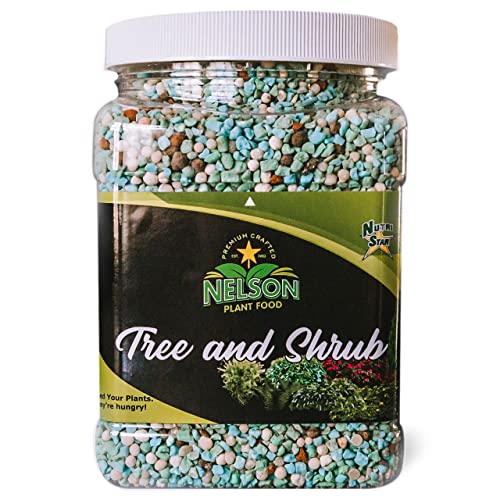
The Nelson NutriStar formula packs a 21-6-8 analysis with five distinct nitrogen sources, each engineered with a different time-release characteristic to provide consistent feeding over weeks. This synthetic granular blend is designed for in-ground and container-grown trees, evergreens, and shrubs including boxwoods, hollies, and oleanders. The immediate green-up effect — visible within two weeks on anemic plants — makes it a top choice for rehabbing winter-damaged foliage.
Landscapers in central Texas have used this formula for years on bougainvilleas and crepe myrtles, reporting four full bloom cycles in favorable years. The micronutrient package supports both foliage density and root vigor, and the granules can be broadcast under the drip line without digging. For nitrogen-deficient boxwoods showing yellow-orange discoloration, users note near-total correction within 48 hours of application.
The 4-pound bag is best suited for smaller properties with a dozen or fewer trees. Owners of large oak specimens may need multiple bags for a single feeding. Apply every 30 days during the growing season, with the final fall application timed before the first hard freeze for maximum root storage.
What works
- Visible greening on distressed plants within two weeks
- Five-source nitrogen extends release curve
- Works well on container-grown specimens
What doesn’t
- Small bag size limits coverage on large properties
- Synthetic formulation not suitable for organic gardeners
3. Fertilome Tree and Shrub Food 19-8-10
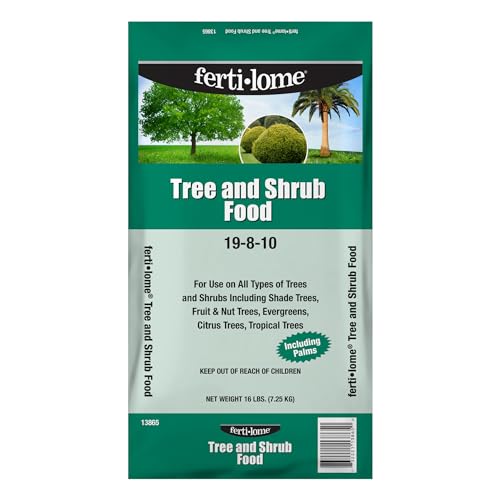
The Fertilome 19-8-10 blend is a landscape professional staple for good reason: its high nitrogen content (19 percent) drives explosive foliage and branch growth on mature oaks, hollies, and shade trees. Users report that under-applied doses on oaks still resulted in noticeably fuller canopies compared to untreated controls. The balanced potassium level supports root carbohydrate storage for winter resilience.
The granular formula is broadcast-friendly — no digging or staking required. Landscape pros recommend applying before rain or watering in immediately to prevent nitrogen volatilization. One bag covered an entire property with a mix of oaks, pear trees, evergreens, and shrubs, producing incredible new growth across all species within a single season.
The 19 percent nitrogen content demands careful application to avoid burning, particularly on young or stressed trees. The 16-pound bag is moderate in size, suitable for a half-acre property with a dozen mature specimens. For owners seeking a single bin that reliably works across diverse deciduous and evergreen species, this is a strong mid-range performer.
What works
- Dramatic foliage response on mature shade trees
- No digging required for application
- 0 percent phosphorus helps prevent wasteful top growth
What doesn’t
- High nitrogen can burn if over-applied
- Not certified for organic gardening
4. Old Farmer’s Almanac 13-3-3 Spikes
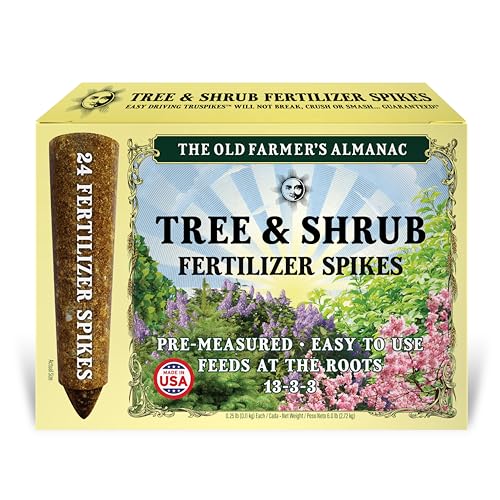
The Old Farmer’s Almanac TruSpikes deliver a 13-3-3 ratio with a 5-inch spike length that withstands hammering into heavy clay soil without shattering. The formula includes natural molasses to feed soil microbes at the root zone, supporting both nutrient uptake and microbial activity through the dormant season. After a hurricane, one user noted that their trees greened up noticeably faster than unfertilized neighbors using these spikes.
Each spike concentrates nutrients directly at the feeder-root interface, reducing runoff and waste. The package recommends one application per season — early spring and late fall — making it a low-maintenance option for homeowners. A Japanese stewartia treated with these spikes produced more flowers than in any prior year, while a fountain beech leafed out denser than its untreated counterparts.
The 6-pound box contains 24 spikes, enough for 12 to 24 trees depending on trunk diameter. In dense clay, pre-drilling with a metal rod or pry bar is recommended to avoid breaking the spike cap. For those who want a precise, mess-free dose without broadcasting, these spikes offer superior control.
What works
- Spikes resist breaking during installation
- Molasses content boosts soil microbiology
- One application per season delivers full coverage
What doesn’t
- Heavy clay requires pre-drilling
- Spike format less efficient for wide-canopy trees
5. Winchester Gardens 15-10-9 Spikes

Winchester Gardens offers a landscaper-sized case of 70 spikes with a 15-10-9 NPK analysis, engineered for deciduous trees such as maple, beech, birch, oak, ash, and willow. Users maintaining a half-acre with mixed planting report that a pry-bar insertion method into sandy or loamy soil delivers six months of slow-release nutrition per application. The 18-pound case covers an entire property without the need for a second purchase.
Owners of 45-year-old sunburst locust trees have used these spikes for over two decades, noting tremendous new foliage density each year. Two 5-foot pines that previously grew only 4 inches annually shot up a full foot with dark green needles after a single spring treatment. The spikes are child- and pet-friendly once inserted, with no surface residue or runoff.
The plastic driving caps included in the box are somewhat brittle — several users reported breakage before completing installation. A metal rod or crowbar is a more reliable tool for insertion in compacted soil. For landowners with 20-plus young trees who need an economical, pre-measured solution, this case delivers the lowest cost per spike.
What works
- 70-spike case covers large properties affordably
- Proven 20-year track record on mature trees
- Slow-release formula lasts a full season
What doesn’t
- Plastic driving caps are brittle and break easily
- Not suitable for acid-loving evergreens needing sulfur
6. Jobe’s 16-4-4 Tree Fertilizer Spikes

Jobe’s 16-4-4 formula is optimized for all deciduous trees and shrubs, delivering a continuous supply of nutrients below the surface where active roots reside. The spike format eliminates mixing, measuring, runoff, and surface odor — a clean solution for homeowners with small ornamental trees, hydrangeas, lilacs, and rose of Sharon. Users have applied these spikes for years with consistent annual flowering and foliage density.
The 16-percent nitrogen promotes deep green color, while the reduced phosphorus (4 percent) aligns with fall feeding recommendations. The slow-release mechanism ensures no burn risk even on young trees. For best results in dry or compacted soil, pre-drilling a pilot hole with a metal rod avoids the need to hammer the spike and risk damage.
The package includes 30 spikes, sufficient for 15 small to medium trees. Drought-stressed trees showed visible recovery after the first year of use, and second-year applications on shrubs produced on-schedule blooming. For homeowners who want a simple, no-measure solution for a moderate number of trees, this is a reliable entry-level pick.
What works
- No mixing, measuring, or runoff
- Safe for young trees — zero burn risk
- Consistent results on flowering shrubs
What doesn’t
- Requires pilot hole in hard soil
- 30 spikes only cover a limited number of larger trees
7. Espoma Organic Evergreen-Tone 4-3-4

The Espoma Evergreen-Tone delivers a 4-3-4 NPK ratio with 5% sulfur, specifically formulated for acid-loving needle and broadleaf evergreens including pine, fir, spruce, juniper, azaleas, rhododendrons, and camellias. The Bio-tone microbial enhancer accelerates organic breakdown in cool fall soil, providing a steady nutrient stream through the winter dormancy period without causing tender new growth.
Users report vibrant green coloration within two weeks of application to established evergreens. The barnyard smell from chicken manure is noticeable but fades within a day. The granules require no mixing — just broadcast under the drip line and water in. For optimal results, apply twice per year — early spring and late fall — to maintain consistent foliage density and color.
As a registered organic input material, Evergreen-Tone is approved for organic production and contains no sludges or synthetic toxins. The 18-pound bag is a practical size for a moderate collection of evergreens. For homeowners specifically targeting acid-soil species during fall feeding, this is the most targeted organic option available.
What works
- Sulfur content lowers pH for acid-loving evergreens
- Visible greening in two weeks
- Approved for organic gardening
What doesn’t
- Strong odor during and just after application
- Not suitable for alkaline-loving deciduous trees
Hardware & Specs Guide
NPK Ratio
The three-number sequence defines the percentage by weight of nitrogen, phosphorus, and potassium. For fall tree feeding, the nitrogen number (first) should dominate because trees store nitrogen in roots for spring growth. Phosphorus (second) should be low to avoid stimulating bloom development before frost. Potassium (third) supports overall root hardiness.
Slow-Release Mechanism
Organic fertilizers release nutrients through microbial digestion, which slows down as soil temperature drops — an ideal natural calendar for autumn feeding. Synthetic time-release formulas use coated granules or multiple nitrogen sources that break down at different rates. A product with at least three nitrogen sources (such as Nelson’s 21-6-8) provides a more consistent feeding curve.
FAQ
Can I apply a high-nitrogen spring fertilizer in fall?
How deep should I insert fertilizer spikes for established trees?
Final Thoughts: The Verdict
For most gardeners, the fall fertilizer for trees winner is the Espoma Organic Tree-Tone 6-3-2 because its organic slow-release profile and calcium content deliver reliable spring results across shade and fruit trees. If you want a rapid green-up on nitrogen-starved evergreens, grab the Nelson NutriStar 21-6-8. And for mess-free feeding on a large property with many young trees, nothing beats the Winchester Gardens 70-spike case.