
Specs are compiled from manufacturer listings and verified buyer reviews and can change over time — please confirm the key details on the product page before buying.
That same frustration hits every season: your evergreens look pale and sparse, while your neighbor’s shrubs stay thick and deeply green. The problem is almost always a lack of the right nutrients — especially since most evergreens need acidic soil, which standard all-purpose fertilizers cannot provide.
I’m Rikta, the founder behind Lawn Gear Lab. This guide compares manufacturers’ published specs and verified customer reviews, so you see each pick’s real strengths and trade-offs without the marketing spin.
The right evergreen shrub fertilizer does more than just feed your plants. It adjusts soil pH, promotes deep root growth, and delivers the specific nitrogen and sulfur balance that keeps needles and leaves vibrantly green all year.
Quick Picks
- Espoma Organic Evergreen-Tone 4-3-4 (8 lb) — Best Overall
- FoxFarm Happy Frog Japanese Maple Fertilizer — Premium Microbe Blend
- Espoma Organic Holly-Tone 4-3-4 — Double Pack Value
- Miracle-Gro Water Soluble Azalea — Fast Green-Up
- True Organic Azalea, Camellia & — Large Area Coverage
- Fertilome Azalea, Camellia — High-Phosphorus Booster
- Dr. Earth Acid Lovers Azalea — Pure Organic Entry Point
How To Choose The Best Evergreen Shrub Fertilizer
Picking the right food for your evergreens depends on a few core decisions: the ratio of nutrients (NPK), if you want synthetic speed or organic soil health, and the sulfur content needed to keep the soil acidic. Here is what to watch for.
NPK Ratio — Nitrogen First
Evergreens are heavy users of nitrogen, which drives that rich green color and dense growth. A balanced fertilizer like 4-3-4 or 10-8-6 works well for most needle and broadleaf evergreens. Extra phosphorus is less critical for shrub health unless you are encouraging flowers on acid-lovers like rhododendrons.
Soil Sulfur — The Acid Magnet
Most evergreens prefer soil with a pH between 5.0 and 6.5. A fertilizer with added sulfur (look for at least 5% on the label) naturally lowers soil pH, helping the plant absorb iron and other essential micronutrients. Without it, leaves can yellow even when you are feeding regularly.
Organic vs. Synthetic — Pace and Soil Life
Organic granules (like those containing Bio-tone or seabird guano) release nutrients slowly and feed the beneficial microbes in your soil. Synthetic water-soluble formulas (like 9-15-13 mixes) give a rapid green-up but require more frequent applications. Your choice depends on if you want immediate visible results or long-term soil improvement.
Quick Comparison
| Model | Best For | NPK Ratio | Weight | Application Type | Amazon |
|---|---|---|---|---|---|
| Espoma Organic Evergreen-Tone 4-3-4 | Best Overall | 4-3-4 | 8 lb | Granules | Amazon |
| FoxFarm Happy Frog Japanese Maple 4-3-4 | Premium Feeding With Microbes | 4-3-4 | 4 lb | Powder | Amazon |
| Espoma Organic Holly-Tone 4-3-4 (Pack of 2) | Versatile Double Pack | 4-3-4 | 4 lb (x2) | Granules | Amazon |
| Miracle-Gro Water Soluble Azalea Food | Quick Green-Up | Mix ratio 1:144 | 5 lb | Powder | Amazon |
| True Organic Azalea, Camellia & Rhododendron | Large Area Coverage | 5-4-3 | 12 lb | Granules | Amazon |
| Fertilome Azalea, Camellia, Rhododendron Food 9-15-13 | High-Phosphorus Booster | 9-15-13 | 4 lb | Granules | Amazon |
| Dr. Earth Acid Lovers Fertilizer | Pure Organic Entry Point | — | 1 lb | Granules | Amazon |
In‑Depth Reviews
1. Espoma Organic Evergreen-Tone 4-3-4 (8 lb)

The 8-pound workhorse that feeds pine, fir, spruce, and azaleas without any mixing.
This is the one you reach for when you want a single bag that covers every needle-leaf and broadleaf evergreen on your property. Its 4-3-4 NPK ratio (Nitrogen-Phosphorus-Potassium — think of nitrogen as the greening power, phosphorus for roots, and potassium for overall strength) delivers balanced nutrition while the 5% sulfur content (the ingredient that lowers soil pH) keeps the ground acidic enough for evergreens to thrive. In the data, the Espoma weighs 8 pounds compared to the 1-pound Dr.
Buyers report that after applying it just before fall, their plants thrived well into November, and the following spring everything in the yard grew much stronger. You sprinkle the granules around the drip line (the outer edge of the branch canopy) and water in — no measuring, no mixing, no sprayer needed. The natural ingredients carry an organic certification and the Bio-tone formula (a blend of beneficial microbes) supports long-term soil health.
One honest trade-off: reviewers mention a strong odor typical of organic fertilizers that lingers for a day or two after application. It is the smell of active biological ingredients, not a defect, but if you are sensitive to scents you might want to apply it before a rain or before spending time near the plants.
The full-yard workhorse: A no-mix, broad-spectrum organic food for all evergreens, backed by real results from spring through fall.
Watch for the smell: The organic ingredients produce a noticeable odor for a couple of days — normal for this type of fertilizer, but worth knowing upfront.
Reach for this if: you want one bag that feeds pines, spruces, junipers, azaleas, and rhododendrons with a single, long-lasting organic application.
Think twice if: you need an immediate foliar green-up — this works steadily over weeks, not hours.
2. FoxFarm Happy Frog Japanese Maple Fertilizer 4-3-4 (4 lb)

A targeted feed that packs soil microbes and mycorrhizal fungi for low-pH feeders.
Unlike the broad-spectrum Espoma above, the FoxFarm formula is specially crafted for Japanese maples, hydrangeas, and other low-pH feeders that struggle with standard fertilizers. The 4-3-4 NPK ratio is the same, but the hidden value is the addition of beneficial soil microbes and mycorrhizal fungi (a type of fungus that connects to plant roots and helps absorb water and nutrients more efficiently). Owners mention their maple has never looked better after using this, and one buyer even brought a plant back to life with it.
The application is a monthly routine — you mix just 2 tablespoons per 1 gallon of water or top-dress (sprinkle dry powder around the base) and water in. The easy-to-use powder format means you can precisely control the dose, unlike the granular Espoma that comes ready to sprinkle. Customers note that their trees develop denser foliage and sturdier branch structure thanks to the phosphorus and potassium in the blend.
A practical limit: at 4 pounds this bag covers less ground than the 12-pound or 8-pound options, so if you have a large hedge row you will need multiple bags. But for specimen trees and container-grown evergreens, the targeted microbe-rich formula gives a noticeable advantage.
What sells it
- Contains mycorrhizal fungi that boost root nutrient uptake
- Easy to measure with a 2-tablespoon-per-gallon ratio
- Reviewers report dramatic recovery in stressed Japanese maples
The real limit
- 4-pound bag goes fast for large plantings or multiple shrubs
- Requires monthly application — not a low-maintenance feed
Pick this if: you own Japanese maples, dogwoods, or other acid-loving ornamentals and want a microbe-rich boost that builds root efficiency over time.
Choose something else if: you need to cover a long row of hedges — you will run through this bag quickly.
3. Espoma Organic Holly-Tone 4-3-4 (4 lb, Pack of 2)
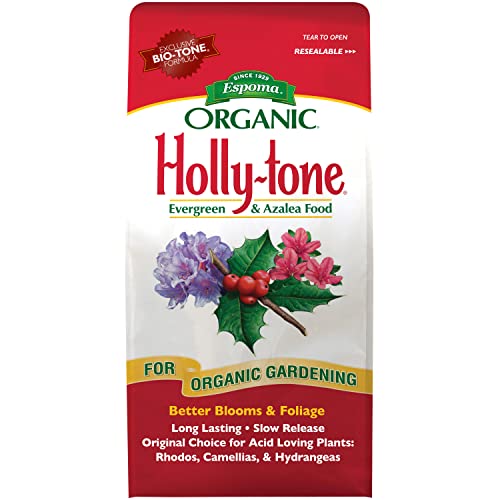
Two 4-pound bags of the original acid-loving plant food, ready to use without mixing.
Holly-Tone is the original organic plant food for all acid-loving plants, and this pack of two gives you 8 pounds total — the same weight as the single Evergreen-Tone bag above, but split into two smaller, easier-to-handle bags. The 4-3-4 NPK ratio with 5% sulfur makes it effective on azaleas, rhododendrons, hydrangeas, blueberries, and evergreens alike. The labeled use is simple: apply in spring and fall around the drip line, water in, and the slow-release organics feed for months.
Reviewers point out that a tree expert recommended this for year-round good health, and one reviewer noted their blueberry bushes definitely liked it and their azalea seemed much happier. The no-mix granules draw a clear contrast with the FoxFarm powder that requires measuring — if you prefer minimal effort, the Espoma products are tough to top. A reviewer did mention the noticeable smell that lingers for a couple of days after application, but noted it dissipates after a few waterings.
One detail to consider: this is Holly-Tone, not Evergreen-Tone. While both work on evergreens, Holly-Tone is formulated for a broader range of acid-lovers including flowering shrubs, so the nutrient release is tuned for plants that also need to set buds. For pure needle evergreens that do not flower, the Evergreen-Tone above might be a slightly more targeted choice.
The versatile double pack: Two easy-to-carry 4-pound bags that cover azaleas, hydrangeas, rhododendrons, and evergreens without mixing.
Bags can be pungent: Buyers consistently warn about the strong organic smell that lasts a couple of days after application — plan your timing accordingly.
Best for: gardeners who want a single product for all their acid-loving shrubs and appreciate having two sealed bags instead of one large open one.
skip it if: you only have needle evergreens — Evergreen-Tone is a slightly more specific formula for your use case.
4. Miracle-Gro Water Soluble Azalea, Camellia, Rhododendron Plant Food (5 lb)

A fast-acting powder that shows visible results on rhododendrons in as little as a week.
This is the product you reach for when an evergreen or acid-loving shrub needs a visible pick-me-up fast — not the slow-release organic approach of the Espoma picks above. The water-soluble formula dissolves completely in water and feeds through the roots immediately. The mixing ratio is simple: use 1 tablespoon per 1 gallon of water for outdoor plants (the label specifies 1:18 for outdoor, 1:144 for indoor use). Shoppers say that this truly helped their rhododendron recover and look stunning within a week, and the bag includes a resealable closure to keep the powder dry.
The Miracle-Gro family has been trusted for decades — one reviewer mentions using it for over 30 years on everything from indoor plants to azaleas and holly bushes. The 5-pound bag goes a long way when mixed with water, making it a cost-conscious option for spot-feeding multiple shrubs. One note from customers: the resealable closure on the bag uses a Velcro-style strip that some buyers found ineffective, so plan to store the bag in a dry container or use clothespins to keep it sealed.
The main trade-off versus the organic granular options is frequency — you need to apply this every 7 to 14 days during the growing season, whereas a single application of Espoma or FoxFarm can last a month or more. The trade is speed of results for frequency of effort.
Why choose this
- Fast-acting — visible greening within a week per buyer reports
- Dissolves completely with no clumps
- Large 5-pound bag provides many waterings
Honest downsides
- Requires reapplication every 7-14 days — more work than granules
- Bag reseal closure is unreliable, per multiple reviews
Reach for this if: you want to see quick improvement on a stressed rhododendron, azalea, or gardenia and do not mind feeding every two weeks.
Look elsewhere if: you prefer a single spring-and-fall schedule — the organic granules require far less hands-on effort.
5. True Organic Azalea, Camellia & Rhododendron Food (12 lb)
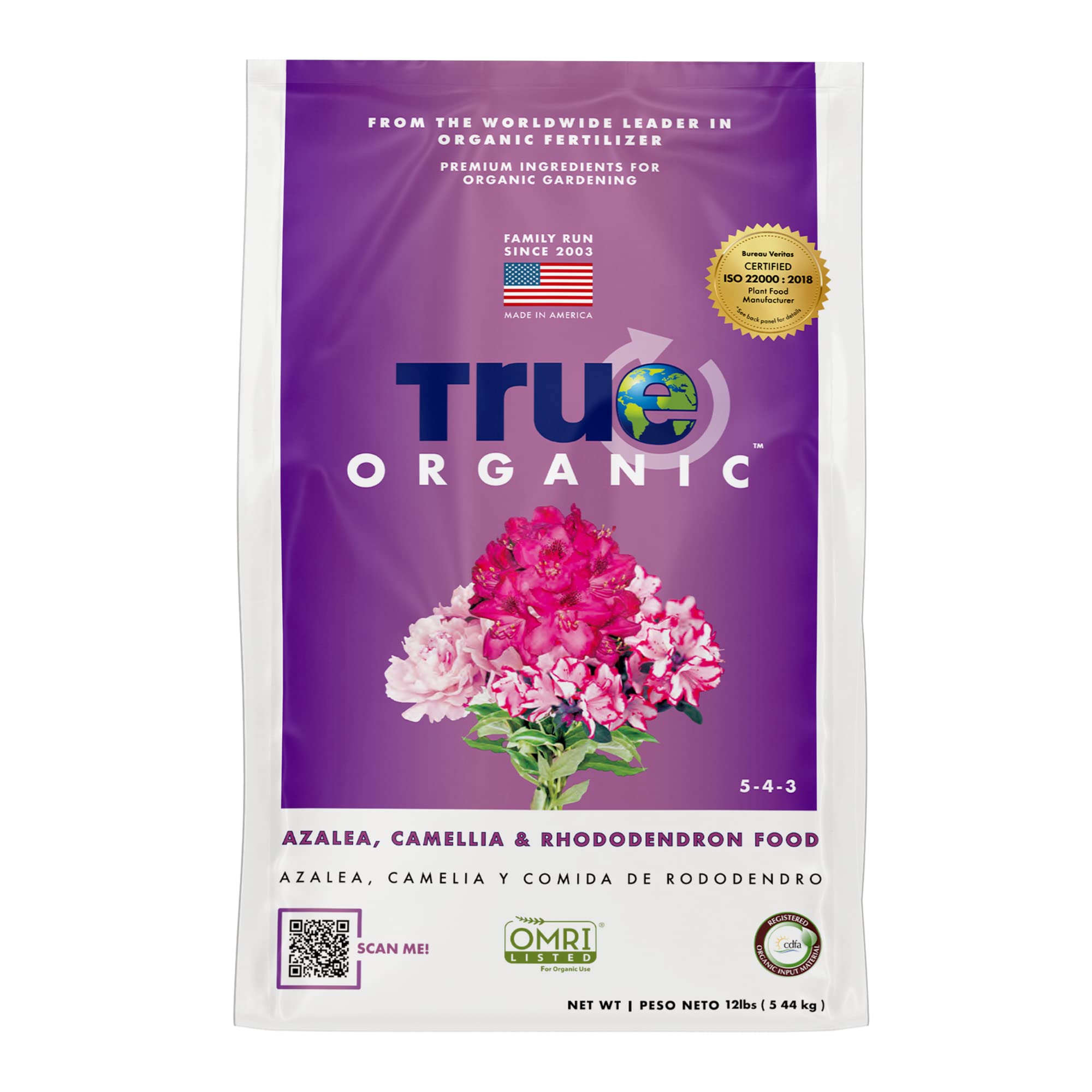
A 12-pound organic bag that covers up to 261 square feet with a twice-yearly schedule.
If you have a long hedge of evergreens, a large bank of azaleas, or a row of camellias, the 12-pound True Organic bag is the practical choice. The label states the 12-pound bag covers up to 261 square feet, with a smaller 4-pound version covering 87 square feet — so you can do the math on your garden area. The 5-4-3 NPK ratio (slightly higher in nitrogen than the 4-3-4 Espoma formulas) gives extra support for green leaf growth, while the 5% sulfur works naturally to lower soil pH.
Ingredients include seabird guano and shrimp and crab shell meal — the same natural inputs that give this category its earthy, fishy smell that buyers report. One buyer shared that their zinnias, which were struggling badly, pushed to 4 feet tall and produced huge blossoms within two weeks of using this fertilizer. The twice-yearly application (spring and fall) matches the schedule of the Espoma products, making it an easy routine to remember. True Organic is made in the USA with organic inputs.
The catch: the 12-pound bag is a significant investment upfront, and the smell from the seabird and shellfish ingredients can be quite strong for a few days after application, especially in warm weather. If you only have a couple of small shrubs, a smaller bag will be less wasteful.
The big-yard organic: 12 pounds covers 261 square feet with a spring-and-fall feeding schedule — perfect for hedges and shrub borders.
Strong fishy odor: Fish-based ingredients produce a smell that buyers confirm lasts a few days; apply before rain or wear gloves if you are sensitive.
Choose this if: you have a large number of acid-loving shrubs to feed and want a single-bag, twice-yearly organic solution.
pass on it if: you need a quick green-up — this works slowly over the season, not overnight.
6. Fertilome Azalea, Camellia, Rhododendron Food 9-15-13 (4 lb)

A high-phosphorus granular feed that snaps stressed rhododendrons back into bloom.
This is the product you turn to when your rhododendrons or azaleas have not bloomed in years or look pale and stressed. The 9-15-13 NPK ratio is much heavier in phosphorus (the middle number) than the other picks on this list, which is the driving force behind flower production and root recovery. Buyers confirm it works: one reviewer had rhododendrons that had not bloomed in almost 3 years and saw them burst into flower after using this, while another reported that stressed plants looked healthier — greener leaves and new growth — after just a few weeks.
The application is simple granular sprinkle: use 1/4 to 1/2 cup for shrubs 1 to 5 feet tall, and 3/4 to 1 1/4 cups for shrubs 6 to 12 feet tall. Feed in very early spring, again after blooming, and again in fall. Unlike the organic options above this is a synthetic fertilizer — it works fast but does not build soil biology long-term.
The 4-pound bag is relatively compact compared to the 8- and 12-pound bags above, so it is a practical size for spot-treating a few shrubs rather than coating a whole hedge. If you only have a couple of plants that need a bloom boost, this is a targeted choice.
What it does best
- High phosphorus content directly supports flowering and root recovery
- Owners mention rapid improvement in stressed, non-blooming rhododendrons
- Easy measured application with clear cup-based instructions
Limitations
- Synthetic formula does not improve long-term soil health like organics do
- 4-pound bag is small for large hedge plantings
Best for: reviving rhododendrons, azaleas, and camellias that have not bloomed or look pale — the phosphorus punch is exactly what they need.
Think twice if: you want a general all-around feed for junipers and pines that do not flower; the high phosphorus is wasted on needle evergreens.
7. Dr. Earth Acid Lovers Azalea, Camellia, Rhododendron & Maple Fertilizer (1 lb)

A 1-pound trial-sized bag of Non-GMO Project Verified organic granules for acid lovers.
If you are new to feeding acid-loving shrubs or just want to test a premium organic fertilizer without committing to a giant bag, the 1-pound Dr. Earth option is a smart entry point. It is the only Non-GMO Project Verified fertilizer in the U.S., and it is handcrafted from human- and feed-grade ingredients with multi-minerals, proteins, and humic acids (natural organic compounds that improve soil structure and nutrient absorption). Customers note dramatic results: one customer applied it to a rhododendron that had not bloomed for two years and watched it spring to life, covered with huge pink flowers.
The formula is certified by OMRI (Organic Material Review Institute), CCOF (California Certified Organic Farmers), and the National Organic Program, so it meets the highest purity standards. One bag of Dr. Earth covers a small area, making it ideal for a single specimen shrub or a container plant but impractical for a row of hedge evergreens.
Reviewers point out that it is People & Pet Safe — no synthetic chemicals, GMO-infested chicken manure, or toxic ingredients — and it works simply by scattering granules on the soil and watering in. The catch is purely coverage: you will need to buy multiple bags for any moderately sized planting, and the cost per pound runs higher than the larger bags in this guide.
The trial-sized organic: Premium Non-GMO Verified ingredients in a small bag, perfect for testing on one shrub or container plant before committing.
Cost per pound is higher: At 1 pound, this will cost more per pound than the 8- or 12-pound bags — buy it for quality or convenience, not for value per pound.
Reach for this if: you want the highest organic purity certification for a single prized rhododendron, maple, or gardenia and are willing to pay a premium per pound.
Look at the bigger bags if: you are feeding multiple shrubs — the 8-pound Espoma or 12-pound True Organic options will go much further for your money.
Understanding the Specs
The NPK Ratio — What Those Three Numbers Mean
The three numbers on any fertilizer bag — like 4-3-4 or 9-15-13 — stand for Nitrogen, Phosphorus, and Potassium in that order. Nitrogen drives leaf and needle growth, giving evergreens their rich green color. Phosphorus supports root systems and flower production (important for rhododendrons and azaleas, less so for pines). Potassium builds overall plant strength and disease resistance. For most evergreens, a balanced ratio with the first number equal or slightly higher works best.
Sulfur Content — The Acid Regulator
Sulfur is the ingredient that naturally lowers soil pH over time, creating the acidic environment that evergreens and acid-loving shrubs need to absorb iron and other micronutrients. Look for at least 5% sulfur on the label. Without it, even well-fertilized plants can develop chlorosis (yellowing leaves from iron deficiency) because the roots cannot access the nutrients in alkaline soil. A single spring application of a sulfur-containing fertilizer is often enough to maintain the right pH all season.
FAQ
When should I fertilize evergreen shrubs?
Can I use regular lawn fertilizer on my evergreens?
What does the sulfur in fertilizer actually do?
How much fertilizer should I use per shrub?
Is organic or synthetic better for evergreens?
Will this help my rhododendron bloom?
Can I mix granular fertilizer directly into the soil?
What is the difference between Holly-Tone and Evergreen-Tone?
Why do organic fertilizers smell so bad?
Can I fertilize newly planted evergreen shrubs right away?
Final Thoughts: The Verdict
If you want one dependable pick, the evergreen shrub fertilizer winner is the Espoma Organic Evergreen-Tone 4-3-4 because it combines 8 pounds of ready-to-use granules, a balanced 4-3-4 NPK ratio with 5% sulfur, and a twice-yearly feeding schedule that gives every needle and broadleaf evergreen the consistent nutrition it needs. If you want a microbe-rich feed for specimen Japanese maples or dogwoods, grab the FoxFarm Happy Frog 4-3-4 and its mycorrhizal fungi. And for bringing stressed rhododendrons back into bloom, the standout is the phosphorus-heavy Fertilome 9-15-13.
How We Picked
We do not accept paid placement. Every pick is matched to a real buyer and a real use-case; we do not hands-on test units.
Sources & Methodology
Specifications: manufacturer listings and product documentation. Review insights: verified customer reviews, as of July 2026. Pricing: not shown on this page (it changes often); check the current price via the retailer link.
As an Amazon Associate, Lawn Gear Lab earns from qualifying purchases. This does not affect which products we feature.