
Specs are compiled from manufacturer listings and verified buyer reviews and can change over time — please confirm the key details on the product page before buying.
You want your evergreens to look dark, dense, and healthy all year long — not pale, yellowing, or barely holding on. The difference is often the fertilizer you choose, because evergreens need a specific acid-boosting formula that standard lawn food cannot provide. Here, we break down four top-tier options using only their published specs and real buyer feedback.
I’m Rikta — the founder and writer behind Lawn Gear Lab. This guide is built by comparing the manufacturers’ published specifications and the patterns across verified customer reviews, so you get each pick’s real strengths and trade-offs instead of marketing spin.
This roundup of the best evergreen fertilizer choices covers spike, granular, and premium organic formulas so you can match the right product to your soil and schedule, whether you are feeding a single container cedar or a row of arborvitae.
Quick Picks
- Espoma Organic Holly-Tone 4-3-4 — Best Overall
- GARDENWISE 8-4-8 Acidic Fertilizer — Fast Green-Up
- Espoma Organic Evergreen-Tone 4-3-4 — Needle Specialist
- Jobe’s 01661 Evergreen Fertilizer Spikes — Set & Forget
How To Choose The Best Evergreen Fertilizer
Evergreens need a fertilizer that keeps the soil acidic (pH roughly 4.5 to 6.0) and delivers nitrogen in a slow, steady stream. The three numbers on the bag — the N-P-K (nitrogen-phosphorus-potassium) ratio — tell you the percentage of each nutrient. For evergreens, the first number (nitrogen) should be the highest, because that is what drives dense, dark-green needle growth. The second two numbers support root and bloom health but matter less for a pine or spruce.
Form: Spikes vs. Granules
Spikes are pre-measured sticks you hammer into the ground around the drip line (the area where rain falls from the outermost branches). They are simple to use for a beginner — you cannot over-apply — and they release nutrients over roughly 90 days. Granules give you more control over application rate and coverage area, and you can mix them into the topsoil, but you have to measure and spread them yourself. Granular organic formulas also feed the soil microbes, which spikes typically do not.
Organic vs. Synthetic
Organic fertilizers (like those with Bio-tone or composted manure) build long-term soil health, improve microbial activity, and release nutrients slowly. Synthetic options deliver a quicker green-up but can burn roots if applied too heavily and do little for soil structure. If you want to feed the soil and the plant together, organic is the smarter long-term play.
Special Additives: Sulfur and Iron
Evergreens in alkaline soil often develop chlorosis — a yellowing of the needles caused by iron deficiency, because high pH ‘locks up’ the iron in the soil. Look for a fertilizer that includes sulfur (which lowers soil pH) and chelated iron (which the plant can absorb immediately). Both GARDENWISE 8-4-8 and the Espoma organic lines include these ingredients, though the levels differ.
Quick Comparison
| Model | Best For | N-P-K Ratio | Form | Weight | Amazon |
|---|---|---|---|---|---|
| Espoma Organic Holly-Tone 4-3-4 | Large-scale organic feeding | 4-3-4 | Granules | 36 lb | Amazon |
| GARDENWISE 8-4-8 Acidic Fertilizer | Fast green-up on iron-deficient soil | 8-4-8 | Granules | 2.1 lb (0.96 kg) | Amazon |
| Espoma Organic Evergreen-Tone 4-3-4 | Needle-specific organic tree care | 4-3-4 | Granules | 18 lb | Amazon |
| Jobe’s 01661 Evergreen Fertilizer Spikes | Set-and-forget convenience | 13-3-4 | Spikes | 1 lb | Amazon |
In‑Depth Reviews
1. Espoma Organic Holly-Tone 4-3-4
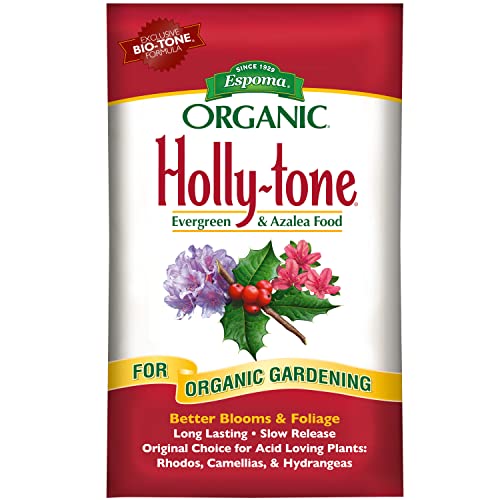
The original acid-loving plant food with a 36-pound bag that lasts all season.
The 36-pound bag is the biggest in this roundup at 36 pounds versus the 2.1-pound GARDENWISE 8-4-8, which makes it the clear choice for anyone feeding multiple trees or a whole bed of acid-loving plants. The 4-3-4 N-P-K (nitrogen-phosphorus-potassium) formula includes 5% sulfur to lower soil pH around the root zone, which is exactly what evergreens need when neighboring grass has pushed the soil alkaline. Buyers report that “the growth of my trees has been incredible as well after using it.”
Unlike the granular GARDENWISE 8-4-8 which is a higher-nitrogen blend, Holly-Tone relies on organic slow-release particles that break down through natural soil biology — you apply it in spring and again in fall, water it in, and let the microbes do the rest. It is also approved for organic gardening, meaning you can use it around edible acid-lovers like blueberries without worry.
Reviewers also note that the barnyard smell (from the chicken manure ingredients) fades after a day, and the results are visible within a couple of weeks. One owner called it “on the miracle level” for blooms on hydrangeas and azaleas.
Why it leads the list
- Massive 36-lb bag for the lowest per-feeding cost among options here
- Organic Bio-tone formula feeds soil microbes, not just the plant
- 5% sulfur content actively acidifies alkaline soil
One real trade-off
- Large bag is heavy to carry and store; you will need a bucket or scoop for application
- Organic granules work slower than the 13-3-4 spikes if you need a quick fix
Grab this for: anyone feeding multiple evergreen trees or a whole acid-loving garden bed and wanting organic, season-long nutrition without mixing or measuring each time.
Consider something else if: you have just a single small shrub and do not want to store a 36-pound bag for two years.
2. GARDENWISE 8-4-8 Acidic Fertilizer
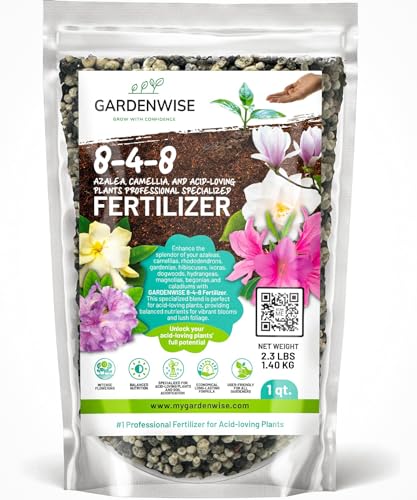
A potent 8-4-8 formula for a fast green-up.
If your evergreens are pale and you need a quick recovery, this granular option uses an 8-4-8 formula versus the Espoma organics’ 4-3-4 formula. That high nitrogen kick (combined with iron and magnesium) targets chlorosis (the yellowing of needles from iron deficiency) directly. One reviewer noted they bought it for a newly planted rhododendron and “it has doubled in size.”
The GARDENWISE formula is enriched with live bacterial microbes processed through a heat-drying treatment that the brand says strips toxins and heavy metals. That sounds technical, but in practice it means you get a slow-release granule that feeds both the plant and the soil biology at the same time. The small 32-ounce bag (roughly 2.1 lb) covers a compact garden or a handful of specimen trees, while the Espoma Holly-Tone bag weighs 36 pounds, so it is much easier to grab and go.
The catch is that its higher nitrogen content demands careful measuring. Over-apply and you risk burning roots on sensitive evergreens like dwarf Alberta spruce. One reviewer warned of the risk of over-fertilization if misapplied. It is also best for acid-loving plants only, so if you have a mixed bed with neutral-soil perennials, keep a separate feed for them.
Who it suits: a gardener with a few specific acid-loving shrubs or trees who wants visible results fast and is comfortable measuring granules by the scoop.
Ideal for: reviving a chlorotic magnolia, azalea, or rhododendron that has been yellowing for two seasons. The iron and sulfur combo corrects the root cause.
skip it if: you need to cover a large hedge row — the 32-ounce bag runs out quickly at the recommended rate.
3. Espoma Organic Evergreen-Tone 4-3-4

Espoma’s dedicated evergreen formula with 5% sulfur and zero synthetic additives.
This 4-3-4 N-P-K (nitrogen-phosphorus-potassium) analysis is identical to the Holly-Tone, but the target species list is tighter: it is formulated specifically for needle-leaf and broadleaf evergreens like pine, fir, spruce, juniper, azalea, and rhododendron. If you have a mixed garden of strictly evergreens, this is the bag to reach for because every nutrient is optimized for their specific uptake pattern.
The 18-pound bag weighs 18 pounds versus the Holly-Tone 36-pound bag, which makes it a practical sweet-spot for the average suburban yard — enough for spring and fall feedings on a dozen medium trees without wrestling a heavy sack. It uses Espoma’s exclusive Bio-tone formula, a blend of natural organics that feed soil microbes. One buyer mentioned “it made my evergreens bright green just after a couple of weeks,” and another noted it smells barnyard-like due to the chicken manure ingredient — an honest sign you are working with real organic material.
Because it is a registered Organic Input Material, you can use it around edible plants without concern. And like Holly-Tone, it requires no mixing — just sprinkle it around the drip line (where rain falls off the branches) and water it in. The only downside is that if your soil is severely alkaline, the 5% sulfur may need a season or two to fully shift the pH.
Best for: the gardener who wants a species-specific organic granule with a proven track record (Espoma has been making it since 1929). The “just after a couple of weeks” green-up feedback is consistent across reviews.
Reach for this when: you are planting new evergreens or feeding established pines and spruces and want organic certification.
Consider an alternative if: you also grow blueberries and hydrangeas — you could use one bag of Holly-Tone for everything rather than buying two separate products.
4. Jobe’s 01661 Evergreen Fertilizer Spikes

Fifteen pre-measured spikes that release a 13-3-4 blend for up to 90 days.
If you hate measuring and mixing, these spikes are your answer. The formulation 13-3-4 delivers the highest nitrogen concentration of any product here, at 13-3-4 versus the 4-3-4 Espoma formulas, which means a strong green-up signal for the tree. Each spike dissolves slowly over about 90 days, so one application in early spring covers the whole growing season without a second visit.
The convenience does come with limits. The entire pack weighs 1 pound, compared to the Espoma Holly-Tone at 36 pounds. That is because spikes work by concentrated local feeding — each spike feeds the roots immediately around it, rather than broadcasting across the whole root zone. For a large tree or a long hedge, you would need multiple packs. One owner reported, “the absolute BEST fertilizing spikes for my green giant trees,” and another mentioned that waiting for rain to soften the soil makes pounding them in much easier.
The synthetic slow-release coating can leave behind a plastic skeleton in the soil, which is a non-issue for the tree but matters if you are committed to a fully organic garden. Reviewers also say the spikes do not crumble when driven into the ground, so installation is clean.
Reasons to choose spikes
- Zero measuring — hammer and done
- 90-day slow release means one application per season
- High 13-3-4 ratio gives a strong nitrogen punch
Reasons to pass
- Coverage limited to 15 feed points; large areas need multiple boxes
- Synthetic format does not build soil microbial life
Choose these when: you have a few specimen evergreens (green giants, arborvitae, pines) and want the simplest possible feeding routine with no measuring.
Look elsewhere if: you need to cover a long hedge row or a large mixed bed — granules spread more evenly and cost less per square foot.
Understanding the Specs
N-P-K Ratio
The three hyphenated numbers on the bag stand for nitrogen (N), phosphorus (P), and potassium (K). For evergreens, the first number is the most important — nitrogen drives dark green needle growth and dense foliage. The second two numbers support root strength and disease resistance but are less critical for a pine or spruce. A 13-3-4 spike gives more nitrogen per application than a 4-3-4 organic granule, but it also releases faster.
Organic vs. Synthetic Slow-Release
Organic slow-release (like Espoma’s Bio-tone) uses natural materials like chicken manure and feather meal that decompose via soil microbes. It feeds the soil food web and improves structure over time. Synthetic slow-release (like Jobe’s spikes) uses coated chemical salts that dissolve at a controlled rate. It delivers a faster green-up but does not nourish the soil biology. If you are building long-term soil health, organics win. If you just want green needles this season, synthetic is fine.
Sulfur Content for Soil Acidification
Sulfur lowers soil pH gradually. Evergreens prefer acidic soil (pH 4.5-6.0), but lawn lime, concrete runoff, and tap water can push the pH up, locking away iron. A fertilizer with 5% sulfur (like the Espoma products) helps reverse that trend over time. If your evergreens are yellowing between the veins, it is likely an iron deficiency caused by alkaline soil — sulfur plus iron is the fix.
Application Form: Spikes vs. Granules
Spikes space nutrients out in concentrated points and release over 90 days. They are ideal for single trees and beginners. Granules spread evenly across the entire root zone, which matters for multi-stem shrubs and hedges where roots spread broadly. Granules also allow you to adjust the rate per plant. For a hedge, you want granules. For a lone green giant in the backyard, spikes work well.
FAQ
What N-P-K ratio is best for evergreen trees?
Can I use regular lawn fertilizer on evergreens?
How often should I fertilize my evergreens?
Are fertilizer spikes better than granules for evergreens?
Will Espoma Holly-Tone work on my pine trees?
What causes evergreens to turn yellow, and can fertilizer fix it?
How much organic fertilizer do I apply per tree?
Is there a risk of burning evergreens with high-nitrogen fertilizer?
Can I use GARDENWISE 8-4-8 on my blueberry bushes?
How long does an 18-pound bag of Espoma Evergreen-Tone last?
Final Thoughts: The Verdict
For most people, the top pick for evergreen fertilizer is the Espoma Organic Holly-Tone 4-3-4 because it combines organic certification, a 36-pound bag for scale, and proven results across the widest range of acid-loving plants. If you want fast results on a chlorotic specimen, grab the GARDENWISE 8-4-8. And for a no-measure, set-and-forget routine around a few specimen evergreens, the standout is the convenience of the Jobe’s 01661 Evergreen Fertilizer Spikes.
How We Picked
We do not accept paid placement. Every pick is matched to a real buyer and a real use-case; we do not hands-on test units.
Sources & Methodology
Specifications: manufacturer listings and product documentation. Review insights: verified customer reviews, as of July 2026. Pricing: not shown on this page (it changes often); check the current price via the retailer link.
As an Amazon Associate, Lawn Gear Lab earns from qualifying purchases. This does not affect which products we feature.