
Specs are compiled from manufacturer listings and verified buyer reviews and can change over time — please confirm the key details on the product page before buying.
Throwing down loose straw on a sloped yard or a patch of bare dirt often feels like a losing battle. A hard rain arrives, and all that carefully spread mulch ends up in a pile at the bottom of the driveway. The real trick is picking the right erosion control straw that actually locks itself in place long enough for new grass to root.
I’m Rikta — the founder and writer behind Lawn Gear Lab. This guide is built by comparing the manufacturers’ published specifications and the patterns across verified customer reviews, so you get each pick’s real strengths and trade-offs instead of marketing spin.
You need erosion control straw that holds soil in place, covers enough ground, and doesn’t leave a mess. This guide breaks down the best erosion control straw options so you can pick the right one for your slope or garden bed.
Our Picks at a Glance


How To Choose The Best Erosion Control Straw
Most first-time buyers grab whatever straw bag is cheapest without realizing the key difference is how the straw is processed. The wrong choice either blows away on a breezy afternoon or turns into a weedy mess. Focus on these three factors, and the decision becomes simple.
Loose Straw vs. Straw Blankets
Loose straw bales are perfect for flat garden beds and small bare patches. You spread them by hand, water them in, and the straw protects the soil. Straw blankets, on the other hand, come as rolled mats with netting stitched through the straw. Use those on steep slopes, ditches, or any area where heavy rain creates runoff. Blankets stay put far better than loose straw on an incline.
Tackifier — The Glue That Holds
A tackifier is a natural, biodegradable bonding agent sprayed or pre-mixed into the straw. When you wet it down, the straw sticks to itself and to the ground below it. Without a tackifier, loose straw is much more vulnerable to wind and water. Almost every processed bag of erosion straw includes one, but not all blanket-style rolls do.
Weed-Free Promise
Plain farm hay is notorious for introducing weeds into your yard. Processed erosion straw is heat-treated or mechanically cleaned to kill seeds inside it. Look for a stated percentage like “99% weed free.” That small label saves you weeks of pulling unwanted plants later.
Quick Comparison
| Model | Best For | Form Factor | Coverage | Weight | Amazon |
|---|---|---|---|---|---|
| Gardener Select Seeding Straw★ Best Overall | Best Overall loose straw | Loose Bale | 2.5 CU FT (500 sq. ft.) | 24.4 lbs | Amazon |
| EZ-Straw Seeding Mulch 2.5 CU FTFast Germination | Fast germination loose straw | Loose Bale | 2.5 CU FT (500 sq. ft.) | 21 lbs | Amazon |
| Farm Plastic Supply Blanket | Heavy-duty slope blanket | Rolled Blanket | 2′ x 112.5′ (225 sq. ft.) | 39 lbs | Amazon |
| American Excelsior QuickGrass Pro | Versatile lightweight blanket | Rolled Blanket | 2.5′ x 50′ (125 sq. ft.) | 11 lbs | Amazon |
| American Excelsior Premier Straw | Wide-coverage budget blanket | Rolled Blanket | 4′ x 50′ (200 sq. ft.) | — | Amazon |
| EZ Straw Germination Blanket | Premium seeded blanket | Rolled Blanket | 4′ x 50′ (200 sq. ft.) | — | Amazon |
| EZ-Straw 2-Pack Bulk Loose | Large-area loose straw value | Loose Bale | 2 x 2.5 CU FT (600 sq. ft. each) | — | Amazon |
In‑Depth Reviews
1. Gardener Select Seeding Straw with Tackifier
Our pick — 4.5★ from 500+ verified ratings; the strongest balance of quality and price.
The crowd-favorite bale that buyers report arrives packed tight and weed-free.
This loose straw bale earns the top spot because it does two critical things well. It is processed with a tackifier (a natural bonding agent that makes the straw cling to itself when damp), and it is 100% biodegradable — you just leave it on the ground after your grass germinates. At 2.5 cubic feet, it covers up to 500 square feet, which owners mention is more than enough for several above-ground garden beds with plenty leftover. Owners praise germination most: the straw keeps seed moist and protected, which directly leads to better sprouting.
The bale is compacted tightly in the box. As customers note, it is “packed and compacted in the box really well and it’s more than enough for my yard.” It is also free of weed seeds — one reviewer flatly called it the “Best straw ever” with “No seeds!” That matters because standard hay often introduces invasive plants. The only trade-off is that, like all loose straw, it is best suited for relatively flat ground. On a steep slope, a rolled blanket like the erosion control straw blanket below would hold up better against rain runoff.
Real-world verdict: For flat yard reseeding, garden beds, and covering new seed, this bale delivers the most value per dollar. The 99% weed-free claim holds up in the review pages, and the tackifier keeps it from blowing into the neighbor’s yard.
Reach for this if: You need a big, weed-free bale of loose straw for a flat lawn or garden bed and want a product that biodegrades without any cleanup.
Think twice if: Your project is on a steep hill or drainage ditch — a straw blanket will stay anchored better than loose straw.
2. EZ-Straw Seeding Mulch with Tackifier
Grass seed that sprouted in five days flat, according to the review pages.
EZ-Straw is the closest rival to the top pick above, and it is nearly identical in coverage: one 2.5-cubic-foot bale covers up to 500 square feet. The defining difference is how fast reviewers point out results. Review archives are full of buyers saying their grass “grew in 5 days.” The tackifier in this bale is a natural bonding agent that holds the straw together, and the straw itself is twice-cut and processed for easy application. Just toss it by hand, and it stays put.
The quality is considered better than baled straw from a local farm supply. It is also 99% weed-free. One owner who tested it against heavy dogs and a torn-up backyard called it a lifesaver, saying it was easy to toss down with just a little sweeping or light raking. The catch is that it is slightly messy during application — you will get straw dust on your clothes — but owners across the board say the results are worth it. At 21 pounds, this bale is lighter than the Gardener Select bale (which weighs 24.4 pounds), making it a touch easier to carry around the yard.
Performance read: If speed of germination is your priority, this bale has the most owner reports of fast, thick growth. The straw also mats down nicely on its own after a watering.
Go for it if: You want the fastest possible grass growth and need a light, easy-to-spread bale that won’t blow away.
Choose the Gardener Select instead if: You want the absolute highest overall owner satisfaction and a slightly denser, more compact bale.
3. Farm Plastic Supply Erosion Control Blanket

The heavyweight blanket that kept fescue seed in place through a Georgia monsoon.
This is the product to grab when you are done fighting with loose straw on a slope. It is a rolled mat made from agricultural wheat that is mechanically stitch-bonded into a blanket. It measures 2 feet wide by 112.5 feet long. At 39 pounds, it is the heaviest pick in this lineup and the only one that can truly handle concentrated water flow. It is designed for riverbeds, hills, culvert inlets, and ditch linings. As one owner who dealt with heavy rain put it, the blanket “keeps Fescue seed in place through heavy rain; grass grew within a week.”
The honest trade-off is the installation. The blanket comes rolled tightly, and some buyers found it very hard to unroll alone. Cutting it into smaller patches around plants caused about 25% of the straw to fall off for one owner. The material is also thinner than some expected, though adequate for a dirt berm. The best approach is to unroll it in one full piece and get a second person to help lay it down. The functionality is strong — 28 owners single that out positively — but the ease of use is mixed, so plan your install carefully.
Bottom line: Unbeatable for steep slopes and heavy rain zones. Just know that unrolling it is a two-person job, and you should not try to cut it into small puzzle pieces.
Best for: Any project involving a hill, a ditch, or a drainage area where loose straw would wash into a pile after the first storm.
Not ideal for: Small garden beds or flat lawns where a loose bale is far easier to apply and requires no netting to manage.
4. American Excelsior QuickGrass Pro Erosion Control Blanket

A 11-pound blanket that goes where heavies cannot — and disintegrates cleanly.
At just 11 pounds, this roll is dramatically lighter than the Farm Plastic Supply blanket (39 pounds), making it the easy choice for anyone who has to carry materials across a lawn by themselves. It measures 2.5 feet by 50 feet and is designed to stop erosion on hills and areas of concentrated flow. It also complies with most stormwater management regulations, a nice detail if you are dealing with local building codes. It degrades over time, and the fibers cling to each other and to the soil, so there is no plastic netting to pull up later.
The lightweight build has a downside: it is thin. Owners who used it in dry weather say it needs daily or twice-daily watering to keep seeds moist. Unrolling it also takes care — the roll can be tricky to start if you rush. But once it is down, it does its job. It keeps birds away from seeds, stops soil from washing away, and is easy to cut with scissors for odd-shaped areas. For raised beds or reseeding a moderately sloped lawn, this is a smart, manageable option.
What wins people over: The weight. You can carry it with one hand, and it biodegrades completely, so you are not stuck removing netting after the grass fills in.
Choose this for: A moderate slope where you need a lightweight blanket that degrades naturally and does not require heavy tools to install.
Look elsewhere if: Your slope is very steep or experiences heavy, daily runoff — the denser Farm Plastic Supply blanket will hold up better.
5. American Excelsior Premier Straw Erosion Control Blanket

A 4-foot-wide blanket — the widest in this guide — that covers 200 square feet per roll, so you can cover a wide slope in fewer passes.
This blanket from American Excelsior is the widest option here, measuring 4 feet by 50 feet to cover 200 square feet. That extra width means fewer overlapping passes and faster coverage on a large slope or barren patch. It is made in the same factory (AEC has been around since 1888) and is designed to enhance germination by retaining water better than bare soil. Like the QuickGrass Pro, it does not contain grass seed — you lay it over freshly seeded ground.
The honest feedback is mixed. Buyers who had a good experience call it excellent, saying the included stakes were perfect for securing it and that grass grew “super thick” after getting the hang of rolling it out. But other owners found the blanket too thin, with one saying it felt like “mostly plastic netting” with very little straw. The consensus among those who loved it was that the mat is best for areas that are more barren and less for spots with existing vegetation. If you get a well-made roll, it is a lifesaver for stopping runoff on side yards.
The honest take: When it works, it works brilliantly for wide areas. The variable density between rolls means your experience may depend on the batch.
Ideal for: Covering large, bare, sloped areas quickly with a wide mat that retains water well.
Best to skip if: You want a consistent, dense blanket with a guaranteed high straw content — the QuickGrass Pro or Farm Plastic Supply blankets are more reliable in that regard.
6. EZ Straw Grass Seed Germination & Erosion Control Blanket
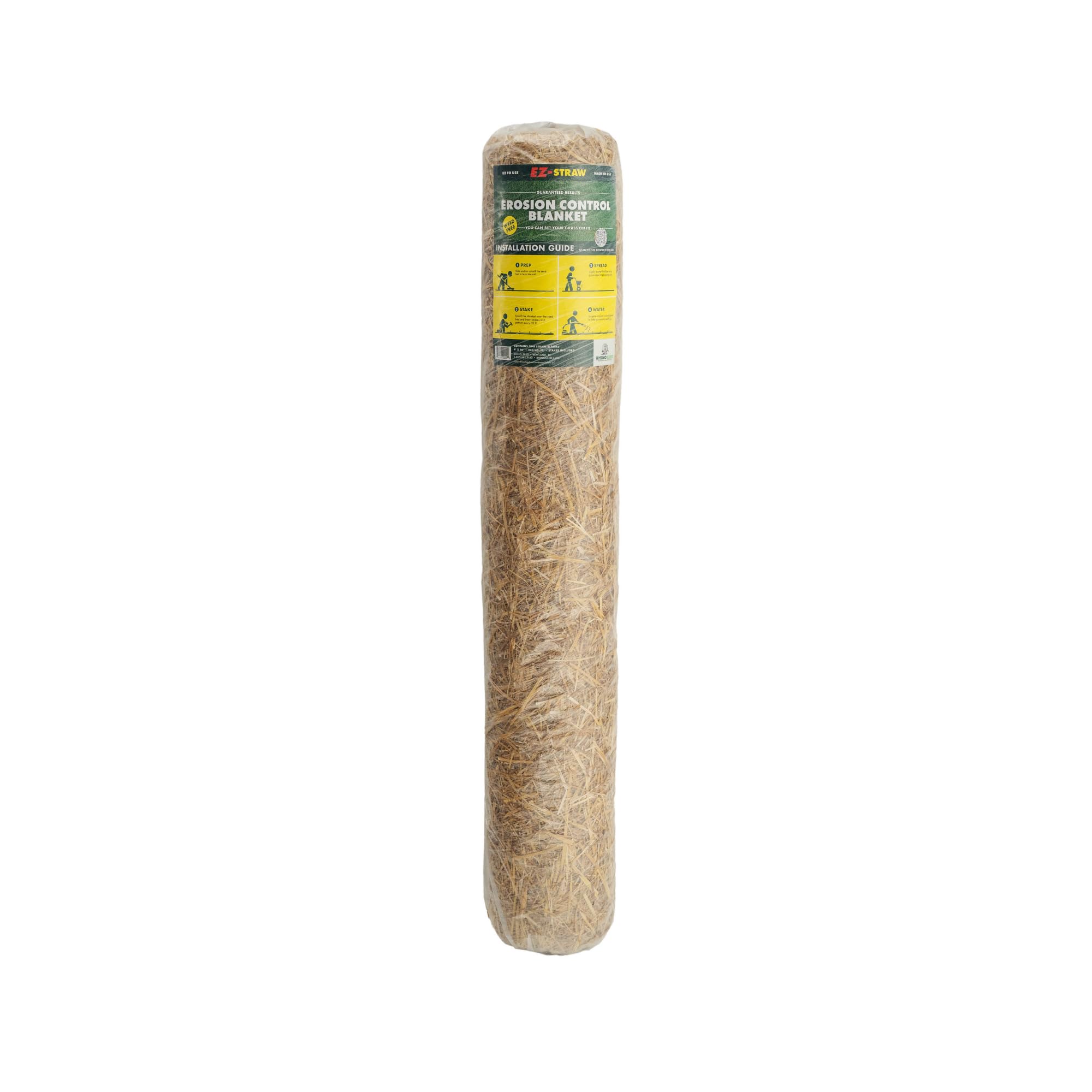
A natural-fiber blanket that comes with 15 biodegradable stakes for secure installation.
This EZ Straw blanket is marketed specifically for grass seed germination and erosion control. It is made from natural straw fibers woven into a blanket-like material using specialized binding techniques. The roll measures 4 feet by 50 feet and covers 200 square feet. It comes with 15 biodegradable stakes to pin it down, which is a helpful inclusion because rolled blankets generally need extra anchoring on slopes.
Shoppers say that grass sprouts within a week with diligent watering, and the blanket effectively prevents seed washout from rain. The critical feedback revolves around the netting. A few buyers found the netting was not biodegradable as advertised (or it took too long to break down), requiring manual removal at the 2-inch grass height. The unrolling process was another sticking point — the mat sometimes arrives less dense than the product photos suggest, and it is best handled by two people. Spending a few extra dollars on metal landscape staples over the included wooden stakes is a common owner tip.
The big picture: Effective for moderate hills and preventing bird predation, but requires a careful install and benefits from upgraded stakes. Quality control on straw density is inconsistent.
Pick this if: You want a dedicated germination blanket with included stakes and you are willing to unroll it carefully with a helper.
skip it if: You are concerned about non-degradable netting or want a denser, more assured straw content for the price.
7. EZ Straw Seeding Mulch with Tackifier (2-Pack)
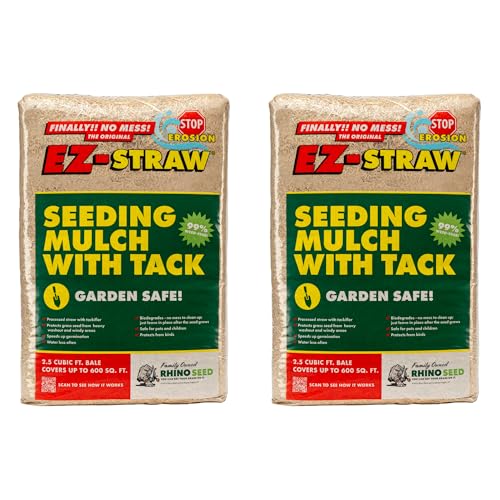
Two bales that stick together with tackifier, covering up to 600 square feet each.
If you have a big project — think a large vegetable garden, a full front lawn reseed, or mud control over a wide area — this 2-pack of EZ Straw delivers the most loose-straw volume here. The straw is 99% weed-free, a claim owners of this specific pack confirm. One buyer used it over 1,100 square feet and got “great grass growth in 3 weeks” with no wheat sprouting.
The price-per-bale shakes out as the most budget-friendly way to buy loose straw in bulk. Just note that the packaging may vary from the product photo. There is also a narrow but real risk of receiving only one bale instead of two — a few shipping hiccups appear in the review history, though the seller typically resolves it. For most buyers, the tackiness and weed-free quality make this the best bulk option for covering a lot of bare ground quickly.
Value verdict: The easiest way to stock up for a large yard. The tackifier means it will not blow away like cheap straw, and the weed-free promise holds up in owner reports.
Reach for this if: You need two bales anyway, or you are covering a large area and want the best per-bale value with proven germination results.
Consider a single bale instead if: Your project is under 500 square feet — you will have less storage hassle and no shipping risk of a missing package.
Understanding the Specs
Coverage (Cubic Feet & Square Feet)
This is the most practical number on the bag. Most loose straw bales are labeled in cubic feet (2.5 CU FT is standard). That volume typically covers around 500 to 600 square feet at a recommended 1- to 2-inch depth. For rolled blankets, look at the width times length — a 4′ x 50′ blanket covers 200 square feet. Measure your area before buying so you do not end up scrambling for a second roll mid-project.
Tackifier
A tackifier is a natural, biodegradable bonding agent mixed into the straw. When you spray water over the straw, the tackifier activates, making each strand stick to its neighbor and to the soil. This is what keeps loose straw from drifting into the street on a windy day or washing into a pile during a rain shower. Without it, you are basically spreading loose hay that will relocate at the first storm.
Blanket vs. Loose Straw
Loose straw is ideal for flat or gently sloped areas and is extremely easy to apply — just open the bag and toss. Straw blankets are rolled mats with netting stitched through, designed for steep slopes, drainage ditches, and areas with concentrated water flow. Blankets stay anchored much better on a hill, but they are heavier to carry and require more effort to install (cutting, staking, and sometimes a second person to help unroll).
Biodegradable & Weed-Free Claims
Processed erosion straw is heat-treated or mechanically cleaned to kill weed seeds that are typically present in farm hay. Look for a “99% weed free” label. Biodegradable means the straw decomposes naturally in the soil over a season, so you do not have to rake it up after the grass is established. Most straw products in this category are fully biodegradable, but some rolled blankets use plastic netting that takes much longer to break down and may need to be removed.
FAQ
How long does erosion control straw take to decompose?
Will erosion control straw prevent weeds from growing?
Can I use loose straw on a steep slope?
How do I apply loose straw with tackifier?
Do I need to remove the straw after grass grows?
What is the difference between straw and hay for erosion control?
Can erosion control straw harm pets or children?
Which is better for a vegetable garden: loose straw or a straw blanket?
Final Thoughts: The Verdict
For most buyers, the best erosion control straw winner is the Gardener Select Seeding Straw because it combines the highest owner satisfaction with a weed-free, tackifier-processed bale that covers a large area and leaves nothing to clean up. If you need fast germination on a flat yard, grab the EZ-Straw Seeding Mulch. And for a steep slope or a heavy-rain zone, the Farm Plastic Supply Erosion Control Blanket is the one to reach for.
How We Picked
We do not accept paid placement. Every pick is matched to a real buyer and a real use-case; we do not hands-on test units.
Sources & Methodology
Specifications: manufacturer listings and product documentation. Review insights: verified customer reviews, as of July 2026. Pricing: not shown on this page (it changes often); check the current price via the retailer link.
As an Amazon Associate, Lawn Gear Lab earns from qualifying purchases. This does not affect which products we feature.