
Specs are compiled from manufacturer listings and verified buyer reviews and can change over time — please confirm the key details on the product page before buying.
You planted, watered, and waited — only to wake up to a garden that looks like a buffet was held. Rabbits, deer, stray dogs, and even the neighbor’s cat see your raised beds as an all-you-can-eat salad bar, and nothing short of a real physical barrier backed by a jolt of electricity stops them for good. An electric fence for your garden isn’t about being mean; it is about drawing a clear, memorable line that wildlife respects after one single bad experience.
I’m Rikta — the writer behind Lawn Gear Lab. This guide compares each manufacturer’s published specs and the patterns across verified customer reviews, so you get each pick’s real strengths and trade-offs instead of marketing spin.
Your goal here is simple: find the best electric fence for garden that fits your plot size, the animals you face, and how much setup you can handle. if you need a lightweight solar charger for a weekend cabin or a full netting fortress for a backyard flock, this breakdown shows what matters and what does not.
Our Picks at a Glance

How To Choose The Best Electric Fence For Garden
You want a fence that actually stops the animals in your area, not one that looks impressive on a box. The real trick is matching the charger’s stored energy, measured in joules, to the length of your fence and the size of the pests. A tiny 0.11-joule unit can deter a raccoon from a bird feeder, but it will laughably fail against a hungry deer. A high-joule premium charger can handle miles of fence, but it is overkill for a 10-by-10 tomato patch. The first decision is solar or mains-powered. Then you choose between portable netting or plain wire on posts. Owners who have used these for years stress that good grounding and tight wire matter just as much as the brand — a fence that sags loses voltage fast.
Stored Energy (Joules) Is What Really Stops Animals
Manufacturers love to shout voltage numbers (5700V, 10200V, 9300V), but the real muscle is stored energy measured in joules. A joule rating tells you how much “punch” the charger can deliver in one pulse — the higher the stored joules, the longer the fence line it can drive and the thicker the animal’s fur it can burn through. For a mid-size garden protecting against raccoons, skunks, and the occasional dog, a unit between 0.1 and 0.3 stored joules is typically enough. For larger pastures with cattle, horses, or determined deer, you want at least 0.4 to 1.2 stored joules. The constant is that the energizer must also be paired with a good ground rod — without it, those joules have no path to complete the circuit and the animal feels nothing.
Solar vs. Plug-In: Reliability in Real Weather
A solar garden fence charger is a dream for remote corners of the property where extension cords do not reach, but its performance hinges on the solar panel wattage, the internal battery capacity, and the weather patterns in your area. Look for a panel of at least 3 to 5 watts and a battery that promises at least 10 to 14 days of operation without sunlight, because one cloudy week should not let the fence go dead. Some premium solar models now include a wall-charge backup so you can top off the battery on a rainy stretch without waiting for the sun. If your garden is near an outdoor outlet, a plug-in energizer is simpler, more predictable, and typically costs less per joule — but it paints you into a fixed location.
Quick Comparison
| Model | Best For | Output (Stored Joules) | Fence Coverage | Power Source | Amazon |
|---|---|---|---|---|---|
| Premier 1 PoultryNet★ Best Overall | Chickens, ducks, goats (netting kit) | — (energizer sold separately) | 164 ft (netting) | Any external energizer | Amazon |
| Epoify LD02Top Performer | Large pastures, horses, cattle | 1.2 J | 45 miles | Solar + wall charge | Amazon |
| RentACoop Poultry NettingPremium Build | Backyard poultry, rotational grazing | — (energizer sold separately) | 168 ft (netting) | Any external energizer | Amazon |
| Andmon MINI400 | Medium pastures, deer, small livestock | 0.4 J | 20 miles | Solar | Amazon |
| Epoify LD01P | Mid-size gardens, goats, chickens | 0.32 J | 20 miles | Solar + AC adapter | Amazon |
| EVIORTER 0.18J | Small gardens, pet containment | 0.18 J | 10 miles | Solar | Amazon |
| MINI160 | Remote pastures, food plots | 0.16 J stored | 2 miles | Solar + DC charger | Amazon |
| Gorhope 0.11J | Bird feeders, small critter control | 0.11 J | 5 miles | Solar | Amazon |
In‑Depth Reviews
1. Premier 1 PoultryNet® Electric Fence for Chickens – 48″H x 164’L
Our pick — 4.5★ from 500+ verified ratings; the strongest balance of quality and price.
The netting that survived a tree fall and still held goats, pigs, and ducks inside.
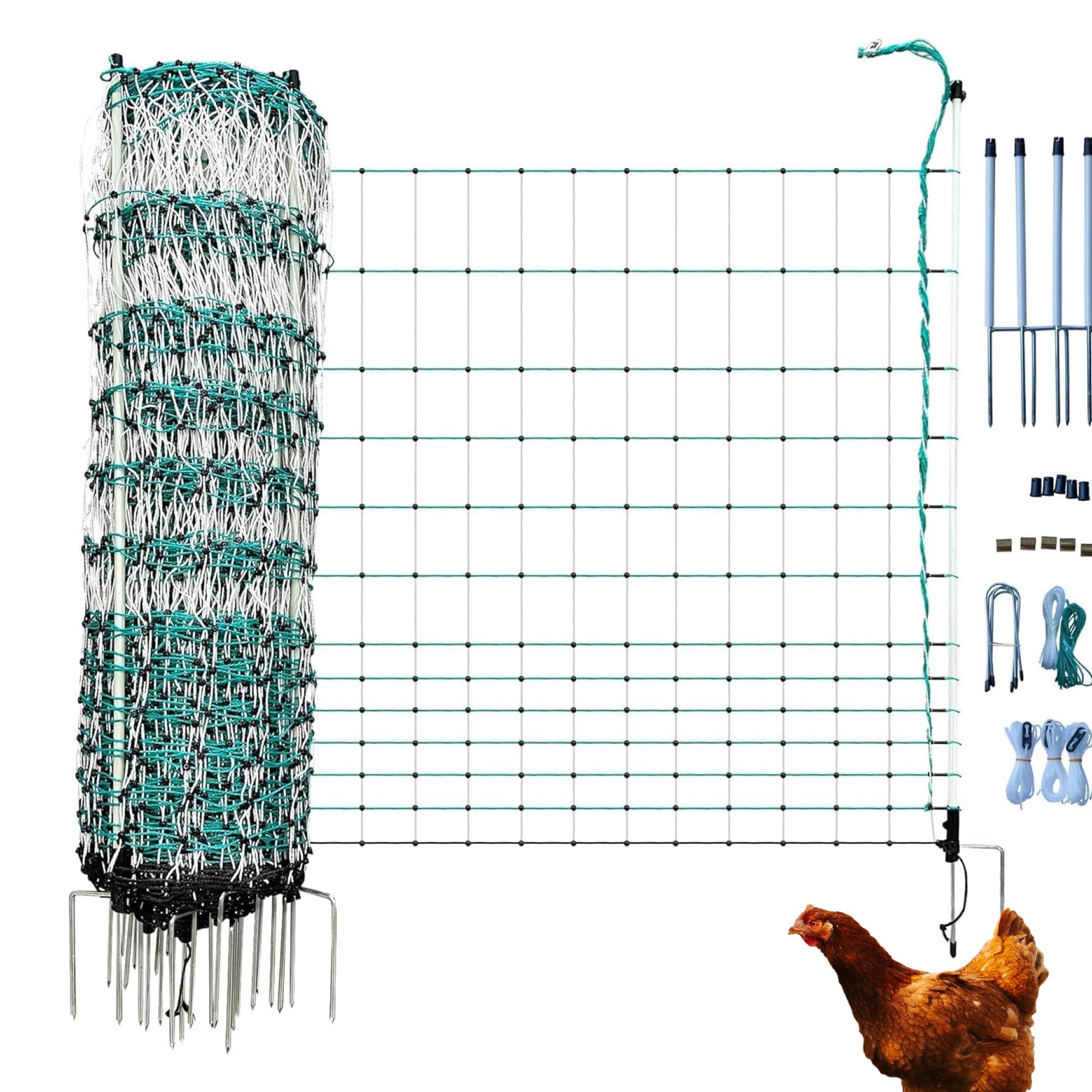
This is not a charger — it is the fence itself. It is the gold standard for anyone keeping poultry, goats, or small livestock in a defined garden area. The netting stands 48 inches tall and features 12 horizontal strands, 11 of which are conductive (they carry the electrical current), with string verticals spaced every 3 inches and built-in double spike line posts every 10 feet. Buyers report connecting up to 492 feet of this stuff and still having it hold strong after 2.5 years of weather, including a tree falling on it. The real-world consensus is that it contains chickens, ducks, and turkeys while keeping out coyotes, foxes, and dogs, and one owner successfully kept goats and pigs inside it for rotational grazing (moving animals between fenced sections so the grass regrows). A key drawback: an energizer is not included — you must buy one separately. The poles also draw mixed feedback on stability; some find them strong while others say the posts need reinforcement on uneven ground. It weighs 24 pounds, versus the MINI160 at 7.96 pounds, and can be awkward for one person to move. The claimed “set up in under 15 minutes with no tools” holds true on flat land. This is a premium investment for a permanent or semi-permanent garden fortress, not a quick fix for a tiny flower bed.
Roll-and-shock verdict: The best integrated netting solution on this list — if you have animals to contain and predators to keep out, and you already own or plan to buy a proper energizer, this is the fence. Plan for a cart if you intend to move it weekly.
Choose this if: You need a portable, electrified pen for poultry or goats and value brand reputation backed by 40 years of experience.
Think twice if: Your garden is hilly or rocky — the fence loses power if the net touches the ground.
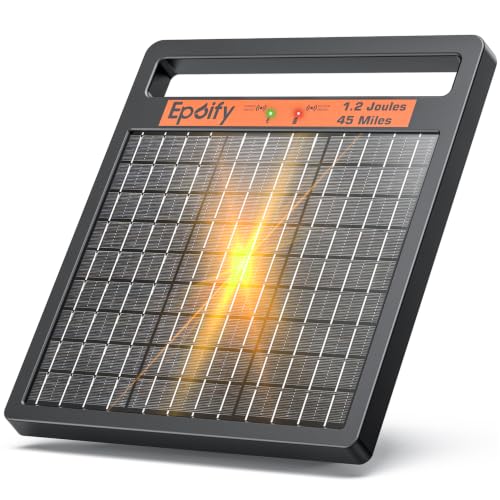
2. Epoify Solar Electric Fence Charger LD02 – 1.2J, 45 Miles
The ranch-grade punch that keeps horses in and raccoons out without an extension cord.
This is the heaviest hitter in the solar charger category — 1.2 stored joules of energy with a 7-11kV pulse that can drive up to 45 miles of fence line, making it the only unit here truly suited for large pastures, cattle, and horses. what separates it is the 8-watt solar panel paired with a 10000mAh internal battery, which owners say charges quickly and keeps the fence alive through multi-day storms. The magnetic on/off switch is a clever design choice — no tiny plastic button to crack or corrode in the rain. A built-in short-circuit buzzer alarm tells you immediately if a wire breaks or touches weeds, which saves hours of walking fence lines. One owner upgraded from a 0.1-joule charger to this one and reported that their sheep finally respected the fence, enabling proper rotational grazing. The only quirk is the magnetic keychain needed to toggle it on and off, and a few owners found the instructions vague, but the functionality gets 15 positive mentions in the review data, backing up the claim that it just works. At 5.5 pounds, it is heavier than the tiny solar units, but the trade-off is genuine large-animal stopping power. Compared to the Andmon MINI400, this Epoify LD02 delivers 1.2J stored joules versus 0.4J stored joules, making it the right pick if you face horses or elk instead of just deer.
What wins people over
- True 1.2 stored joules stops horses and cattle cold
- 8W solar panel and big battery handle cloudy weeks
- Built-in alarm finds fence faults quickly
The honest trade-off
- Magnetic switch takes getting used to — no physical button
- Overkill for a small flower or vegetable garden
Reach for this if: You have a large pasture, run cattle or horses, and need a solar charger that can handle real weather without quitting.
Pass on it if: You only need to protect a 50-foot garden perimeter — a smaller, cheaper unit will do the job with less bulk.
3. RentACoop Poultry Netting Electric Fence – 48″ H x 168′ L
168 feet of electrified netting that folds up fast and moves with your flock.
This is the direct competitor to the Premier 1 netting, and it brings its own strengths — primarily a slightly longer roll at 168 feet, triple-braided stainless steel and copper conductive wires (which means three strands twisted together for durability), and pre-attached FRP (fiberglass-reinforced plastic) posts spaced every 12 feet that make setup quick. Owners consistently praise the ease of installation, with the data showing 70 positive mentions for that exact aspect, and the netting effectively contains chickens, ducks, and turkeys while deterring dogs, raccoons, and foxes. The kit includes thoughtful extras: 4 U-shaped stakes with guy lines, 14 metal stakes, 4 mini-posts, a repair kit, and a warning sign. The common owner-adjustment here is adding extra stakes or a second ground rod to maintain 10-12kV on the line — sag between posts is the one recurring theme, and buyers who added mini-posts fixed it. One owner called it “better than I expected” after getting poles in hard clay, and another combines two units for a larger pen. Like the Premier 1, an energizer is sold separately, so factor that into your total spend. This is a strong choice for backyard poultry keepers who want a complete netting kit with good parts support.
Setup-and-go verdict: The included hardware package (guy lines, repair kit, multiple stake types) makes this the most complete netting bundle on the list — ideal for new poultry owners who want everything but the energizer in one box.
Choose this if: You want a ready-to-deploy poultry net with extra hardware for stability on uneven ground.
Note that: Poles are thin and need guy lines or mini-posts to prevent sag, especially in soft soil.
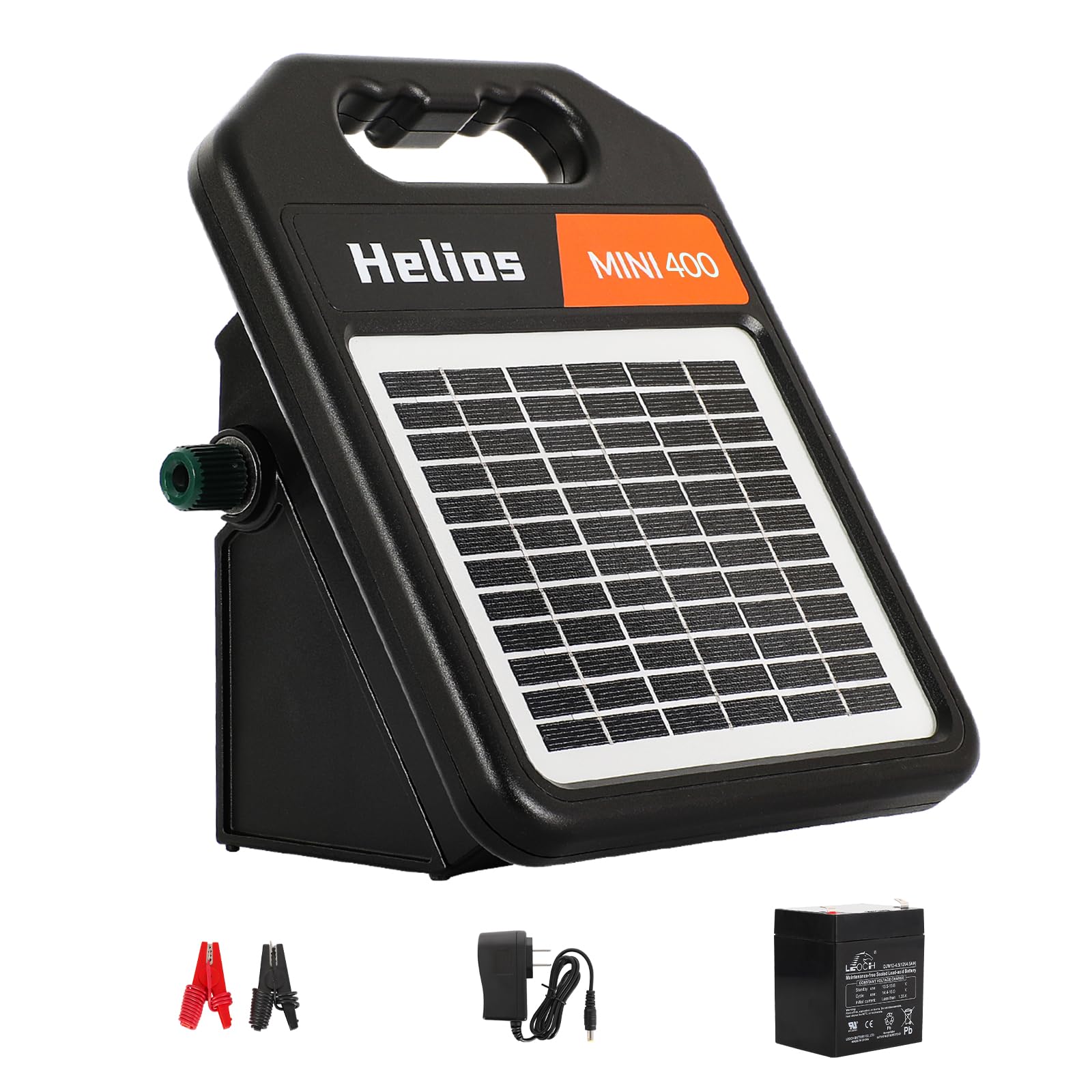
4. Andmon MINI400 Solar Electric Fence Charger – 0.4J, 20 Miles
The 0.4-joule solar unit that owners say keeps deer out and works great for small goats.
Stepping up from the entry-level chargers, the MINI400 offers a meaningful boost to 0.4 stored joules with a 3-watt solar panel and a 12V/4.5AH sealed lead-acid battery (a type of rechargeable battery that holds a charge well) that can run up to 14 days without sun. That coverage claim of 20 miles is under ideal conditions, but for a realistic garden perimeter of a few hundred feet, this is more than enough to deter deer, stray dogs, and medium-sized predators. The IPX4 waterproof ASA outer casing (a durable plastic that resists weather) is built to survive extreme temperatures from -20°C to 80°C, making it a genuine all-season choice. Owners specifically call out how easy it is to mount on a T-post — the unit has a built-in slot that doubles as a ground rod mount. The mixed-reality aspect here is that functionality has 61 mentions with a mixed sentiment: about as many owners mention it works great for years as report it stops working after one year. The day/night mode (which slows the pulse at night to save battery) is also not perfectly clear to all users, but those who kept it in day mode had no issues. At this price-to-joule ratio, it is the best mid-range value for a solar charger that needs to handle a real garden fence rather than just a bird feeder. It offers a better power-to-cost balance than the Epoify LD02, but lacks that unit’s plug-in backup option.
Why owners recommend it
- 0.4 joules is the balance for medium gardens and small livestock
- T-post mounting is straightforward and built into the design
- 14-day battery backup for cloudy stretches
The honest long-term warning
- A fair number of units reportedly stop working after a year
- Day/Night mode operation is not clearly explained
Best for: Garden owners with deer problems who want a mid-power solar charger that mounts directly on a T-post without extra brackets.
Keep in mind: Long-term durability is a split verdict; some owners had to replace it within 12 months.
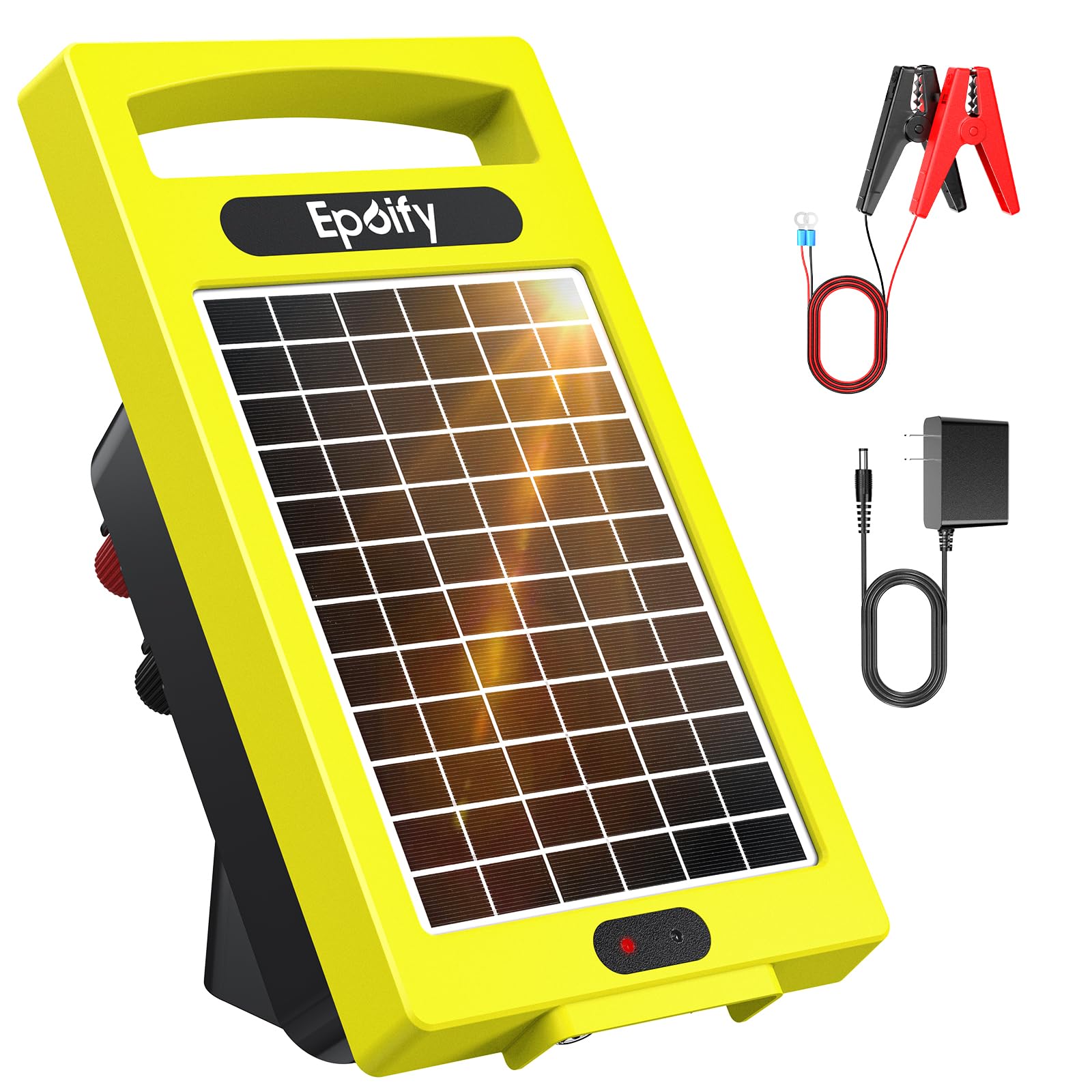
5. Epoify Solar Electric Fence Charger LD01P – 0.32J, 20 Miles
The dual-power charger that works for a 50×50 garden and still scares off bears.
This charger from Epoify delivers 0.32 stored joules with a 5700-10200V pulse output, and the big advantage here is that it comes with an included AC adapter (a wall plug) so you can plug it in when solar is not enough — a rare bonus at this price tier. The data shows it is capable of powering up to 20 miles of fencing, and owners confirm it works for goats, keeps bears away, and holds a charge through the night. One owner specifically mentions it works well for a 50 x 50 garden, which is a very common suburban garden size. Reliability gets the most positive mentions at 89 counts, which is a strong vote of confidence. On the downside, battery life is the most mixed aspect: while many owners say it holds a charge for months, a vocal minority report it stops charging after 47 days. The included AC adapter provides a workaround for that scenario, but if you need pure solar independence, this unit’s battery is the weak link for some. It is lightweight at 1.44 kg and has a water-resistant ABS housing (a tough plastic shell). For the price, you get both solar freedom and a plug-in backup — a safety net most pure-solar units, like the Andmon MINI400, do not offer.
Dual-power verdict: The included wall adapter makes this the most forgiving solar charger for gardens that see long overcast stretches — when the battery dips, just plug it in overnight and you are back online.
Go with this if: You want the security of a plug-in backup on a solar unit, without paying premium prices.
Watch out for: Some units show battery degradation after about six weeks; the AC adapter is your safety net.
6. EVIORTER Solar Electric Fence Charger – 0.18J, 10 Miles
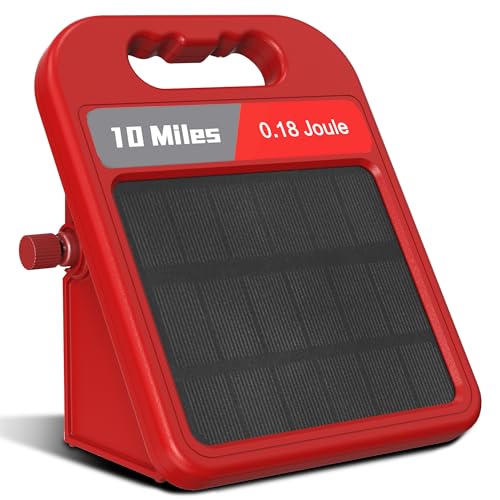
A tiny, tool-free solar unit that claims 25 days of backup for small gardens.
At 0.18 stored joules with a maximum output voltage of 9300V, this EVIORTER unit sits in the entry-to-mid range for energy, but it has two standout numbers: a 5-watt monocrystalline solar panel (a high-efficiency type made from single-crystal silicon) that recharges the battery in about 6 sunny days, and an unusually long 25-day backup runtime thanks to the internal battery. That backup claim is one of the highest on this list for a unit this size, making it a good choice for a remote garden you do not check every day. The 10-mile coverage claim is realistic only under clean, unweeded fence conditions, but for a garden perimeter of 100-200 feet, the 0.18 joules is enough to deter raccoons, dogs, and smaller deer. Owners note it is lightweight, tool-free to set up, and the waterproof construction handles rain and snow. The honest caution here is that several of the reviews for this listing appear to be about a flag or banner rather than the fence charger — suggesting the listing has some product mixing issues on Amazon. The three relevant reviews confirm it works perfectly, is easy to install, and saves energy. At this price point, you are getting good value for a small garden, just buy from a reliable seller.
Solar endurance verdict: The 25-day backup claim is the longest on this list for a sub-0.2J charger, ideal for weekend-property owners who are not on site every day.
Choose this for: A small flower or vegetable garden where you need a set-and-forget solar unit that lasts through overcast weeks.
Be aware: Review samples are small and some reviews relate to a different product — verify the listing before purchase.
7. MINI160 2 Miles Solar Fence Charger – 0.16 Stored Joule

The value champ that charges in clouds and runs a month without seeing the sun.
Don’t let the 2-mile coverage claim fool you — the MINI160 is a focused tool designed for small-to-medium gardens, food plots, and remote pastures where you need reliable solar performance. It outputs 0.16 stored joules (0.11 joule output) with a night mode (a setting that slows the pulse to every 2.9 seconds at night to save battery) that helps the 12V/4.5AH sealed lead-acid battery operate up to 28 days without sunshine — that is an entire month of protection. Owners repeatedly mention it charges quickly even in cloudy weather and holds the charge for days, making it a genuinely low-maintenance option. One owner let it sit in the box for a year, then set it up and it worked immediately. The honest split in the data is that while most owners say it works great, a small number report the unit dying after 2 months — though the seller in those cases sent a replacement that worked perfectly. At just 7.96 pounds, it is also notably lighter than the Premier 1 PoultryNet (24 pounds, a 3.0x gap), making it easy to move around the property. This is the budget pick for price-conscious garden owners who need a dependable solar pulse, not a massive joule count.
Why it is a crowd favorite
- 28-day backup runtime is class-leading for a sub- charger
- Night mode extends battery life significantly
- Charges reliably even under overcast skies
The known risk
- A minority of units fail within 2 months — seller replacement seems to fix it
- At 0.16 J, it is too weak for large animals like cattle or elk
Best for: Garden owners on a budget who want solar reliability and a 28-day battery life, not raw horsepower.
Skip if: You need to stop determined deer or bears — step up to at least a 0.3J+ charger.
8. Gorhope 5 Miles Solar Electric Fence Charger – 0.11J
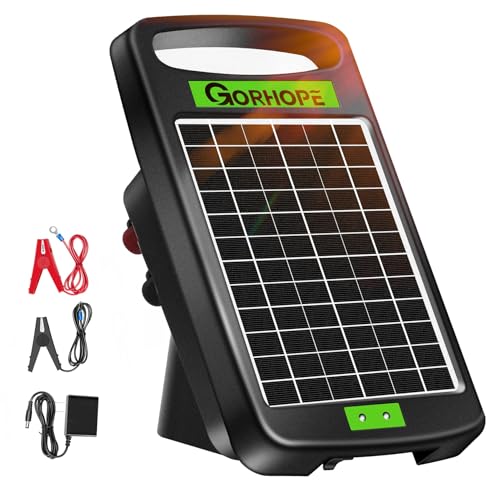
The solar charger that zaps a dog’s nose and survives an entire season in the hot sun.
Entering at the lowest energy output on the list at 0.11 joules, this Gorhope unit is not built for large pastures or heavy predators — it is built for garden owners who have a specific, small-scale problem: a single raccoon raiding the bird feeder, a neighbor’s dog digging under a fence, or squirrels climbing a pole to reach tomatoes. The output voltage range is 5700-10200V, which sounds dramatic, but the low stored energy means it is best for short, clean fence runs under 1 mile. What owners love most is performance — 25 positive mentions — and the fact that it charges and works well in direct sun, with one owner accidentally confirming the shock works after touching it. The tempered glass solar panel is thicker and larger than basic plastic panels, and the unit has weathered a full season with no signs of degradation. The catch is that battery life is mixed: several owners note it does not hold a charge for a full 24 hours in heavy shade or poor sun, so placement is critical. At this price, it is the cheapest way to electrify a small garden patch, but you must pair it with a spot that gets direct sun most of the day. The 14-day continuous protection without sunlight claim requires the battery to be fully charged first, which takes 1-2 days of good sun. Compared to the MINI160, this Gorhope delivers 0.11J vs. 0.16 stored joules, so it is weaker but also simpler and cheaper for the smallest jobs.
Small-garden verdict: For a 10×10 vegetable patch, a bird feeder pole, or a dog-dig barrier, this is the most affordable solar zap you can buy — just make sure it sees the sun.
Reach for this if: Your problem is small critters in a small space and you want the lowest-cost solar entry point.
Pass on this if: Your fence runs through shade or you need to stop anything larger than a raccoon.
Understanding the Specs
Stored Joules vs. Output Joules
This is the single most misunderstood spec in electric fencing. Stored energy (joules) is what the charger keeps in its capacitor (a component that holds an electrical charge) ready to fire. Output energy is what actually reaches the fence after internal resistance — usually about 60-70% of the stored figure. When a manufacturer says “0.16 stored joules, 0.11 output joules,” the output number is what the animal actually feels. For garden use, compare stored joules between models, but know that a clean, weed-free fence will deliver closer to the full stored value than an overgrown one.
Solar Panel Wattage and Backup Days
Solar fence chargers live and die by their panel wattage and battery size. A 3W panel on a 4.5AH battery (like the MINI400) will need several good sunny days to fully charge, while an 8W panel on a 10000mAh battery (like the LD02) charges roughly twice as fast. Backup days refer to how long the fence stays operational with zero sunlight — look for 14 days minimum if you live in a region with frequent cloud cover. The night-mode feature on some units slows the pulse rate to conserve battery, effectively doubling the backup time at night.
FAQ
Can I use a solar fence charger for a small vegetable garden?
Do I need a separate energizer for the netting fences?
How many joules do I need to keep deer out of my garden?
Is a solar fence charger safe for pets and children?
How long does the battery last on a solar electric fence charger?
Can I connect multiple solar chargers to one fence line?
What gauge wire should I use for a garden electric fence?
Will an electric fence work in wet or rainy weather?
How do I ground a solar electric fence properly?
Is a fence charger with a higher voltage always better?
Final Thoughts: The Verdict
For the majority of shoppers, the electric fence for garden winner depends on if you need the complete fence or just the brains. The Premier 1 PoultryNet is the best all-in-one netting