
Specs are compiled from manufacturer listings and verified buyer reviews and can change over time — please confirm the key details on the product page before buying.
You need to cut through thick brambles, saplings, and nettles without wrestling a petrol engine, and you want to know if a battery-powered brush cutter can actually do it. Yes, it can — provided you match the blade type, motor speed measured in RPM (revolutions per minute, how fast the blade spins), and battery capacity (measured in amp-hours or mAh, how much energy it stores) to the density of your growth. This guide separates cutters that genuinely chop through tough stuff from ones that stall on a stiff weed.
I’m Rikta — the founder behind Lawn Gear Lab. The picks here are based on published specs and patterns in verified customer reviews, so you get real strengths and trade-offs rather than marketing claims.
The best electric brush cutter uk buyers choose depends on matching a machine’s cutting power and battery stamina to what you actually grow. The Embui 30000 RPM model wins the top spot because it cuts faster than any other here while its wheeled design reduces arm fatigue on flat ground.
Quick Picks
- Embui 2026 New 30000 RPM Brushless Cordless Weed Wacker — Top Performer
- denqir 20000 RPM Electric Weed Wacker with Wheel — Best Overall
- AHPUCEP Brush Cutter Cordless Weed Wacker Electric — Best Value
- MAXMAN Weed Wacker Cordless Electric Brush Cutter 52 Inch — Lightweight Specialist
- Ryobi OBC1820B 18V ONE+ Brush Cutter — System Pick
How To Choose The Best Electric Brush Cutter UK
Picking the right battery-powered brush cutter in the UK is about matching the tool’s real-world specs to what you are actually cutting, not the marketing claims on the box. The three decisions that matter most are the motor type and speed (RPM), the blade system, and the battery capacity (Ah). A cutter that runs out of battery halfway through a bramble patch is just dead weight. Here is what to look for.
Motor Power and Speed (RPM)
You need enough blade speed to slice through thick stems without bogging down. The motor’s revolutions per minute (RPM) determines this. A brushless motor — one that uses electronics instead of physical brushes to spin the rotor — is more efficient, runs cooler, and lasts longer than a brushed motor of the same wattage. For heavy weeds and small saplings, look for a no-load speed of at least 18000 RPM. Machines at 20000 RPM or 30000 RPM cut noticeably faster because the blade hits each stem more times per second before the motor can slow down.
Blade Types and Cutting Width
Plastic blades are fine for soft grass but shatter on hidden rocks or thick brambles. Metal blades — especially manganese steel saw blades — cut through tough weeds, vines, and branches up to about half an inch thick by sawing instead of whipping. A wider cutting width, like 12 inches versus 6 inches, lets you cover more ground per pass and cuts down your walking time. But a wider blade demands more from the motor to keep up speed in heavy growth. The best UK cutters include multiple blade options so you can switch from grass trimming to brush cutting without buying a second tool.
Battery Capacity and Runtime
Battery capacity is measured in ampere-hours (Ah). A higher Ah number means the battery stores more energy and runs longer before a recharge. For dense weeds, a single 4Ah battery typically delivers about 40 to 60 minutes of continuous cutting. Machines with two batteries let you swap and keep working while the first charges. Pay attention to the charger speed too — a fast charger that tops up in 2 to 3 hours is far more practical than one that takes 5 or 6 hours, because you are not stuck waiting half the day between swaps.
Quick Comparison
On smaller screens, swipe sideways to see the full table.
| Model | Best For | Motor Speed | Cutting Width | Battery Capacity | Amazon |
|---|---|---|---|---|---|
| Embui 30000 RPM | Comfort & speed | 30000 RPM | 12 Inches | 6000mAh | Amazon |
| denqir 20000 RPM | Wheeled ease | 20000 RPM | 12 Inches | 2 x 3000mAh | Amazon |
| AHPUCEP Brush Cutter | Versatile blades | — | 6 Inches | 2 x 4Ah | Amazon |
| MAXMAN Weed Wacker | Lightweight reach | 18000 RPM | 11.81 Inches | 2 x Lithium | Amazon |
| Ryobi OBC1820B | ONE+ system users | — | 30 cm | Body only | Amazon |
In‑Depth Reviews
1. Embui 2026 New 30000 RPM Brushless Cordless Weed Wacker
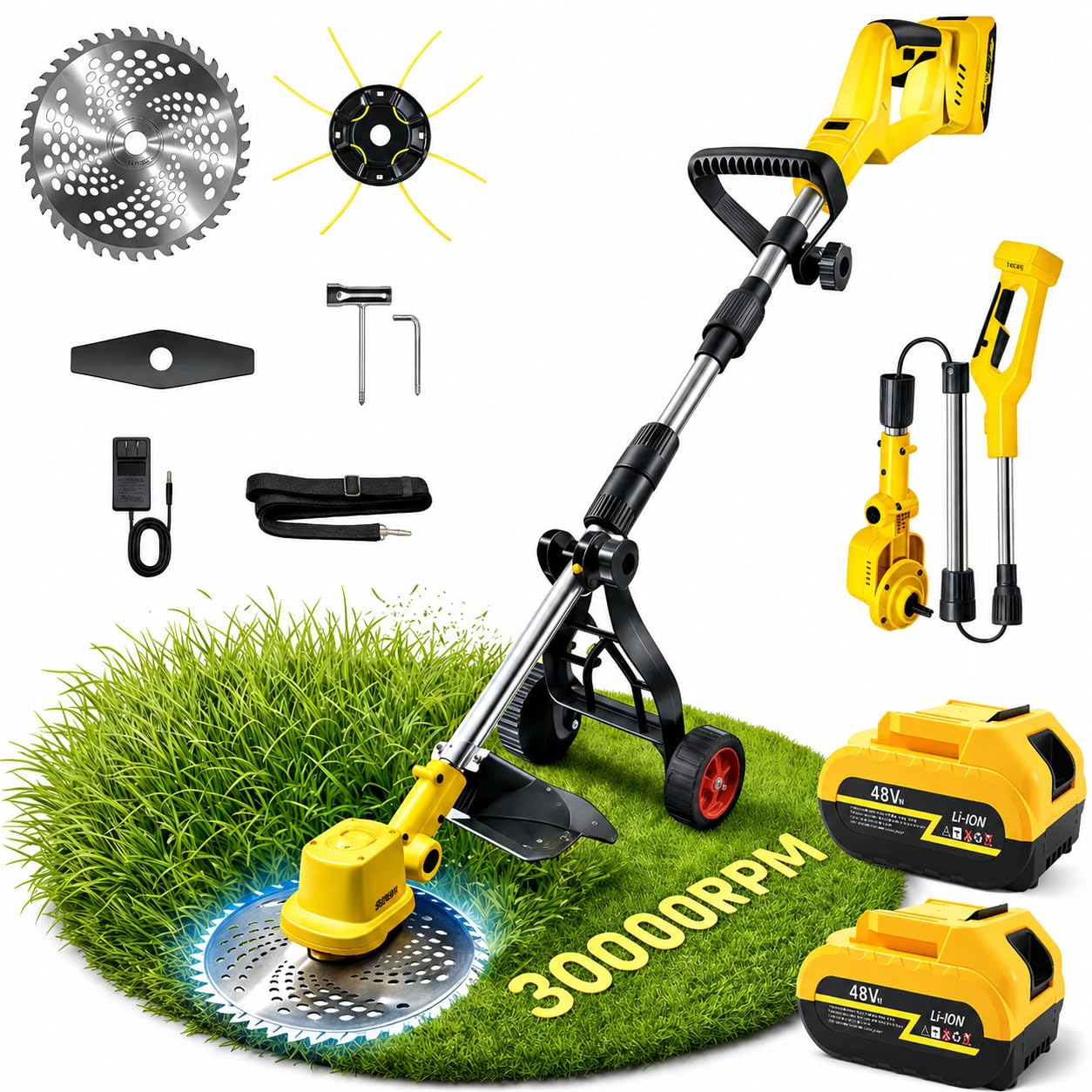
The smooth-running speedster that finishes your yard in half the time.
The Embui cuts faster than any other machine here because its brushless motor spins at 30000 RPM — that is 11% faster than the denqir 20000 RPM model below. A higher RPM means the blade hits each stem more times per second, so it slices through thick brambles without stalling. The 12-inch cutting width covers more ground per pass than the AHPUCEP’s 6-inch model, so buyers report finishing their whole yard in half the time. The 6000mAh battery (mAh is milliampere-hours, a measure of energy storage; 6000mAh is roughly 6 amp-hours) has a level display so you see the remaining charge, and owners mention one battery lasts an entire session.
The wheeled design reduces arm fatigue during long edging along driveways and fence lines. Owners also highlight the minimal vibration — one reviewer noted “no more vibrations that hurt my hands” — making it comfortable for older users or anyone spending hours on overgrowth. The foldable design stores neatly in a small cabinet, a bonus if shed space is tight.
The catch: the wheeled frame adds bulk for carrying up steep banks or through narrow gaps. It is not ideal for tight flower beds. For most UK gardeners tackling bramble lines and paddock edges, though, the combination of speed, comfort, and battery stamina makes this the strongest all-rounder.
Why it wins
- 30000 RPM brushless motor cuts faster than any other machine here
- 6000mAh battery with level display — lasts a full yard session, per multiple reviewers
- Minimal vibration and wheeled design reduce arm fatigue on long jobs
- 4-in-1 head swaps between trimmer, brush cutter, edger, and stringless mower
The trade-offs
- Wheeled frame adds bulk for carrying up slopes or through tight corners
- Nylon blades wear fast on rocky ground — stick to metal blades for UK brambles
Reach for this if: you want the fastest cutting speed available and a battery that lasts an entire yard, and you work mostly on flat or gently sloping ground where the wheels glide.
Look elsewhere if: your garden is full of steep banks, narrow paths, or awkward corners where a wheeled frame would be a hindrance rather than a help.
2. denqir 20000 RPM Electric Weed Wacker with Wheel
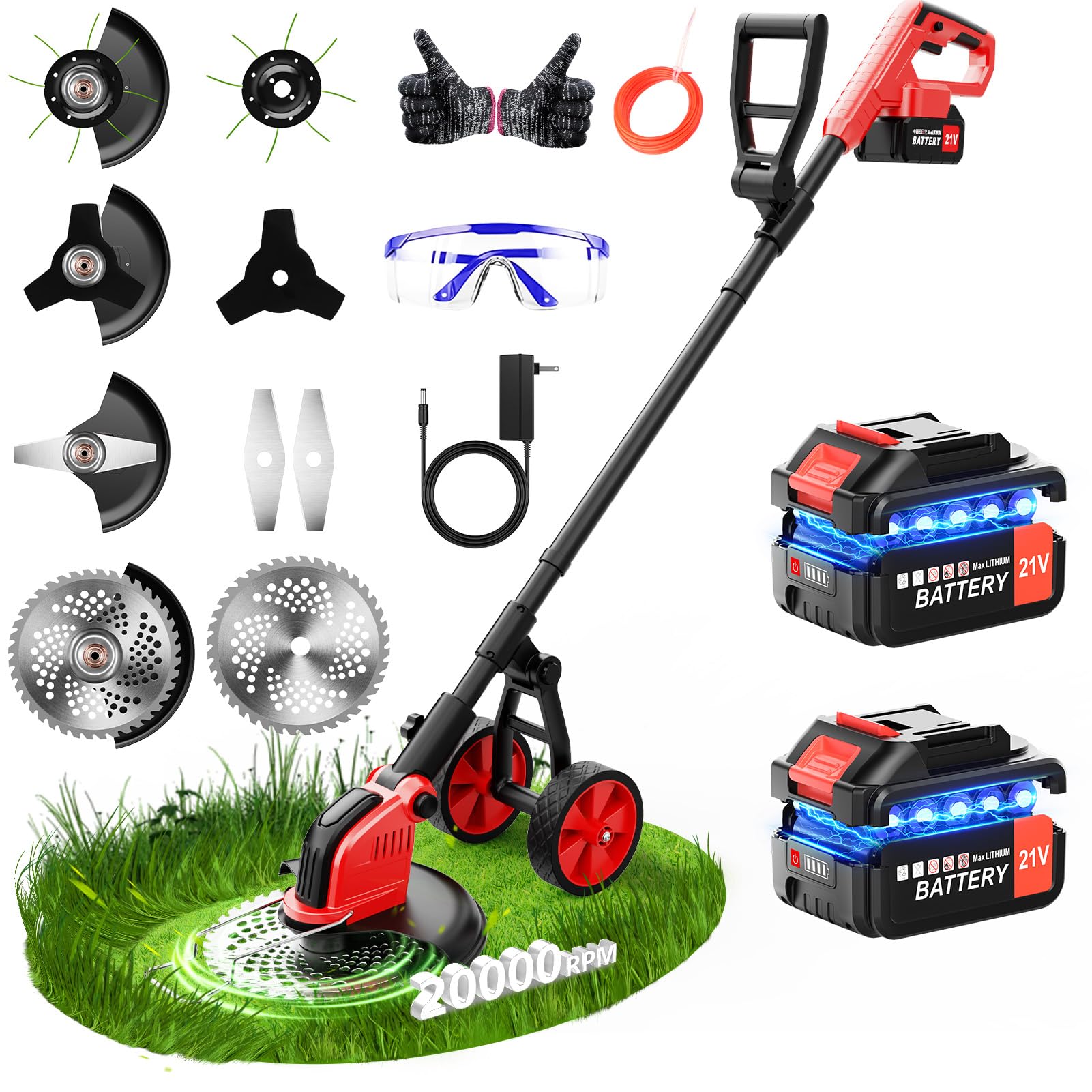
The wheeled all-rounder that turns weeding into a walking job.
The denqir sits between pure power and everyday practicality. Its 800W brushless motor at 20000 RPM drives a 12-inch cutting width — the same width as the Embui above, but at two-thirds the speed. You get clean cuts through grass and dense weeds, but it works a little slower through really thick saplings than the 30000 RPM model. The standout feature is the removable wheel kit: clip it on and the tool rolls like a mini mower, saving your arms from holding the full weight on paths and borders.
It comes with two 3000mAh batteries that customers note deliver about 45 to 50 minutes each, giving roughly 100 minutes of total runtime if you rotate them. One owner noted the large cutting blade “is very effective at mowing down weeds and grass.” The head adjusts 0 to 90 degrees vertically and 360 degrees horizontally, so you edge kerbs and trim under shrubs without bending.
Buyers do flag that the wheel assembly slides off during use — there is no locking clip to hold it in place. The front wire piece is considered useless by some owners. It is also heavier than lightweight handheld cutters at 11 pounds, though the wheels compensate on flat ground. For the UK buyer who wants a wheeled option that edges, trims, and cuts brush without spending top-tier money, this is the most balanced pick.
What works
- Removable wheels turn it into a rolling cutter — less arm fatigue on flat ground
- 12-inch cutting width covers ground faster than narrower models
- Two 3000mAh batteries give roughly 100 minutes of total runtime
- Head adjusts vertically and horizontally for edging and awkward spots
What to watch
- Wheel assembly slides off during use — no locking clip provided
- Heavier than handheld cutters at 11 pounds; less convenient for slopes
Best for: anyone with a medium-to-large garden who wants wheel-assisted cutting on paths and borders without paying for a premium-speed motor.
Not ideal for: steep banks or uneven terrain where the wheels become a nuisance rather than a help — a lighter handheld model will suit better.
3. AHPUCEP Brush Cutter Cordless Weed Wacker Electric
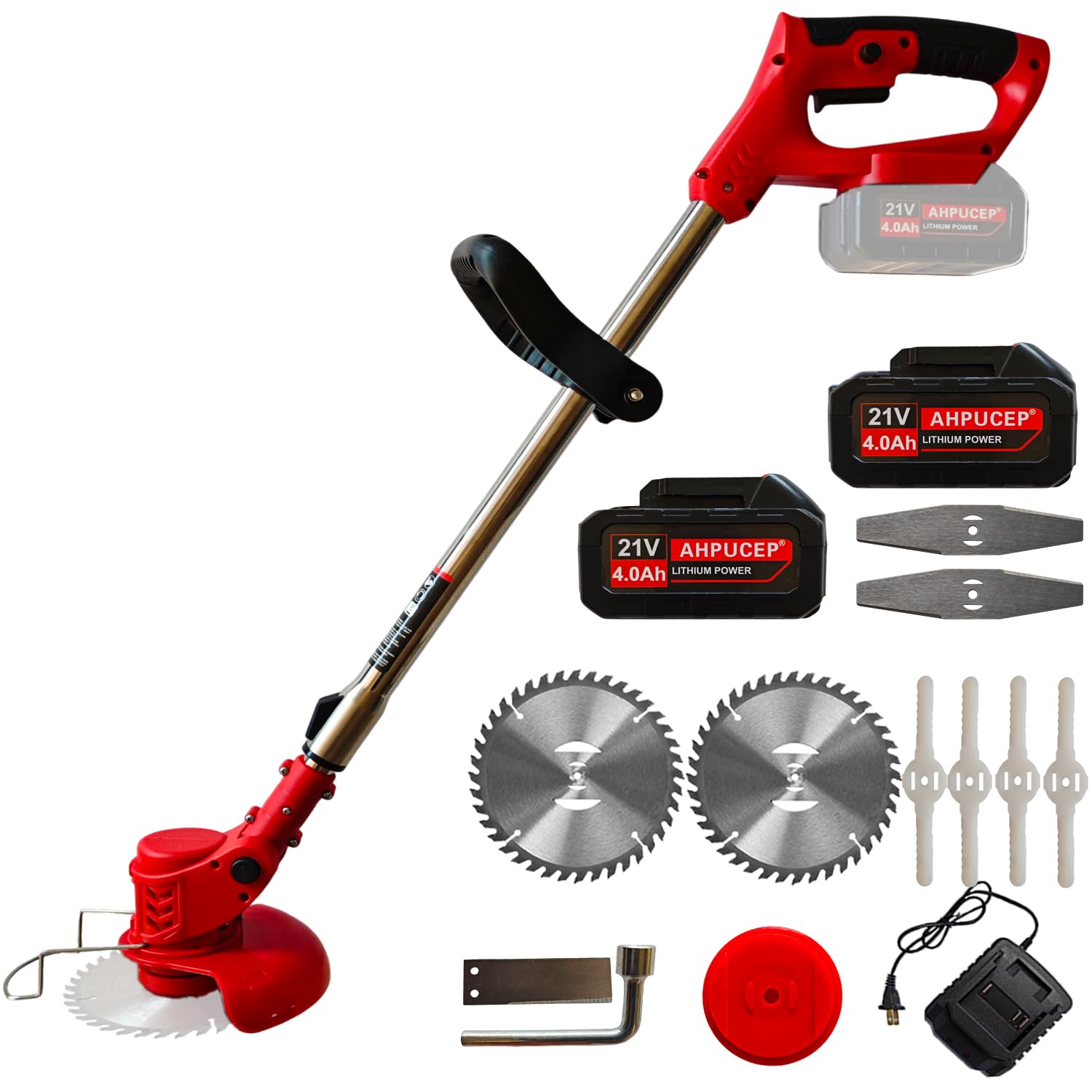
The lightweight blade-swapper that punches above its price on brambles.
At just 2.6 pounds for the body, the AHPUCEP is the lightest brush cutter here. That makes a real difference when reaching under shrubs or working along a fence line without a wheel kit. The 650W motor drives three blade types: plastic blades for soft grass, metal blades for weeds, and manganese steel round saw blades for thicker brush and branches. One buyer mentioned clearing a 500-foot shoreline of heavy weeds and half-inch willow saplings on roughly one battery charge, which shows its stamina against UK-type bramble.
The 6-inch cutting width is noticeably narrower than the 12-inch models — a 2.0x gap — so you cover less ground per pass. That is the trade-off for the lightweight feel and lower price. It comes with two 4Ah batteries, the highest individual battery capacity in this comparison. The telescoping pole extends from 33.7 to 46.25 inches, fitting different user heights, and the handle rotates 360 degrees for edging along paths.
Reviewers point out the shaft detent slips and needs occasional repositioning. Plastic blades break fairly easily on hidden rocks, but the saw blade handles thin branches up to about half an inch. One owner found the saw blade stopped on vines over an inch thick, so this is not a heavy-duty scrub-clearing machine. For medium-density weeds and the occasional sapling on a budget, it offers impressive value.
Why it delivers
- Ultra-light 2.6 lb body reduces fatigue during extended use
- Three blade types included — saw blade handles half-inch saplings effectively
- Two 4Ah batteries provide long runtime; one charge cleared 500 feet of shoreline
- Telescoping pole and 360-degree adjustable handle fit different user heights
The downsides
- 6-inch cutting width is the narrowest here — more passes needed for large areas
- Plastic blades break easily on rocks; saw blade stalls on branches over 1 inch
- Shaft detent slips and needs periodic re-tightening during use
Grab it for: light-to-medium clearing jobs where weight matters most — ideal for older users, small gardens, and reaching awkward spots.
Pass on it if: you need to clear large paddocks or thick saplings regularly, where the narrow cutting width and occasional stalling will frustrate.
4. MAXMAN Weed Wacker Cordless Electric Brush Cutter 52 Inch

The featherweight that slices through lilac shoots like butter.
The MAXMAN weighs just 3 pounds — nearly as light as the AHPUCEP — but offers a much wider 11.81-inch cutting width, roughly double the coverage per pass of the 6-inch model. Its 18000 RPM motor is the slowest in this lineup, falling 11% short of the denqir’s 20000 RPM, but shoppers say it cuts through tough weeds and small branches with surprising ease. One owner reported it “cuts lilac sucker shoots and debris in 30 seconds per bush, reducing a 2-week task to 2 days.”
It includes eight metal blades: six slotted stainless steel and two manganese steel circular saw blades. Two lithium batteries come with a fast charger that tops up in 2-3 hours — a meaningful upgrade over chargers that take 5 or 6 hours. The telescopic rod extends to 34 inches overall length, and the head rotates 0 to 90 degrees for vertical trimming against walls. The rotating baffle design reduces debris splash-back, a welcome detail near flower beds.
Buyers report two consistent issues: the plastic at the rotation point can break if you hit a half-inch twig at full speed, and the battery slides in very tightly, requiring a firm whack to seat it. One customer observed an 83-year-old user found it “lightweight and easy to use,” and the circular blades held up without breaking. The 18000 RPM speed handles dense weeds well but lacks headroom for really thick saplings — keep it to growth under about half an inch.
What stands out
- Ultra-light 3 lb body with a wide 11.81-inch cutting width — great coverage with low fatigue
- Eight metal blades included, with manganese steel saw blades for tough growth
- Fast 2-3 hour charger means less downtime between battery swaps
- Rotating head and baffle reduce debris splash and allow vertical trimming
The catches
- Plastic rotation joint can snap on half-inch twigs — be careful with hidden branches
- Battery slides in very tightly, requiring force to seat and remove
- 18000 RPM is adequate for weeds but slows noticeably on thick saplings
Best for: elderly or strength-limited gardeners who need a very light machine with wide cutting coverage and fast recharging.
skip it if: you regularly clear saplings thicker than your thumb or work on rocky ground where plastic joints are vulnerable.
5. Ryobi OBC1820B 18V ONE+ Brush Cutter

The system-agnostic pro tool that lives and dies by your existing batteries.
The Ryobi is different from the others — it is sold as a ‘body only’ tool with no battery or charger. It relies entirely on your existing 18V ONE+ system batteries. That makes it a sensible buy only if you already own Ryobi ONE+ batteries. If you do not, the total cost will be higher than any all-in-one machine here. The 20 cm (roughly 8-inch) hardened steel triarc cutting blade — a triangular blade with three edges that slices tough grass — is serious metal for long weeds. The 30 cm line trimmer head handles grass at a wider path than the blade.
It has a soft-grip bike handle with variable speed control, so you dial the power back for light trimming or push it full for thick patches. The motor is an 18V unit; the exact RPM is not specified. Owners mention mixed experiences: one owner noted the harness assembly is confusing and the non-adjustable rod makes it hard to cut flush with the ground. Another found it stopped working after four months. Several reviews mention poor assembly instructions with pictures only and no text.
The Ryobi weighs 7.08 kilograms (about 15.6 pounds) — the heaviest machine here by a significant margin. The harness is considered uncomfortable by some buyers. The 5-year EU spare parts availability is a strong benefit for long-term ownership, assuming you already own the batteries. For the UK gardener already deep in the Ryobi ONE+ ecosystem, this is the obvious choice. For everyone else, all-in-one battery packages above offer better value and simpler setup.
The system advantage
- Works with all Ryobi 18V ONE+ batteries if you already own them — no new charger needed
- Triarc steel blade cuts tough grass and weeds aggressively; line head for lighter trimming
- Variable speed trigger and soft-grip bike handle for extended comfort
The real-world issues
- Heaviest pick at 7.08 kg (15.6 lb); harness is poorly documented and uncomfortable
- Rod length and angle are not adjustable — difficult to cut flush with ground
- Mixed reliability feedback; multiple customers note failures within months
- Body-only means no battery included — total cost is much higher if you are not already in the ONE+ system
Only buy this if: you already own multiple Ryobi ONE+ batteries and a charger and want a single dedicated brush cutter head without adding another charging ecosystem to your shed.
Skip it for: anyone who does not already own Ryobi ONE+ batteries, or who values lightweight handling, adjustable cutting angles, and reliable first-use assembly.
Understanding the Specs
RPM — Revolutions Per Minute
This number tells you how fast the blade spins when not under load. A higher RPM means the cutting edge hits each stem more times per second. That translates to cleaner slices through tough weeds, so the blade stalls less often when you hit a thick bramble. For UK paddocks and overgrown borders, look for at least 18000 RPM as a baseline. At 20000 RPM the cutting feels noticeably more assertive. At 30000 RPM you can work through medium saplings without the motor bogging down.
Blade Type — Metal vs. Plastic vs. Saw
Not all blades cut the same stuff. Plastic blades are light and cheap but shatter on rocks and thick stems — they are only for soft grass. Metal blades work like miniature mower blades, slicing through weeds and thin branches by impact. Manganese steel saw blades are the serious option for brush cutting: they saw through half-inch saplings, ivy roots, and brambles by cutting rather than whipping, so the motor does not work as hard. The best machines include all three types so you swap based on what you are cutting that day.
FAQ
Will a battery-powered brush cutter handle brambles and nettles in a UK garden?
How long does a battery last when cutting thick weeds?
What is the advantage of a brushless motor in a brush cutter?
Can I use an electric brush cutter to trim grass as well as cut brush?
Is a wheeled brush cutter better than a handheld one?
What does “body only” mean for the Ryobi brush cutter?
How often do the blades need replacing on an electric brush cutter?
Will a 6-inch cutting width be enough for a large garden?
Are electric brush cutters quieter than petrol ones?
What is the difference between a triarc blade and a regular metal blade?
Final Thoughts: The Verdict
For most people, the best electric brush cutter uk winner is the Embui 30000 RPM Brushless Cordless Weed Wacker because it combines the fastest cutting speed in this comparison with a long-lasting 6000mAh battery, minimal vibration, and a wheeled design that reduces fatigue on flat ground. If you want a wheeled all-rounder at a more accessible price point, grab the denqir 20000 RPM with Wheel. And for lightweight work where every pound of weight matters, the MAXMAN Weed Wacker at just 3 pounds with its 11.81-inch cutting width is the clear choice for elderly or strength-limited gardeners.
How We Picked
We do not accept paid placement, and we did not hands-on test every unit. Instead, we match each pick to a real buyer and use-case by comparing the manufacturers’ published specifications against the patterns in verified customer reviews — so you get each pick’s real strengths and trade-offs instead of marketing copy.
Sources & Methodology
Specifications: manufacturer listings and product documentation. Review insights: verified customer reviews, as of July 2026. Pricing: not shown on this page (it changes often); check the current price via the retailer link.
As an Amazon Associate, Lawn Gear Lab earns from qualifying purchases. This does not affect which products we feature.